
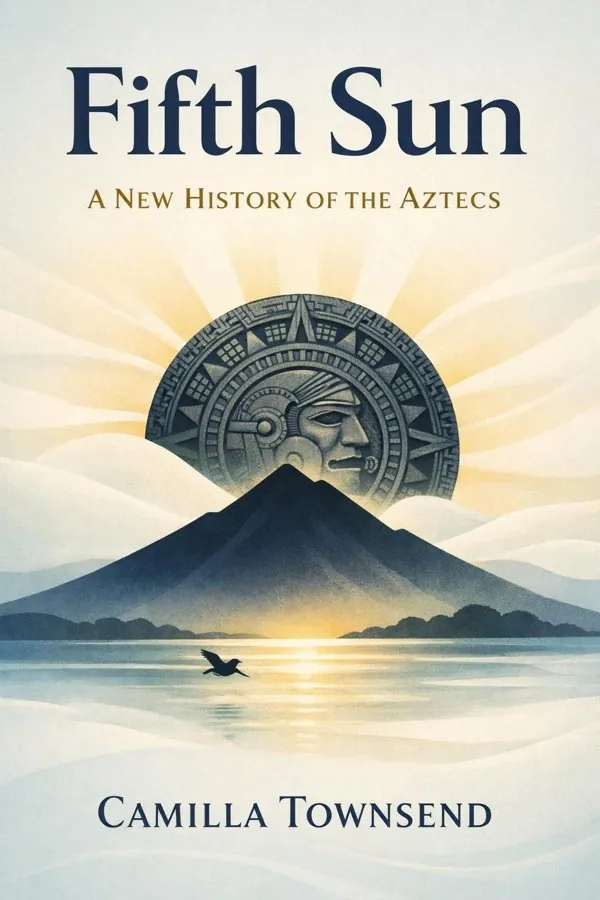
Fifth Sun: A New History of the Aztecs: Summary & Key Insights
 10 min10 chaptersAudio available
What Is Fifth Sun: A New History of the Aztecs About?
Fifth Sun: A New History of the Aztecs by Camilla Townsend is a world_history book spanning 10 pages. Este libro ofrece una nueva interpretación de la historia mexica (azteca) basada en fuentes indígenas escritas en náhuatl después de la conquista española. Townsend reconstruye la historia desde la perspectiva de los propios pueblos nahuas, mostrando cómo entendieron su pasado y su relación con los conquistadores. A través de una lectura cuidadosa de los anales y crónicas indígenas, la autora revela una narrativa compleja de resistencia, adaptación y memoria cultural.
This FizzRead summary covers all 10 key chapters of Fifth Sun: A New History of the Aztecs in approximately 10 minutes, distilling the most important ideas, arguments, and takeaways from Camilla Townsend's work. Also available as an audio summary and Key Quotes Podcast.
Fifth Sun: A New History of the Aztecs
Este libro ofrece una nueva interpretación de la historia mexica (azteca) basada en fuentes indígenas escritas en náhuatl después de la conquista española. Townsend reconstruye la historia desde la perspectiva de los propios pueblos nahuas, mostrando cómo entendieron su pasado y su relación con los conquistadores. A través de una lectura cuidadosa de los anales y crónicas indígenas, la autora revela una narrativa compleja de resistencia, adaptación y memoria cultural.
Who Should Read Fifth Sun: A New History of the Aztecs?
This book is perfect for anyone interested in world_history and looking to gain actionable insights in a short read. Whether you're a student, professional, or lifelong learner, the key ideas from Fifth Sun: A New History of the Aztecs by Camilla Townsend will help you think differently.
- ✓Readers who enjoy world_history and want practical takeaways
- ✓Professionals looking to apply new ideas to their work and life
- ✓Anyone who wants the core insights of Fifth Sun: A New History of the Aztecs in just 10 minutes
Want the full summary?
Get instant access to this book summary and 100K+ more with Fizz Moment.
Get Free SummaryAvailable on App Store • Free to download
Key Chapters
Before Tenochtitlan rose from the waters of Lake Texcoco, the Valley of Mexico was a mosaic of towns and cultures whose memory the Nahuas preserved in their migration stories. In their annals they wrote of earlier peoples—Toltecs, Chichimecs, and Acolhuas—each contributing myths and customs that shaped what would later be called Aztec civilization. These accounts do not read as simple chronicles; they carry spiritual resonance. To the Nahuas, migration was never mere movement—it was a sacred journey guided by omens, symbolizing the search for legitimacy and harmony with the gods.
In recreating this world, I wanted readers to see how the Mexica were not primitive newcomers who stumbled into power, but heirs to a long and complex regional tradition. Their language, religion, and governance grew out of centuries of exchange among neighboring peoples. Archaeology confirms settlements thriving around lakeshores and fertile plains, sustaining elaborate trade networks long before the Mexica arrived. Through indigenous eyes, this pre-Mexica world appears not as a prelude waiting for empire, but as a vibrant stage of competing city-states, each narrating its place in the cosmic order.
Understanding that landscape is essential. It reminds us that the Mexica story began within an already interconnected world, with alliances and rivalries that would later dictate their rise. The chroniclers described that past not to glorify lineage but to explain destiny—how their ancestors’ wandering ultimately converged at a chosen place under divine instruction. Their migration myths therefore contained both geographical memory and moral guidance, revealing the values of perseverance and sacred duty that would define their empire.
According to Nahua annals, when the Mexica arrived at the lakes of the valley, they were far from powerful. They served as mercenaries for stronger neighbors, enduring humiliation and hardship. Yet in their narratives, this period of servitude holds moral weight: it demonstrates the virtue of endurance. Through cunning diplomacy and strategic marriage alliances, they slowly built influence, until their settlement on a small island became the foundation for one of the greatest cities in the Americas.
The rise of Tenochtitlan was not the result of blind conquest—it was a calculated act of political creation. The Mexica leaders, particularly Itzcoatl and later Motecuhzoma I, understood the need to legitimize their rule through a coherent ideology. They rewrote old histories, merging their lineage with sacred Toltec predecessors, and established an alliance with Texcoco and Tlacopan—the famous Triple Alliance. Indigenous records reveal how these moves were perceived internally: not as trickery, but as fulfillment of cosmic design.
In the Nahua worldview, worldly power mirrored celestial harmony. To bring order to society was to imitate the gods’ balancing of the universe. Thus empire-building acquired a religious dimension. Tenochtitlan became both the political center and a cosmological axis, where human offerings sustained the rhythm of creation. Yet daily life, as told by the chroniclers, also revolved around pragmatic concerns—tribute collection, artisan production, and the routines of commoners who built temples and farmed chinampas.
From the indigenous perspective, their city’s rise was never inevitable nor purely martial. It was the outcome of moral discipline and collective striving. That sense of self-made destiny permeates every Nahua retelling of their origins, reminding us that empire-building was as much a spiritual enterprise as a political one.
+ 8 more chapters — available in the FizzRead app
All Chapters in Fifth Sun: A New History of the Aztecs
About the Author
Camilla Townsend es profesora de historia en la Universidad de Rutgers, especializada en historia indígena de las Américas y en fuentes en lengua náhuatl. Su trabajo se centra en la reinterpretación de la historia colonial desde las voces nativas, y ha recibido múltiples premios por su investigación sobre los pueblos indígenas de México.
Get This Summary in Your Preferred Format
Read or listen to the Fifth Sun: A New History of the Aztecs summary by Camilla Townsend anytime, anywhere. FizzRead offers multiple formats so you can learn on your terms — all free.
Available formats: App · Audio · PDF · EPUB — All included free with FizzRead
Download Fifth Sun: A New History of the Aztecs PDF and EPUB Summary
Key Quotes from Fifth Sun: A New History of the Aztecs
“Before Tenochtitlan rose from the waters of Lake Texcoco, the Valley of Mexico was a mosaic of towns and cultures whose memory the Nahuas preserved in their migration stories.”
“According to Nahua annals, when the Mexica arrived at the lakes of the valley, they were far from powerful.”
Frequently Asked Questions about Fifth Sun: A New History of the Aztecs
Fifth Sun: A New History of the Aztecs by Camilla Townsend is a world_history book that explores key ideas across 10 chapters. Este libro ofrece una nueva interpretación de la historia mexica (azteca) basada en fuentes indígenas escritas en náhuatl después de la conquista española. Townsend reconstruye la historia desde la perspectiva de los propios pueblos nahuas, mostrando cómo entendieron su pasado y su relación con los conquistadores. A través de una lectura cuidadosa de los anales y crónicas indígenas, la autora revela una narrativa compleja de resistencia, adaptación y memoria cultural.
You Might Also Like
The Age of Capital
Eric Hobsbawm
10 min
The Gulag Archipelago
Aleksandr Solzhenitsyn
10 min
Jerusalem: The Biography
Simon Sebag Montefiore
10 min
The Anglo-Saxons
James Campbell
10 min
The Boer War
Thomas Pakenham
10 min
The Industrial Revolutionaries: The Making of the Modern World 1776–1914
Gavin Weightman
10 minBrowse by Category
Ready to read Fifth Sun: A New History of the Aztecs?
Get the full summary and 100K+ more books with Fizz Moment.