
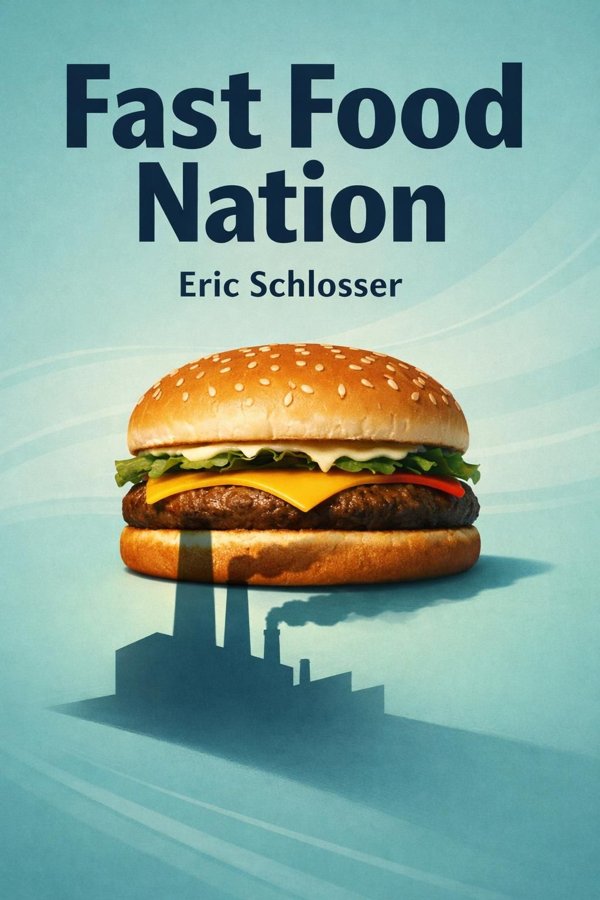
Fast Food Nation: The Dark Side of the All-American Meal: Summary & Key Insights
 10 min9 chaptersAudio available
What Is Fast Food Nation: The Dark Side of the All-American Meal About?
Fast Food Nation: The Dark Side of the All-American Meal by Eric Schlosser is a sociology book spanning 9 pages. Fast Food Nation es un libro de no ficción que examina el impacto de la industria de la comida rápida en la economía, la salud pública, la cultura y el medio ambiente de los Estados Unidos. A través de una investigación exhaustiva, Schlosser revela las prácticas laborales, las estrategias de marketing y las consecuencias sociales y sanitarias derivadas del auge de las cadenas de comida rápida.
This FizzRead summary covers all 9 key chapters of Fast Food Nation: The Dark Side of the All-American Meal in approximately 10 minutes, distilling the most important ideas, arguments, and takeaways from Eric Schlosser's work. Also available as an audio summary and Key Quotes Podcast.
Fast Food Nation: The Dark Side of the All-American Meal
Fast Food Nation es un libro de no ficción que examina el impacto de la industria de la comida rápida en la economía, la salud pública, la cultura y el medio ambiente de los Estados Unidos. A través de una investigación exhaustiva, Schlosser revela las prácticas laborales, las estrategias de marketing y las consecuencias sociales y sanitarias derivadas del auge de las cadenas de comida rápida.
Who Should Read Fast Food Nation: The Dark Side of the All-American Meal?
This book is perfect for anyone interested in sociology and looking to gain actionable insights in a short read. Whether you're a student, professional, or lifelong learner, the key ideas from Fast Food Nation: The Dark Side of the All-American Meal by Eric Schlosser will help you think differently.
- ✓Readers who enjoy sociology and want practical takeaways
- ✓Professionals looking to apply new ideas to their work and life
- ✓Anyone who wants the core insights of Fast Food Nation: The Dark Side of the All-American Meal in just 10 minutes
Want the full summary?
Get instant access to this book summary and 100K+ more with Fizz Moment.
Get Free SummaryAvailable on App Store • Free to download
Key Chapters
The roots of the fast food industry stretch deep into the sunlit streets of Southern California in the years after World War II. The state was bursting with prosperity, automobiles were plentiful, and the dream of efficiency was everywhere. Men like Carl Karcher, who began with a single hot dog cart, embodied this restless optimism. His story mirrors the postwar American fantasy: hard work, faith in innovation, and the belief that speed was synonymous with progress. Similarly, the McDonald brothers introduced a system that revolutionized food service—simplifying menus, emphasizing uniformity, and redesigning kitchens so that each worker performed one small repetitive task with maximum efficiency.
What they created was more than a restaurant model; it was an ideology of production. Customers were drawn not by culinary excellence but by reliability—food that tasted exactly the same every time, regardless of location. I recall tracing how such simplicity became its own seduction: Americans, newly mobile in their cars, sought familiarity in an unfamiliar landscape. In the process, they embraced a culture that prized convenience over craft.
From those modest California beginnings grew an empire that defined an era. The early pioneers—young, ambitious, and often devoutly patriotic—saw their work as democratizing food, making it cheap and accessible. Yet embedded in their success was a paradox: as they standardized meals, they also began standardizing human experiences. By the 1950s, eating out was no longer an event; it was a routine. Through Carl’s Jr. and McDonald’s, the American palate and rhythm of life were irrevocably altered.
The genius and danger of fast food expansion lay in franchising. When I delved into its mechanics, I saw how franchising turned once-local diners into appendages of national corporations. The model encouraged individuals to buy a piece of the dream—the semblance of independence with minimal entrepreneurial risk—but in reality imposed rigid corporate controls. Franchising was designed to replicate the McDonald system endlessly, guaranteeing conformity.
Behind the glossy advertisements that promised self-made success, franchise operators often faced limited autonomy. Headquarters dictated menus, ingredients, and even the color of the walls. The value wasn’t in creativity; it was in predictability. This standardization made possible the exponential growth of chains and, at the same time, eliminated local diversity. Town after town began to look and taste the same.
I came to see this model as emblematic of broader American economic trends—a shift from local ownership to corporate centralization. The franchise boom mirrored patterns visible in other industries, where small players were absorbed into vast networks ruled by marketing rather than craftsmanship. Through franchising, fast food became not merely a business model but a metaphor for modern capitalism: speed, sameness, controllability, and the illusion of choice.
+ 7 more chapters — available in the FizzRead app
All Chapters in Fast Food Nation: The Dark Side of the All-American Meal
About the Author
Eric Schlosser es un periodista y escritor estadounidense conocido por su trabajo de investigación sobre temas sociales y económicos. Ha escrito extensamente sobre la industria alimentaria, el sistema penitenciario y la economía subterránea de Estados Unidos.
Get This Summary in Your Preferred Format
Read or listen to the Fast Food Nation: The Dark Side of the All-American Meal summary by Eric Schlosser anytime, anywhere. FizzRead offers multiple formats so you can learn on your terms — all free.
Available formats: App · Audio · PDF · EPUB — All included free with FizzRead
Download Fast Food Nation: The Dark Side of the All-American Meal PDF and EPUB Summary
Key Quotes from Fast Food Nation: The Dark Side of the All-American Meal
“The roots of the fast food industry stretch deep into the sunlit streets of Southern California in the years after World War II.”
“The genius and danger of fast food expansion lay in franchising.”
Frequently Asked Questions about Fast Food Nation: The Dark Side of the All-American Meal
Fast Food Nation: The Dark Side of the All-American Meal by Eric Schlosser is a sociology book that explores key ideas across 9 chapters. Fast Food Nation es un libro de no ficción que examina el impacto de la industria de la comida rápida en la economía, la salud pública, la cultura y el medio ambiente de los Estados Unidos. A través de una investigación exhaustiva, Schlosser revela las prácticas laborales, las estrategias de marketing y las consecuencias sociales y sanitarias derivadas del auge de las cadenas de comida rápida.
More by Eric Schlosser

You Might Also Like
Between the World and Me
Ta-Nehisi Coates
10 min
Half the Sky
Nicholas D. Kristof, Sheryl WuDunn
10 min
Men Explain Things To Me
Rebecca Solnit
10 min
Rational Ritual
Michael Suk-Young Chwe
10 min
The New Jim Crow
Michelle Alexander
10 min
Beyond Culture
Edward T. Hall
10 minBrowse by Category
Ready to read Fast Food Nation: The Dark Side of the All-American Meal?
Get the full summary and 100K+ more books with Fizz Moment.