
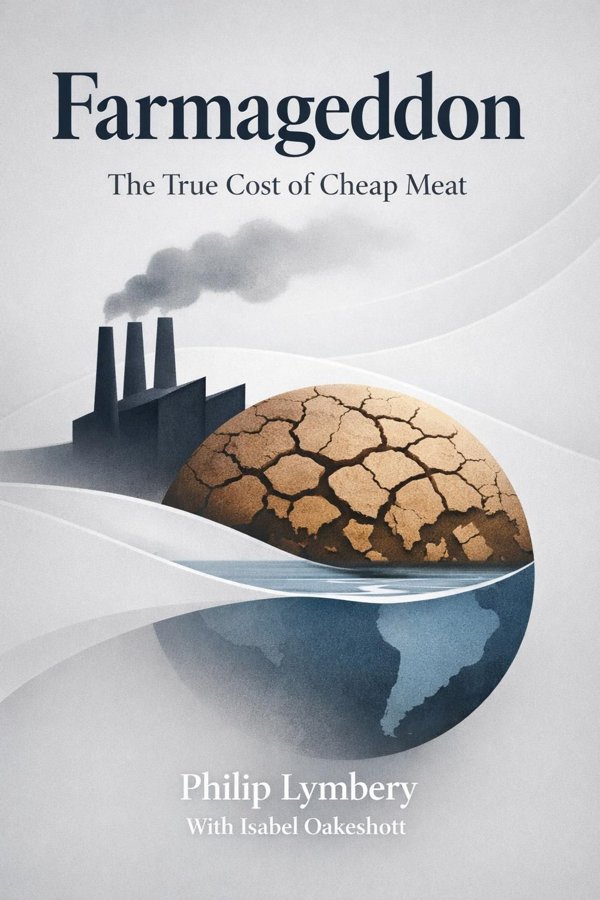
Farmageddon: The True Cost of Cheap Meat: Summary & Key Insights
by Philip Lymbery With Isabel Oakeshott
 10 min9 chaptersAudio available
What Is Farmageddon: The True Cost of Cheap Meat About?
Farmageddon: The True Cost of Cheap Meat by Philip Lymbery With Isabel Oakeshott is a environment book spanning 9 pages. Farmageddon: The True Cost of Cheap Meat is an investigative work that exposes the hidden costs of industrial farming. Philip Lymbery, CEO of Compassion in World Farming, together with journalist Isabel Oakeshott, travels across the globe to reveal how factory farming damages the environment, human health, and animal welfare. The book argues for a more sustainable and humane approach to food production, emphasizing the urgent need to reform the global food system.
This FizzRead summary covers all 9 key chapters of Farmageddon: The True Cost of Cheap Meat in approximately 10 minutes, distilling the most important ideas, arguments, and takeaways from Philip Lymbery With Isabel Oakeshott's work. Also available as an audio summary and Key Quotes Podcast.
Farmageddon: The True Cost of Cheap Meat
Farmageddon: The True Cost of Cheap Meat is an investigative work that exposes the hidden costs of industrial farming. Philip Lymbery, CEO of Compassion in World Farming, together with journalist Isabel Oakeshott, travels across the globe to reveal how factory farming damages the environment, human health, and animal welfare. The book argues for a more sustainable and humane approach to food production, emphasizing the urgent need to reform the global food system.
Who Should Read Farmageddon: The True Cost of Cheap Meat?
This book is perfect for anyone interested in environment and looking to gain actionable insights in a short read. Whether you're a student, professional, or lifelong learner, the key ideas from Farmageddon: The True Cost of Cheap Meat by Philip Lymbery With Isabel Oakeshott will help you think differently.
- ✓Readers who enjoy environment and want practical takeaways
- ✓Professionals looking to apply new ideas to their work and life
- ✓Anyone who wants the core insights of Farmageddon: The True Cost of Cheap Meat in just 10 minutes
Want the full summary?
Get instant access to this book summary and 100K+ more with Fizz Moment.
Get Free SummaryAvailable on App Store • Free to download
Key Chapters
To understand how we reached this crisis, we need to revisit the postwar years when governments promised to eradicate hunger through science and scale. What began as an ambitious vision—to produce more food from less land—slowly morphed into an industrial juggernaut. In the 1950s and 60s, new technologies married cheap feed, antibiotics, and confinement systems, turning living creatures into production units. Chickens that once scratched in yards were now packed by the thousands into windowless sheds. Pigs were moved from straw-filled barns into metal pens where they could barely turn around. Governments lauded this as progress; they called it efficiency.
But efficiency at what cost? The small mixed farms that had sustained communities for generations began to vanish. Farmers became contractors to corporations, tied to cycles of debt and price pressure. The cheap meat flooding supermarkets was celebrated as a victory of modernity, yet its production relied on a formula that burned through fossil fuels, land, and life itself. The drive for maximum yield created an illusion of abundance while quietly hollowing out the planet’s capacity to sustain it.
From the author’s travels in America’s Midwest, Europe, and China, a recurring truth emerges: this system is no accident. It was designed to prioritize quantity over quality, profit over welfare. And with each industrial barn built, the less visible costs mounted—soil stripped of nutrients, rivers fouled with waste, and a rural culture squeezed out of existence. The rise of factory farming, I came to see, is not a story of progress, but of dependency—of humans and animals alike caught inside an economic machine that claims efficiency while breeding fragility.
Standing inside a broiler shed or a sow crate unit, one cannot escape the sense that something profoundly unnatural has taken root in our food chain. Animals have become biological raw materials, their lives reduced to weight gain or productivity metrics. In the book, I describe visiting a pig farm where sows lived their entire gestation confined to crates so small they could not turn around. Chickens bred for rapid growth collapsed under their own weight, their legs unable to support bodies enlarged by genetic selection. Such scenes are not exceptions—they are the norm of industrial production.
This is not merely a moral issue but a biological and ecological one. Animals subjected to such stress are routinely dosed with antibiotics, not just to treat disease but to prevent it in unhygienic environments. This practice, initially hailed as innovation, has triggered one of the most urgent medical threats of our time: antibiotic resistance. By prioritizing confinement over natural behavior, we have endangered both animal dignity and human health.
Yet the tragedy is silent because factory farms are invisible. Consumers see the sanitized packaging, never the warehouse of suffering behind it. What struck me most was the cognitive dissonance: people genuinely care for animals, yet our food system depends on structures that systematically deny them their nature. The more I investigated, the clearer it became that animal welfare cannot be an afterthought—it is the foundation of sustainability. When we ignore the lives of animals, we undermine the health of ecosystems, the resilience of rural life, and ultimately our own integrity as humans.
+ 7 more chapters — available in the FizzRead app
All Chapters in Farmageddon: The True Cost of Cheap Meat
About the Author
Philip Lymbery is a British environmentalist, author, and chief executive of Compassion in World Farming. He has been a leading voice in animal welfare and sustainable agriculture. Isabel Oakeshott is a British political journalist and author known for her investigative reporting and collaborations on non-fiction works.
Get This Summary in Your Preferred Format
Read or listen to the Farmageddon: The True Cost of Cheap Meat summary by Philip Lymbery With Isabel Oakeshott anytime, anywhere. FizzRead offers multiple formats so you can learn on your terms — all free.
Available formats: App · Audio · PDF · EPUB — All included free with FizzRead
Download Farmageddon: The True Cost of Cheap Meat PDF and EPUB Summary
Key Quotes from Farmageddon: The True Cost of Cheap Meat
“To understand how we reached this crisis, we need to revisit the postwar years when governments promised to eradicate hunger through science and scale.”
“Standing inside a broiler shed or a sow crate unit, one cannot escape the sense that something profoundly unnatural has taken root in our food chain.”
Frequently Asked Questions about Farmageddon: The True Cost of Cheap Meat
Farmageddon: The True Cost of Cheap Meat by Philip Lymbery With Isabel Oakeshott is a environment book that explores key ideas across 9 chapters. Farmageddon: The True Cost of Cheap Meat is an investigative work that exposes the hidden costs of industrial farming. Philip Lymbery, CEO of Compassion in World Farming, together with journalist Isabel Oakeshott, travels across the globe to reveal how factory farming damages the environment, human health, and animal welfare. The book argues for a more sustainable and humane approach to food production, emphasizing the urgent need to reform the global food system.
You Might Also Like

A Life on Our Planet: My Witness Statement and a Vision for the Future
David Attenborough
10 min
A Sky Full Of Birds
Matt Merritt
10 min
Carbon Zero: Imagining Cities That Can Save the Planet
Alex Steffen
10 min
Eaarth: Making a Life on a Tough New Planet
Bill McKibben
10 min
The Social Contract and Environmental Governance
Various Editors
10 min
The Wild Places
Robert Macfarlane
10 minBrowse by Category
Ready to read Farmageddon: The True Cost of Cheap Meat?
Get the full summary and 100K+ more books with Fizz Moment.