
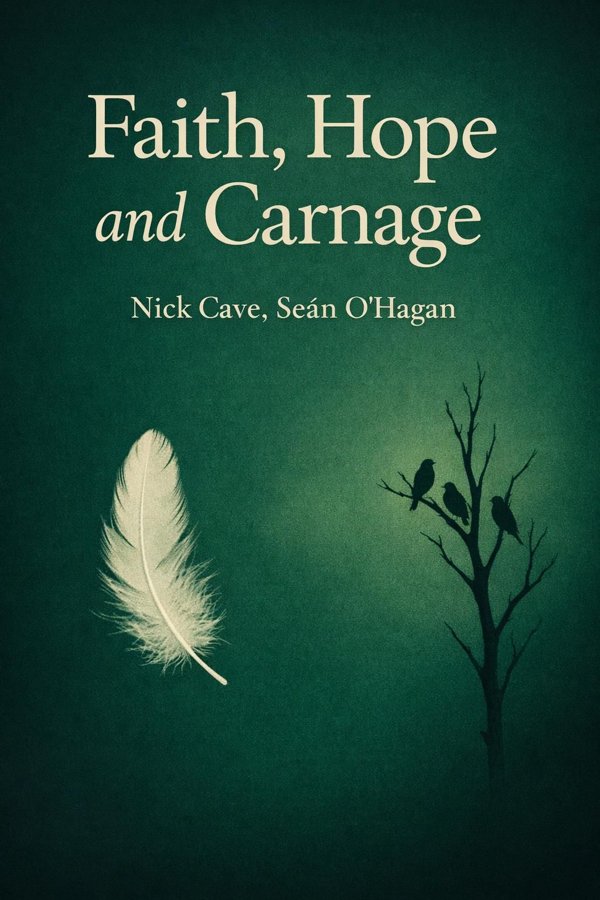
Faith, Hope and Carnage: Summary & Key Insights
 10 min9 chaptersAudio available
Key Takeaways from Faith, Hope and Carnage
We rarely outgrow the landscapes that first taught us how to feel.
The blank page is frightening because it asks us to face what we cannot control.
Loss does not simply wound us; it rearranges the architecture of our being.
Real faith is rarely neat, certain, or untouched by catastrophe.
Private suffering often creates the illusion that we are alone, yet one of Cave’s most important discoveries is that grief can become a bridge to others.
What Is Faith, Hope and Carnage About?
Faith, Hope and Carnage by Nick Cave, Seán O’Hagan is a biographies book spanning 9 pages. Faith, Hope and Carnage is not a conventional memoir, nor is it a standard celebrity interview book. Instead, it is a searching, emotionally raw conversation between musician and writer Nick Cave and journalist Seán O’Hagan, recorded across a series of extended dialogues. Through these exchanges, Cave reflects on childhood, artistic formation, addiction, love, grief, belief, public life, and the difficult work of continuing after devastating loss. The death of his son Arthur reshaped Cave’s inner world, and this book traces how suffering altered his art, his faith, and his understanding of human connection. What makes the book matter is its refusal to offer easy consolation. Cave does not present pain as something to be neatly solved; he explores how grief can strip away vanity, deepen compassion, and force a person into a more honest relationship with mystery. O’Hagan’s thoughtful questioning gives structure and intimacy to these reflections without flattening them into simple lessons. As one of the most distinctive songwriters of his generation, Cave brings unusual authority to questions of creativity and transcendence, while O’Hagan helps draw out the philosophical and personal depth behind the public persona. The result is a profound meditation on art, loss, faith, and survival.
This FizzRead summary covers all 9 key chapters of Faith, Hope and Carnage in approximately 10 minutes, distilling the most important ideas, arguments, and takeaways from Nick Cave, Seán O’Hagan's work. Also available as an audio summary and Key Quotes Podcast.
Faith, Hope and Carnage
Faith, Hope and Carnage is not a conventional memoir, nor is it a standard celebrity interview book. Instead, it is a searching, emotionally raw conversation between musician and writer Nick Cave and journalist Seán O’Hagan, recorded across a series of extended dialogues. Through these exchanges, Cave reflects on childhood, artistic formation, addiction, love, grief, belief, public life, and the difficult work of continuing after devastating loss. The death of his son Arthur reshaped Cave’s inner world, and this book traces how suffering altered his art, his faith, and his understanding of human connection.
What makes the book matter is its refusal to offer easy consolation. Cave does not present pain as something to be neatly solved; he explores how grief can strip away vanity, deepen compassion, and force a person into a more honest relationship with mystery. O’Hagan’s thoughtful questioning gives structure and intimacy to these reflections without flattening them into simple lessons. As one of the most distinctive songwriters of his generation, Cave brings unusual authority to questions of creativity and transcendence, while O’Hagan helps draw out the philosophical and personal depth behind the public persona. The result is a profound meditation on art, loss, faith, and survival.
Who Should Read Faith, Hope and Carnage?
This book is perfect for anyone interested in biographies and looking to gain actionable insights in a short read. Whether you're a student, professional, or lifelong learner, the key ideas from Faith, Hope and Carnage by Nick Cave, Seán O’Hagan will help you think differently.
- ✓Readers who enjoy biographies and want practical takeaways
- ✓Professionals looking to apply new ideas to their work and life
- ✓Anyone who wants the core insights of Faith, Hope and Carnage in just 10 minutes
Want the full summary?
Get instant access to this book summary and 100K+ more with Fizz Moment.
Get Free SummaryAvailable on App Store • Free to download
Key Chapters
We rarely outgrow the landscapes that first taught us how to feel. For Nick Cave, childhood in rural Australia was not just background material; it was the emotional terrain from which his imagination emerged. The emptiness, silence, severity, and spiritual strangeness of that environment became part of his inner language. Just as important was the influence of his father, an English teacher who opened the door to literature, myth, poetry, and the dramatic force of language. Shakespeare, the Bible, and classic storytelling did more than educate Cave; they gave him a sense that words could hold terror, beauty, and revelation at the same time.
This idea matters because artistic identity is often less about talent alone than about what forms us early and deeply. Cave’s reflections suggest that our creative obsessions are not random. They often come from childhood atmospheres, family voices, formative books, and early experiences of fear, wonder, or loneliness. Even people who are not artists can recognize this pattern. The way someone leads, loves, works, or dreams is often rooted in the emotional weather of their early life.
A practical application is to examine your own origin story. What images, places, or voices still live in you? Which books, songs, or family dynamics helped shape your sense of the world? If you create, these may be the sources that make your work distinctive. If you feel stuck, returning to them may reconnect you to what feels most alive and true.
Actionable takeaway: Write down three childhood experiences, places, or influences that still affect how you think and feel, and use them as clues to your deepest values and creative instincts.
The blank page is frightening because it asks us to face what we cannot control. Cave speaks of songwriting not as a technical exercise or a performance of cleverness, but as an encounter with the unknown. He approaches creation as a spiritual act, one that requires receptivity, humility, and the willingness to be surprised. Rather than forcing meaning onto a song, he waits for something to arrive through the process of attention. This makes art less an act of domination and more an act of listening.
That idea cuts against the modern pressure to optimize creativity into a system of outputs, productivity tricks, and personal branding. Cave does not deny discipline; in fact, he values it deeply. But he insists that genuine creation cannot be reduced to routine alone. The artist must make room for accident, intuition, and mystery. In this view, the work becomes a conversation with something larger than the self, whether one names it inspiration, subconscious truth, or the sacred.
This applies beyond music. A teacher designing a lesson, an entrepreneur solving a difficult problem, or a writer shaping an essay all benefit from this posture. Preparation matters, but so does openness. Sometimes the best ideas emerge when we stop trying to appear in control and allow uncertainty to do its work.
Actionable takeaway: The next time you begin a creative or difficult task, spend five quiet minutes without distraction, then start with curiosity rather than pressure, asking not “How do I impress?” but “What wants to emerge here?”
Loss does not simply wound us; it rearranges the architecture of our being. One of the central movements in Faith, Hope and Carnage is Cave’s attempt to describe what happened to him after the death of his son Arthur. He does not package grief into a therapeutic slogan or a clean narrative of recovery. Instead, he shows how bereavement can break open identity itself. The person who emerges after catastrophic loss is not the same person who existed before. Grief is not a temporary interruption; it is a force that alters perception, values, relationships, and even language.
Cave’s honesty is powerful because he rejects the fantasy of “moving on” in any simple sense. What he describes is closer to learning how to live inside a transformed reality. Pain remains, but it may become more porous, allowing compassion, tenderness, and awe to enter. Suffering can strip away triviality and ego. It can also deepen one’s sense of kinship with others who carry invisible devastation.
For readers facing grief, this perspective can be stabilizing. It suggests that disorientation is not failure but part of the process. For those supporting someone in mourning, the book offers a crucial lesson: do not rush them toward closure. Presence matters more than explanation.
Actionable takeaway: If you are grieving, replace the question “When will I be normal again?” with “What kind of person is this loss asking me to become?” If you are supporting someone else, offer consistent presence instead of advice.
Real faith is rarely neat, certain, or untouched by catastrophe. In Cave’s account, faith is not a rigid set of doctrines that protects a person from pain. It is a living, evolving relationship with mystery, love, and transcendence that becomes most meaningful when life falls apart. His spiritual reflections are compelling precisely because they do not emerge from comfort. They arise from devastation, doubt, questioning, and the need to keep speaking into silence.
Cave’s faith is imaginative and experiential rather than narrowly dogmatic. He draws on Christianity, scripture, poetry, and moral intuition, but he is less interested in winning theological arguments than in understanding how belief functions in a broken world. Faith becomes a language for attention, mercy, humility, and endurance. It does not erase sorrow; it creates a way of carrying sorrow without becoming spiritually dead.
This is useful even for secular readers. The broader principle is that people need frameworks of meaning that can withstand suffering. Whether one finds that in religion, philosophy, art, or community, the challenge is the same: how do we remain open to beauty and goodness when reality wounds us? Cave’s answer is not certainty but devotion to the search itself.
Actionable takeaway: Identify one practice that keeps you connected to meaning during difficult times, such as prayer, journaling, reading, walking, or silent reflection, and return to it consistently rather than only in crisis.
Private suffering often creates the illusion that we are alone, yet one of Cave’s most important discoveries is that grief can become a bridge to others. Through his public interactions, especially with audiences and through projects like The Red Hand Files, he found that vulnerability invited connection rather than diminishing him. People responded not just to his music, but to his willingness to speak honestly about loss, confusion, longing, and love. In that exchange, a different form of community emerged: not fan culture in the shallow sense, but a fellowship of wounded, searching people.
This matters because contemporary life encourages performance and distance. Public figures are expected to maintain brand identity, and ordinary people often feel pressure to hide pain behind competence. Cave’s experience suggests the opposite approach can be more humanizing. When we speak truthfully about suffering, we create room for others to do the same. Shared fragility becomes a source of solidarity.
In practical terms, this might mean reaching out instead of withdrawing, joining spaces where honest conversation is possible, or responding to others with seriousness and care when they disclose pain. Community does not remove grief, but it can keep grief from hardening into despair.
Actionable takeaway: Choose one relationship or community where you can be more honest this week, and share something real rather than polished. Genuine connection begins when image gives way to truth.
When life is shattered, meaningful work can become a way of continuing. Cave treats artistic labor not as distraction but as devotion. Writing, recording, performing, and answering letters are not merely professional obligations; they are ways of staying in relationship with life itself. Work, in this sense, is not busyness for its own sake. It is disciplined engagement with what still matters. It gives shape to days that might otherwise collapse into numbness.
The redemptive quality of work lies partly in its demand for attention. To make something well, one must leave the prison of pure self-absorption and enter into dialogue with craft, language, sound, or service. This does not mean productivity cures pain. Cave is too honest for that. But committed work can help transform suffering into form, offering structure where chaos threatens to dominate.
This lesson applies widely. A person grieving may find steadiness in gardening, teaching, caregiving, carpentry, writing, or any labor that asks for care and skill. The key is not to use work as emotional avoidance, but to let it become a meaningful expression of love, persistence, and responsibility.
Actionable takeaway: If you are in a difficult season, choose one piece of work each day to do with full attention and care. Let the act of making, serving, or repairing become a practice of staying connected to life.
Pain does not automatically make art profound, but honestly confronted suffering can strip art of falseness. Cave is careful not to romanticize anguish. He does not suggest that tragedy is desirable or that artists need to be damaged to make important work. Instead, he shows that when suffering enters life, it can alter the moral and emotional stakes of creation. It can force an artist away from irony, vanity, or posturing and toward greater seriousness, tenderness, and truth.
In Cave’s case, grief changed not only what he wrote about but how he understood the purpose of art. Songs and performances became acts of communication with the brokenness of the world. Art was no longer simply self-expression; it became service, witness, and consolation. This shift helps explain the intense emotional resonance many people find in his later work.
For readers and creators alike, the lesson is to resist both sentimental and cynical views of suffering. Hardship can embitter, flatten, or close a person. But if it is met with reflection, discipline, and openness, it can also produce work of unusual depth and usefulness. The point is not to mine pain for content, but to allow experience to enlarge compassion and sharpen honesty.
Actionable takeaway: When creating or reflecting on difficult experiences, ask not “How can I make this dramatic?” but “What is the most truthful, humane thing I can say from here?”
The self we perform in public can become a prison if we mistake it for who we really are. Cave has long been associated with a dark, commanding, mythic stage presence, but Faith, Hope and Carnage shows what happens when that persona is softened by candor. He reflects on the difference between being seen as an icon and being known as a person. Over time, especially through grief, he became less interested in maintaining mystery as armor and more willing to allow brokenness, tenderness, and ordinary humanity into view.
This does not mean abandoning artistic identity. Cave still values theatricality, symbolism, and performance. But the book suggests that public life becomes healthier when persona is grounded in truth rather than defended at all costs. The result is not less power, but a different kind of power: one based on trust, resonance, and emotional authenticity.
This is relevant to anyone navigating professional or social roles. Leaders, creators, and even private individuals often feel pressure to appear invulnerable. Yet carefully chosen honesty can strengthen credibility rather than weaken it. People tend to trust those who acknowledge complexity and limitation.
Actionable takeaway: Review one role in your life where you rely too heavily on image or control, and experiment with a more human form of presence by admitting uncertainty, asking for help, or speaking more personally.
Hope is often misunderstood as optimism, but Cave presents it as something tougher and more deliberate. Optimism assumes things will work out; hope chooses to remain open to meaning even when there is no guarantee. In a world marked by death, disorder, and disappointment, this kind of hope is an act of moral imagination. It is sustained not by denial but by continuity: continuing to love, to work, to speak, to listen, to make, and to believe that beauty still matters.
This is one of the book’s deepest contributions. Hope does not arrive all at once as a feeling. It is built through repeated gestures of fidelity to life. Cave’s conversations show that survival after grief involves ritual, labor, relationship, and attention. One keeps going not because suffering is solved, but because one discovers that existence still contains moments of grace, absurdity, humor, and connection.
This framework can help anyone facing uncertainty. Instead of waiting to feel inspired or healed before re-engaging with life, one can practice hope through action: showing up for people, keeping commitments, making art, going for walks, praying, reading, or listening deeply.
Actionable takeaway: Choose one small daily practice that expresses commitment to life, such as writing for ten minutes, calling someone you love, or taking a reflective walk, and treat it as a concrete act of hope.
All Chapters in Faith, Hope and Carnage
About the Authors
Nick Cave is an Australian musician, songwriter, author, screenwriter, and performer best known as the frontman of Nick Cave and the Bad Seeds. Across decades of work, he has built a reputation for emotionally intense music marked by literary ambition, spiritual inquiry, and dark, lyrical storytelling. In addition to recording and performing, Cave has written novels, film scripts, and the widely read online correspondence project The Red Hand Files. Seán O’Hagan is an Irish journalist, critic, and feature writer known for his work in The Observer and The Guardian. He has written extensively on music, photography, culture, and the arts, and is especially respected for his long-form interviews. In Faith, Hope and Carnage, O’Hagan’s thoughtful questioning helps draw out the philosophical and personal depth of Cave’s reflections.
Get This Summary in Your Preferred Format
Read or listen to the Faith, Hope and Carnage summary by Nick Cave, Seán O’Hagan anytime, anywhere. FizzRead offers multiple formats so you can learn on your terms — all free.
Available formats: App · Audio · PDF · EPUB — All included free with FizzRead
Download Faith, Hope and Carnage PDF and EPUB Summary
Key Quotes from Faith, Hope and Carnage
“We rarely outgrow the landscapes that first taught us how to feel.”
“The blank page is frightening because it asks us to face what we cannot control.”
“Loss does not simply wound us; it rearranges the architecture of our being.”
“Real faith is rarely neat, certain, or untouched by catastrophe.”
“Private suffering often creates the illusion that we are alone, yet one of Cave’s most important discoveries is that grief can become a bridge to others.”
Frequently Asked Questions about Faith, Hope and Carnage
Faith, Hope and Carnage by Nick Cave, Seán O’Hagan is a biographies book that explores key ideas across 9 chapters. Faith, Hope and Carnage is not a conventional memoir, nor is it a standard celebrity interview book. Instead, it is a searching, emotionally raw conversation between musician and writer Nick Cave and journalist Seán O’Hagan, recorded across a series of extended dialogues. Through these exchanges, Cave reflects on childhood, artistic formation, addiction, love, grief, belief, public life, and the difficult work of continuing after devastating loss. The death of his son Arthur reshaped Cave’s inner world, and this book traces how suffering altered his art, his faith, and his understanding of human connection. What makes the book matter is its refusal to offer easy consolation. Cave does not present pain as something to be neatly solved; he explores how grief can strip away vanity, deepen compassion, and force a person into a more honest relationship with mystery. O’Hagan’s thoughtful questioning gives structure and intimacy to these reflections without flattening them into simple lessons. As one of the most distinctive songwriters of his generation, Cave brings unusual authority to questions of creativity and transcendence, while O’Hagan helps draw out the philosophical and personal depth behind the public persona. The result is a profound meditation on art, loss, faith, and survival.
You Might Also Like

An American Marriage
Tayari Jones
10 min
Benjamin Franklin: An American Life
Walter Isaacson
10 min
I Know Why The Caged Bird Sings
Maya Angelou
10 min
Long Walk to Freedom
Nelson Mandela
10 min
Persepolis
Marjane Satrapi
10 min
Surely You're Joking, Mr. Feynman!
Richard P. Feynman
10 minBrowse by Category
Ready to read Faith, Hope and Carnage?
Get the full summary and 100K+ more books with Fizz Moment.