
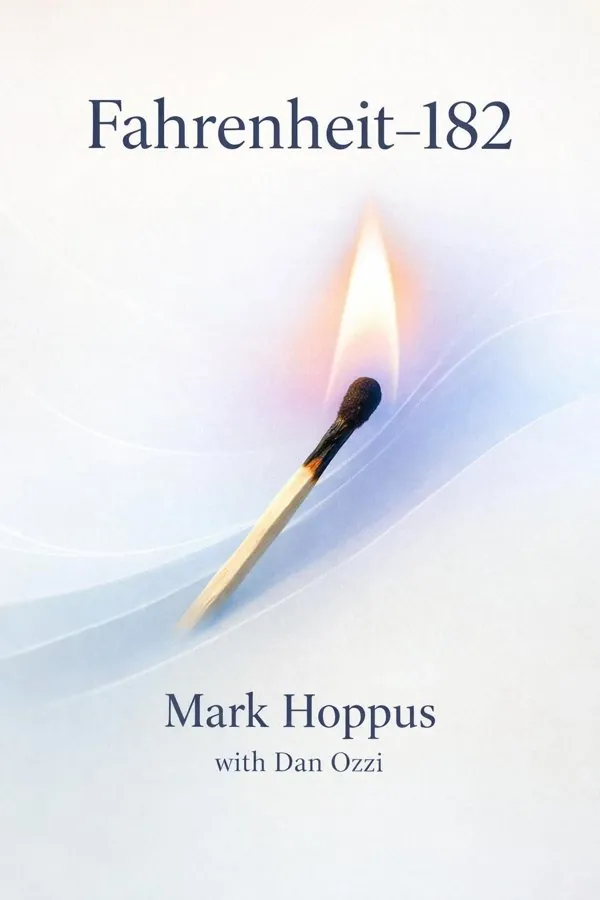
Fahrenheit-182: Summary & Key Insights
 10 min9 chaptersAudio available
Key Takeaways from Fahrenheit-182
A public image can be so effective that it hides the labor, doubt, and discipline underneath it.
Most artistic movements begin not as industries but as refuges.
Bands are often described as businesses, but their deepest engine is usually emotional chemistry.
Fame rarely transforms a person as much as it enlarges preexisting traits, fears, and habits.
A health crisis has a brutal way of clarifying what performance, busyness, and distraction normally conceal.
What Is Fahrenheit-182 About?
Fahrenheit-182 by Mark Hoppus with Dan Ozzi is a biographies book spanning 5 pages. "Fahrenheit-182" is Mark Hoppus’s memoir of music, friendship, identity, survival, and the strange emotional math of growing up in public. Best known as the bassist, co-lead vocalist, and co-founder of Blink-182, Hoppus helped define a generation of pop-punk with songs that mixed adolescent humor, anxiety, romance, and loneliness. Written with music journalist Dan Ozzi, this book promises more than backstage anecdotes or a victory-lap history of a famous band. It is a personal reckoning with creativity, fame, fractured relationships, aging, and Hoppus’s battle with cancer. What makes the memoir matter is the tension at its center: Blink-182 built its identity on irreverence, but the life behind the jokes includes ambition, insecurity, grief, and endurance. Hoppus is uniquely positioned to tell the story from the inside—as a songwriter, bandmate, and public figure who experienced both the rewards and distortions of success. Ozzi’s reporting background adds structure and perspective, helping turn one musician’s life into a broader reflection on punk culture, artistic partnership, and what it means to keep going when the persona no longer protects the person.
This FizzRead summary covers all 9 key chapters of Fahrenheit-182 in approximately 10 minutes, distilling the most important ideas, arguments, and takeaways from Mark Hoppus with Dan Ozzi's work. Also available as an audio summary and Key Quotes Podcast.
Fahrenheit-182
"Fahrenheit-182" is Mark Hoppus’s memoir of music, friendship, identity, survival, and the strange emotional math of growing up in public. Best known as the bassist, co-lead vocalist, and co-founder of Blink-182, Hoppus helped define a generation of pop-punk with songs that mixed adolescent humor, anxiety, romance, and loneliness. Written with music journalist Dan Ozzi, this book promises more than backstage anecdotes or a victory-lap history of a famous band. It is a personal reckoning with creativity, fame, fractured relationships, aging, and Hoppus’s battle with cancer.
What makes the memoir matter is the tension at its center: Blink-182 built its identity on irreverence, but the life behind the jokes includes ambition, insecurity, grief, and endurance. Hoppus is uniquely positioned to tell the story from the inside—as a songwriter, bandmate, and public figure who experienced both the rewards and distortions of success. Ozzi’s reporting background adds structure and perspective, helping turn one musician’s life into a broader reflection on punk culture, artistic partnership, and what it means to keep going when the persona no longer protects the person.
Who Should Read Fahrenheit-182?
This book is perfect for anyone interested in biographies and looking to gain actionable insights in a short read. Whether you're a student, professional, or lifelong learner, the key ideas from Fahrenheit-182 by Mark Hoppus with Dan Ozzi will help you think differently.
- ✓Readers who enjoy biographies and want practical takeaways
- ✓Professionals looking to apply new ideas to their work and life
- ✓Anyone who wants the core insights of Fahrenheit-182 in just 10 minutes
Want the full summary?
Get instant access to this book summary and 100K+ more with Fizz Moment.
Get Free SummaryAvailable on App Store • Free to download
Key Chapters
A public image can be so effective that it hides the labor, doubt, and discipline underneath it. That paradox sits at the heart of "Fahrenheit-182." Mark Hoppus became globally associated with Blink-182’s prankish humor, adolescent chaos, and sarcastic charm, yet the memoir reveals how much intentional creative work stood behind that image. Pop-punk may sound spontaneous, but building songs that feel effortless requires sharp instincts, editing, repetition, and a clear understanding of audience emotion.
Hoppus’s story matters because it challenges a common misconception: if art looks fun, people assume it was easy. In reality, many artists use humor as both expression and camouflage. Comedy can carry vulnerability more safely than confession. A catchy three-minute song about heartbreak, alienation, or confusion may reach listeners precisely because it arrives through wit instead of solemnity. That balancing act helped Blink-182 stand out. Their music was accessible, but not empty; playful, but emotionally observant.
For readers, this idea has practical relevance beyond music. Many people are underestimated because their style is casual, funny, or unpretentious. A teacher who uses jokes may be deeply rigorous. A leader who seems relaxed may be strategically focused. A creative project that feels light may still reflect serious craftsmanship. Hoppus’s memoir encourages us to look past tone and examine substance.
It also reminds aspiring creators that identity and output are not identical. You can make work that feels loose while practicing with precision. You can entertain while still saying something real. The point is not to abandon humor in order to be taken seriously, but to trust that humor itself can be a serious artistic tool.
Actionable takeaway: If your work is often dismissed as “just fun,” identify the deeper skill or intention beneath it and communicate that clearly—without giving up the style that makes it uniquely yours.
Most artistic movements begin not as industries but as refuges. One of the likely driving themes of "Fahrenheit-182" is that punk rock first offered Mark Hoppus a sense of belonging before it offered him fame. Long before Blink-182 became a global success, punk functioned as a social world with its own values, codes, energy, and pathways for self-invention. In that environment, identity was not handed down from institutions; it was assembled through taste, participation, and commitment.
That matters because scenes shape people as much as people shape scenes. For Hoppus, punk was not merely a sound. It was a place to test ideas about authenticity, rebellion, humor, friendship, and creative freedom. DIY culture taught that you did not need permission to start a band, make a flyer, book a show, or build an audience. That mindset can be life-changing, especially for people who feel out of step with mainstream expectations.
The practical lesson here extends far beyond music. Careers often become sustainable only after they begin as communities of practice. Writers need circles of readers. Entrepreneurs need peers who share information. Young professionals need environments where experimentation is normal and imperfection is tolerated. What people often call “networking” is, at its best, a form of mutual recognition and support.
Hoppus’s journey also suggests that success can complicate your relationship with the community that formed you. When a subculture becomes profitable, questions of credibility, compromise, and ownership quickly follow. Yet the original gift remains: a scene can provide the confidence to become more fully yourself.
Actionable takeaway: Instead of asking only how to advance your career, ask where your creative or professional community is—and contribute to it before you expect it to elevate you.
Bands are often described as businesses, but their deepest engine is usually emotional chemistry. "Fahrenheit-182" is likely to show that Blink-182’s rise cannot be understood through music alone; it must also be understood through friendship, friction, loyalty, misunderstanding, and changing personal needs. The connection between bandmates creates more than collaboration. It shapes trust, timing, risk-taking, conflict, and the feeling that the work matters.
In groups with high visibility, friendship becomes especially complicated. Personal disagreements are amplified by money, schedules, media scrutiny, and fan attachment. Every creative difference can feel existential because the art is tied to identity. When one member changes, the whole system shifts. What begins as mutual excitement can harden into resentment if communication weakens or assumptions go unspoken.
Hoppus’s story is especially compelling because Blink-182’s history has included both intense closeness and painful separation. That makes the memoir relevant not only to music fans but to anyone who has worked in a high-stakes partnership. Co-founders, collaborators, siblings in family businesses, and long-term teammates will recognize the challenge: how do you preserve honesty when the relationship is central to your life and livelihood?
One practical application is learning to distinguish a role problem from a relationship problem. Sometimes tension is caused by unclear expectations, not broken affection. Another is recognizing that nostalgia can obscure reality. People often wish a group could return to its “best years,” but growth changes what each person can tolerate, contribute, or need.
The larger insight is sobering: success does not eliminate relational work; it increases the need for it. Talent gets attention, but trust sustains continuity.
Actionable takeaway: In any important partnership, schedule direct conversations about expectations, pressure, and change before conflict forces the issue.
Fame rarely transforms a person as much as it enlarges preexisting traits, fears, and habits. A memoir like "Fahrenheit-182" matters because Mark Hoppus did not simply become known; he became known while still developing as a person. That is a destabilizing experience. Public success can freeze an image of you at one stage of life, while your private self keeps changing behind it.
For a musician associated with youth culture, this tension is especially intense. Fans often want continuity, but real life brings aging, parenthood, health crises, shifting priorities, and evolving emotional language. The more iconic the persona, the harder it may be to revise. Hoppus’s memoir likely explores the strange duality of being both an ordinary person with private vulnerabilities and a symbol onto which millions project meaning.
This idea applies broadly in the age of social media. Most people now manage some version of a public-facing identity, even if the audience is small. The lesson from fame is useful at every scale: when external attention grows, unresolved internal issues do not disappear. Validation can become addictive. Criticism can feel catastrophic. Persona management can crowd out self-examination.
The antidote is not invisibility but grounding. People need relationships and routines that exist outside performance. They need spaces where they are not reduced to their most marketable traits. They also need permission to outgrow the character others expect them to play.
Hoppus’s life offers a vivid case study because Blink-182’s brand was so recognizable. If he can revisit what that image concealed and distorted, readers gain a lens on their own smaller forms of performative pressure.
Actionable takeaway: Make a list of the roles or labels others associate with you, then identify which ones still fit and which ones you may be preserving only out of habit or expectation.
A health crisis has a brutal way of clarifying what performance, busyness, and distraction normally conceal. One of the most powerful dimensions of "Fahrenheit-182" is Hoppus’s battle with cancer, which reframes the memoir from a story about a famous musician into a more universal account of fear, endurance, and perspective. Illness interrupts the illusion that control is stable. It forces a person to confront mortality not as abstraction, but as logistics, uncertainty, pain, and waiting.
What gives this theme its force is contrast. Blink-182’s cultural image has long been tied to momentum, irreverence, and youthful energy. Cancer introduces stillness, fragility, and vulnerability. In memoir form, that collision can be transformative. Readers see not just a public figure receiving sympathy, but a human being recalibrating value: relationships over image, presence over ambition, honesty over posture.
This theme resonates because many readers have experienced serious illness themselves or through someone they love. Hoppus’s account can normalize the emotional complexity of treatment—the fear, numbness, gratitude, anger, dependence, and strange humor that often coexist. It also models the courage of speaking plainly about suffering without reducing oneself to it.
Practically, this idea reminds us not to postpone emotional clarity. People often wait for a crisis before saying thank you, asking for help, changing priorities, or admitting what matters. Illness exposes how costly that delay can be. While not everyone faces cancer, everyone lives with uncertainty.
The deepest lesson is not simply “life is short.” It is that life becomes more meaningful when stripped of unnecessary performance. What remains—love, connection, purpose, presence—is what was real all along.
Actionable takeaway: Ask yourself what would matter most if your schedule were suddenly erased by crisis, then move one of those priorities into your life this week.
We often talk about resilience as if it means returning to normal, but real resilience usually means becoming capable of living differently after disruption. In "Fahrenheit-182," Hoppus’s story likely demonstrates that survival is not a clean arc from hardship to triumph. Instead, resilience involves adaptation, humility, support, and a willingness to be changed by what you endure.
This distinction matters because “bouncing back” can be a misleading standard. It suggests that the ideal outcome is restoration of a former self. Yet major experiences—fame, betrayal, illness, recovery, aging—alter people permanently. The stronger question is not whether you can become exactly who you were before, but whether you can build a meaningful life from where you are now.
Hoppus’s career offers several examples of this broader resilience. Creative reinvention after lineup changes. Emotional endurance through public scrutiny. Physical and psychological steadiness during treatment. Continued openness to music, audience, and memory after periods that could easily have produced bitterness or withdrawal. None of that implies invulnerability. On the contrary, resilience often begins when someone stops pretending to be unaffected.
For readers, this is highly practical. After a breakup, job loss, health scare, or creative failure, many people waste energy trying to recover a past version of themselves. A more productive approach is to ask: What capacities has this experience forced me to develop? What support do I now know I need? What assumptions no longer hold? Those questions create forward motion.
Resilience, then, is relational as much as individual. People endure better with care, honesty, and structure. Strength is not isolation; it is sustainable openness.
Actionable takeaway: The next time you face a setback, replace the question “How do I get back to normal?” with “What new way of living does this situation require me to learn?”
A memoir is never just a record of events; it is an argument about what those events mean. In "Fahrenheit-182," Hoppus is not only recounting the past but selecting, arranging, and interpreting it. That process matters because a life in music can easily be reduced to milestones—albums, tours, charts, breakups, reunions. Memory adds another layer: what did those moments feel like from the inside, and what do they reveal now?
This interpretive work is especially important for public figures whose stories are often told by headlines, fan mythology, or industry narratives. A memoir allows Hoppus to reclaim authorship over his own life. He can connect dots outsiders miss: how a formative insecurity shaped a performance style, how a friendship fracture altered a song, how a diagnosis changed the meaning of earlier success. In this sense, the book becomes not just autobiographical but reflective.
Readers can apply this insight in their own lives. Most people live chronologically but understand themselves narratively. The stories we tell about our past determine what we believe about our identity, capabilities, and future. If your inner narrative is dominated by embarrassment, betrayal, or failure, it can trap you in a narrow self-concept. Revisiting key events with more maturity may reveal courage where you once saw awkwardness, learning where you once saw loss.
That does not mean rewriting history dishonestly. It means interpreting it more truthfully. A career, relationship, or crisis may have contained multiple meanings at once. The passage of time can surface them.
Hoppus’s memoir likely demonstrates that memory is not passive recall but active meaning-making. We become ourselves partly by how we understand what has happened to us.
Actionable takeaway: Choose one defining event from your past and write a short account of it from today’s perspective, focusing on what it taught you rather than only what it cost you.
What does rebellion look like when you are no longer young, unknown, or invincible? That question gives "Fahrenheit-182" broader cultural depth. Blink-182 emerged from a scene associated with speed, irreverence, and anti-authoritarian energy, but aging alters both the performer and the performance. The issues that once felt urgent—fitting in, escaping boredom, mocking convention—do not disappear so much as evolve into new concerns: mortality, family, legacy, health, and honesty.
For Hoppus, this likely means confronting how a band built on youth adapts to adulthood without becoming a parody of itself. That challenge is relevant to anyone whose identity was formed in resistance. Over time, rebellion can become branding, and authenticity can become nostalgia. The task is not to remain frozen in an earlier posture, but to discover what integrity requires now.
In practical terms, aging often asks people to revise their methods while preserving their core values. A rebellious teenager might reject norms through style and noise. A mature adult may express the same spirit by protecting creative independence, refusing cynicism, prioritizing truth over image, or staying emotionally honest in a culture of performance. The external form changes; the inner principle remains.
This idea helps explain why memoir is an ideal format for Hoppus. It allows him to examine whether the things he once resisted were actually the right targets, and whether the freedom he sought through music still matters in the same way. Growth is not betrayal. Sometimes the most radical act is dropping the mask that once made you visible.
Actionable takeaway: Identify one value that has guided you since youth, then ask how it should be expressed differently at your current stage of life.
Longevity in art rarely comes from repeating a formula forever; it comes from preserving emotional truth while allowing form to evolve. "Fahrenheit-182" likely underlines this through Hoppus’s experience of sustaining a career across decades, cultural shifts, personal upheavals, and changes within Blink-182 itself. Fans often celebrate consistency, but what they usually love most is not sameness—it is recognizability anchored in sincerity.
This is a crucial distinction. Artists can become trapped by their own breakthroughs. The sound, persona, or dynamic that once created momentum can later become a cage. If they cling to it too rigidly, the work turns stale. If they abandon it too abruptly, they may lose the thread that made the art resonate. The challenge is reinvention without self-erasure.
Hoppus’s story is well suited to illustrate that balance. Blink-182’s legacy is strong enough to invite constant backward comparison, yet life has undeniably changed. Relationships have shifted. Bodies age. Audiences mature. Serious experiences, including illness, alter what can be sung, joked about, or felt with conviction. Honest reinvention means letting those realities enter the work rather than pretending time has not passed.
Readers can apply this principle in any long-term endeavor. Professionals, founders, teachers, and creators all face moments when former strengths no longer fully fit new conditions. The answer is not to discard your identity, but to refine it. What remains essential? What needs updating? What are you doing now out of fear rather than purpose?
In this way, the memoir offers a model of continuity through change. Endurance is not static repetition. It is responsive faithfulness to what is most real.
Actionable takeaway: Review one long-term project or role in your life and separate its non-negotiable core from the habits or formats that may now need to evolve.
All Chapters in Fahrenheit-182
About the Author
Mark Hoppus is an American musician, songwriter, producer, and television personality best known as the bassist and co-lead vocalist of Blink-182. As a co-founder of the band, he helped shape the sound and mainstream rise of pop-punk through songs that blended humor, melody, and emotional candor. Across decades in music, Hoppus has also worked on side projects, production, and media appearances, becoming a defining voice in alternative rock culture. Dan Ozzi is an acclaimed music journalist and author known for his reporting on punk, emo, hardcore, and alternative music scenes. His collaboration with Hoppus brings journalistic clarity and narrative structure to the memoir, combining firsthand experience with thoughtful cultural context.
Get This Summary in Your Preferred Format
Read or listen to the Fahrenheit-182 summary by Mark Hoppus with Dan Ozzi anytime, anywhere. FizzRead offers multiple formats so you can learn on your terms — all free.
Available formats: App · Audio · PDF · EPUB — All included free with FizzRead
Download Fahrenheit-182 PDF and EPUB Summary
Key Quotes from Fahrenheit-182
“A public image can be so effective that it hides the labor, doubt, and discipline underneath it.”
“Most artistic movements begin not as industries but as refuges.”
“Bands are often described as businesses, but their deepest engine is usually emotional chemistry.”
“Fame rarely transforms a person as much as it enlarges preexisting traits, fears, and habits.”
“A health crisis has a brutal way of clarifying what performance, busyness, and distraction normally conceal.”
Frequently Asked Questions about Fahrenheit-182
Fahrenheit-182 by Mark Hoppus with Dan Ozzi is a biographies book that explores key ideas across 9 chapters. "Fahrenheit-182" is Mark Hoppus’s memoir of music, friendship, identity, survival, and the strange emotional math of growing up in public. Best known as the bassist, co-lead vocalist, and co-founder of Blink-182, Hoppus helped define a generation of pop-punk with songs that mixed adolescent humor, anxiety, romance, and loneliness. Written with music journalist Dan Ozzi, this book promises more than backstage anecdotes or a victory-lap history of a famous band. It is a personal reckoning with creativity, fame, fractured relationships, aging, and Hoppus’s battle with cancer. What makes the memoir matter is the tension at its center: Blink-182 built its identity on irreverence, but the life behind the jokes includes ambition, insecurity, grief, and endurance. Hoppus is uniquely positioned to tell the story from the inside—as a songwriter, bandmate, and public figure who experienced both the rewards and distortions of success. Ozzi’s reporting background adds structure and perspective, helping turn one musician’s life into a broader reflection on punk culture, artistic partnership, and what it means to keep going when the persona no longer protects the person.
You Might Also Like

An American Marriage
Tayari Jones
10 min
Benjamin Franklin: An American Life
Walter Isaacson
10 min
I Know Why The Caged Bird Sings
Maya Angelou
10 min
Long Walk to Freedom
Nelson Mandela
10 min
Persepolis
Marjane Satrapi
10 min
Surely You're Joking, Mr. Feynman!
Richard P. Feynman
10 minBrowse by Category
Ready to read Fahrenheit-182?
Get the full summary and 100K+ more books with Fizz Moment.