
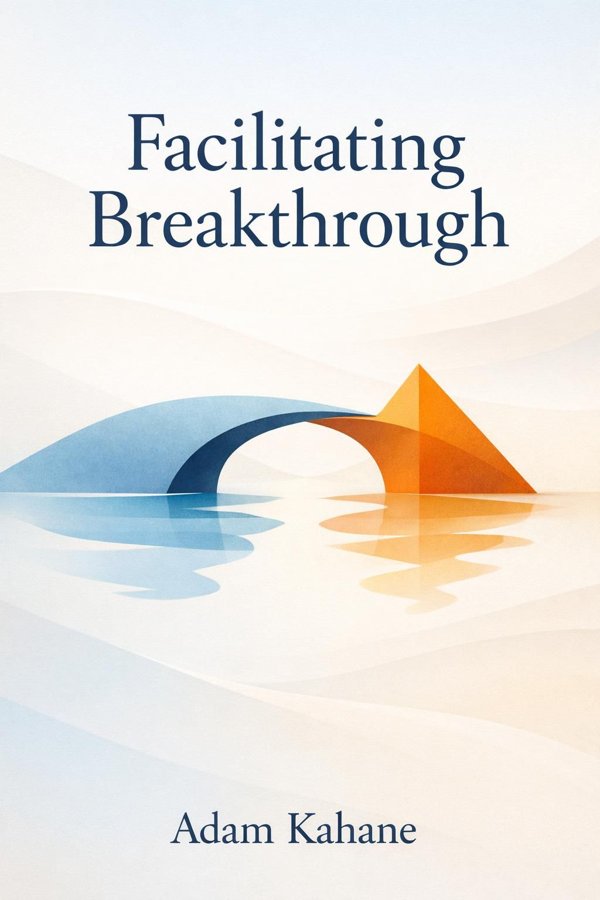
Facilitating Breakthrough: How to Remove Obstacles, Bridge Differences, and Move Forward Together: Summary & Key Insights
by Adam Kahane
 10 min11 chaptersAudio available
What Is Facilitating Breakthrough: How to Remove Obstacles, Bridge Differences, and Move Forward Together About?
Facilitating Breakthrough: How to Remove Obstacles, Bridge Differences, and Move Forward Together by Adam Kahane is a leadership book spanning 11 pages. In this book, Adam Kahane presents a practical approach to collaboration that helps groups overcome polarization and gridlock. Drawing on his experience facilitating complex social and organizational change processes around the world, he introduces methods for moving forward together even when participants have conflicting interests, values, or power. The book emphasizes the importance of embracing both love and power in facilitation to achieve genuine breakthroughs.
This FizzRead summary covers all 11 key chapters of Facilitating Breakthrough: How to Remove Obstacles, Bridge Differences, and Move Forward Together in approximately 10 minutes, distilling the most important ideas, arguments, and takeaways from Adam Kahane's work. Also available as an audio summary and Key Quotes Podcast.
Facilitating Breakthrough: How to Remove Obstacles, Bridge Differences, and Move Forward Together
In this book, Adam Kahane presents a practical approach to collaboration that helps groups overcome polarization and gridlock. Drawing on his experience facilitating complex social and organizational change processes around the world, he introduces methods for moving forward together even when participants have conflicting interests, values, or power. The book emphasizes the importance of embracing both love and power in facilitation to achieve genuine breakthroughs.
Who Should Read Facilitating Breakthrough: How to Remove Obstacles, Bridge Differences, and Move Forward Together?
This book is perfect for anyone interested in leadership and looking to gain actionable insights in a short read. Whether you're a student, professional, or lifelong learner, the key ideas from Facilitating Breakthrough: How to Remove Obstacles, Bridge Differences, and Move Forward Together by Adam Kahane will help you think differently.
- ✓Readers who enjoy leadership and want practical takeaways
- ✓Professionals looking to apply new ideas to their work and life
- ✓Anyone who wants the core insights of Facilitating Breakthrough: How to Remove Obstacles, Bridge Differences, and Move Forward Together in just 10 minutes
Want the full summary?
Get instant access to this book summary and 100K+ more with Fizz Moment.
Get Free SummaryAvailable on App Store • Free to download
Key Chapters
When I talk about groups being "stuck," I’m not referring to simple inefficiency or lack of motivation. Stuckness is deeper—it reflects the structural tension that arises when people hold incompatible goals or operate within systems that reward contention. I have seen this in political dialogues between armed factions, in boardrooms where executives pull in opposite directions, and in civic forums where distrust has hardened into identity.
In these moments, the system itself resists movement. Participants feel trapped: each side believes that changing course means losing something vital. Fear replaces imagination. Conversations become circular. My task as a facilitator begins with recognizing this emotional and systemic frozen state, not as a failure but as a signal that something important is being protected.
Understanding stuckness requires humility. It arises from conflicting interests, values, and power dynamics—not from bad people. When I first realized this, my whole approach changed. The facilitator’s job is not to fix others or their disputes but to help them see the total field of their situation, including how their own positions contribute to the gridlock. By illuminating how each actor’s intentions and constraints intersect, we uncover the hidden logic of the standstill. This awareness can build the trust needed to move again, even slightly.
The breakthrough begins when participants accept that they cannot control one another but can co-create the conditions for collective movement. To get unstuck, we must move from binary thinking—right versus wrong, win versus lose—to a more systemic view that acknowledges everyone’s partial truths. Only then can we begin to act together in a new, uncertain space.
Much of what passes for facilitation today strives for consensus and control. Traditional methods assume cooperation is possible if we manage communication properly, set clear goals, and encourage goodwill. These tools work well when participants share common objectives and trust. But in the world I inhabit—where people’s histories, identities, and interests collide—these techniques reach their limits quickly.
I have seen processes fail because facilitators tried to suppress conflict or push for agreement prematurely. When faced with polarization, this approach often deepens mistrust: one group feels coerced, another feels unheard. The outcome is fragile—a surface consensus masking unresolved tensions that return stronger later.
A deeper problem lies in our misunderstanding of power. Many facilitators avoid it altogether, fearing that acknowledging unequal power will disrupt the group’s harmony. Yet refusing to deal with power makes movement impossible. Real collaboration requires confronting who has the ability to decide and act, and how that power can be shared responsibly.
The alternative to traditional facilitation is what I call stretch collaboration. It doesn’t seek unity before action but works with tension openly. It invites participants to engage even when agreement seems unreachable. My own learning has been that breakthrough facilitation demands courage—the courage to hold space for discomfort and ambiguity, trusting that movement will emerge not from consensus but from creative coexistence.
+ 9 more chapters — available in the FizzRead app
All Chapters in Facilitating Breakthrough: How to Remove Obstacles, Bridge Differences, and Move Forward Together
About the Author
Adam Kahane is a director of Reos Partners, an international social enterprise that helps people move forward together on their most important and intractable issues. He has worked in more than fifty countries with governments, corporations, and civil society organizations. Kahane is also the author of several influential books on collaboration and change, including 'Solving Tough Problems' and 'Collaborating with the Enemy.'
Get This Summary in Your Preferred Format
Read or listen to the Facilitating Breakthrough: How to Remove Obstacles, Bridge Differences, and Move Forward Together summary by Adam Kahane anytime, anywhere. FizzRead offers multiple formats so you can learn on your terms — all free.
Available formats: App · Audio · PDF · EPUB — All included free with FizzRead
Download Facilitating Breakthrough: How to Remove Obstacles, Bridge Differences, and Move Forward Together PDF and EPUB Summary
Key Quotes from Facilitating Breakthrough: How to Remove Obstacles, Bridge Differences, and Move Forward Together
“When I talk about groups being "stuck," I’m not referring to simple inefficiency or lack of motivation.”
“Much of what passes for facilitation today strives for consensus and control.”
Frequently Asked Questions about Facilitating Breakthrough: How to Remove Obstacles, Bridge Differences, and Move Forward Together
Facilitating Breakthrough: How to Remove Obstacles, Bridge Differences, and Move Forward Together by Adam Kahane is a leadership book that explores key ideas across 11 chapters. In this book, Adam Kahane presents a practical approach to collaboration that helps groups overcome polarization and gridlock. Drawing on his experience facilitating complex social and organizational change processes around the world, he introduces methods for moving forward together even when participants have conflicting interests, values, or power. The book emphasizes the importance of embracing both love and power in facilitation to achieve genuine breakthroughs.
More by Adam Kahane
You Might Also Like

Extreme Ownership
Jocko Willink
10 min
Dare to Lead
Brene Brown
10 min
Leaders Eat Last
Simon Sinek
10 min
The 21 Irrefutable Laws of Leadership
John Maxwell
10 min
Start With Why
Simon Sinek
10 min
How to Lead When You're Not in Charge
Clay Scroggins
10 minBrowse by Category
Ready to read Facilitating Breakthrough: How to Remove Obstacles, Bridge Differences, and Move Forward Together?
Get the full summary and 100K+ more books with Fizz Moment.