
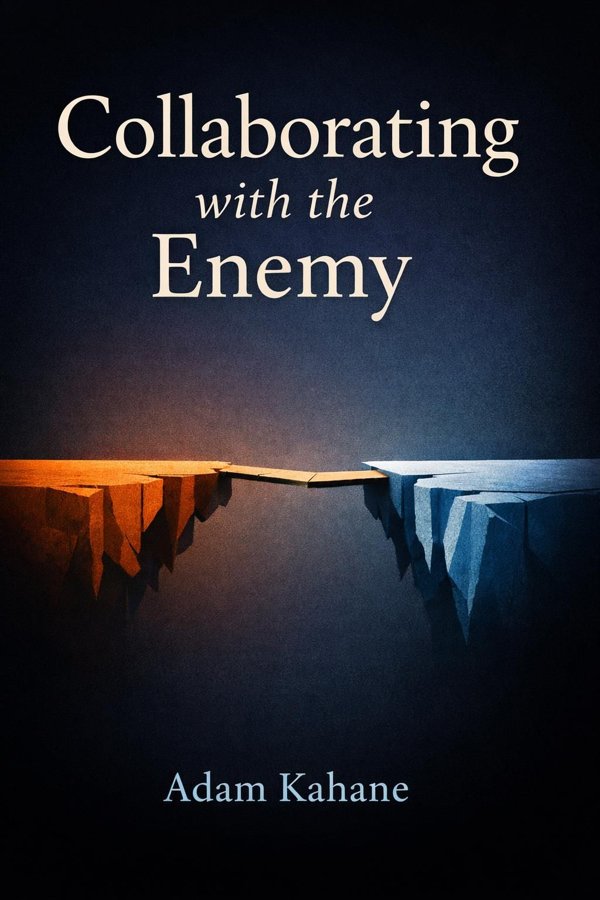
Collaborating with the Enemy: How to Work with People You Don’t Agree with or Like or Trust: Summary & Key Insights
by Adam Kahane
 10 min11 chaptersAudio available
What Is Collaborating with the Enemy: How to Work with People You Don’t Agree with or Like or Trust About?
Collaborating with the Enemy: How to Work with People You Don’t Agree with or Like or Trust by Adam Kahane is a leadership book spanning 11 pages. In this book, Adam Kahane explores how to collaborate effectively with people who hold opposing views, interests, or values. Drawing on his experience in conflict resolution and social change projects around the world, he presents practical strategies for working together even when trust and agreement are absent. The book emphasizes adaptive collaboration, humility, and the ability to move forward despite deep differences.
This FizzRead summary covers all 11 key chapters of Collaborating with the Enemy: How to Work with People You Don’t Agree with or Like or Trust in approximately 10 minutes, distilling the most important ideas, arguments, and takeaways from Adam Kahane's work. Also available as an audio summary and Key Quotes Podcast.
Collaborating with the Enemy: How to Work with People You Don’t Agree with or Like or Trust
In this book, Adam Kahane explores how to collaborate effectively with people who hold opposing views, interests, or values. Drawing on his experience in conflict resolution and social change projects around the world, he presents practical strategies for working together even when trust and agreement are absent. The book emphasizes adaptive collaboration, humility, and the ability to move forward despite deep differences.
Who Should Read Collaborating with the Enemy: How to Work with People You Don’t Agree with or Like or Trust?
This book is perfect for anyone interested in leadership and looking to gain actionable insights in a short read. Whether you're a student, professional, or lifelong learner, the key ideas from Collaborating with the Enemy: How to Work with People You Don’t Agree with or Like or Trust by Adam Kahane will help you think differently.
- ✓Readers who enjoy leadership and want practical takeaways
- ✓Professionals looking to apply new ideas to their work and life
- ✓Anyone who wants the core insights of Collaborating with the Enemy: How to Work with People You Don’t Agree with or Like or Trust in just 10 minutes
Want the full summary?
Get instant access to this book summary and 100K+ more with Fizz Moment.
Get Free SummaryAvailable on App Store • Free to download
Key Chapters
Most of us have been taught that collaboration is a matter of alignment: you gather stakeholders, find common ground, and reach agreement. This works when the problem is simple, when interests and values converge, and when control is possible. But in contexts of deep polarization and complexity, that model breaks down. In such situations, waiting for agreement only ensures paralysis.
In my work with teams across nations and sectors, I realized that conventional collaboration assumes too much coherence. It asks us to suppress disagreement for the sake of progress. But disagreement, I discovered, is not the obstacle—it’s the raw material. Adaptive collaboration begins by acknowledging differences and uncertainty. It replaces ‘agreement first’ with ‘engagement first.’ Instead of focusing on consensus, we focus on understanding each other enough to move forward together despite friction.
This demands a new mindset. You must let go of the idea that collaboration is about control. It’s about connection amid tension. Adaptive collaboration works through dialogue, experimentation, and shared action; it thrives precisely because participants bring distinct perspectives. It feels messy—and that’s by design, because complexity cannot be managed through neat alignment. The very discomfort of difference becomes the energy that propels transformation.
Everywhere I traveled—South Africa after apartheid, Guatemala after civil war, corporate tables where unions and CEOs barely spoke—I found the same pattern: polarization makes people withdraw. One side sees itself as righteous and the other as misguided, malicious, or ignorant. Collaboration seems impossible because the psychological distance is immense.
But polarization, though painful, is not the end of conversation—it is the starting point. When we resist that instinct to retreat, we begin to recognize that both sides usually want the same underlying thing: safety, recognition, and agency. Yet each defines those differently. My role as a facilitator was never to erase those differences but to create conditions where they could be expressed safely, where each person could remain fully themselves while still contributing.
I learned that polarization is fueled by stories—stories that tell us who belongs and who doesn’t. To collaborate across such divides, we need to hear those stories in full. Listening does not mean agreement; it means willing exposure to perspectives that threaten your certainty. Through genuine listening, the field begins to shift. People stop defending positions and start noticing patterns. That’s when a shared future becomes possible.
Polarization can be reframed as an invitation to stretch—to see the world not as black and white but as a complex web of interdependence. True progress requires us to stand in that complexity and work with it, not against it.
+ 9 more chapters — available in the FizzRead app
All Chapters in Collaborating with the Enemy: How to Work with People You Don’t Agree with or Like or Trust
About the Author
Adam Kahane is a facilitator, author, and director at Reos Partners, known for his work on complex social change initiatives. He has worked with governments, corporations, and civil society organizations worldwide to address challenging issues through dialogue and collaboration. His previous books include 'Solving Tough Problems' and 'Power and Love'.
Get This Summary in Your Preferred Format
Read or listen to the Collaborating with the Enemy: How to Work with People You Don’t Agree with or Like or Trust summary by Adam Kahane anytime, anywhere. FizzRead offers multiple formats so you can learn on your terms — all free.
Available formats: App · Audio · PDF · EPUB — All included free with FizzRead
Download Collaborating with the Enemy: How to Work with People You Don’t Agree with or Like or Trust PDF and EPUB Summary
Key Quotes from Collaborating with the Enemy: How to Work with People You Don’t Agree with or Like or Trust
“Most of us have been taught that collaboration is a matter of alignment: you gather stakeholders, find common ground, and reach agreement.”
“Everywhere I traveled—South Africa after apartheid, Guatemala after civil war, corporate tables where unions and CEOs barely spoke—I found the same pattern: polarization makes people withdraw.”
Frequently Asked Questions about Collaborating with the Enemy: How to Work with People You Don’t Agree with or Like or Trust
Collaborating with the Enemy: How to Work with People You Don’t Agree with or Like or Trust by Adam Kahane is a leadership book that explores key ideas across 11 chapters. In this book, Adam Kahane explores how to collaborate effectively with people who hold opposing views, interests, or values. Drawing on his experience in conflict resolution and social change projects around the world, he presents practical strategies for working together even when trust and agreement are absent. The book emphasizes adaptive collaboration, humility, and the ability to move forward despite deep differences.
More by Adam Kahane

You Might Also Like

Extreme Ownership
Jocko Willink
10 min
Dare to Lead
Brene Brown
10 min
Leaders Eat Last
Simon Sinek
10 min
The 21 Irrefutable Laws of Leadership
John Maxwell
10 min
Start With Why
Simon Sinek
10 min
How to Lead When You're Not in Charge
Clay Scroggins
10 minBrowse by Category
Ready to read Collaborating with the Enemy: How to Work with People You Don’t Agree with or Like or Trust?
Get the full summary and 100K+ more books with Fizz Moment.