
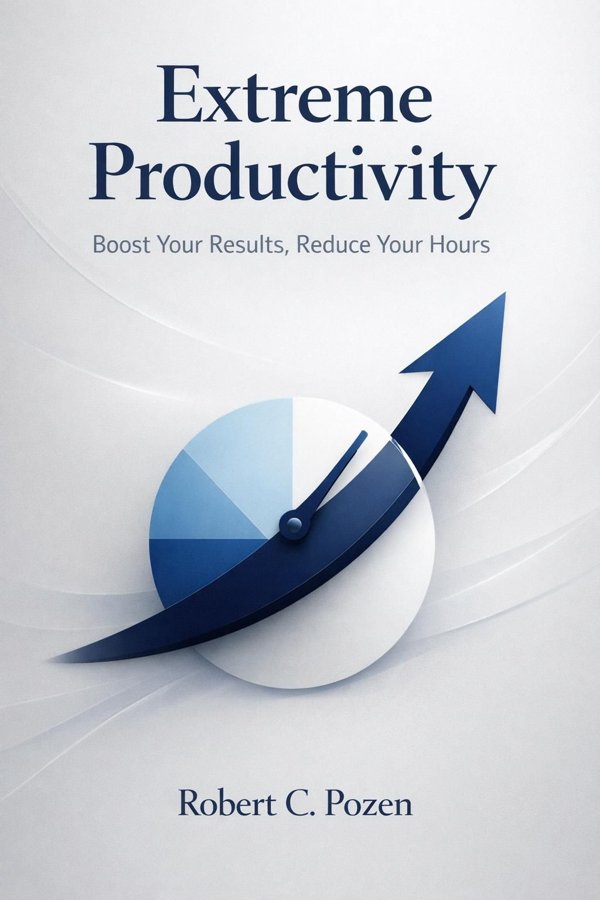
Extreme Productivity: Boost Your Results, Reduce Your Hours: Summary & Key Insights
 10 min9 chaptersAudio available
Key Takeaways from Extreme Productivity: Boost Your Results, Reduce Your Hours
Most people are not defeated by lack of effort; they are defeated by vague priorities.
A day can feel full and still be strategically empty.
Time management often fails because people treat it like a quest for perfect control.
Indecision is one of the most expensive forms of inefficiency.
Few workplace habits destroy productivity faster than unfocused meetings and careless communication.
What Is Extreme Productivity: Boost Your Results, Reduce Your Hours About?
Extreme Productivity: Boost Your Results, Reduce Your Hours by Robert C. Pozen is a productivity book spanning 9 pages. Extreme Productivity is a practical guide to getting more of the right work done without surrendering your life to endless busyness. Robert C. Pozen argues that real productivity is not about cramming more tasks into the day or becoming obsessively efficient for its own sake. It is about identifying what creates the most value, focusing intensely on those priorities, and building systems that reduce wasted time, friction, and fatigue. The book combines strategic thinking with highly actionable advice on planning, decision-making, delegation, meetings, email, reading, and work-life balance. What makes the book especially valuable is Pozen’s authority. He writes not as a theorist but as a senior executive who led major financial institutions, taught at Harvard Business School, and managed immense professional demands while maintaining a sustainable life. His recommendations are grounded in lived experience and tested in high-pressure environments. For professionals overwhelmed by meetings, inboxes, and competing priorities, Extreme Productivity offers a clear alternative: stop measuring effort, start measuring outcomes, and redesign your habits around what matters most. The result is a smarter, calmer, and far more effective way to work.
This FizzRead summary covers all 9 key chapters of Extreme Productivity: Boost Your Results, Reduce Your Hours in approximately 10 minutes, distilling the most important ideas, arguments, and takeaways from Robert C. Pozen's work. Also available as an audio summary and Key Quotes Podcast.
Extreme Productivity: Boost Your Results, Reduce Your Hours
Extreme Productivity is a practical guide to getting more of the right work done without surrendering your life to endless busyness. Robert C. Pozen argues that real productivity is not about cramming more tasks into the day or becoming obsessively efficient for its own sake. It is about identifying what creates the most value, focusing intensely on those priorities, and building systems that reduce wasted time, friction, and fatigue. The book combines strategic thinking with highly actionable advice on planning, decision-making, delegation, meetings, email, reading, and work-life balance.
What makes the book especially valuable is Pozen’s authority. He writes not as a theorist but as a senior executive who led major financial institutions, taught at Harvard Business School, and managed immense professional demands while maintaining a sustainable life. His recommendations are grounded in lived experience and tested in high-pressure environments. For professionals overwhelmed by meetings, inboxes, and competing priorities, Extreme Productivity offers a clear alternative: stop measuring effort, start measuring outcomes, and redesign your habits around what matters most. The result is a smarter, calmer, and far more effective way to work.
Who Should Read Extreme Productivity: Boost Your Results, Reduce Your Hours?
This book is perfect for anyone interested in productivity and looking to gain actionable insights in a short read. Whether you're a student, professional, or lifelong learner, the key ideas from Extreme Productivity: Boost Your Results, Reduce Your Hours by Robert C. Pozen will help you think differently.
- ✓Readers who enjoy productivity and want practical takeaways
- ✓Professionals looking to apply new ideas to their work and life
- ✓Anyone who wants the core insights of Extreme Productivity: Boost Your Results, Reduce Your Hours in just 10 minutes
Want the full summary?
Get instant access to this book summary and 100K+ more with Fizz Moment.
Get Free SummaryAvailable on App Store • Free to download
Key Chapters
Most people are not defeated by lack of effort; they are defeated by vague priorities. Pozen’s core insight is that productivity begins long before calendars, to-do lists, or efficiency tools. It begins with deciding what matters most. If you do not define value clearly, other people will define your day for you through emails, meetings, interruptions, and requests that feel urgent but contribute little to meaningful progress.
Pozen encourages readers to distinguish between activity and contribution. A long day full of responses, updates, and administrative work may feel productive, but if it does not advance your most important objectives, it is only motion. The more senior and ambitious you become, the more this distinction matters. High performers create leverage by identifying the few goals that produce outsized results, then organizing their work around those goals.
This requires asking sharper questions: What outcomes matter most this quarter? Which projects align with my larger responsibilities? What work can only I do? For example, a manager might realize that mentoring a top employee, preparing a strategy memo, and securing a client renewal matter more than attending every optional meeting. A student or entrepreneur can apply the same logic by focusing on the assignments, relationships, or product decisions that create the most long-term value.
Pozen’s approach also pushes readers to define success in concrete terms. Broad intentions like “improve performance” are weak. A better goal is “complete the client proposal by Thursday” or “reduce approval delays by 20 percent this month.” Precision leads to better decisions.
Actionable takeaway: Write down your top three professional goals for the next month and identify which daily activities truly support them. Reduce or eliminate the ones that do not.
A day can feel full and still be strategically empty. One of Pozen’s most useful principles is to connect each day’s actions to larger goals instead of treating all tasks as equally important. Productivity improves dramatically when you stop reacting to everything and start selecting the few actions that matter most.
Pozen recommends narrowing daily focus to a small number of major priorities, often framed as the most important tasks that would make the day successful even if lesser items remained unfinished. This approach counters the common mistake of building long task lists that mix critical work with trivial errands. Long lists create the illusion of control while encouraging procrastination on the hardest and most valuable work.
Imagine a lawyer, executive, or project lead who starts each day by identifying three significant outcomes: finalize a contract issue, give feedback to a direct report, and prepare for a board discussion. Once these are clear, minor tasks can be fitted around them rather than replacing them. The result is not only higher output but greater psychological clarity. You know what winning the day looks like.
This method also improves decision-making under pressure. When new requests appear, you can evaluate them against existing priorities. Does this deserve immediate attention, or can it wait? Should it be delegated, shortened, or declined? Prioritization becomes a filter, not a feeling.
Pozen’s perspective is especially powerful because it links short-term discipline with long-term achievement. Careers advance through repeated progress on important work, not through constant responsiveness. Over weeks and months, daily focus compounds into major results.
Actionable takeaway: Before checking email each morning, identify the three most important outcomes for the day and schedule protected time for at least the first one.
Time management often fails because people treat it like a quest for perfect control. Pozen offers a more realistic and effective model: manage time by intention, not by fantasy. You will always face interruptions, competing demands, and unexpected problems. The goal is not to create a flawless schedule but to consistently direct your best energy toward high-value work.
One of his practical recommendations is to estimate how long tasks should take and compare that with how long they actually take. Many professionals lose time because they do not notice the gap between intention and reality. A report that should require forty-five minutes expands to two hours because of overediting, distractions, or poor preparation. By tracking time more honestly, you can see where your day leaks away.
Pozen also encourages structuring the day around your cognitive strengths. For example, if you think most clearly in the morning, use that period for analysis, writing, or strategy rather than routine communication. Reserve lower-energy periods for administrative tasks, quick replies, or logistics. This simple shift often produces more value without adding a single hour of work.
He is also skeptical of the habit of touching the same task multiple times. Reopening files, revisiting emails, and restarting unfinished work creates hidden friction. Better to batch similar tasks and complete them decisively. For instance, handle expense approvals in one block, not in scattered fragments throughout the day.
The larger lesson is that productivity is not about squeezing every minute. It is about protecting attention, reducing transition costs, and matching your time to your priorities.
Actionable takeaway: For one week, track where your work hours actually go, then redesign your schedule so your highest-energy periods are devoted to your highest-value tasks.
Indecision is one of the most expensive forms of inefficiency. Pozen argues that many professionals waste enormous time revisiting decisions that do not deserve prolonged analysis. While important choices require care, a surprising number of daily decisions can be made quickly once you define the right criteria. Productivity rises when you stop treating every issue like a high-stakes dilemma.
A useful principle here is to match the speed of the decision to the importance of the consequence. Not every presentation slide, internal approval, or wording choice requires deep review. In many cases, 80 percent certainty is enough. Delay often reflects discomfort, not wisdom. The cost is compounded when teams wait on a leader who cannot decide.
Delegation follows the same logic. People often resist delegating because they believe others will perform the task less well or because teaching someone feels slower in the short term. Pozen’s point is that effective delegation is not dumping work; it is transferring responsibility in a way that frees you for more valuable contributions while helping others grow. This means choosing the right person, clarifying the objective, defining the level of authority, and agreeing on check-in points.
For example, instead of reviewing every detail of a recurring report, a manager can ask a capable team member to own the first draft, summarize key changes, and escalate only major issues. Over time, this saves hours and builds capacity across the team. Delegation is especially essential for leaders, because doing everything personally caps the organization’s output at one person’s bandwidth.
Actionable takeaway: This week, identify one decision you are overthinking and make it using clear criteria, then delegate one recurring responsibility with explicit expectations and a review date.
Few workplace habits destroy productivity faster than unfocused meetings and careless communication. Pozen treats both as design problems rather than unavoidable annoyances. If a meeting lacks a clear purpose, the right participants, and a defined outcome, it should be shortened, restructured, or canceled. The same goes for communication that creates confusion, duplication, or needless back-and-forth.
His first principle for meetings is simple: know why you are gathering. Is the goal to decide, inform, brainstorm, or solve a problem? Each purpose requires a different structure. A decision meeting should include decision-makers and pre-read materials. An informational update may not require a meeting at all; a concise written memo could suffice. Too many organizations default to meetings because they feel collaborative, even when they waste collective time.
Pozen also stresses preparation and brevity. If attendees receive materials in advance and come ready to discuss the important issues, meetings become shorter and sharper. Leaders should keep discussions on track, prevent repetition, and end with explicit next steps, owners, and deadlines. Otherwise, the same topics return the following week.
On communication more broadly, Pozen favors clarity over volume. Emails should be concise, direct, and easy to answer. If a message requires a long explanation or could trigger misunderstanding, a brief call may be better. The objective is to minimize ambiguity and reduce the total communication burden on everyone involved.
A manager applying this idea might replace a standing hour-long weekly meeting with a twenty-minute decision check-in supported by a one-page update. The result is not just saved time but better momentum.
Actionable takeaway: Audit your recurring meetings and keep only those with a clear purpose, defined decisions, and the minimum necessary participants.
Many professionals spend huge amounts of time reading, reviewing, and preparing without extracting proportional value. Pozen’s approach is refreshing because he challenges the assumption that thoroughness always means reading everything in full, taking exhaustive notes, or overpreparing for every interaction. Real learning depends on purpose, structure, and selectivity.
He recommends beginning any reading task by asking, why am I reading this? If the answer is to grasp the main argument, prepare for a discussion, or identify a decision point, then your reading method should match that purpose. This often means skimming strategically before reading deeply. Start with headings, summaries, charts, conclusions, and topic sentences. Then focus on the sections most relevant to your objective. This is not laziness; it is intelligent triage.
The same principle applies to preparation. People often overprepare because it feels safer, but excessive preparation can consume time that would be better spent elsewhere. For a meeting or presentation, Pozen suggests identifying the few issues most likely to matter and preparing around them. If you are meeting a client, know their priorities, likely concerns, and the outcome you want. You do not need to memorize every background detail.
This method is especially useful in information-heavy roles such as consulting, finance, law, academia, and management. A professional who learns to process material efficiently gains a major advantage. Instead of drowning in input, they move quickly to insight and action.
The broader lesson is that learning is not measured by time spent but by useful understanding gained. Better readers and preparers are often not more exhaustive; they are more intentional.
Actionable takeaway: Before your next report, book, or briefing packet, define your reading goal in one sentence and use that goal to decide what to skim, what to study deeply, and what to ignore.
Extreme productivity is not a call for extreme work hours. One of Pozen’s most important contributions is his insistence that sustainable high performance depends on making deliberate choices about life outside work. Without boundaries, professional ambition expands endlessly, consuming time, attention, and relationships until success becomes hollow or unsustainable.
Pozen rejects the idea that balance means equal time for everything. Instead, he emphasizes conscious trade-offs. Different stages of life and career may require different allocations of energy, but those choices should be made intentionally rather than by default. Too many people let work take whatever time remains after family, health, and recovery have already been neglected.
A practical way to think about balance is to identify your non-negotiables. These might include dinner with family several nights a week, exercise four times a week, uninterrupted weekend hours, or protected time for sleep. Once these are defined, work should be organized around them as much as possible. This may involve saying no to low-value commitments, limiting after-hours communication, or creating routines that separate work time from personal time.
Pozen’s argument is not sentimental. He sees rest, health, and relationships as performance issues as much as personal ones. Fatigued, distracted, and overextended people make worse decisions, communicate poorly, and lose strategic perspective. Sustainable productivity requires renewal.
For ambitious professionals, this reframing matters. The goal is not to work less out of laziness, but to work better so that career success does not demand constant sacrifice.
Actionable takeaway: Define two personal commitments you want to protect each week and redesign your work habits so they are scheduled first rather than squeezed in last.
The productivity of a leader cannot be measured only by personal output. Pozen argues that leadership becomes truly effective when it multiplies the performance of others. A manager who completes many tasks personally may appear efficient, but a leader who builds capable, independent people creates far greater long-term results.
This requires a shift in mindset. Instead of asking, how can I get this done fastest myself, leaders should ask, how can I build a team that can handle this well without constant intervention? Coaching, feedback, and clear expectations may feel slower today, but they reduce dependency tomorrow. That is one of the highest-return investments a leader can make.
Pozen emphasizes clarity in assigning work. People perform better when they understand the desired outcome, the standard of quality, the timeline, and the decision rights they hold. Ambiguity creates delays, rework, and unnecessary escalation. Effective leaders also create systems for review that support accountability without micromanagement.
Consider a department head who repeatedly rewrites subordinates’ reports. The immediate fix may improve the document, but it also trains the team to rely on the boss as editor-in-chief. A better approach is to explain the expectations, provide examples of strong work, and review patterns of weakness so the team improves. Over time, the leader handles fewer corrections and more strategic work.
This idea extends beyond delegation. Productive leaders shape cultures where meetings are better run, decisions are made at the right level, and information flows efficiently. Their impact is amplified through norms.
Actionable takeaway: Choose one team member to develop in a specific skill this month, and replace one instance of direct takeover with coaching, feedback, and clear ownership.
Short bursts of efficiency are easy; sustained productivity is harder. Pozen closes the gap by showing that long-term results come from repeatable habits, not occasional heroic effort. Many people can perform well under pressure for a week. Far fewer can maintain high-quality output year after year without burning out, becoming disorganized, or losing focus.
Sustainable productivity starts with routines that reduce decision fatigue. If you regularly plan your week, review priorities, clear bottlenecks, and protect deep work time, you rely less on willpower. Your system carries you forward. This is why disciplined habits outperform motivational surges. They make productivity normal rather than exceptional.
Pozen also highlights the importance of periodic reflection. Work systems become outdated. Roles evolve, organizations change, and old routines can quietly become inefficient. Reviewing how you spend time, what creates the most value, and where you get stuck allows continual improvement. Even small adjustments, repeated consistently, can produce major gains.
Another key part of sustainability is accepting imperfection. Productive people do not complete everything. They make informed trade-offs and keep moving. Trying to optimize every detail leads to exhaustion and delay. Better to do the most important things well, let some minor things remain good enough, and preserve the energy to continue performing tomorrow.
In this sense, extreme productivity is less about intensity than durability. It is a way of working that can survive real life, changing demands, and long careers.
Actionable takeaway: Create a weekly thirty-minute review to assess your top priorities, unfinished tasks, energy levels, and workflow problems, then make one concrete adjustment for the following week.
All Chapters in Extreme Productivity: Boost Your Results, Reduce Your Hours
About the Author
Robert C. Pozen is an American business executive, author, and educator known for his work in productivity, finance, and corporate governance. He served as president of Fidelity Investments and later as chairman of MFS Investment Management, gaining a reputation for disciplined thinking and high-level leadership in complex organizations. In addition to his executive career, Pozen has taught as a senior lecturer at Harvard Business School, where he has shared practical insights on management, business strategy, and public policy. His writing stands out for combining real-world executive experience with clear, actionable advice. In Extreme Productivity, he draws on decades of leadership and decision-making under pressure to show professionals how to improve results, reduce wasted effort, and build more sustainable ways of working.
Get This Summary in Your Preferred Format
Read or listen to the Extreme Productivity: Boost Your Results, Reduce Your Hours summary by Robert C. Pozen anytime, anywhere. FizzRead offers multiple formats so you can learn on your terms — all free.
Available formats: App · Audio · PDF · EPUB — All included free with FizzRead
Download Extreme Productivity: Boost Your Results, Reduce Your Hours PDF and EPUB Summary
Key Quotes from Extreme Productivity: Boost Your Results, Reduce Your Hours
“Most people are not defeated by lack of effort; they are defeated by vague priorities.”
“A day can feel full and still be strategically empty.”
“Time management often fails because people treat it like a quest for perfect control.”
“Indecision is one of the most expensive forms of inefficiency.”
“Few workplace habits destroy productivity faster than unfocused meetings and careless communication.”
Frequently Asked Questions about Extreme Productivity: Boost Your Results, Reduce Your Hours
Extreme Productivity: Boost Your Results, Reduce Your Hours by Robert C. Pozen is a productivity book that explores key ideas across 9 chapters. Extreme Productivity is a practical guide to getting more of the right work done without surrendering your life to endless busyness. Robert C. Pozen argues that real productivity is not about cramming more tasks into the day or becoming obsessively efficient for its own sake. It is about identifying what creates the most value, focusing intensely on those priorities, and building systems that reduce wasted time, friction, and fatigue. The book combines strategic thinking with highly actionable advice on planning, decision-making, delegation, meetings, email, reading, and work-life balance. What makes the book especially valuable is Pozen’s authority. He writes not as a theorist but as a senior executive who led major financial institutions, taught at Harvard Business School, and managed immense professional demands while maintaining a sustainable life. His recommendations are grounded in lived experience and tested in high-pressure environments. For professionals overwhelmed by meetings, inboxes, and competing priorities, Extreme Productivity offers a clear alternative: stop measuring effort, start measuring outcomes, and redesign your habits around what matters most. The result is a smarter, calmer, and far more effective way to work.
You Might Also Like



Browse by Category
Ready to read Extreme Productivity: Boost Your Results, Reduce Your Hours?
Get the full summary and 100K+ more books with Fizz Moment.