
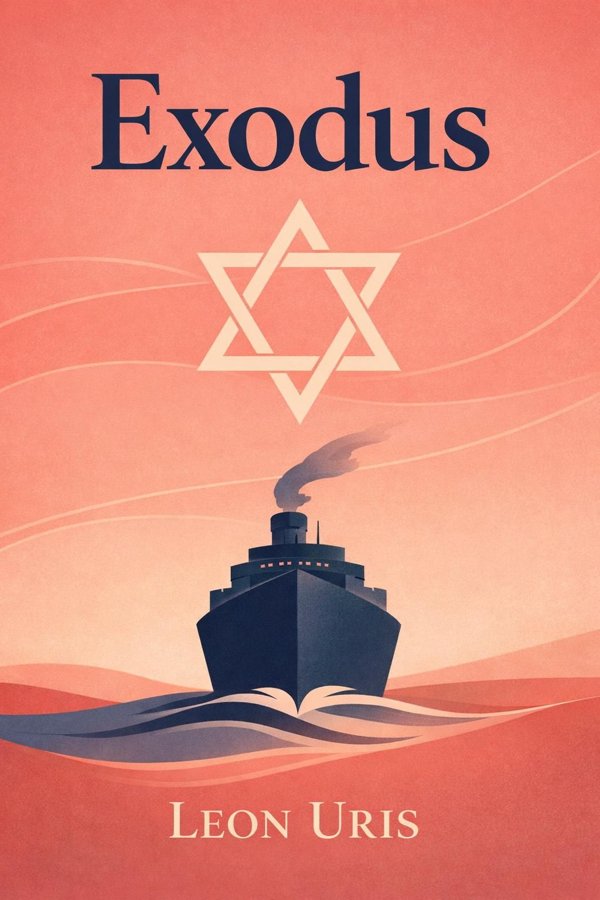
Exodus: Summary & Key Insights
by Leon Uris
 10 min3 chaptersAudio available
What Is Exodus About?
Exodus by Leon Uris is a world_history book spanning 3 pages. Exodus es una novela histórica escrita por Leon Uris que narra la fundación del Estado de Israel. A través de personajes ficticios y eventos basados en hechos reales, la obra describe la lucha del pueblo judío por establecer un hogar nacional tras el Holocausto, centrándose en la inmigración clandestina a Palestina y los conflictos políticos y militares que siguieron.
This FizzRead summary covers all 3 key chapters of Exodus in approximately 10 minutes, distilling the most important ideas, arguments, and takeaways from Leon Uris's work. Also available as an audio summary and Key Quotes Podcast.
Exodus
Exodus es una novela histórica escrita por Leon Uris que narra la fundación del Estado de Israel. A través de personajes ficticios y eventos basados en hechos reales, la obra describe la lucha del pueblo judío por establecer un hogar nacional tras el Holocausto, centrándose en la inmigración clandestina a Palestina y los conflictos políticos y militares que siguieron.
Who Should Read Exodus?
This book is perfect for anyone interested in world_history and looking to gain actionable insights in a short read. Whether you're a student, professional, or lifelong learner, the key ideas from Exodus by Leon Uris will help you think differently.
- ✓Readers who enjoy world_history and want practical takeaways
- ✓Professionals looking to apply new ideas to their work and life
- ✓Anyone who wants the core insights of Exodus in just 10 minutes
Want the full summary?
Get instant access to this book summary and 100K+ more with Fizz Moment.
Get Free SummaryAvailable on App Store • Free to download
Key Chapters
The story opens in the shattered world of post–World War II Cyprus, where Jewish refugees — survivors of the Holocaust — are confined in British detention camps. Here, thousands who escaped the furnaces of Europe are being prevented from reaching Palestine, the land they call home. They are guarded, quarantined, and treated as political burdens rather than human beings. This opening captures the global moral exhaustion that followed the war, and the hypocrisy of nations too weary or unwilling to act justly.
Amid this despair stands Ari Ben Canaan, a sabra whose confidence and unyielding pride represent the new Jewish generation born in Palestine. Ari has grown up under foreign rule, and he understands both the patient endurance and the silent rage of his people. He devises an audacious plan — a public confrontation with British authority. By refitting an aging ship and naming it *Exodus*, Ari intends to carry hundreds of refugees to Palestine in open defiance of the blockade. His plan is not only an act of transport but a declaration: the Jewish people will no longer accept permission to exist.
Into this atmosphere comes Kitty Fremont, an American nurse who serves among the Cyprus camps with skepticism and sympathy. At first, she views Ari as reckless, and the Jewish struggle as an echo of ancient grievances. But as she listens to the children’s songs of exile and sees their numbered arms, her objectivity dissolves. She becomes entwined emotionally with the refugees, particularly with Karen Hansen Clement, a young girl whose gentleness and courage symbolize the soul of the displaced nation.
When the Exodus finally sets sail, it is no longer merely a ship but a manifesto in motion. On its decks are the living remnants of Europe’s ashes, stepping toward rebirth. Ari stands not only as commander but as shepherd of a people asserting life against tyranny. The British blockade is waiting, yet the voyage itself is the victory — it captivates the conscience of the world. The refugees proclaim that to return home is not a privilege but a right, and their defiance shakes international apathy. As I wrote that passage, I wanted readers to feel that longing physically, the heartbeat of history on the deck of that ship. Exodus sails as political resistance, spiritual restoration, and living symbol of an entire nation’s endurance.
To understand why Ari’s mission carries such moral weight, we must travel backward — into the haunted landscapes of Europe that birthed the refugees. Through the voices of Dov Landau and Karen, I shaped the human memory behind the statistics of genocide. Dov’s story begins in the Warsaw Ghetto, as a teenage fighter who watches his family consumed by the Nazi machinery. His survival is not gentle; it is carved in resistance and guilt. Dov represents the wounded conscience of a generation — the youth transformed by cruelty into defiance. When he rebuilds his life in Palestine, his fury becomes purpose. He channels his trauma into the fight for freedom, reminding us that nations are born not only of dreams but of scars.
Karen Hansen Clement’s background is equally complex. She was sheltered in Denmark during the Nazi occupation, a glimpse of humanity amid dark times. Her love for Ari and her involvement with the refugees bridge the chasm between outsider compassion and insider faith. Through her eyes, the reader senses the yearning of children who survived the camps yet still carry fear in their blood. These flashbacks bind personal tragedy to historical truth: Europe’s silence and the world’s hesitation produced not only loss but determination.
When these survivors gather on the Exodus, they do not sail simply toward geography but toward restoration of dignity. The Holocaust, in *Exodus*, is not treated as a separate chapter of history but as the womb of modern Jewish nationhood. Ari and his comrades bear that memory as weapon and warning. They remember a world that allowed monsters to govern conscience, and they vow that this shall never be repeated. Their struggle is thus both political and existential, a demand that humanity confess where it once looked away.
Through these memories, I hoped to show that suffering can be transmuted, that identity rebuilt from ashes can carry unbroken pride. The Holocaust thus stands not merely as past but as everlasting shadow beneath the light of Israel’s rebirth. Every survivor aboard the Exodus carries death within, but together they turn that death into belonging. That is why the ship’s name is more than biblical imagery — it is the movement from slavery to freedom retold in modern time.
+ 1 more chapters — available in the FizzRead app
All Chapters in Exodus
About the Author
Get This Summary in Your Preferred Format
Read or listen to the Exodus summary by Leon Uris anytime, anywhere. FizzRead offers multiple formats so you can learn on your terms — all free.
Available formats: App · Audio · PDF · EPUB — All included free with FizzRead
Download Exodus PDF and EPUB Summary
Key Quotes from Exodus
“The story opens in the shattered world of post–World War II Cyprus, where Jewish refugees — survivors of the Holocaust — are confined in British detention camps.”
“To understand why Ari’s mission carries such moral weight, we must travel backward — into the haunted landscapes of Europe that birthed the refugees.”
Frequently Asked Questions about Exodus
Exodus by Leon Uris is a world_history book that explores key ideas across 3 chapters. Exodus es una novela histórica escrita por Leon Uris que narra la fundación del Estado de Israel. A través de personajes ficticios y eventos basados en hechos reales, la obra describe la lucha del pueblo judío por establecer un hogar nacional tras el Holocausto, centrándose en la inmigración clandestina a Palestina y los conflictos políticos y militares que siguieron.
You Might Also Like
The Age of Capital
Eric Hobsbawm
10 min
The Gulag Archipelago
Aleksandr Solzhenitsyn
10 min
Jerusalem: The Biography
Simon Sebag Montefiore
10 min
The Anglo-Saxons
James Campbell
10 min
The Boer War
Thomas Pakenham
10 min
The Industrial Revolutionaries: The Making of the Modern World 1776–1914
Gavin Weightman
10 minBrowse by Category
Ready to read Exodus?
Get the full summary and 100K+ more books with Fizz Moment.