
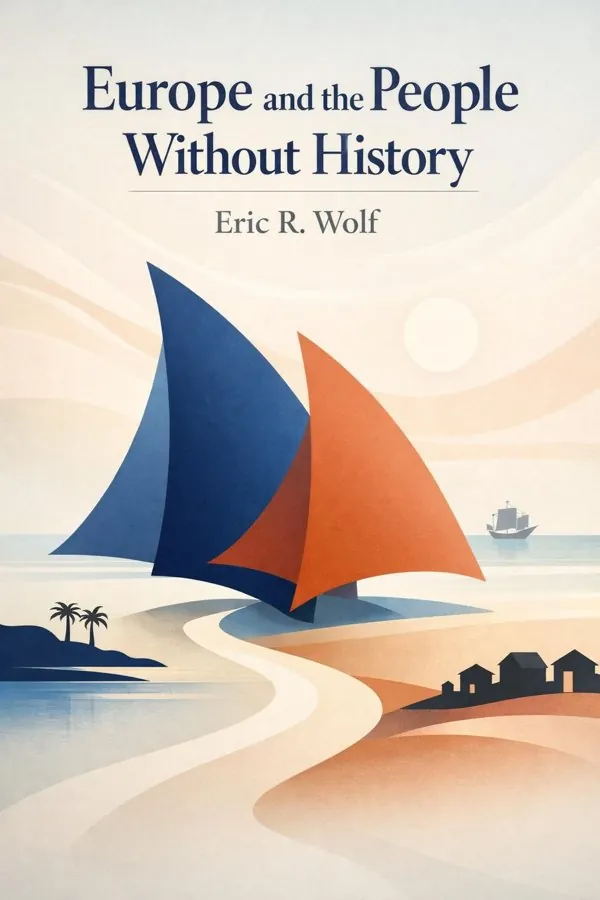
Europe and the People Without History: Summary & Key Insights
by Eric R. Wolf
 10 min9 chaptersAudio available
What Is Europe and the People Without History About?
Europe and the People Without History by Eric R. Wolf is a world_history book spanning 9 pages. This influential work by anthropologist Eric R. Wolf examines the global processes of expansion, trade, and colonization that shaped the modern world. Wolf challenges Eurocentric narratives by exploring how non-European societies were integral to world history, emphasizing interconnected economic and social systems from 1400 onward.
This FizzRead summary covers all 9 key chapters of Europe and the People Without History in approximately 10 minutes, distilling the most important ideas, arguments, and takeaways from Eric R. Wolf's work. Also available as an audio summary and Key Quotes Podcast.
Europe and the People Without History
This influential work by anthropologist Eric R. Wolf examines the global processes of expansion, trade, and colonization that shaped the modern world. Wolf challenges Eurocentric narratives by exploring how non-European societies were integral to world history, emphasizing interconnected economic and social systems from 1400 onward.
Who Should Read Europe and the People Without History?
This book is perfect for anyone interested in world_history and looking to gain actionable insights in a short read. Whether you're a student, professional, or lifelong learner, the key ideas from Europe and the People Without History by Eric R. Wolf will help you think differently.
- ✓Readers who enjoy world_history and want practical takeaways
- ✓Professionals looking to apply new ideas to their work and life
- ✓Anyone who wants the core insights of Europe and the People Without History in just 10 minutes
Want the full summary?
Get instant access to this book summary and 100K+ more with Fizz Moment.
Get Free SummaryAvailable on App Store • Free to download
Key Chapters
To make sense of this vast web of interrelations, I turned to what economic historians such as Immanuel Wallerstein have called the world-system perspective—but I aimed to merge it with anthropological sensitivity to local contexts. In the historical vision I propose, starting from around 1400, the world became an increasingly integrated system of production and exchange. Europe’s rising mercantile capitalism connected distant societies in a common network of labor and resources. Yet this was not a simple process of European dominance imposed on passive others. Each society contributed to the system according to its own conditions, shaping and being shaped in turn.
Anthropology teaches us to look at how people sustain themselves—their modes of production, subsistence, and exchange. When these local systems come into contact through trade and conquest, they begin to interlock in asymmetrical ways. The capitalist mode of production is expansionary; it depends upon drawing new regions into its orbit. Europeans did not simply discover markets—they created dependency. Through trade, taxation, and colonization, they transformed the conditions under which local people lived and worked.
In this theoretical framework, “core” and “periphery” are not static categories but relational positions. A core region dominates production and trade through technological and organizational advantages; peripheral regions provide resources and labor under coercive terms. Between them are semiperipheral zones, constantly shifting as political and economic power evolves. The vitality of capitalism lies precisely in these exchanges—its ability to absorb the energies of diverse societies while maintaining inequality within the system.
Anthropology allows us to see the human consequences of this. Behind market exchange lies the transformation of livelihoods, identities, and ecological relations. When Africa became a supplier of enslaved labor, whole communities were restructured around the demands of Europeans; when China and India were drawn into world trade, their artisans confronted new pressures from industrial competition. These are not abstract dynamics; they are the daily realities of people confronting an expanding world economy.
By combining historical analysis with anthropological insight, my aim was to transcend disciplinary silos. Global capitalism must be studied both as a system of relations and as a set of human experiences. Only then can we understand how the world we inhabit took shape through centuries of linked transformations.
The encounter between Europe and the Americas was a transformative moment in world history. When Spanish and Portuguese explorers reached the Caribbean and the mainland, they did not find empty lands but societies with rich traditions and economies. Yet European conquest quickly set in motion a massive reshaping. The extraction of silver from Potosí, the cultivation of sugar in the Caribbean, and the establishment of colonial administrations all served a single purpose—the accumulation of wealth to feed Europe’s mercantile capitalist ambitions.
Silver and sugar became commodities of global consequence. The silver mines powered the Spanish empire’s trade with Asia; bullion from the New World flowed into China as payment for silk and porcelain. Sugar plantations relied on enslaved African labor, linking three continents in a brutal economic triangle. Europeans created colonial institutions that redefined indigenous labor systems—they imposed encomiendas, forced conversions, and tribute demands that destroyed older social balances.
But in this transformation, the peoples of the Americas did not simply vanish. They adapted, resisted, and reshaped colonial power in countless ways—from selective cooperation with traders to revolts against abusive officials. Their histories reveal how indigenous societies negotiated survival within a globalizing economy. The European expansion was not the spread of civilization into a void; it was a violent integration that carried both destruction and the seeds of new hybrid cultures.
For me, understanding Europe’s rise requires seeing these connections clearly. The mercantile empire was sustained not only by European innovation but by the forced labor and resources of colonized peoples. The global economy was born in conquest, but also in interaction—an unsteady mixture of domination and adaptation that continues to ripple through modern structures of inequality.
+ 7 more chapters — available in the FizzRead app
All Chapters in Europe and the People Without History
About the Author
Eric R. Wolf (1923–1999) was an Austrian-born American anthropologist known for his studies of peasant societies and political economy. His work bridged anthropology and history, focusing on power, inequality, and global interconnections.
Get This Summary in Your Preferred Format
Read or listen to the Europe and the People Without History summary by Eric R. Wolf anytime, anywhere. FizzRead offers multiple formats so you can learn on your terms — all free.
Available formats: App · Audio · PDF · EPUB — All included free with FizzRead
Download Europe and the People Without History PDF and EPUB Summary
Key Quotes from Europe and the People Without History
“In the historical vision I propose, starting from around 1400, the world became an increasingly integrated system of production and exchange.”
“The encounter between Europe and the Americas was a transformative moment in world history.”
Frequently Asked Questions about Europe and the People Without History
Europe and the People Without History by Eric R. Wolf is a world_history book that explores key ideas across 9 chapters. This influential work by anthropologist Eric R. Wolf examines the global processes of expansion, trade, and colonization that shaped the modern world. Wolf challenges Eurocentric narratives by exploring how non-European societies were integral to world history, emphasizing interconnected economic and social systems from 1400 onward.
You Might Also Like
The Age of Capital
Eric Hobsbawm
10 min
The Gulag Archipelago
Aleksandr Solzhenitsyn
10 min
Jerusalem: The Biography
Simon Sebag Montefiore
10 min
The Anglo-Saxons
James Campbell
10 min
The Boer War
Thomas Pakenham
10 min
The Industrial Revolutionaries: The Making of the Modern World 1776–1914
Gavin Weightman
10 minBrowse by Category
Ready to read Europe and the People Without History?
Get the full summary and 100K+ more books with Fizz Moment.