
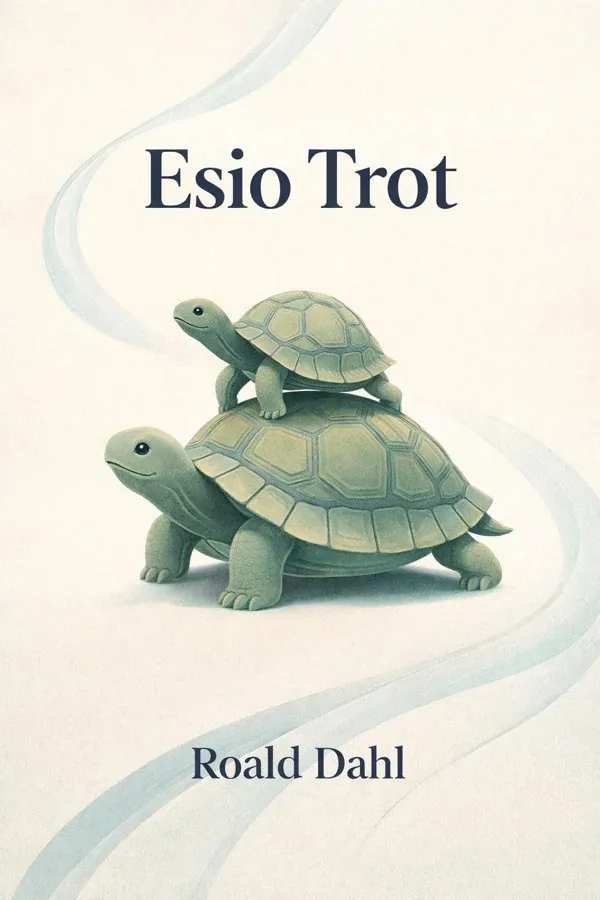
Esio Trot: Summary & Key Insights
by Roald Dahl
 10 min8 chaptersAudio available
Key Takeaways from Esio Trot
Loneliness often hides in plain sight, and Esio Trot begins by showing how two people can live physically close to one another while remaining emotionally distant.
Imagination becomes powerful when it gives shape to desire, and the famous phrase “Esio Trot” captures exactly that.
Clever plans often succeed not because they are magical, but because they rely on patience, logistics, and close attention to detail.
Happy endings are often more complicated than they first appear, and Esio Trot closes on exactly that note.
One of the most relatable truths in Esio Trot is that shyness can be as powerful as any external obstacle.
What Is Esio Trot About?
Esio Trot by Roald Dahl is a classics book spanning 4 pages. Esio Trot is one of Roald Dahl’s gentlest and most unusual children’s stories: a short, witty tale about loneliness, longing, and the surprising ways love can take shape. At its center is Mr. Hoppy, a quiet retired man who lives alone in a London apartment building and spends much of his time admiring his downstairs neighbor, Mrs. Silver. She, however, pours her affection into Alfie, her pet tortoise, and worries that he is too small. Hoping to win her attention, Mr. Hoppy invents a magical-sounding plan built around a backwards phrase—“Esio Trot,” which is “tortoise” reversed—and an elaborate secret involving many different tortoises. What makes the book memorable is not a grand adventure but its emotional precision. Dahl turns an ordinary setting into a playful fable about desire, imagination, and the risks people take when they are afraid to speak plainly. Best known for classics like Matilda and Charlie and the Chocolate Factory, Dahl brings his trademark humor and cleverness here in a softer, more tender form. Esio Trot matters because it shows that even the shyest hearts can act boldly, and that small stories can carry big truths.
This FizzRead summary covers all 8 key chapters of Esio Trot in approximately 10 minutes, distilling the most important ideas, arguments, and takeaways from Roald Dahl's work. Also available as an audio summary and Key Quotes Podcast.
Esio Trot
Esio Trot is one of Roald Dahl’s gentlest and most unusual children’s stories: a short, witty tale about loneliness, longing, and the surprising ways love can take shape. At its center is Mr. Hoppy, a quiet retired man who lives alone in a London apartment building and spends much of his time admiring his downstairs neighbor, Mrs. Silver. She, however, pours her affection into Alfie, her pet tortoise, and worries that he is too small. Hoping to win her attention, Mr. Hoppy invents a magical-sounding plan built around a backwards phrase—“Esio Trot,” which is “tortoise” reversed—and an elaborate secret involving many different tortoises.
What makes the book memorable is not a grand adventure but its emotional precision. Dahl turns an ordinary setting into a playful fable about desire, imagination, and the risks people take when they are afraid to speak plainly. Best known for classics like Matilda and Charlie and the Chocolate Factory, Dahl brings his trademark humor and cleverness here in a softer, more tender form. Esio Trot matters because it shows that even the shyest hearts can act boldly, and that small stories can carry big truths.
Who Should Read Esio Trot?
This book is perfect for anyone interested in classics and looking to gain actionable insights in a short read. Whether you're a student, professional, or lifelong learner, the key ideas from Esio Trot by Roald Dahl will help you think differently.
- ✓Readers who enjoy classics and want practical takeaways
- ✓Professionals looking to apply new ideas to their work and life
- ✓Anyone who wants the core insights of Esio Trot in just 10 minutes
Want the full summary?
Get instant access to this book summary and 100K+ more with Fizz Moment.
Get Free SummaryAvailable on App Store • Free to download
Key Chapters
Loneliness often hides in plain sight, and Esio Trot begins by showing how two people can live physically close to one another while remaining emotionally distant. Mr. Hoppy is a retired bachelor living alone in a flat above Mrs. Silver. He is gentle, private, and deeply enchanted by her, yet he cannot bring himself to express his feelings directly. Mrs. Silver, kind and unsuspecting, devotes her affection to her pet tortoise, Alfie, chatting about him with the fondness others might reserve for family.
This setup does more than introduce the plot. It highlights a common human truth: many people long for connection but struggle to bridge the gap between feeling and action. Mr. Hoppy tends flowers on his balcony, creating beauty in a small, controlled space. That balcony becomes a symbol of his life—careful, orderly, and safe, but also limited. Mrs. Silver, meanwhile, appears open and warm, but her attention is focused elsewhere. The result is a quiet emotional mismatch that feels both funny and poignant.
Readers can see themselves in this dynamic. Perhaps you have admired someone from afar, waited too long to speak, or hidden affection behind politeness. Dahl makes these feelings accessible to children while still resonating with adults. He suggests that loneliness is not always dramatic; sometimes it looks like routine, courtesy, and unspoken hope.
The relationship also establishes the stakes of the story. Mr. Hoppy does not want money, power, or fame. He wants to be noticed and loved. That makes his later scheme both understandable and morally complicated. His actions grow out of tenderness, but they also reveal what people may do when fear keeps them from honesty.
Actionable takeaway: Notice where silence is shaping your relationships, and take one small, sincere step toward connection instead of waiting indefinitely.
Imagination becomes powerful when it gives shape to desire, and the famous phrase “Esio Trot” captures exactly that. When Mrs. Silver laments that Alfie has not grown much, Mr. Hoppy spots an opportunity. Instead of simply agreeing with her concern, he invents a mysterious spell that he claims will make the tortoise grow. The phrase itself is charming nonsense: “Esio Trot,” the word “tortoise” spelled backward. Like many Dahl inventions, it sounds magical while also carrying a joke for attentive readers.
The spell matters because it reveals how language can create belief. Mrs. Silver is willing to trust the ritual because it offers hope, structure, and wonder. She is not stupid; she is human. People often respond to stories, symbols, and repeated words more deeply than to dry facts. In everyday life, this happens whenever someone frames a challenge in a motivating way, uses ritual to build confidence, or relies on a meaningful phrase to encourage change.
At the same time, Dahl invites readers to think critically. The spell is not real magic. Its power comes from persuasion and Mr. Hoppy’s careful manipulation of appearances. This introduces one of the book’s most interesting tensions: imagination can delight, comfort, and inspire, but it can also mislead. The line between creativity and deception is thinner than we like to admit.
For children, the backwards phrase is funny and memorable. For adults, it is a reminder that words can shape perception. A catchy slogan, a superstition, or a romantic story can influence how people interpret events. Mr. Hoppy understands this instinctively. He gives Mrs. Silver not evidence, but enchantment.
The brilliance of this section is that Dahl does not present imagination as bad. Instead, he shows that fantasy is a tool. Its value depends on how and why it is used. Mr. Hoppy uses it to make Mrs. Silver happy, but he also uses it to conceal the truth.
Actionable takeaway: Pay attention to the stories and phrases that influence your choices, and ask whether they are guiding you wisely or merely charming you.
Clever plans often succeed not because they are magical, but because they rely on patience, logistics, and close attention to detail. Mr. Hoppy’s scheme is the engine of Esio Trot. After convincing Mrs. Silver that Alfie can grow through a special spell, he secretly purchases many tortoises of slightly increasing sizes. Then, little by little, he substitutes one for another so that Mrs. Silver believes her beloved pet is steadily growing.
This is classic Roald Dahl mischief: outrageous, precise, and darkly funny. The humor comes from the absurd seriousness of the operation. Mr. Hoppy is not simply telling a lie; he is running an elaborate private theater production involving animals, timing, and concealment. He uses a contraption to lift Alfie from one balcony to another, adding suspense and inventiveness to the tale.
The plan also shows how appearances shape belief. Mrs. Silver sees what she hopes to see, and each slightly larger tortoise confirms the story she already wants to trust. This reflects a broader psychological truth. People often accept evidence that matches their wishes. In work, relationships, and personal habits, we can miss what is really happening because we are invested in a pleasing explanation.
Yet Mr. Hoppy’s method also demonstrates persistence. He does not expect instant results. He builds his illusion gradually, understanding that believable change often happens step by step. Ironically, this mirrors many real achievements. Learning a skill, building trust, or improving health usually requires incremental progress. Dahl turns that principle into comedy by applying it to a fraudulent tortoise growth project.
Still, the moral ambiguity remains important. The plan is ingenious, but it is also dishonest. Readers are invited to admire the creativity while questioning the ethics. That tension gives the story depth beyond its playful surface.
Actionable takeaway: Respect the power of small, consistent changes—but make sure your methods are transparent and ethical, especially when other people’s trust is involved.
Happy endings are often more complicated than they first appear, and Esio Trot closes on exactly that note. Mr. Hoppy’s plan appears to work. Mrs. Silver is delighted by Alfie’s apparent growth and increasingly appreciative of Mr. Hoppy’s help. In time, affection blossoms, and the lonely man who once watched her from above finally seems to receive the companionship he long desired.
On the surface, this ending feels sweet and satisfying. A shy man takes a risk, a lonely woman finds love, and a whimsical scheme transforms ordinary life into romance. For many readers, especially children, the conclusion offers the pleasure of wish fulfillment. Someone kind and overlooked gets his chance at happiness.
But Dahl leaves a subtle disturbance beneath the warmth. Mr. Hoppy does not win Mrs. Silver through honest confession. He wins her by staging a miracle. That raises an uncomfortable question: does the happiness at the end excuse the deception that made it possible? Different readers answer differently. Some see the story as a harmless fairy tale, while others read it as a comic reminder that people sometimes prefer charming illusions to plain truth.
This ambiguity is part of the book’s lasting appeal. It encourages conversation rather than delivering a simple moral. Love, in Dahl’s version, is not pure sentiment. It is entangled with insecurity, manipulation, hope, and performance. That makes the story richer than a standard romance.
In practical terms, the ending invites us to consider how relationships begin. It is tempting to present an edited version of ourselves, to exaggerate, impress, or hide our fears. Yet genuine closeness usually depends on honesty sooner or later. Mr. Hoppy gets the outcome he wants, but the reader is left to wonder what truth would mean after the final page.
Actionable takeaway: When pursuing love or approval, ask not only whether your approach works, but whether it allows real trust to grow afterward.
One of the most relatable truths in Esio Trot is that shyness can be as powerful as any external obstacle. Mr. Hoppy’s central problem is not distance, poverty, or rivalry. It is his inability to tell Mrs. Silver how he feels. That hesitation shapes the entire story. Instead of a simple conversation, we get a complex plot involving fake magic and dozens of tortoises.
Dahl treats this fear with humor, but he never dismisses it. For many people, speaking honestly is genuinely difficult. They rehearse conversations, imagine rejection, and search for indirect ways to reveal interest without risking embarrassment. Mr. Hoppy embodies this emotional pattern. He is not foolish; he is frightened. His elaborate behavior grows from a very ordinary anxiety: what if I say how I feel and the other person does not feel the same?
This makes the book unexpectedly insightful. Children can recognize the broad idea of being too nervous to speak, while older readers can appreciate the deeper pattern of avoidance. In real life, avoidance often becomes complicated. Instead of making one vulnerable move, people overprepare, overexplain, or try to control the outcome. Mr. Hoppy’s scheme is an exaggerated version of that impulse.
There is also a lesson about delayed courage. Mr. Hoppy eventually acts, but not in the simplest way available. He chooses cleverness over openness. While the story rewards him, readers can still see the cost of waiting too long to be direct. Sometimes the longer we avoid a necessary conversation, the more tangled our actions become.
A practical example is familiar in everyday life: someone wanting a promotion may hint at their value for months rather than asking; a friend may quietly resent a misunderstanding instead of addressing it; a person with romantic feelings may stay silent until circumstances force some awkward substitute. Shyness itself is not the problem. The problem is letting fear dictate strategy.
Actionable takeaway: If you are avoiding an honest conversation, replace one complicated workaround with one clear, respectful sentence and start there.
Stories can explore uncomfortable truths more effectively when they make us laugh first. Roald Dahl excels at this, and Esio Trot is a fine example of how humor can cushion moral complexity without erasing it. The premise is undeniably funny: a lovestruck old man acquires a whole collection of tortoises in different sizes and secretly swaps them one by one to simulate growth. The sheer absurdity invites delight.
That humor matters because the underlying situation is ethically uneasy. Mr. Hoppy deceives a trusting woman for personal gain. In a more realistic or serious novel, this might feel manipulative or even troubling. But Dahl’s comic tone changes the emotional register. The reader is encouraged to view the events as whimsical, theatrical, and slightly ridiculous rather than sinister.
This does not mean the book has no moral substance. Quite the opposite. Humor creates enough distance for readers to engage with the problem safely. Children can enjoy the trick and begin to notice that something about it is not entirely right. Adults can appreciate the craft while debating whether the ending is truly innocent. In this way, laughter becomes an entry point to ethical thinking.
The same principle works beyond literature. Teachers use humor to discuss difficult topics. Parents soften correction with playfulness. Leaders sometimes use a light touch to make criticism easier to hear. But the method has limits. Humor should open thought, not silence it. If a joke excuses harmful behavior too easily, we stop asking necessary questions.
Dahl walks this line skillfully. He keeps the story buoyant and affectionate, yet the deceit remains visible. That balance is one reason Esio Trot lingers in the mind. It entertains without becoming empty.
Actionable takeaway: Use humor to make challenging conversations more approachable, but do not let amusement prevent honest reflection about right and wrong.
A story does not need epic scale to feel meaningful. Esio Trot takes place largely within a modest urban apartment setting, focused on balconies, rooms, and the small routines of daily life. Yet within that narrow physical space, Dahl creates a full emotional world of longing, hope, secrecy, and transformation.
This is one of the book’s quiet strengths. The setting is ordinary, even limited, but it becomes vivid because of how the characters invest meaning in it. Mr. Hoppy’s balcony is not just a place for plants; it is his observation post, his refuge, and eventually the launch point for his scheme. Mrs. Silver’s home is not just a flat; it is the center of her attachment to Alfie and the site where belief in the miracle takes root. The tiny distance between the two apartments becomes more significant than a journey across continents.
For readers, this offers a useful perspective: emotional drama often unfolds in familiar places. A kitchen conversation can change a family. A hallway encounter can alter a friendship. A routine workplace meeting can open or close a career path. Literature sometimes trains us to look for significance in grand events, but Dahl reminds us that everyday environments are where much of life really happens.
This idea is especially valuable for young readers. It suggests that their own worlds—bedrooms, classrooms, apartment buildings, neighborhoods—are not too small for wonder. Imagination can expand any setting. For adults, the same insight can restore attention to the life already around them. Meaning does not always arrive from elsewhere; it often emerges from noticing the stakes hidden in ordinary routines.
By keeping the scope small, Dahl also sharpens the emotional focus. There are few distractions. Every glance, exchange, and small action matters more.
Actionable takeaway: Look again at the ordinary spaces you inhabit each day and ask what relationships, hopes, or possibilities are quietly growing there.
The best children’s books do not talk down to children, and they often reward adults just as richly. Esio Trot is short and accessible, but its appeal reaches beyond a young audience because it operates on multiple levels at once. A child can enjoy the funny backwards phrase, the pet tortoise, and the clever secret plan. An adult can see the satire of social awkwardness, the ethical ambiguity of manipulation, and the melancholy of aging and loneliness.
This layered quality is a hallmark of Roald Dahl’s storytelling. He understands that simplicity in language does not require simplicity in feeling. The prose moves quickly, the premise is easy to grasp, and the scenes are vivid, yet the emotional and moral questions remain open-ended. That is part of what makes the book a classic rather than merely a cute tale.
Esio Trot also demonstrates that children’s literature can explore themes often associated with adult fiction: unspoken love, the performance of self, and the compromises people make to get what they want. It does so lightly enough for younger readers, but thoughtfully enough that older readers do not feel excluded. Reading it together can even create valuable intergenerational discussion. A child may ask, “Why didn’t Mr. Hoppy just tell her?” An adult may realize that the question is not childish at all.
In practical terms, books like this are useful because they invite shared reading experiences. Families, teachers, and book groups can use them to explore emotional intelligence, honesty, and perspective-taking without the heaviness of a more serious novel. The story’s brevity also makes it ideal for revisiting. Different ages bring different interpretations.
Esio Trot proves that a slim children’s story can carry both delight and depth. Its size is not a limitation; it is part of its elegance.
Actionable takeaway: Revisit a well-loved children’s book with older eyes, and notice what emotional or moral layers you missed the first time.
All Chapters in Esio Trot
About the Author
Roald Dahl (1916–1990) was a British author celebrated for some of the most beloved children’s books of the twentieth century. Born in Wales to Norwegian parents, he lived an adventurous life before turning fully to writing, serving as a fighter pilot in the Royal Air Force during World War II. Dahl first gained recognition for his short stories for adults, but he became world-famous through children’s classics such as Charlie and the Chocolate Factory, Matilda, James and the Giant Peach, Fantastic Mr. Fox, and The BFG. His work is known for its inventive plots, mischievous humor, memorable villains, and deep sympathy for children. Though often whimsical, his stories frequently explore fear, power, and justice. Dahl remains a towering figure in children’s literature, with books that continue to captivate readers across generations.
Get This Summary in Your Preferred Format
Read or listen to the Esio Trot summary by Roald Dahl anytime, anywhere. FizzRead offers multiple formats so you can learn on your terms — all free.
Available formats: App · Audio · PDF · EPUB — All included free with FizzRead
Download Esio Trot PDF and EPUB Summary
Key Quotes from Esio Trot
“Loneliness often hides in plain sight, and Esio Trot begins by showing how two people can live physically close to one another while remaining emotionally distant.”
“Imagination becomes powerful when it gives shape to desire, and the famous phrase “Esio Trot” captures exactly that.”
“Clever plans often succeed not because they are magical, but because they rely on patience, logistics, and close attention to detail.”
“Happy endings are often more complicated than they first appear, and Esio Trot closes on exactly that note.”
“One of the most relatable truths in Esio Trot is that shyness can be as powerful as any external obstacle.”
Frequently Asked Questions about Esio Trot
Esio Trot by Roald Dahl is a classics book that explores key ideas across 8 chapters. Esio Trot is one of Roald Dahl’s gentlest and most unusual children’s stories: a short, witty tale about loneliness, longing, and the surprising ways love can take shape. At its center is Mr. Hoppy, a quiet retired man who lives alone in a London apartment building and spends much of his time admiring his downstairs neighbor, Mrs. Silver. She, however, pours her affection into Alfie, her pet tortoise, and worries that he is too small. Hoping to win her attention, Mr. Hoppy invents a magical-sounding plan built around a backwards phrase—“Esio Trot,” which is “tortoise” reversed—and an elaborate secret involving many different tortoises. What makes the book memorable is not a grand adventure but its emotional precision. Dahl turns an ordinary setting into a playful fable about desire, imagination, and the risks people take when they are afraid to speak plainly. Best known for classics like Matilda and Charlie and the Chocolate Factory, Dahl brings his trademark humor and cleverness here in a softer, more tender form. Esio Trot matters because it shows that even the shyest hearts can act boldly, and that small stories can carry big truths.
More by Roald Dahl



You Might Also Like






Browse by Category
Ready to read Esio Trot?
Get the full summary and 100K+ more books with Fizz Moment.