
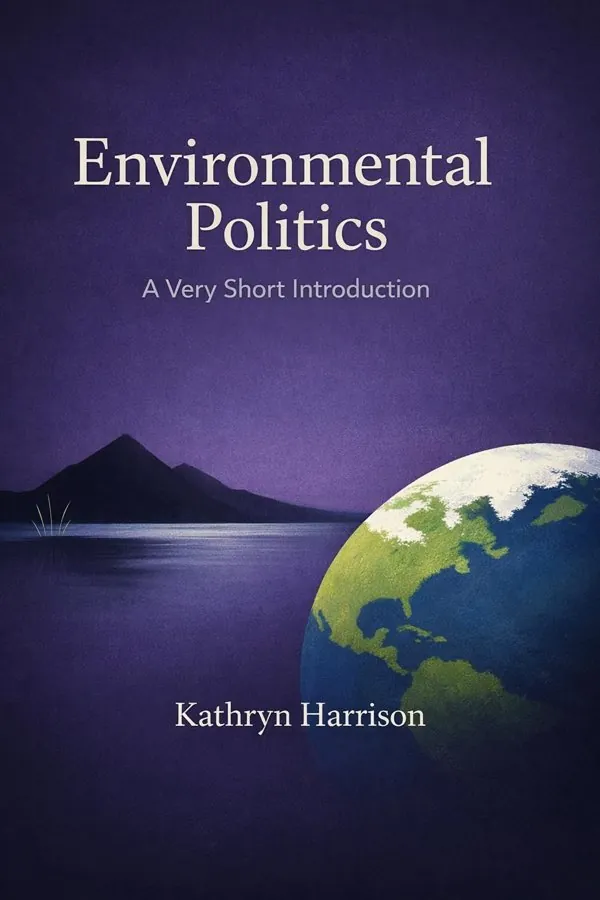
Environmental Politics: A Very Short Introduction: Summary & Key Insights
 10 min5 chaptersAudio available
What Is Environmental Politics: A Very Short Introduction About?
Environmental Politics: A Very Short Introduction by Kathryn Harrison is a environment book spanning 5 pages. This concise introduction explores the key debates and challenges in environmental politics, including climate change, biodiversity loss, and sustainable development. Kathryn Harrison examines how governments, international organizations, and civil society respond to environmental crises, and how political ideologies and institutions shape environmental policy outcomes.
This FizzRead summary covers all 5 key chapters of Environmental Politics: A Very Short Introduction in approximately 10 minutes, distilling the most important ideas, arguments, and takeaways from Kathryn Harrison's work. Also available as an audio summary and Key Quotes Podcast.
Environmental Politics: A Very Short Introduction
This concise introduction explores the key debates and challenges in environmental politics, including climate change, biodiversity loss, and sustainable development. Kathryn Harrison examines how governments, international organizations, and civil society respond to environmental crises, and how political ideologies and institutions shape environmental policy outcomes.
Who Should Read Environmental Politics: A Very Short Introduction?
This book is perfect for anyone interested in environment and looking to gain actionable insights in a short read. Whether you're a student, professional, or lifelong learner, the key ideas from Environmental Politics: A Very Short Introduction by Kathryn Harrison will help you think differently.
- ✓Readers who enjoy environment and want practical takeaways
- ✓Professionals looking to apply new ideas to their work and life
- ✓Anyone who wants the core insights of Environmental Politics: A Very Short Introduction in just 10 minutes
Want the full summary?
Get instant access to this book summary and 100K+ more with Fizz Moment.
Get Free SummaryAvailable on App Store • Free to download
Key Chapters
Environmental awareness, as we understand it today, did not burst onto the scene fully formed. It grew gradually, nurtured by crises, science, and a shifting sense of moral obligation toward the natural world. In the early twentieth century, environmental policy was largely local and utilitarian—concerned with forestry management, clean water, and public health. Yet by the 1960s and 1970s, environmentalism had crystallized into a global social movement. The publication of Rachel Carson’s *Silent Spring* and the first Earth Day transformed public perception. Pollution and species extinction were no longer seen as mere technical matters; they became political issues demanding public accountability.
In those years, new organizations and protest movements emerged that insisted governmental institutions recognize environmental limits. The atmosphere of activism fostered landmark legislation in many countries—the Clean Air Act, the Endangered Species Act, and others—that institutionalized protection of nature as a public good. Such achievements proved that popular mobilization could reshape priorities once dismissed as fringe concerns. However, this new politics also faced backlash. Economic interests, especially those tied to fossil fuels and heavy industry, soon learned to contest environmental regulation through lobbying and political pressure.
These early developments reveal a fundamental truth about environmental politics: it must constantly negotiate between scientific warnings and societal willingness to act. Political will, after all, never exists in a vacuum. The public’s growing environmental concern interacted with shifting ideologies, from post-war optimism in technological salvation to a dawning awareness of ecological fragility. This was the moment when environmentalism became both a scientific and a moral enterprise — one that tied human fate to planetary stewardship.
Thus, the environmental movement’s historical roots remind us that progress is always cyclical. Gains are hard-won, easily eroded, and endlessly contested. Yet each resurgence of awareness grows from the last, drawing strength from memory and hope.
When we look closely at environmental policy, we often find it constrained by the structure of the state itself. Governments must weigh competing demands: the pressure to deliver economic growth, the expectations of voters, and the influence of powerful industries. Yet institutions—laws, agencies, courts, and procedural norms—also matter profoundly. They shape how environmental problems are defined and who bears responsibility for addressing them.
Environmental regulation operates at multiple scales: local zoning decisions, national emission standards, and global treaties. In democratic systems, public opinion and media attention can galvanize swift responses, as in the aftermath of oil spills or air quality crises. However, political cycles and electoral incentives often favor short-term fixes over long-term investments. By contrast, authoritarian regimes may implement sweeping environmental measures but lack transparency and public participation. Both models reveal the importance of institutional design. An environmental policy is only as credible as the process that sustains it.
Internationally, environmental governance is even more complex. Treaties such as the Montreal Protocol and the Paris Agreement demonstrate how cooperation can transcend national boundaries. Yet they also highlight the persistent challenge of ensuring equity among richer and poorer nations. Developing countries often argue that industrialized states, whose growth caused the bulk of historical emissions, should bear greater responsibility. Thus, environmental policy is not merely a technical endeavor; it is a negotiation across unequal histories and future visions.
I stress this institutional dimension because it reminds us that success in environmental governance depends on aligning incentives and capacities. No policy can thrive without credible enforcement, transparent monitoring, and trust among actors. Environmental politics, in this sense, is the art of institution-building under conditions of immense uncertainty and conflicting interests.
+ 3 more chapters — available in the FizzRead app
All Chapters in Environmental Politics: A Very Short Introduction
About the Author
Kathryn Harrison is a Professor of Political Science at the University of British Columbia. Her research focuses on environmental policy, climate change politics, and comparative public policy, with numerous publications on environmental governance and sustainability.
Get This Summary in Your Preferred Format
Read or listen to the Environmental Politics: A Very Short Introduction summary by Kathryn Harrison anytime, anywhere. FizzRead offers multiple formats so you can learn on your terms — all free.
Available formats: App · Audio · PDF · EPUB — All included free with FizzRead
Download Environmental Politics: A Very Short Introduction PDF and EPUB Summary
Key Quotes from Environmental Politics: A Very Short Introduction
“Environmental awareness, as we understand it today, did not burst onto the scene fully formed.”
“When we look closely at environmental policy, we often find it constrained by the structure of the state itself.”
Frequently Asked Questions about Environmental Politics: A Very Short Introduction
Environmental Politics: A Very Short Introduction by Kathryn Harrison is a environment book that explores key ideas across 5 chapters. This concise introduction explores the key debates and challenges in environmental politics, including climate change, biodiversity loss, and sustainable development. Kathryn Harrison examines how governments, international organizations, and civil society respond to environmental crises, and how political ideologies and institutions shape environmental policy outcomes.
You Might Also Like

A Life on Our Planet: My Witness Statement and a Vision for the Future
David Attenborough
10 min
A Sky Full Of Birds
Matt Merritt
10 min
Carbon Zero: Imagining Cities That Can Save the Planet
Alex Steffen
10 min
Eaarth: Making a Life on a Tough New Planet
Bill McKibben
10 min
The Social Contract and Environmental Governance
Various Editors
10 min
The Wild Places
Robert Macfarlane
10 minBrowse by Category
Ready to read Environmental Politics: A Very Short Introduction?
Get the full summary and 100K+ more books with Fizz Moment.