
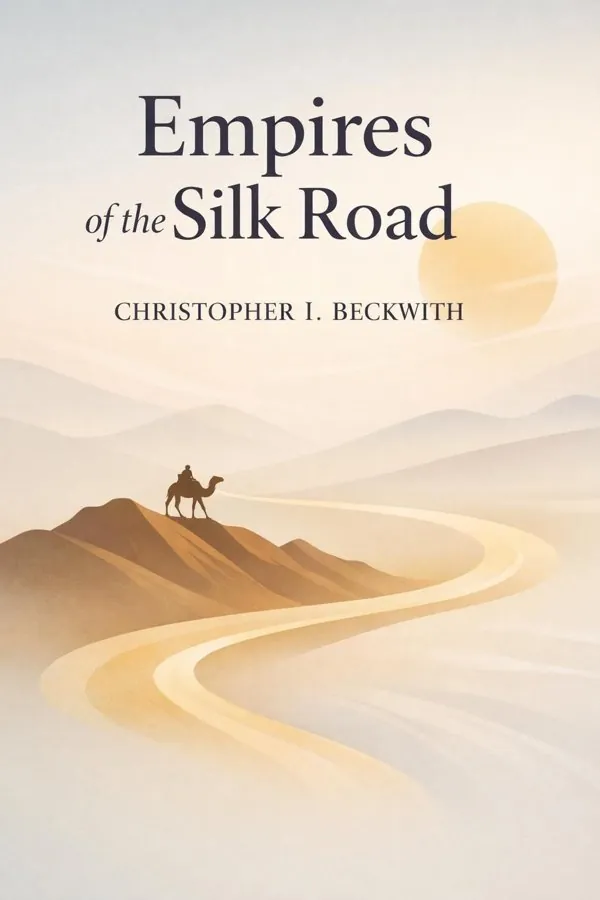
Empires of the Silk Road: A History of Central Eurasia from the Bronze Age to the Present: Summary & Key Insights
 10 min6 chaptersAudio available
What Is Empires of the Silk Road: A History of Central Eurasia from the Bronze Age to the Present About?
Empires of the Silk Road: A History of Central Eurasia from the Bronze Age to the Present by Christopher I. Beckwith is a world_history book spanning 6 pages. This book presents a comprehensive history of Central Eurasia, tracing the rise and fall of empires and cultures that flourished along the Silk Road from the Bronze Age to modern times. Beckwith challenges conventional Eurocentric narratives, emphasizing the region’s pivotal role in shaping global civilization through trade, language, and cultural exchange.
This FizzRead summary covers all 6 key chapters of Empires of the Silk Road: A History of Central Eurasia from the Bronze Age to the Present in approximately 10 minutes, distilling the most important ideas, arguments, and takeaways from Christopher I. Beckwith's work. Also available as an audio summary and Key Quotes Podcast.
Empires of the Silk Road: A History of Central Eurasia from the Bronze Age to the Present
This book presents a comprehensive history of Central Eurasia, tracing the rise and fall of empires and cultures that flourished along the Silk Road from the Bronze Age to modern times. Beckwith challenges conventional Eurocentric narratives, emphasizing the region’s pivotal role in shaping global civilization through trade, language, and cultural exchange.
Who Should Read Empires of the Silk Road: A History of Central Eurasia from the Bronze Age to the Present?
This book is perfect for anyone interested in world_history and looking to gain actionable insights in a short read. Whether you're a student, professional, or lifelong learner, the key ideas from Empires of the Silk Road: A History of Central Eurasia from the Bronze Age to the Present by Christopher I. Beckwith will help you think differently.
- ✓Readers who enjoy world_history and want practical takeaways
- ✓Professionals looking to apply new ideas to their work and life
- ✓Anyone who wants the core insights of Empires of the Silk Road: A History of Central Eurasia from the Bronze Age to the Present in just 10 minutes
Want the full summary?
Get instant access to this book summary and 100K+ more with Fizz Moment.
Get Free SummaryAvailable on App Store • Free to download
Key Chapters
To understand the Silk Road, we must begin long before the first caravans left China. During the Bronze Age, long-distance exchange networks already linked the steppe, the Iranian Plateau, and the borders of both Mesopotamia and the Chinese world. The earliest Indo-European groups spread across these zones, carrying metallurgy, chariot warfare, and linguistic ancestry that would underpin Latin, Persian, Sanskrit, and many other tongues. Contrary to stereotypes of primitive nomads, these societies were highly organized and cosmopolitan, thriving on mobility.
In this early period, the steppe was not isolated wilderness but a sea of connectivity. Horses and wheeled vehicles revolutionized mobility, allowing highland and plain communities to maintain regular contact. Archaeological finds, from Andronovo pottery to Seima-Turbino bronze artifacts, mark a pattern of shared technologies that define what I identify as the Central Eurasian Culture Complex. These people were not imitators of settled civilizations to the south; they were innovators whose mobile lifestyle fostered trade and the rapid diffusion of ideas.
This phase also established a deep social ethos that would endure throughout Central Eurasian history: the heroic ideal of the warrior-noble. Poetry, language, and legend from the steppe—echoing later in Indo-Iranian and even European myth—celebrate honor, loyalty, and reciprocal hospitality. These values became the moral basis of steppe politics and diplomacy, giving rise to the trust necessary for a world of long-distance exchange long before formal empire-building.
By the first millennium BCE, the steppe came under the leadership of organized, semi-nomadic polities such as the Scythians and later the Xiongnu. Their emergence was not sudden conquest but a political crystallization of networks that had long existed. The steppe rulers forged federations based on the charisma of war leaders who balanced armed force with alliance-making and intermarriage.
The Xiongnu confederation, often simplified as China’s early adversary, was in fact one of the first great imperial systems in Inner Asia, matching the Han politically and militarily. Its model of loose confederation influenced later Turkic and Mongolic empires. Likewise, the Scythians, who connected the Pontic steppe to Persia and Greece, were cosmopolitan intermediaries whose art, tactics, and diplomatic presence impressed the classical world.
It is within these cultural ecologies that the Silk Road truly took shape. What modern historians call ‘the Silk Road’ was not a single road but a vast economic organism—a living synthesis of pastoral mobility and oasis-based commerce. Caravans and embassies moved goods, but they also moved news, languages, scripts, technologies, and religions. Steppe rulers controlled routes not only for wealth but for legitimacy; to rule the Silk Road was to command the pulse of Eurasia.
+ 4 more chapters — available in the FizzRead app
All Chapters in Empires of the Silk Road: A History of Central Eurasia from the Bronze Age to the Present
About the Author
Christopher I. Beckwith is a professor of Central Eurasian Studies at Indiana University. His research focuses on the history and languages of Central Eurasia, and he is known for his contributions to the study of ancient and medieval Inner Asia.
Get This Summary in Your Preferred Format
Read or listen to the Empires of the Silk Road: A History of Central Eurasia from the Bronze Age to the Present summary by Christopher I. Beckwith anytime, anywhere. FizzRead offers multiple formats so you can learn on your terms — all free.
Available formats: App · Audio · PDF · EPUB — All included free with FizzRead
Download Empires of the Silk Road: A History of Central Eurasia from the Bronze Age to the Present PDF and EPUB Summary
Key Quotes from Empires of the Silk Road: A History of Central Eurasia from the Bronze Age to the Present
“To understand the Silk Road, we must begin long before the first caravans left China.”
“By the first millennium BCE, the steppe came under the leadership of organized, semi-nomadic polities such as the Scythians and later the Xiongnu.”
Frequently Asked Questions about Empires of the Silk Road: A History of Central Eurasia from the Bronze Age to the Present
Empires of the Silk Road: A History of Central Eurasia from the Bronze Age to the Present by Christopher I. Beckwith is a world_history book that explores key ideas across 6 chapters. This book presents a comprehensive history of Central Eurasia, tracing the rise and fall of empires and cultures that flourished along the Silk Road from the Bronze Age to modern times. Beckwith challenges conventional Eurocentric narratives, emphasizing the region’s pivotal role in shaping global civilization through trade, language, and cultural exchange.
You Might Also Like
The Age of Capital
Eric Hobsbawm
10 min
The Gulag Archipelago
Aleksandr Solzhenitsyn
10 min
Jerusalem: The Biography
Simon Sebag Montefiore
10 min
The Anglo-Saxons
James Campbell
10 min
The Boer War
Thomas Pakenham
10 min
The Industrial Revolutionaries: The Making of the Modern World 1776–1914
Gavin Weightman
10 minBrowse by Category
Ready to read Empires of the Silk Road: A History of Central Eurasia from the Bronze Age to the Present?
Get the full summary and 100K+ more books with Fizz Moment.