
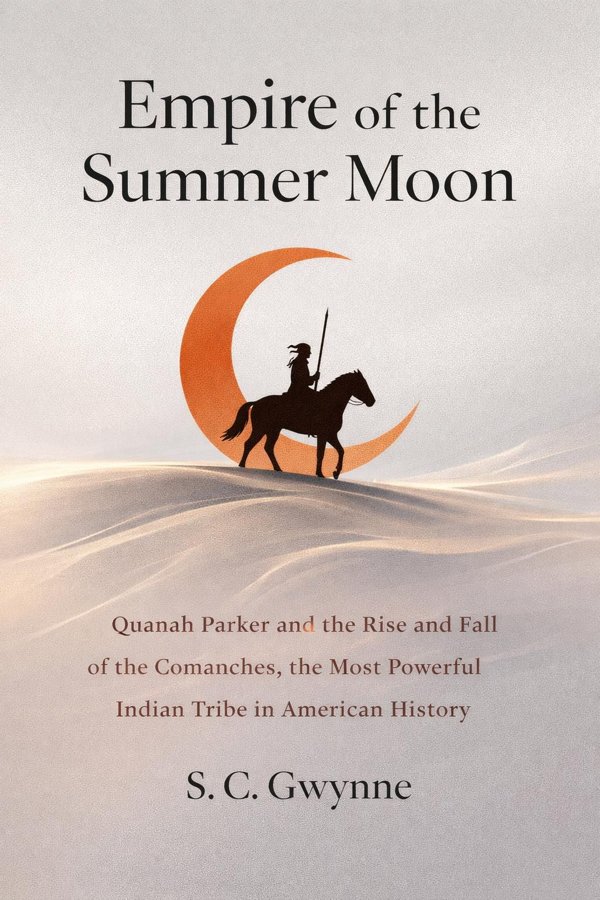
Empire of the Summer Moon: Quanah Parker and the Rise and Fall of the Comanches, the Most Powerful Indian Tribe in American History: Summary & Key Insights
by S. C. Gwynne
 10 min9 chaptersAudio available
Key Takeaways from Empire of the Summer Moon: Quanah Parker and the Rise and Fall of the Comanches, the Most Powerful Indian Tribe in American History
Power does not always come from cities, walls, or formal states; sometimes it comes from speed, adaptability, and mastery of terrain.
Settlers often believed courage and faith were enough to tame the frontier, but the book shows how dangerous that illusion could be.
Belonging is not always determined by birth; sometimes it is shaped by adoption, survival, and the world that teaches you how to live.
It is easy to condemn frontier violence in abstract moral terms, but Gwynne insists that to understand the Comanche wars, you must first understand the system that produced them.
No warrior culture, however brilliant, can remain dominant forever when the material foundations of the conflict shift against it.
What Is Empire of the Summer Moon: Quanah Parker and the Rise and Fall of the Comanches, the Most Powerful Indian Tribe in American History About?
Empire of the Summer Moon: Quanah Parker and the Rise and Fall of the Comanches, the Most Powerful Indian Tribe in American History by S. C. Gwynne is a world_history book spanning 8 pages. Empire of the Summer Moon is a sweeping history of the Comanche nation, the people who dominated the Southern Plains for more than a century and fought longer and harder than almost any other Native power against American expansion. At the center of the story is Quanah Parker, the son of a captured white woman and a Comanche chief, who would become the tribe’s last great leader and one of the most complex figures in the history of the American West. Through his life, the book traces a larger drama: the collision between mobile horse cultures and industrial nation-states, between Indigenous sovereignty and settler empire, between survival and assimilation. What makes the book matter is not only its narrative force, but its refusal to romanticize or simplify either side. S. C. Gwynne, an acclaimed journalist and historian, combines vivid storytelling with deep research to explain how the Comanches rose, why they were so formidable, and how their world was ultimately destroyed. The result is both a gripping frontier epic and a serious meditation on violence, adaptation, and historical change.
This FizzRead summary covers all 9 key chapters of Empire of the Summer Moon: Quanah Parker and the Rise and Fall of the Comanches, the Most Powerful Indian Tribe in American History in approximately 10 minutes, distilling the most important ideas, arguments, and takeaways from S. C. Gwynne's work. Also available as an audio summary and Key Quotes Podcast.
Empire of the Summer Moon: Quanah Parker and the Rise and Fall of the Comanches, the Most Powerful Indian Tribe in American History
Empire of the Summer Moon is a sweeping history of the Comanche nation, the people who dominated the Southern Plains for more than a century and fought longer and harder than almost any other Native power against American expansion. At the center of the story is Quanah Parker, the son of a captured white woman and a Comanche chief, who would become the tribe’s last great leader and one of the most complex figures in the history of the American West. Through his life, the book traces a larger drama: the collision between mobile horse cultures and industrial nation-states, between Indigenous sovereignty and settler empire, between survival and assimilation. What makes the book matter is not only its narrative force, but its refusal to romanticize or simplify either side. S. C. Gwynne, an acclaimed journalist and historian, combines vivid storytelling with deep research to explain how the Comanches rose, why they were so formidable, and how their world was ultimately destroyed. The result is both a gripping frontier epic and a serious meditation on violence, adaptation, and historical change.
Who Should Read Empire of the Summer Moon: Quanah Parker and the Rise and Fall of the Comanches, the Most Powerful Indian Tribe in American History?
This book is perfect for anyone interested in world_history and looking to gain actionable insights in a short read. Whether you're a student, professional, or lifelong learner, the key ideas from Empire of the Summer Moon: Quanah Parker and the Rise and Fall of the Comanches, the Most Powerful Indian Tribe in American History by S. C. Gwynne will help you think differently.
- ✓Readers who enjoy world_history and want practical takeaways
- ✓Professionals looking to apply new ideas to their work and life
- ✓Anyone who wants the core insights of Empire of the Summer Moon: Quanah Parker and the Rise and Fall of the Comanches, the Most Powerful Indian Tribe in American History in just 10 minutes
Want the full summary?
Get instant access to this book summary and 100K+ more with Fizz Moment.
Get Free SummaryAvailable on App Store • Free to download
Key Chapters
Power does not always come from cities, walls, or formal states; sometimes it comes from speed, adaptability, and mastery of terrain. One of the book’s most important insights is that the Comanches created an empire without the usual machinery of empire. They dominated the Southern Plains not through bureaucracy or permanent settlements, but through horsemanship, raiding skill, decentralized leadership, and a deep understanding of an enormous, harsh landscape that outsiders found nearly unlivable.
Before the Comanches, the Southern Plains were often treated as a marginal zone. The Comanches transformed them into a strategic homeland. Horses changed everything. Once they became perhaps the finest mounted warriors in North America, they could hunt buffalo with astonishing efficiency, travel vast distances quickly, strike enemies by surprise, and evade slower armies. Their economy, warfare, and identity became inseparable from mobility. This made them especially dangerous to Spanish, Mexican, Texan, and American rivals, all of whom struggled to impose control over a people who could not easily be pinned down.
Gwynne shows that the Comanche rise was not accidental. It was the result of relentless adaptation to ecological and military reality. They absorbed new tools, exploited weak frontiers, and built regional dominance through intimidation and force. For modern readers, this history offers a broader lesson: groups that thrive in turbulent environments are often the ones most willing to reorganize themselves around new technologies and conditions.
A practical way to apply this idea is to look at your own work or organization. Are you relying on fixed structures while conditions around you are changing? The Comanches remind us that flexibility can itself be a form of power. Actionable takeaway: identify one area of your life where greater speed, mobility, or adaptability would create a real advantage, and redesign your approach around it.
Settlers often believed courage and faith were enough to tame the frontier, but the book shows how dangerous that illusion could be. The story of Fort Parker and the 1836 raid that led to the capture of Cynthia Ann Parker is one of the defining episodes in the book because it reveals a deep mismatch between frontier assumptions and frontier reality.
The Parker family came west with conviction, discipline, and religious purpose. They built a fortified settlement and believed they could carve safety out of contested territory through hard work and determination. Yet they underestimated the political and military complexity of the region. The land was not empty, and the dangers were not random. They were living inside a zone shaped by Comanche power, intertribal warfare, and unstable borders. What looked to settlers like opportunity looked to the Comanches like intrusion.
The raid itself shattered any comforting mythology of orderly westward progress. It exposed how vulnerable isolated communities were when facing mounted warriors who understood the terrain and fought according to different rules. Cynthia Ann’s abduction would also become historically significant because her later life among the Comanches and the birth of Quanah Parker linked the two worlds in intimate, tragic, and unexpected ways.
For modern readers, this episode carries a practical lesson about entering unfamiliar systems. Confidence, good intentions, and internal solidarity are not enough if you misunderstand the environment. Businesses fail this way in new markets, leaders fail this way in new institutions, and individuals fail this way in life transitions.
Actionable takeaway: before entering any new territory, literal or metaphorical, spend more time understanding the rules, power dynamics, and risks than affirming your own readiness.
Belonging is not always determined by birth; sometimes it is shaped by adoption, survival, and the world that teaches you how to live. Cynthia Ann Parker’s life among the Comanches illustrates one of the book’s most powerful themes: culture can become more decisive than origin. Captured as a child during the Fort Parker raid, she did not remain psychologically frozen as a victim in waiting. She was absorbed into Comanche life, married the chief Peta Nocona, and became the mother of Quanah Parker.
This transformation unsettles simplistic assumptions about civilization and savagery. Cynthia Ann did not merely endure among the Comanches; by historical accounts, she became fully Comanche in language, habit, and emotional allegiance. Her life shows how identity can be remade by circumstance, especially in childhood. It also reveals how borderlands produce hybrid histories that rigid categories cannot easily contain.
Quanah’s birth from this union made him an embodiment of the cultural collision at the heart of the book. He was not a symbolic bridge in some sentimental sense. He inherited a world of violence, dislocation, and divided historical memory. Yet that mixed inheritance would later help him navigate the devastating transformation of his people’s world.
This story has modern relevance because many people live between cultures, institutions, or value systems. Children of immigrants, people raised in multiple countries, and professionals moving across social worlds often face similar questions of belonging, though in less extreme circumstances. The lesson is that identity can be layered rather than pure.
Actionable takeaway: instead of asking whether you fully belong to one world, ask what strengths come from understanding more than one.
It is easy to condemn frontier violence in abstract moral terms, but Gwynne insists that to understand the Comanche wars, you must first understand the system that produced them. The Southern Plains were governed by an ecology of scarcity, raiding, revenge, prestige, and survival. Violence was not an interruption of life there; it was one of its organizing principles.
For the Comanches, raiding served many functions at once. It brought horses, captives, and material wealth. It trained young warriors, enforced status, and projected power over neighbors and settlers. On the other side, Texans and later Americans responded with escalating force, often shaped by fear, retaliation, and racial ideology. This was not a conflict between peaceful farmers and inexplicable brutality. It was a prolonged struggle between societies with incompatible claims to land, security, and legitimacy.
The horse was central to this system. It expanded range, intensified warfare, and made the Comanches exceptionally effective in fast attacks and withdrawals. Military institutions built for fixed battle often looked clumsy against them. Not until the United States brought overwhelming numbers, logistical capacity, and a willingness to wage relentless campaigns did the balance decisively shift.
A useful modern application is to recognize that behavior that seems irrational from the outside often makes sense within a local incentive structure. In organizations, politics, or international affairs, people act according to rules shaped by status, fear, and resource competition.
Actionable takeaway: when confronted by persistent conflict, stop asking only who is right; also ask what incentives, traditions, and pressures keep the conflict alive.
No warrior culture, however brilliant, can remain dominant forever when the material foundations of the conflict shift against it. One of the book’s clearest arguments is that the fall of the Comanche empire was not simply the result of declining courage or inferior leadership. It was driven by changes in scale, technology, and state capacity that made older forms of resistance increasingly unsustainable.
The United States could absorb losses, field larger forces, supply distant campaigns, and coordinate military pressure in ways earlier frontier societies could not. Better firearms mattered, but so did railroads, telegraph lines, organized logistics, and a growing political commitment to conquering the Plains. The U.S. Army also learned. It adapted from episodic punitive expeditions to more comprehensive campaigns that targeted the foundations of Comanche life.
Equally important was the destruction of the buffalo. Because the Comanche economy and mobility depended on the buffalo herds, the mass slaughter of these animals was not merely environmental tragedy; it was strategic devastation. Once food systems, horse systems, and seasonal movement patterns were broken, resistance became far harder to sustain.
The broader lesson is that historical outcomes are often decided not by a single battle, but by infrastructure and supply chains. The same principle appears today in business competition, geopolitical rivalry, and social change. Superior tactics can win moments; superior systems win eras.
Actionable takeaway: if you are trying to build lasting success, focus less on one dramatic victory and more on the underlying systems, resources, and networks that determine long-term resilience.
When states decide that coexistence has failed, they often stop fighting only enemy combatants and begin targeting the conditions that make a way of life possible. Gwynne’s account of the Red River War and the final campaigns against the Comanches shows this shift with painful clarity. The U.S. military did not merely seek to defeat warriors in open battle. It aimed to collapse the entire material basis of Comanche independence.
Winter campaigns, destruction of horse herds, attacks on villages, seizure of supplies, and confinement to reservations all reflected a strategy of total pressure. The famous fight in Palo Duro Canyon was significant not simply because of battlefield action, but because the capture and slaughter of Comanche horses crippled future mobility. For a horse culture, this was existential. The campaign was as much economic and ecological warfare as military warfare.
What vanished in these years was not only armed resistance. A whole social world was dismantled: patterns of hunting, childrearing, authority, migration, trade, and spiritual life. The reservation system then imposed dependence where autonomy had once existed. This is one reason the book feels larger than a military history. It is about the destruction of a civilization.
Modern readers can apply this idea by recognizing that institutions and communities are rarely destroyed only by direct attack. More often, they are weakened when the supporting systems beneath them are removed. Families, businesses, and cultures all depend on invisible infrastructures.
Actionable takeaway: identify the hidden supports that make your own goals possible, and protect them before a crisis exposes how vulnerable they are.
Some leaders are forged in conquest; others prove themselves in the far harder work of guiding their people through irreversible loss. Quanah Parker stands out in the book because he did both. Raised in the final era of Comanche freedom, he became a formidable war leader. But his greatest historical significance came after military defeat, when he helped the Comanches navigate life on the reservation without entirely surrendering dignity or influence.
Quanah was uniquely positioned for this role. As the son of Cynthia Ann Parker and Peta Nocona, he carried a history that linked white America and Comanche society. Yet Gwynne does not portray him as a simple reconciler. He was pragmatic, ambitious, politically skilled, and often controversial. He learned how to negotiate with federal authorities, adapted to ranching and new economic realities, and used personal charisma to remain a central figure in a transformed world.
His leadership illustrates a difficult truth: adaptation after defeat is not betrayal by default. For conquered peoples, survival may require compromise, strategic cooperation, and selective reinvention. Quanah embraced some aspects of the new order while also defending Comanche interests and preserving elements of cultural identity. That balancing act is one of the book’s richest insights.
In practical terms, this matters for anyone facing a major disruption that cannot be reversed. A failed business model, a career-ending change, or a political defeat may make restoration impossible. The challenge becomes how to retain agency in new conditions.
Actionable takeaway: when a lost world cannot be recovered, focus on what can still be protected, translated, and rebuilt rather than wasting all energy on undoing the irreversible.
Few stories in American history reveal the cruelty of cultural collision more clearly than Cynthia Ann Parker’s forced return to white society. After living for decades as a Comanche woman, she was recaptured by Texas Rangers and brought back against her will. To white Texans, this was celebrated as a rescue. To Cynthia Ann, it was a second captivity.
This reversal exposes one of the book’s deepest moral insights: liberation is not always liberation when outsiders define it. By the time she was returned, her language, family, emotional attachments, and sense of self were Comanche. She had children there, including Quanah. Being taken from them did not restore her to a former life; it severed the life she actually had. She reportedly never reintegrated into white society and declined into grief and despair.
Gwynne uses this story to challenge triumphalist frontier narratives. The line between victim and belonging is not always where later generations expect it to be. Cynthia Ann’s experience demonstrates how violently states and communities can impose their own ideas of identity, kinship, and civilization on individuals.
Today, the episode resonates wherever institutions assume they know what is best for someone without understanding that person’s own attachments and world. This appears in family conflict, social services, education, and even management culture. Good intentions do not erase the harm of misrecognition.
Actionable takeaway: before deciding what will help or save another person, first ask how they define home, loyalty, and well-being for themselves.
The American West is often remembered as a place of opportunity, expansion, and national destiny, but this book insists on a harder truth: the creation of the modern West required the destruction of prior sovereignties. The end of the Comanche empire was not a side note to progress. It was one of the central conditions that made settlement, rail expansion, ranching, and state power possible across the Southern Plains.
Gwynne helps readers see the frontier not as a meeting point between empty land and heroic settlers, but as a contested political space. Once the Comanches were confined and the buffalo were gone, the region could be reorganized according to American economic and legal systems. Towns grew, ranches spread, railroads connected markets, and the old military problem of the Plains was reframed as a story of civilization achieved. In that process, the memory of what had been erased was often softened, distorted, or omitted.
This matters because national myths shape civic identity. If we tell expansion as inevitable and benign, we fail to understand the costs paid by those who lost worlds, not just battles. A mature historical perspective does not require self-hatred; it requires clarity about how power works.
The practical application is simple but important: whenever a system appears stable and natural, ask what had to be displaced for it to emerge. That question is useful in urban development, corporate change, politics, and personal success narratives.
Actionable takeaway: look at any modern structure you benefit from and ask whose labor, loss, or exclusion made it possible.
All Chapters in Empire of the Summer Moon: Quanah Parker and the Rise and Fall of the Comanches, the Most Powerful Indian Tribe in American History
About the Author
S. C. Gwynne is an American journalist, editor, and author known for writing vivid, deeply researched narrative nonfiction. He has worked for major publications including Time and Texas Monthly, where he built a reputation for explaining complex subjects with clarity and dramatic force. Gwynne is especially skilled at combining historical scholarship with storytelling that appeals to both general readers and serious history fans. Empire of the Summer Moon became his breakthrough historical work, earning broad acclaim for its powerful account of the Comanches, Quanah Parker, and the making of the American West. His writing often focuses on conflict, leadership, cultural change, and overlooked dimensions of American history, making him one of the most engaging contemporary interpreters of the nation’s past.
Get This Summary in Your Preferred Format
Read or listen to the Empire of the Summer Moon: Quanah Parker and the Rise and Fall of the Comanches, the Most Powerful Indian Tribe in American History summary by S. C. Gwynne anytime, anywhere. FizzRead offers multiple formats so you can learn on your terms — all free.
Available formats: App · Audio · PDF · EPUB — All included free with FizzRead
Download Empire of the Summer Moon: Quanah Parker and the Rise and Fall of the Comanches, the Most Powerful Indian Tribe in American History PDF and EPUB Summary
Key Quotes from Empire of the Summer Moon: Quanah Parker and the Rise and Fall of the Comanches, the Most Powerful Indian Tribe in American History
“Power does not always come from cities, walls, or formal states; sometimes it comes from speed, adaptability, and mastery of terrain.”
“Settlers often believed courage and faith were enough to tame the frontier, but the book shows how dangerous that illusion could be.”
“Belonging is not always determined by birth; sometimes it is shaped by adoption, survival, and the world that teaches you how to live.”
“It is easy to condemn frontier violence in abstract moral terms, but Gwynne insists that to understand the Comanche wars, you must first understand the system that produced them.”
“No warrior culture, however brilliant, can remain dominant forever when the material foundations of the conflict shift against it.”
Frequently Asked Questions about Empire of the Summer Moon: Quanah Parker and the Rise and Fall of the Comanches, the Most Powerful Indian Tribe in American History
Empire of the Summer Moon: Quanah Parker and the Rise and Fall of the Comanches, the Most Powerful Indian Tribe in American History by S. C. Gwynne is a world_history book that explores key ideas across 9 chapters. Empire of the Summer Moon is a sweeping history of the Comanche nation, the people who dominated the Southern Plains for more than a century and fought longer and harder than almost any other Native power against American expansion. At the center of the story is Quanah Parker, the son of a captured white woman and a Comanche chief, who would become the tribe’s last great leader and one of the most complex figures in the history of the American West. Through his life, the book traces a larger drama: the collision between mobile horse cultures and industrial nation-states, between Indigenous sovereignty and settler empire, between survival and assimilation. What makes the book matter is not only its narrative force, but its refusal to romanticize or simplify either side. S. C. Gwynne, an acclaimed journalist and historian, combines vivid storytelling with deep research to explain how the Comanches rose, why they were so formidable, and how their world was ultimately destroyed. The result is both a gripping frontier epic and a serious meditation on violence, adaptation, and historical change.
You Might Also Like
The Age of Capital
Eric Hobsbawm
10 min
The Gulag Archipelago
Aleksandr Solzhenitsyn
10 min
Jerusalem: The Biography
Simon Sebag Montefiore
10 min
The Anglo-Saxons
James Campbell
10 min
The Boer War
Thomas Pakenham
10 min
The Industrial Revolutionaries: The Making of the Modern World 1776–1914
Gavin Weightman
10 minBrowse by Category
Ready to read Empire of the Summer Moon: Quanah Parker and the Rise and Fall of the Comanches, the Most Powerful Indian Tribe in American History?
Get the full summary and 100K+ more books with Fizz Moment.