
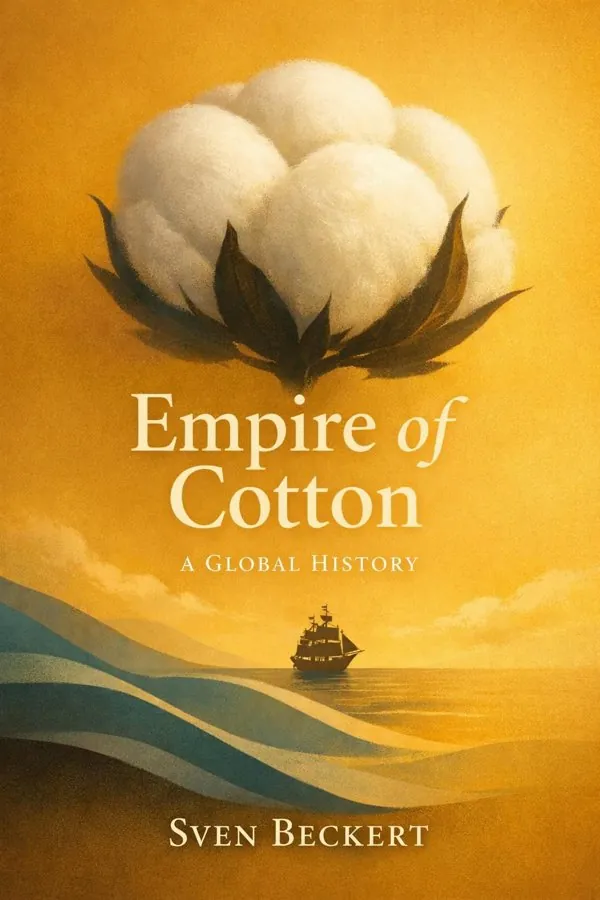
Empire of Cotton: A Global History: Summary & Key Insights
by Sven Beckert
 10 min10 chaptersAudio available
What Is Empire of Cotton: A Global History About?
Empire of Cotton: A Global History by Sven Beckert is a world_history book spanning 10 pages. Empire of Cotton: A Global History traces the rise and transformation of the global cotton industry, revealing how this single commodity shaped the modern world economy. Sven Beckert explores the intertwined histories of slavery, colonialism, and industrial capitalism, showing how cotton connected distant regions and peoples through networks of trade, labor, and power. The book offers a sweeping narrative of economic and social change from the early modern period to the present.
This FizzRead summary covers all 10 key chapters of Empire of Cotton: A Global History in approximately 10 minutes, distilling the most important ideas, arguments, and takeaways from Sven Beckert's work. Also available as an audio summary and Key Quotes Podcast.
Empire of Cotton: A Global History
Empire of Cotton: A Global History traces the rise and transformation of the global cotton industry, revealing how this single commodity shaped the modern world economy. Sven Beckert explores the intertwined histories of slavery, colonialism, and industrial capitalism, showing how cotton connected distant regions and peoples through networks of trade, labor, and power. The book offers a sweeping narrative of economic and social change from the early modern period to the present.
Who Should Read Empire of Cotton: A Global History?
This book is perfect for anyone interested in world_history and looking to gain actionable insights in a short read. Whether you're a student, professional, or lifelong learner, the key ideas from Empire of Cotton: A Global History by Sven Beckert will help you think differently.
- ✓Readers who enjoy world_history and want practical takeaways
- ✓Professionals looking to apply new ideas to their work and life
- ✓Anyone who wants the core insights of Empire of Cotton: A Global History in just 10 minutes
Want the full summary?
Get instant access to this book summary and 100K+ more with Fizz Moment.
Get Free SummaryAvailable on App Store • Free to download
Key Chapters
Long before European industrialists discovered its potential, cotton was already one of the world’s most significant commodities. It was grown and spun in India, woven into fine muslins in Bengal, and traded across Asia, Africa, and the Mediterranean. For centuries, Indian cloth dominated world markets. Its production system was a marvel of efficiency and skill: small-scale yet highly coordinated, relying on generations of artisans who transformed raw fiber into fabrics prized from Cairo to Canton.
These early cotton economies reveal a global world that existed without Europe at its center. African societies cultivated and traded cotton both for local use and exchange; in the Americas, indigenous peoples already knew how to spin and weave cotton fibers. Yet the organization of this trade depended primarily on stable social systems and rich local knowledge, rather than imperial power or global finance.
In recounting these origins, I wanted to demonstrate that cotton’s story did not begin with European inventiveness. Instead, Europe entered a preexisting network and, over time, replaced it with one of its own making—violent, extractive, and globally integrated. The preindustrial cotton world was one of diversity and autonomy. That independence would not last once the age of war capitalism began.
The rise of European global dominance in the seventeenth and eighteenth centuries marked a decisive shift. Merchants, monarchs, and chartered companies sought control over global cotton trade routes, and they did so through violence. I call this stage 'war capitalism'—a form of expansion in which European actors combined armed conquest, coerced labor, and the expropriation of land to secure raw materials and markets.
War capitalism was not capitalism in the sense of voluntary exchange. It thrived on the destruction of older economies. The Atlantic slave trade became a crucial mechanism, turning millions of Africans into forced laborers who would produce the raw cotton that powered the industrial age. Entire regions—from the Caribbean to the American South—were reorganized to feed this growing global appetite.
Empires competed for cotton territories much as they did for gold or silver. European traders dismantled existing Asian mercantile systems, imposed their own terms of exchange, and wielded military power to secure monopoly privileges. The textile markets of the world were forcibly reoriented toward Europe’s factories, setting the stage for industrial capitalism to flourish.
+ 8 more chapters — available in the FizzRead app
All Chapters in Empire of Cotton: A Global History
About the Author
Sven Beckert is a German-American historian and professor of history at Harvard University. His research focuses on global capitalism, economic history, and the social transformations of the nineteenth century. Beckert is known for his work on the history of cotton and the development of industrial capitalism.
Get This Summary in Your Preferred Format
Read or listen to the Empire of Cotton: A Global History summary by Sven Beckert anytime, anywhere. FizzRead offers multiple formats so you can learn on your terms — all free.
Available formats: App · Audio · PDF · EPUB — All included free with FizzRead
Download Empire of Cotton: A Global History PDF and EPUB Summary
Key Quotes from Empire of Cotton: A Global History
“Long before European industrialists discovered its potential, cotton was already one of the world’s most significant commodities.”
“The rise of European global dominance in the seventeenth and eighteenth centuries marked a decisive shift.”
Frequently Asked Questions about Empire of Cotton: A Global History
Empire of Cotton: A Global History by Sven Beckert is a world_history book that explores key ideas across 10 chapters. Empire of Cotton: A Global History traces the rise and transformation of the global cotton industry, revealing how this single commodity shaped the modern world economy. Sven Beckert explores the intertwined histories of slavery, colonialism, and industrial capitalism, showing how cotton connected distant regions and peoples through networks of trade, labor, and power. The book offers a sweeping narrative of economic and social change from the early modern period to the present.
You Might Also Like
The Age of Capital
Eric Hobsbawm
10 min
The Gulag Archipelago
Aleksandr Solzhenitsyn
10 min
Jerusalem: The Biography
Simon Sebag Montefiore
10 min
The Anglo-Saxons
James Campbell
10 min
The Boer War
Thomas Pakenham
10 min
The Industrial Revolutionaries: The Making of the Modern World 1776–1914
Gavin Weightman
10 minBrowse by Category
Ready to read Empire of Cotton: A Global History?
Get the full summary and 100K+ more books with Fizz Moment.