
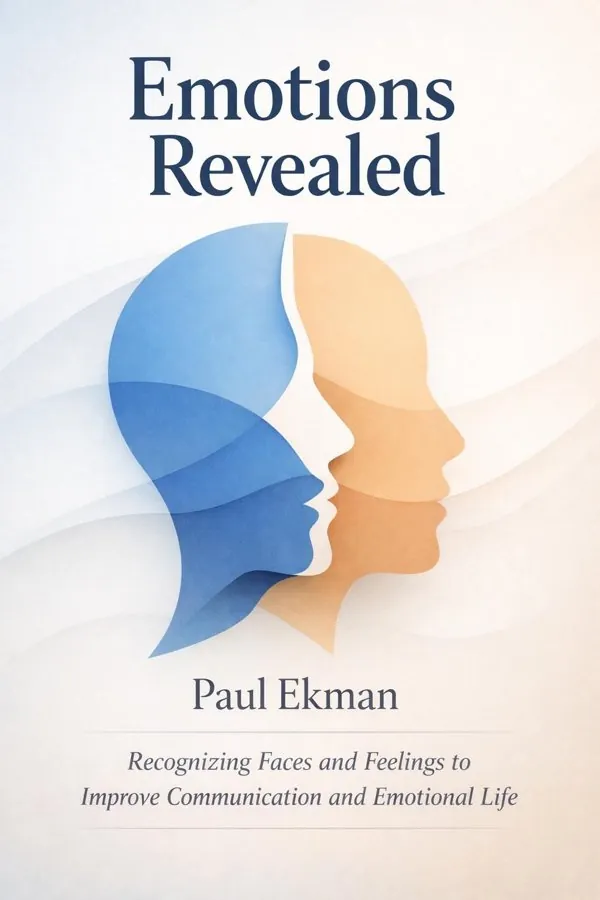
Emotions Revealed: Recognizing Faces and Feelings to Improve Communication and Emotional Life: Summary & Key Insights
by Paul Ekman
 10 min5 chaptersAudio available
What Is Emotions Revealed: Recognizing Faces and Feelings to Improve Communication and Emotional Life About?
Emotions Revealed: Recognizing Faces and Feelings to Improve Communication and Emotional Life by Paul Ekman is a psychology book spanning 5 pages. In this groundbreaking work, psychologist Paul Ekman explores the science of emotions and facial expressions, revealing how understanding emotional signals can enhance empathy, communication, and relationships. Drawing on decades of research, Ekman explains how emotions are universal yet shaped by culture, and how recognizing them can transform personal and professional interactions.
This FizzRead summary covers all 5 key chapters of Emotions Revealed: Recognizing Faces and Feelings to Improve Communication and Emotional Life in approximately 10 minutes, distilling the most important ideas, arguments, and takeaways from Paul Ekman's work. Also available as an audio summary and Key Quotes Podcast.
Emotions Revealed: Recognizing Faces and Feelings to Improve Communication and Emotional Life
In this groundbreaking work, psychologist Paul Ekman explores the science of emotions and facial expressions, revealing how understanding emotional signals can enhance empathy, communication, and relationships. Drawing on decades of research, Ekman explains how emotions are universal yet shaped by culture, and how recognizing them can transform personal and professional interactions.
Who Should Read Emotions Revealed: Recognizing Faces and Feelings to Improve Communication and Emotional Life?
This book is perfect for anyone interested in psychology and looking to gain actionable insights in a short read. Whether you're a student, professional, or lifelong learner, the key ideas from Emotions Revealed: Recognizing Faces and Feelings to Improve Communication and Emotional Life by Paul Ekman will help you think differently.
- ✓Readers who enjoy psychology and want practical takeaways
- ✓Professionals looking to apply new ideas to their work and life
- ✓Anyone who wants the core insights of Emotions Revealed: Recognizing Faces and Feelings to Improve Communication and Emotional Life in just 10 minutes
Want the full summary?
Get instant access to this book summary and 100K+ more with Fizz Moment.
Get Free SummaryAvailable on App Store • Free to download
Key Chapters
Early in my career, I sought to answer one of psychology’s enduring questions: Are emotions universal, or are they constructed by culture? To explore this, I traveled to places where Western influence was minimal, including remote regions of Papua New Guinea. I showed individuals photographs of facial expressions and asked them to describe what each face was feeling. Astonishingly, their answers matched those given by people in San Francisco or Tokyo. Joy, anger, fear, sadness, disgust, surprise—these six emotional expressions were recognized across all cultures.
This discovery confirmed Darwin’s century-old hypothesis that emotions are biologically innate. Our faces, like our hearts and lungs, evolved to perform adaptive functions. A widened eye in fear increases visual intake; a wrinkled nose in disgust prevents the intake of harmful particles. The facial expressions are not arbitrary—they signal our internal states and prepare our bodies to act accordingly.
Yet universality does not mean uniformity. Culture shapes *rules of display*—guidelines for when and how we allow emotions to show. Where one culture encourages public joy, another may value restraint. Understanding this helps us navigate global communication: the underlying emotion may be the same, but the mode of expression differs.
In recognizing that emotions speak a universal language, you begin to see connections where differences once stood. You realize that when someone from another world smiles or frowns, they are revealing an emotion that you, too, have felt. It is this shared emotional anatomy that makes empathy possible.
Emotions are not arbitrary feelings; they are deeply biological strategies that aid survival. Each emotion mobilizes the body through a distinct physiological pattern. When you experience fear, your heartbeat quickens, your pupils dilate, and muscles tense—preparing you for flight or defense. Anger channels energy toward confronting obstacles. Sadness withdraws you into reflection and recovery. These patterns evolved long before language.
The evolutionary function of emotions is what gives them their power. A mother’s joy when seeing her child’s face strengthens attachment. Disgust warns against contamination. Even contempt plays a social role—it enforces boundaries against those who violate ethical or moral codes. Emotions thus serve as both biological alarms and social signals.
In my research, I found that the same emotional triggers can vary depending on personal history. For example, fear may arise from physical danger in one person but from potential loss of status in another. The trigger changes, but the underlying mechanism remains consistent. Understanding this allows you not only to see what emotions do but also why they arise: they are evolved programs designed to protect and guide.
To master emotional life, you must recognize that emotions are not enemies to control but allies to understand. They reveal your needs, limits, and values. By seeing the evolutionary intelligence within emotions, you begin to interpret them as essential information rather than noise. This is the foundation of emotional insight.
+ 3 more chapters — available in the FizzRead app
All Chapters in Emotions Revealed: Recognizing Faces and Feelings to Improve Communication and Emotional Life
About the Author
Paul Ekman is an American psychologist renowned for his pioneering research on emotions and facial expressions. His work on microexpressions and emotional universality has influenced psychology, law enforcement, and media. Ekman has been listed among Time magazine’s 100 most influential people and continues to contribute to emotional intelligence studies.
Get This Summary in Your Preferred Format
Read or listen to the Emotions Revealed: Recognizing Faces and Feelings to Improve Communication and Emotional Life summary by Paul Ekman anytime, anywhere. FizzRead offers multiple formats so you can learn on your terms — all free.
Available formats: App · Audio · PDF · EPUB — All included free with FizzRead
Download Emotions Revealed: Recognizing Faces and Feelings to Improve Communication and Emotional Life PDF and EPUB Summary
Key Quotes from Emotions Revealed: Recognizing Faces and Feelings to Improve Communication and Emotional Life
“Early in my career, I sought to answer one of psychology’s enduring questions: Are emotions universal, or are they constructed by culture?”
“Emotions are not arbitrary feelings; they are deeply biological strategies that aid survival.”
Frequently Asked Questions about Emotions Revealed: Recognizing Faces and Feelings to Improve Communication and Emotional Life
Emotions Revealed: Recognizing Faces and Feelings to Improve Communication and Emotional Life by Paul Ekman is a psychology book that explores key ideas across 5 chapters. In this groundbreaking work, psychologist Paul Ekman explores the science of emotions and facial expressions, revealing how understanding emotional signals can enhance empathy, communication, and relationships. Drawing on decades of research, Ekman explains how emotions are universal yet shaped by culture, and how recognizing them can transform personal and professional interactions.
More by Paul Ekman
You Might Also Like
The Body Keeps the Score
Bessel van der Kolk
10 min
Surrounded by Idiots
Thomas Erikson
10 min
Emotional Intelligence
Daniel Goleman
10 min
Attached
Amir Levine
10 min
Why Does He Do That
Lundy Bancroft
10 min
Women Who Run with the Wolves
Clarissa Pinkola Estés
10 minBrowse by Category
Ready to read Emotions Revealed: Recognizing Faces and Feelings to Improve Communication and Emotional Life?
Get the full summary and 100K+ more books with Fizz Moment.