
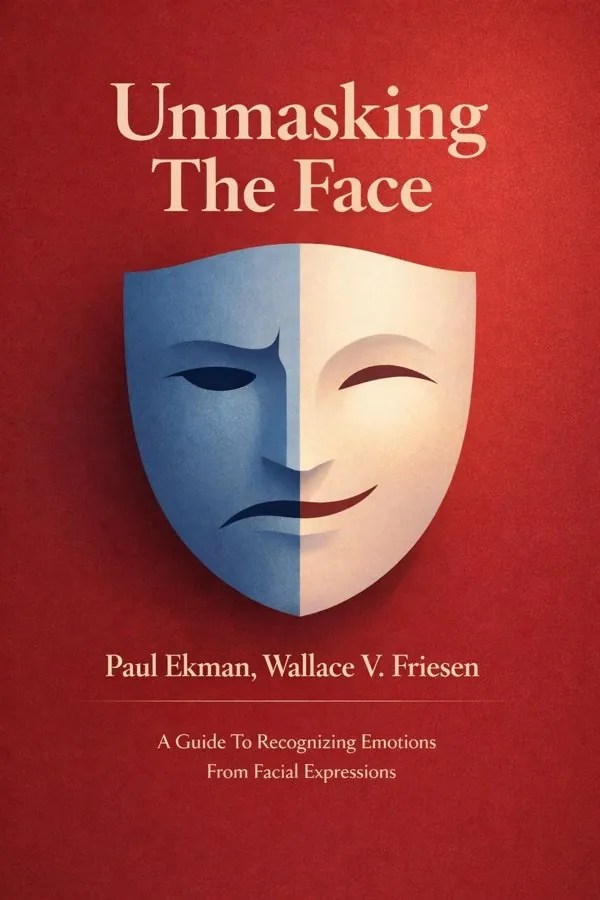
Unmasking The Face: A Guide To Recognizing Emotions From Facial Expressions: Summary & Key Insights
by Paul Ekman, Wallace V. Friesen
 10 min11 chaptersAudio available
What Is Unmasking The Face: A Guide To Recognizing Emotions From Facial Expressions About?
Unmasking The Face: A Guide To Recognizing Emotions From Facial Expressions by Paul Ekman, Wallace V. Friesen is a psychology book spanning 11 pages. This book provides a comprehensive guide to understanding and interpreting human facial expressions. Drawing on years of psychological research, Paul Ekman and Wallace V. Friesen present a systematic approach to recognizing emotions such as anger, fear, disgust, happiness, sadness, and surprise through subtle facial cues. The work is foundational in the study of nonverbal communication and has applications in psychology, law enforcement, and interpersonal relations.
This FizzRead summary covers all 11 key chapters of Unmasking The Face: A Guide To Recognizing Emotions From Facial Expressions in approximately 10 minutes, distilling the most important ideas, arguments, and takeaways from Paul Ekman, Wallace V. Friesen's work. Also available as an audio summary and Key Quotes Podcast.
Unmasking The Face: A Guide To Recognizing Emotions From Facial Expressions
This book provides a comprehensive guide to understanding and interpreting human facial expressions. Drawing on years of psychological research, Paul Ekman and Wallace V. Friesen present a systematic approach to recognizing emotions such as anger, fear, disgust, happiness, sadness, and surprise through subtle facial cues. The work is foundational in the study of nonverbal communication and has applications in psychology, law enforcement, and interpersonal relations.
Who Should Read Unmasking The Face: A Guide To Recognizing Emotions From Facial Expressions?
This book is perfect for anyone interested in psychology and looking to gain actionable insights in a short read. Whether you're a student, professional, or lifelong learner, the key ideas from Unmasking The Face: A Guide To Recognizing Emotions From Facial Expressions by Paul Ekman, Wallace V. Friesen will help you think differently.
- ✓Readers who enjoy psychology and want practical takeaways
- ✓Professionals looking to apply new ideas to their work and life
- ✓Anyone who wants the core insights of Unmasking The Face: A Guide To Recognizing Emotions From Facial Expressions in just 10 minutes
Want the full summary?
Get instant access to this book summary and 100K+ more with Fizz Moment.
Get Free SummaryAvailable on App Store • Free to download
Key Chapters
Facial expression is the most direct, most powerful route for emotions to surface. I have long argued that facial behavior is not merely ornamental—it is biologically and socially necessary. Our faces announce our feelings before words exist, shaping relationships and survival alike. When infants cry or smile, they are already participating in a silent communication system that has been refined through evolution.
In my early collaboration with Wallace Friesen, we sought to differentiate voluntary facial movement from involuntary expression. We found that certain muscle actions cannot be fabricated convincingly; the face’s moral compass remains partially autonomous. This insight drove us to craft rigorous methods for measuring and decoding expression scientifically. I wanted psychologists, physicians, investigators, and ordinary observers to no longer depend on vague intuition. Instead, we could use verified patterns of muscle contraction and movement that deliver reliable indications of anger, fear, sadness, disgust, surprise, and happiness.
Facial expressions are more than emotional signals—they are part of continuous interpersonal dialogue. When someone perceives your smile, their own facial muscles respond microscopically in kind. We mimic and mirror emotions, unconsciously synchronizing our expressions, which has been shown to create empathy and rapport. Emotional communication through the face precedes spoken conversation and often deepens it. Understanding this process invites us into both the science of perception and the art of connection.
The cornerstone of my research was testing whether expressions of emotion were universal. Collaborating with anthropologists and psychologists across the world, I compared responses to photographs that displayed different emotional faces. Participants from isolated cultures—those without exposure to Western media—could still identify the emotion accurately. This finding struck at the heart of earlier theories that emotions are socially learned.
I recall vividly our time in Papua New Guinea, studying the Fore people. Despite never having seen a European face, they recognized happiness and anger instantly. This cross-cultural validation revealed profound evolutionary roots: emotional expression is a biological inheritance, not a cultural artifact. It means every human face, regardless of race or upbringing, shares the same emotional signals.
Cultural differences still influence how and when we show feelings, a concept I termed 'display rules.' In Japan, people often mask negative emotions, maintaining social harmony by smiling even in discomfort. In the United States, showing happiness is encouraged, but tears might be restrained in public. These rules alter the external expression but not the internal experience. Understanding them helps prevent misinterpretation. When we decode facial cues, we must learn to discern between the universal signal of emotion and the culturally shaped mask covering it. This awareness balances our scientific accuracy with cultural sensitivity.
+ 9 more chapters — available in the FizzRead app
All Chapters in Unmasking The Face: A Guide To Recognizing Emotions From Facial Expressions
About the Authors
Paul Ekman is an American psychologist known for his pioneering work on emotions and facial expressions. Wallace V. Friesen collaborated with Ekman on the Facial Action Coding System (FACS), a tool for objectively measuring facial movements related to emotions.
Get This Summary in Your Preferred Format
Read or listen to the Unmasking The Face: A Guide To Recognizing Emotions From Facial Expressions summary by Paul Ekman, Wallace V. Friesen anytime, anywhere. FizzRead offers multiple formats so you can learn on your terms — all free.
Available formats: App · Audio · PDF · EPUB — All included free with FizzRead
Download Unmasking The Face: A Guide To Recognizing Emotions From Facial Expressions PDF and EPUB Summary
Key Quotes from Unmasking The Face: A Guide To Recognizing Emotions From Facial Expressions
“Facial expression is the most direct, most powerful route for emotions to surface.”
“The cornerstone of my research was testing whether expressions of emotion were universal.”
Frequently Asked Questions about Unmasking The Face: A Guide To Recognizing Emotions From Facial Expressions
Unmasking The Face: A Guide To Recognizing Emotions From Facial Expressions by Paul Ekman, Wallace V. Friesen is a psychology book that explores key ideas across 11 chapters. This book provides a comprehensive guide to understanding and interpreting human facial expressions. Drawing on years of psychological research, Paul Ekman and Wallace V. Friesen present a systematic approach to recognizing emotions such as anger, fear, disgust, happiness, sadness, and surprise through subtle facial cues. The work is foundational in the study of nonverbal communication and has applications in psychology, law enforcement, and interpersonal relations.
You Might Also Like

The Body Keeps the Score
Bessel van der Kolk
10 min
Surrounded by Idiots
Thomas Erikson
10 min
Emotional Intelligence
Daniel Goleman
10 min
Attached
Amir Levine
10 min
Why Does He Do That
Lundy Bancroft
10 min
Women Who Run with the Wolves
Clarissa Pinkola Estés
10 minBrowse by Category
Ready to read Unmasking The Face: A Guide To Recognizing Emotions From Facial Expressions?
Get the full summary and 100K+ more books with Fizz Moment.