
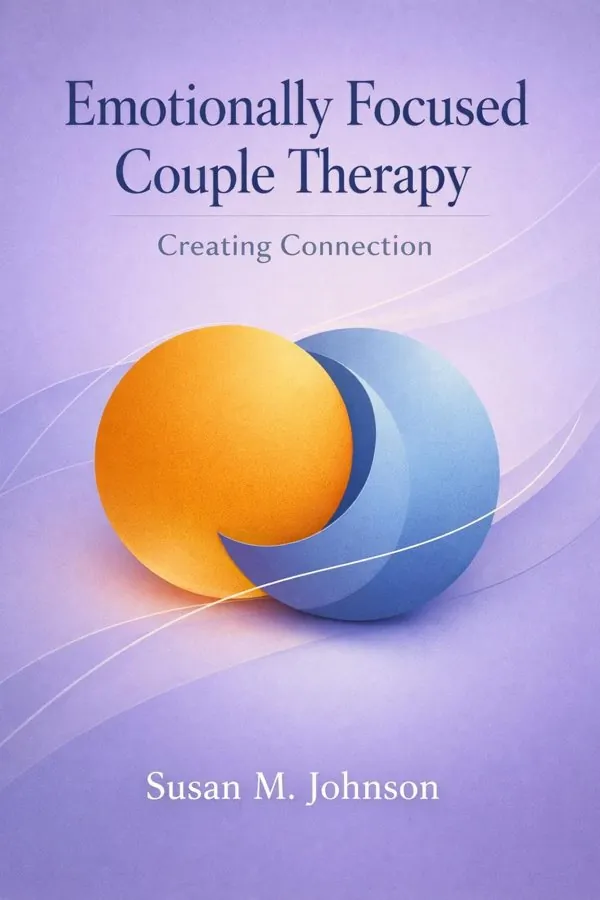
Emotionally Focused Couple Therapy: Creating Connection: Summary & Key Insights
 10 min11 chaptersAudio available
What Is Emotionally Focused Couple Therapy: Creating Connection About?
Emotionally Focused Couple Therapy: Creating Connection by Susan M. Johnson is a mental_health book spanning 11 pages. Emotionally Focused Couple Therapy (EFT) is a structured approach to couples therapy formulated in the 1980s by Dr. Susan M. Johnson. This book presents the theoretical foundations and practical applications of EFT, emphasizing the role of attachment theory in adult relationships. It provides clinicians with a step-by-step guide to help couples identify negative interaction cycles, access underlying emotions, and build secure emotional bonds.
This FizzRead summary covers all 11 key chapters of Emotionally Focused Couple Therapy: Creating Connection in approximately 10 minutes, distilling the most important ideas, arguments, and takeaways from Susan M. Johnson's work. Also available as an audio summary and Key Quotes Podcast.
Emotionally Focused Couple Therapy: Creating Connection
Emotionally Focused Couple Therapy (EFT) is a structured approach to couples therapy formulated in the 1980s by Dr. Susan M. Johnson. This book presents the theoretical foundations and practical applications of EFT, emphasizing the role of attachment theory in adult relationships. It provides clinicians with a step-by-step guide to help couples identify negative interaction cycles, access underlying emotions, and build secure emotional bonds.
Who Should Read Emotionally Focused Couple Therapy: Creating Connection?
This book is perfect for anyone interested in mental_health and looking to gain actionable insights in a short read. Whether you're a student, professional, or lifelong learner, the key ideas from Emotionally Focused Couple Therapy: Creating Connection by Susan M. Johnson will help you think differently.
- ✓Readers who enjoy mental_health and want practical takeaways
- ✓Professionals looking to apply new ideas to their work and life
- ✓Anyone who wants the core insights of Emotionally Focused Couple Therapy: Creating Connection in just 10 minutes
Want the full summary?
Get instant access to this book summary and 100K+ more with Fizz Moment.
Get Free SummaryAvailable on App Store • Free to download
Key Chapters
When people fall in love, they often imagine that passion, companionship, and communication alone sustain intimacy. But in my years of research and therapy, I found that love’s true essence lies elsewhere—it is an emotional bond, deeply rooted in our evolutionary drive for attachment. Adult love mirrors infant attachment because both are guided by the same biological imperative: safety and comfort through closeness.
Attachment theory helps us understand that our need for connection is not weakness; it is a survival mechanism. When partners feel securely attached, they can explore the world, take risks, and handle stress, knowing their emotional home is safe. When that bond feels insecure, however, emotions like fear, shame, and anger arise. We protest disconnection by attacking, withdrawing, or placating—forms of protest behavior that mask our deeper plea: ‘Do you still love me? Will you still be there when I need you?’
In adult relationships, attachment styles—secure, anxious, avoidant, or disorganized—shape how partners respond to intimacy and threat. The securely attached partner trusts emotional closeness and can repair ruptures easily. The anxious partner craves reassurance but fears abandonment; the avoidant partner distances to reduce vulnerability. EFT recognizes these patterns as adaptive but maladaptive in love contexts, where safety arises not from independence but mutual responsiveness.
Understanding these patterns enables both therapist and couple to shift perspective. The angry demand of one partner transforms into a cry for connection. The emotional withdrawal of the other becomes a strategy to avoid rejection. By viewing distress through the attachment lens, we break free from blame and begin to see vulnerability—the hidden layer under every conflict. My approach as a therapist is to help partners articulate these attachment fears and longings, often buried under years of hurt, and guide them back to secure bonding. Love, in its healthiest form, is a constant reassurance: ‘You are safe here with me.’ EFT creates that reassurance in real time, turning abstract theory into lived emotional experience.
Couple distress is never random. It follows predictable emotional patterns that repeat until partners either repair or separate. I often describe these repetitive exchanges as dances—a choreography of pain where each step triggers the next. One partner may pursue and criticize, desperate for response; the other may withdraw to avoid emotional attack, reinforcing loneliness and resentment. Both partners are caught in a negative cycle, not as enemies, but as dancers locked in a rhythm they cannot see.
Such cycles are nearly universal. They stem from unmet attachment needs—needs for safety, validation, and comfort. When those needs go unrecognized or are dismissed, emotional disconnection grows. Partners begin interpreting each other’s behaviors not as protective strategies, but as rejections. The pursuer feels ignored and amplifies protest. The withdrawer feels overwhelmed and retreats further. This cycle fuels itself until both partners become trapped in defensive positions.
Through my clinical lens, the task is not to solve surface conflicts like chores or finances, but to identify and restructure this emotional choreography. EFT helps couples see the cycle as the enemy, not each other. The therapist guides them to map the triggers, secondary emotions (anger, frustration), and primary emotions (fear of loss, sadness, shame) that drive the cycle. Once partners can see this dance from above, they begin to soften, realizing they both long for the same thing—to be seen and understood.
In practical terms, breaking cycles starts with slowing them down. By helping each partner access and speak from their deeper emotional reality, we reduce the escalation of defensiveness. Emotional alignment replaces blame with compassion. The therapy room becomes a sanctuary where vulnerabilities are not punished but embraced. Over time, this new pattern becomes internalized, restoring the sense of safety the relationship lost.
The revelation is always the same and always profound: beneath every couple’s distress lies a longing to connect. When partners understand this, conflict transforms from chaos to clarity.
+ 9 more chapters — available in the FizzRead app
All Chapters in Emotionally Focused Couple Therapy: Creating Connection
About the Author
Susan M. Johnson, EdD, is a clinical psychologist, researcher, professor, and one of the primary developers of Emotionally Focused Therapy (EFT). She is the founder and director of the International Centre for Excellence in Emotionally Focused Therapy (ICEEFT) and has authored numerous influential works on attachment and couple therapy.
Get This Summary in Your Preferred Format
Read or listen to the Emotionally Focused Couple Therapy: Creating Connection summary by Susan M. Johnson anytime, anywhere. FizzRead offers multiple formats so you can learn on your terms — all free.
Available formats: App · Audio · PDF · EPUB — All included free with FizzRead
Download Emotionally Focused Couple Therapy: Creating Connection PDF and EPUB Summary
Key Quotes from Emotionally Focused Couple Therapy: Creating Connection
“When people fall in love, they often imagine that passion, companionship, and communication alone sustain intimacy.”
“It follows predictable emotional patterns that repeat until partners either repair or separate.”
Frequently Asked Questions about Emotionally Focused Couple Therapy: Creating Connection
Emotionally Focused Couple Therapy: Creating Connection by Susan M. Johnson is a mental_health book that explores key ideas across 11 chapters. Emotionally Focused Couple Therapy (EFT) is a structured approach to couples therapy formulated in the 1980s by Dr. Susan M. Johnson. This book presents the theoretical foundations and practical applications of EFT, emphasizing the role of attachment theory in adult relationships. It provides clinicians with a step-by-step guide to help couples identify negative interaction cycles, access underlying emotions, and build secure emotional bonds.
You Might Also Like
Big Feelings: How to Be Okay When Things Are Not Okay
Liz Fosslien, Mollie West Duffy
10 min
Creative Arts Therapies Handbook: Art, Music and Dance Therapy Practices for Wellbeing
Susan I. Buchalter
10 min
Emotional First Aid: Healing Rejection, Guilt, Failure, and Other Everyday Hurts
Guy Winch
10 min
Lost Connections: Why You're Depressed and How to Find Hope
Johann Hari
10 min
No Time to Panic: How to Stop Worrying and Embrace Life
Matt Gutman
10 min
Overcoming Mobbing: A Recovery Guide for Workplace Aggression and Bullying
Maureen Duffy, Len Sperry
10 minBrowse by Category
Ready to read Emotionally Focused Couple Therapy: Creating Connection?
Get the full summary and 100K+ more books with Fizz Moment.