
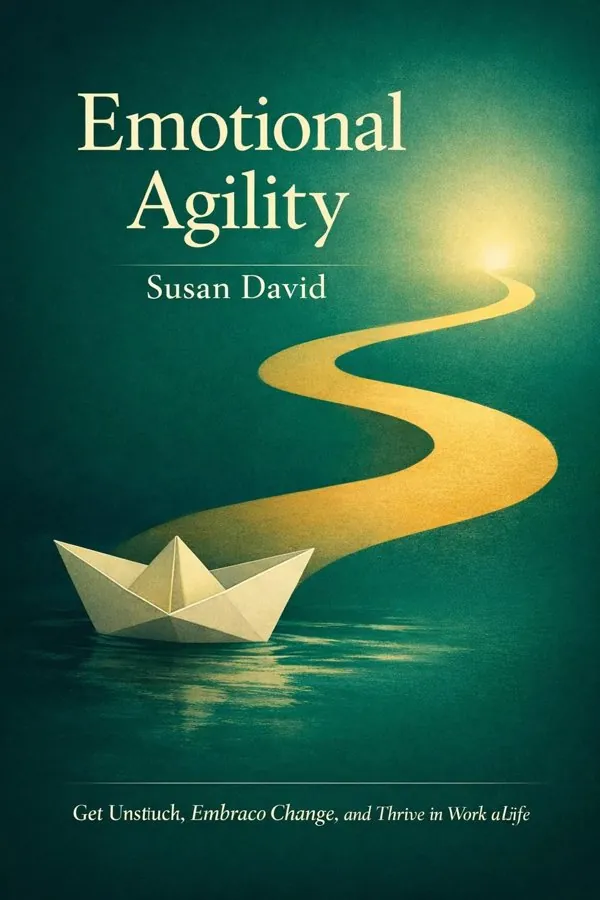
Emotional Agility: Get Unstuck, Embrace Change, and Thrive in Work and Life: Summary & Key Insights
by Susan David
 10 min10 chaptersAudio available
What Is Emotional Agility: Get Unstuck, Embrace Change, and Thrive in Work and Life About?
Emotional Agility: Get Unstuck, Embrace Change, and Thrive in Work and Life by Susan David is a psychology book spanning 10 pages. Emotional Agility es un libro de desarrollo personal que explora cómo las personas pueden manejar sus pensamientos y emociones de manera flexible para vivir de acuerdo con sus valores. Susan David, psicóloga de Harvard, presenta estrategias basadas en la investigación para superar la rigidez emocional, adaptarse al cambio y prosperar tanto en el trabajo como en la vida personal.
This FizzRead summary covers all 10 key chapters of Emotional Agility: Get Unstuck, Embrace Change, and Thrive in Work and Life in approximately 10 minutes, distilling the most important ideas, arguments, and takeaways from Susan David's work. Also available as an audio summary and Key Quotes Podcast.
Emotional Agility: Get Unstuck, Embrace Change, and Thrive in Work and Life
Emotional Agility es un libro de desarrollo personal que explora cómo las personas pueden manejar sus pensamientos y emociones de manera flexible para vivir de acuerdo con sus valores. Susan David, psicóloga de Harvard, presenta estrategias basadas en la investigación para superar la rigidez emocional, adaptarse al cambio y prosperar tanto en el trabajo como en la vida personal.
Who Should Read Emotional Agility: Get Unstuck, Embrace Change, and Thrive in Work and Life?
This book is perfect for anyone interested in psychology and looking to gain actionable insights in a short read. Whether you're a student, professional, or lifelong learner, the key ideas from Emotional Agility: Get Unstuck, Embrace Change, and Thrive in Work and Life by Susan David will help you think differently.
- ✓Readers who enjoy psychology and want practical takeaways
- ✓Professionals looking to apply new ideas to their work and life
- ✓Anyone who wants the core insights of Emotional Agility: Get Unstuck, Embrace Change, and Thrive in Work and Life in just 10 minutes
Want the full summary?
Get instant access to this book summary and 100K+ more with Fizz Moment.
Get Free SummaryAvailable on App Store • Free to download
Key Chapters
We all experience moments when emotions take the driver’s seat and we become passengers. Perhaps it’s anger that flares uncontrollably in a meeting, or the quiet sadness we bury beneath busyness. Emotional rigidity happens when we either deny our emotions or become consumed by them. In my research, I found that people often fall into one of two traps: bottling and brooding. Bottlers suppress their feelings to appear composed or ‘positive.’ Brooders, on the other hand, get caught in endless cycles of rumination, rehashing painful thoughts until they harden into identity—‘I am unworthy,’ ‘I am always unlucky.’
Both responses are forms of rigidity. Denial prevents change by disengaging us from truth. Over-identification prevents change by making emotions seem absolute. What makes rigidity dangerous is not the emotions themselves but our response to them. When we deny discomfort, we lose insight. When we over-identify with it, we lose perspective.
Rigid patterns show up most clearly when we face change. The uncertain project at work, the failing relationship, the unexpected illness—all challenge our capacity to adapt. Yet many of us respond not with openness but with defensiveness, clinging to habits and stories that keep us ‘safe’ but small. Emotional agility begins when we recognize this rigidity and are willing to loosen it—not by force, but through awareness and compassion.
Rigidity often arises from well-intentioned cultural myths: the pressure to ‘stay positive,’ the belief that strong people don’t feel pain, or that emotions are irrational. Such myths teach us to mistrust our inner signals. But psychological research consistently shows that recognizing emotion—even difficult emotion—is essential for effective self-regulation. When we suppress sadness or anxiety, those emotions don’t disappear; they metastasize, driving unconscious decisions and physical stress responses.
Becoming emotionally agile starts with humility—the willingness to see our reactions clearly and admit that automatic patterns don’t serve us. In doing so, we reclaim the freedom to respond differently.
Our emotions don’t arise in isolation; they are triggered by stories—narratives we tell ourselves about who we are and how the world works. I call these emotional hooks because they catch us before we’re even aware of being caught. You’ve likely experienced this: a colleague’s offhand remark feels like rejection; a friend’s silence triggers insecurity. In reality, these reactions are shaped by embedded mental scripts formed over years of experience.
To become emotionally agile, we must first learn to see these stories unfolding. Imagine emotions as waves and stories as the wind beneath them; you cannot stop the wind, but you can learn how to surf the wave. When we pause long enough to ask, ‘What story am I telling myself right now?’ we create the space to choose—not react.
In practice, this means noticing the patterns in our internal dialogue. Do we label ourselves harshly? Do we catastrophize? The key is not to silence these thoughts but to name them gently. Naming distills emotion into awareness. For example: ‘I’m having the thought that I’m not good enough.’ That small shift—turning identity into observation—breaks the hook’s power.
Research in cognitive psychology shows that such distancing enables the brain’s prefrontal cortex to engage, improving flexibility and problem-solving. Awareness transforms emotion from master to messenger. Each emotional hook becomes data, signaling what matters to us or where we feel vulnerable. When we learn to listen without judgment, these hooks guide rather than trap.
In everyday life, this may mean recognizing that your frustration at a colleague stems not just from their behavior but from your deeper value of respect; or that your anxiety about change reflects a yearning for stability. These insights free you from automatic looping and invite intentional response.
+ 8 more chapters — available in the FizzRead app
All Chapters in Emotional Agility: Get Unstuck, Embrace Change, and Thrive in Work and Life
About the Author
Susan David es psicóloga, investigadora y conferencista en la Escuela de Medicina de Harvard. Es reconocida internacionalmente por su trabajo sobre la agilidad emocional, la resiliencia y el bienestar psicológico. Ha publicado en revistas científicas y medios como Harvard Business Review y The New York Times.
Get This Summary in Your Preferred Format
Read or listen to the Emotional Agility: Get Unstuck, Embrace Change, and Thrive in Work and Life summary by Susan David anytime, anywhere. FizzRead offers multiple formats so you can learn on your terms — all free.
Available formats: App · Audio · PDF · EPUB — All included free with FizzRead
Download Emotional Agility: Get Unstuck, Embrace Change, and Thrive in Work and Life PDF and EPUB Summary
Key Quotes from Emotional Agility: Get Unstuck, Embrace Change, and Thrive in Work and Life
“We all experience moments when emotions take the driver’s seat and we become passengers.”
“Our emotions don’t arise in isolation; they are triggered by stories—narratives we tell ourselves about who we are and how the world works.”
Frequently Asked Questions about Emotional Agility: Get Unstuck, Embrace Change, and Thrive in Work and Life
Emotional Agility: Get Unstuck, Embrace Change, and Thrive in Work and Life by Susan David is a psychology book that explores key ideas across 10 chapters. Emotional Agility es un libro de desarrollo personal que explora cómo las personas pueden manejar sus pensamientos y emociones de manera flexible para vivir de acuerdo con sus valores. Susan David, psicóloga de Harvard, presenta estrategias basadas en la investigación para superar la rigidez emocional, adaptarse al cambio y prosperar tanto en el trabajo como en la vida personal.
You Might Also Like
The Body Keeps the Score
Bessel van der Kolk
10 min
Surrounded by Idiots
Thomas Erikson
10 min
Emotional Intelligence
Daniel Goleman
10 min
Attached
Amir Levine
10 min
Why Does He Do That
Lundy Bancroft
10 min
Women Who Run with the Wolves
Clarissa Pinkola Estés
10 minBrowse by Category
Ready to read Emotional Agility: Get Unstuck, Embrace Change, and Thrive in Work and Life?
Get the full summary and 100K+ more books with Fizz Moment.