
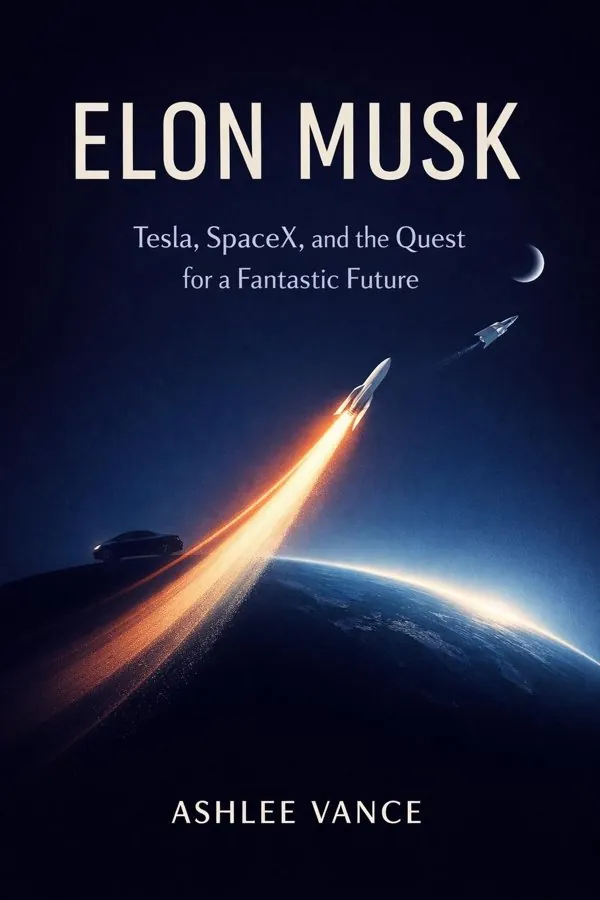
Elon Musk: Tesla, SpaceX, and the Quest for a Fantastic Future: Summary & Key Insights
by Ashlee Vance
 10 min10 chaptersAudio available
Key Takeaways from Elon Musk: Tesla, SpaceX, and the Quest for a Fantastic Future
Great ambition often begins in private struggle rather than public triumph.
Sometimes the most important decision is not what to build, but where to place yourself.
Big careers are often built on unglamorous beginnings.
A founder’s second act often reveals whether success was luck or method.
The industries most worth changing are often the ones everyone else has abandoned to specialists.
What Is Elon Musk: Tesla, SpaceX, and the Quest for a Fantastic Future About?
Elon Musk: Tesla, SpaceX, and the Quest for a Fantastic Future by Ashlee Vance is a biographies book spanning 10 pages. Ashlee Vance’s Elon Musk: Tesla, SpaceX, and the Quest for a Fantastic Future is more than a standard business biography. It is a close-up study of a founder who set out not merely to build companies, but to reshape entire industries that most people assumed were too large, too old, or too difficult to change. The book follows Musk from a difficult childhood in South Africa to the creation of PayPal, SpaceX, Tesla, and SolarCity, showing how his appetite for risk, speed, and technical depth became both his greatest strength and his greatest source of conflict. What makes this biography matter is that Musk’s story sits at the intersection of entrepreneurship, engineering, energy, transportation, and space exploration. Vance does not present Musk as a simple hero. He portrays him as brilliant, demanding, often harsh, and relentlessly future-focused. Through interviews with Musk, family members, colleagues, competitors, and former employees, Vance offers an unusually detailed account of how Musk thinks and works. The result is a vivid portrait of modern ambition: inspiring, uncomfortable, and essential for anyone who wants to understand innovation in the 21st century.
This FizzRead summary covers all 10 key chapters of Elon Musk: Tesla, SpaceX, and the Quest for a Fantastic Future in approximately 10 minutes, distilling the most important ideas, arguments, and takeaways from Ashlee Vance's work. Also available as an audio summary and Key Quotes Podcast.
Elon Musk: Tesla, SpaceX, and the Quest for a Fantastic Future
Ashlee Vance’s Elon Musk: Tesla, SpaceX, and the Quest for a Fantastic Future is more than a standard business biography. It is a close-up study of a founder who set out not merely to build companies, but to reshape entire industries that most people assumed were too large, too old, or too difficult to change. The book follows Musk from a difficult childhood in South Africa to the creation of PayPal, SpaceX, Tesla, and SolarCity, showing how his appetite for risk, speed, and technical depth became both his greatest strength and his greatest source of conflict.
What makes this biography matter is that Musk’s story sits at the intersection of entrepreneurship, engineering, energy, transportation, and space exploration. Vance does not present Musk as a simple hero. He portrays him as brilliant, demanding, often harsh, and relentlessly future-focused. Through interviews with Musk, family members, colleagues, competitors, and former employees, Vance offers an unusually detailed account of how Musk thinks and works. The result is a vivid portrait of modern ambition: inspiring, uncomfortable, and essential for anyone who wants to understand innovation in the 21st century.
Who Should Read Elon Musk: Tesla, SpaceX, and the Quest for a Fantastic Future?
This book is perfect for anyone interested in biographies and looking to gain actionable insights in a short read. Whether you're a student, professional, or lifelong learner, the key ideas from Elon Musk: Tesla, SpaceX, and the Quest for a Fantastic Future by Ashlee Vance will help you think differently.
- ✓Readers who enjoy biographies and want practical takeaways
- ✓Professionals looking to apply new ideas to their work and life
- ✓Anyone who wants the core insights of Elon Musk: Tesla, SpaceX, and the Quest for a Fantastic Future in just 10 minutes
Want the full summary?
Get instant access to this book summary and 100K+ more with Fizz Moment.
Get Free SummaryAvailable on App Store • Free to download
Key Chapters
Great ambition often begins in private struggle rather than public triumph. Vance shows that Elon Musk’s early years in Pretoria, South Africa, were marked by loneliness, intense reading, and emotional hardship. As a child, Musk was deeply introspective and frequently absorbed in books, especially science fiction and technical subjects. He was bullied at school and lived within a family environment that could be unstable and difficult, particularly in relation to his father. These experiences helped create a personality that was unusually self-contained, resilient, and willing to imagine an escape into bigger futures.
This chapter matters because it explains that Musk’s later appetite for impossible missions did not emerge from comfort. He learned early to retreat into ideas, systems, and long-term visions. Instead of seeking approval, he developed the habit of testing reality against what he believed should be possible. That mindset would later define his approach to rockets, electric cars, and solar energy.
For readers, the practical lesson is not that hardship automatically creates genius, but that adversity can sharpen focus when paired with curiosity and discipline. Musk’s childhood also highlights the power of deep reading. He educated himself through voracious consumption of books before gaining formal opportunities.
A useful application is simple: when facing isolation, setback, or lack of support, build an inner engine through learning. Read beyond your immediate environment, develop technical literacy, and let difficult circumstances strengthen your sense of direction rather than shrink it. Actionable takeaway: turn hardship into leverage by creating a disciplined habit of self-education.
Sometimes the most important decision is not what to build, but where to place yourself. Musk’s move from South Africa to Canada, and later to the United States, reflected more than a desire for personal advancement. He saw North America as the arena where large-scale technological and entrepreneurial dreams could become reality. Escaping South Africa also meant avoiding military conscription and distancing himself from a political environment he found limiting.
Vance presents this move as both strategic and philosophical. Musk was not drifting. He was positioning himself near capital, talent, research institutions, and a culture more open to risk-taking. Along the way, he endured uncertainty, unstable housing, odd jobs, and the difficulty of starting over. Yet he treated geography as a tool. Location, in his view, was part of the architecture of ambition.
This idea has wide application. Many people think of success primarily in terms of talent or effort, but environment shapes both. The people around you, the institutions you can access, and the industries concentrated in a region can dramatically alter your chances of execution. Musk recognized that dreams need infrastructure.
In practical terms, readers can apply this by evaluating whether their current environment supports their goals. That does not always require moving countries. It may mean changing cities, industries, networks, or even online communities. The broader lesson is to choose settings that amplify your strengths and expose you to possibility.
Actionable takeaway: audit your environment and ask whether it is actively helping you build the future you want, or quietly teaching you to settle.
Big careers are often built on unglamorous beginnings. Before Musk became a symbol of futuristic ambition, he was a young founder trying to keep a small software company alive. Zip2, which provided online city guides and business directories for newspapers, was not a moonshot in the modern sense. It was a practical internet business launched during the early web era, when many traditional industries still did not understand what the internet would become.
Vance uses Zip2 to show Musk in his raw entrepreneurial form: intensely driven, technically capable, and willing to work to extremes. He and his brother Kimbal lived frugally, pushed product improvements constantly, and chased investors and clients with determination. Musk wrote code, argued strategy, and fought for influence even after venture capital arrived and professional management began to reshape the company.
The deeper point is that early ventures teach founders how markets actually work. Zip2 forced Musk to deal with customers, cash constraints, product-market fit, and the painful reality that investors may support your company without fully trusting your leadership. It also introduced a recurring pattern in his life: he wanted not just to invent, but to control the speed and ambition of execution.
For readers, Zip2 is a reminder that you do not need a perfect first idea. You need a real problem, relentless effort, and the willingness to learn under pressure. Many transformational careers begin with businesses that look modest from the outside but are formative on the inside.
Actionable takeaway: treat your first serious project as a training ground for execution, not as a final statement of your potential.
A founder’s second act often reveals whether success was luck or method. Musk’s role in the creation of X.com and the eventual rise of PayPal demonstrated his obsession with scale, digital systems, and financial infrastructure. He believed money itself could be improved through software, and he pushed aggressively into online banking and payments at a time when trust in internet finance was still fragile.
Vance describes a period full of infighting, mergers, strategy conflicts, and leadership battles. Musk was visionary but polarizing. He wanted speed, bold architecture, and aggressive expansion. Others worried about stability, security, and management style. Eventually, he was removed as CEO, but the company he helped build became PayPal and later sold to eBay, making Musk wealthy enough to fund much larger ambitions.
The practical importance of this chapter lies in how it distinguishes value creation from personal control. Musk’s ideas helped shape a company that transformed digital payments, yet he also learned that being right about the future does not automatically make you easy to work with or institutionally durable. Talent without alignment creates friction.
Readers can apply this insight in any collaborative setting. A sharp vision matters, but organizations also run on trust, timing, and the ability to bring others with you. PayPal also shows the power of compounding. One successful exit can finance a lifetime of more daring bets if the founder reinvests instead of retreating.
Actionable takeaway: think beyond your first win and ask how today’s success can become fuel, credibility, and learning for a much larger mission.
The industries most worth changing are often the ones everyone else has abandoned to specialists. Musk founded SpaceX because he concluded that space exploration had become too slow, too expensive, and too lacking in imagination. Instead of accepting the aerospace industry’s assumptions, he questioned basic cost structures and engineering processes. Why should rockets remain so expensive? Why not build a company that designs and manufactures critical components internally and eventually makes rockets reusable?
Vance shows how radical this vision sounded at the time. Musk lacked aerospace credentials in the traditional sense, and the company suffered repeated failures in its early launches. Rockets exploded. Money ran thin. Experts doubted him. Yet Musk persisted by hiring top engineers, learning rapidly, and refusing to separate business ambition from engineering detail. SpaceX was not built through charisma alone. It was built through technical immersion, ruthless iteration, and a refusal to normalize failure as final.
This chapter provides one of the book’s strongest lessons: first-principles thinking can unlock innovation in industries trapped by habit. Rather than asking what competitors charge or how things are usually done, Musk asked what physics required and what materials actually cost. That mental model allowed him to rebuild assumptions from the ground up.
In practical terms, readers can use first-principles thinking in product design, operations, budgeting, and strategy. Break a problem into fundamentals, identify inherited assumptions, and rebuild from necessity rather than convention.
Actionable takeaway: when a field seems impossible to enter, stop copying industry norms and start questioning the assumptions those norms are built on.
Transformative products succeed when they change both performance and perception. Tesla did not merely make electric vehicles more acceptable; it made them desirable. Vance explains that Musk saw the auto industry as stagnant, environmentally harmful, and psychologically trapped. Many consumers associated electric cars with compromise: low range, weak performance, and unattractive design. Tesla’s strategy was to attack that narrative directly by building high-performance electric vehicles people would aspire to own.
Musk joined Tesla as an investor and later became its dominant force, pushing the company through engineering challenges, production delays, financial crises, and constant skepticism. The Roadster proved an electric sports car could be fast and exciting. The Model S then showed that an electric sedan could compete with luxury incumbents on software, performance, and design. Underneath the products was a larger systems vision involving batteries, charging networks, manufacturing, and energy storage.
The practical significance of Tesla’s story is that category change often requires emotional change. If customers see your product as morally worthy but practically inferior, adoption will remain limited. Tesla made sustainability aspirational. It aligned mission with delight.
For readers building products or leading change, this is a powerful lesson. Do not ask people to sacrifice forever in the name of the future. Give them a better experience now. Whether in technology, education, health, or services, adoption accelerates when innovation feels superior rather than merely responsible.
Actionable takeaway: if you want to shift behavior at scale, design solutions that people want for their own sake, not just because they are told they should.
Real innovation rarely lives inside one product. Musk’s involvement with SolarCity reflected a broader ambition: to connect transportation, energy generation, and storage into a coherent sustainable ecosystem. Rather than treating electric cars as an isolated business, he saw them as one part of a larger transition away from fossil fuels. Solar panels, batteries, and electric vehicles could reinforce each other if designed as pieces of one system.
Vance uses SolarCity to illustrate Musk’s ability to think across industries. His cousins ran the company, but Musk helped shape the strategic logic behind it. The idea was not only to sell solar installations. It was to lower barriers to clean energy adoption through financing models and eventually tie solar generation to battery storage and electric mobility. This systems perspective distinguishes Musk from founders who optimize one product at a time without considering the ecosystem around it.
For readers, this chapter offers a practical lens for solving complex problems. Many challenges persist because they are attacked in fragments. A company may improve one step of a customer journey while leaving surrounding bottlenecks intact. A city may encourage electric vehicles without charging infrastructure. A business may digitize sales without modernizing operations. Systems thinking asks how the pieces interact.
Applied personally, this means looking at goals as networks rather than tasks. Career growth depends on skills, relationships, habits, and positioning working together. Health depends on sleep, food, movement, stress, and environment. The strongest improvements often come from aligning multiple elements at once.
Actionable takeaway: stop optimizing isolated parts of a problem and start mapping the whole system that determines whether change will actually stick.
The true shape of a leader appears when success is no longer available as a story. One of the most dramatic sections of Vance’s biography covers the 2008 period, when both Tesla and SpaceX were close to failure. Launches had gone wrong, Tesla faced production nightmares and cost overruns, and Musk’s personal life was under strain. His fortune from earlier successes was nearly exhausted. From the outside, the empire looked less like visionary progress and more like an impending breakdown.
What stands out is Musk’s tolerance for personal and financial risk. He poured his remaining capital into his companies rather than protecting himself. He drove teams mercilessly, made painful decisions, and pushed for outcomes others considered unrealistic. Eventually, a successful SpaceX launch and crucial financing for Tesla helped both companies survive.
This episode matters because it strips away the illusion that innovation is a smooth upward curve. Breakthrough ventures often survive on narrow margins of time, capital, and morale. Recovery requires not just belief, but operational intensity. It also reveals the cost of extreme ambition: burnout, damaged relationships, and fear among employees.
Readers can draw two lessons. First, resilience is not passive optimism; it is decisive action under pressure. Second, survival planning matters. Visionary companies still need cash discipline, contingency options, and execution rigor. Ambition without operational control creates fragile dreams.
Actionable takeaway: in periods of crisis, focus on the few actions most likely to extend runway, restore confidence, and create proof that your mission still deserves to live.
Some leaders inspire through warmth; others through intensity. Musk belongs firmly to the second category. Vance portrays him as a leader capable of drawing extraordinary effort from teams, but also one who often created fear, exhaustion, and conflict. He set extreme deadlines, challenged assumptions relentlessly, and expected near-total commitment. Employees frequently described working for him as both career-defining and personally punishing.
This duality is central to the book. Musk’s companies achieved outcomes many experts thought impossible, and his standards were often a key reason. He forced engineers and managers to move faster, think bigger, and avoid complacency. Yet the same style could veer into impulsiveness, emotional volatility, and disregard for human limits. The biography refuses a simplistic answer to whether this approach is justified. Instead, it shows the complicated reality: extraordinary results can emerge from extraordinary pressure, but the human cost is real.
For readers, the takeaway is not to imitate Musk’s temperament. It is to understand the relationship between standards and culture. High expectations are valuable when paired with clarity, competence, and purpose. They become destructive when paired with chaos, humiliation, or unpredictability. Great organizations need urgency, but they also need trust.
If you lead others, ask what kind of intensity your mission truly requires and what support systems your team needs to sustain it. If you work under demanding leaders, distinguish between environments that stretch you productively and ones that erode your judgment and health.
Actionable takeaway: pursue high standards, but build them on clarity and respect rather than fear alone.
The most striking thing about Musk is not simply that he wants to build successful companies, but that he links those companies to civilizational survival. Vance frames Musk’s grand project as a portfolio of existential bets: make humanity multiplanetary through SpaceX, accelerate sustainable transport through Tesla, and promote renewable energy through SolarCity. Whether or not one agrees with every method, the scale of intention is undeniable.
This long-range thinking helps explain Musk’s relentless behavior. He does not act as if he is optimizing for comfort, reputation, or short-term wealth. He acts as if time is scarce and the future is vulnerable. That belief allows him to tolerate criticism, financial exposure, and operational stress that would be irrational under ordinary incentives. It also helps explain why supporters see him as uniquely important and critics see him as dangerously unrestrained.
The practical value of this chapter lies in the power of mission. People and organizations become more resilient when they connect daily work to a cause larger than immediate reward. A strong mission can attract talent, sustain effort, and sharpen decision-making. But mission must also be translated into concrete steps. Musk’s genius, as Vance presents it, is not just dreaming big. It is tying those dreams to factories, launch pads, battery packs, supply chains, and engineering milestones.
Readers need not adopt a planetary mission to benefit from this lesson. They can ask a simpler question: what larger future does my work serve, and how can I make that connection more real?
Actionable takeaway: define a mission bigger than personal gain, then convert it into specific, measurable work that can be pursued today.
All Chapters in Elon Musk: Tesla, SpaceX, and the Quest for a Fantastic Future
About the Author
Ashlee Vance is an American journalist, business writer, and author best known for his reporting on technology, entrepreneurship, and Silicon Valley. Over the course of his career, he has written for major publications including Bloomberg Businessweek and The New York Times, covering subjects such as startups, computing, artificial intelligence, and influential founders. Vance has earned a reputation for translating complex technical and business developments into clear, engaging narratives for general readers. In Elon Musk: Tesla, SpaceX, and the Quest for a Fantastic Future, he combines investigative reporting with biography, drawing on interviews with Musk, family members, colleagues, and former employees. His work stands out for its balance, storytelling energy, and ability to place individual ambition within the larger forces shaping modern innovation.
Get This Summary in Your Preferred Format
Read or listen to the Elon Musk: Tesla, SpaceX, and the Quest for a Fantastic Future summary by Ashlee Vance anytime, anywhere. FizzRead offers multiple formats so you can learn on your terms — all free.
Available formats: App · Audio · PDF · EPUB — All included free with FizzRead
Download Elon Musk: Tesla, SpaceX, and the Quest for a Fantastic Future PDF and EPUB Summary
Key Quotes from Elon Musk: Tesla, SpaceX, and the Quest for a Fantastic Future
“Great ambition often begins in private struggle rather than public triumph.”
“Sometimes the most important decision is not what to build, but where to place yourself.”
“Big careers are often built on unglamorous beginnings.”
“A founder’s second act often reveals whether success was luck or method.”
“The industries most worth changing are often the ones everyone else has abandoned to specialists.”
Frequently Asked Questions about Elon Musk: Tesla, SpaceX, and the Quest for a Fantastic Future
Elon Musk: Tesla, SpaceX, and the Quest for a Fantastic Future by Ashlee Vance is a biographies book that explores key ideas across 10 chapters. Ashlee Vance’s Elon Musk: Tesla, SpaceX, and the Quest for a Fantastic Future is more than a standard business biography. It is a close-up study of a founder who set out not merely to build companies, but to reshape entire industries that most people assumed were too large, too old, or too difficult to change. The book follows Musk from a difficult childhood in South Africa to the creation of PayPal, SpaceX, Tesla, and SolarCity, showing how his appetite for risk, speed, and technical depth became both his greatest strength and his greatest source of conflict. What makes this biography matter is that Musk’s story sits at the intersection of entrepreneurship, engineering, energy, transportation, and space exploration. Vance does not present Musk as a simple hero. He portrays him as brilliant, demanding, often harsh, and relentlessly future-focused. Through interviews with Musk, family members, colleagues, competitors, and former employees, Vance offers an unusually detailed account of how Musk thinks and works. The result is a vivid portrait of modern ambition: inspiring, uncomfortable, and essential for anyone who wants to understand innovation in the 21st century.
You Might Also Like

An American Marriage
Tayari Jones
10 min
Benjamin Franklin: An American Life
Walter Isaacson
10 min
I Know Why The Caged Bird Sings
Maya Angelou
10 min
Long Walk to Freedom
Nelson Mandela
10 min
Persepolis
Marjane Satrapi
10 min
Surely You're Joking, Mr. Feynman!
Richard P. Feynman
10 minBrowse by Category
Ready to read Elon Musk: Tesla, SpaceX, and the Quest for a Fantastic Future?
Get the full summary and 100K+ more books with Fizz Moment.