
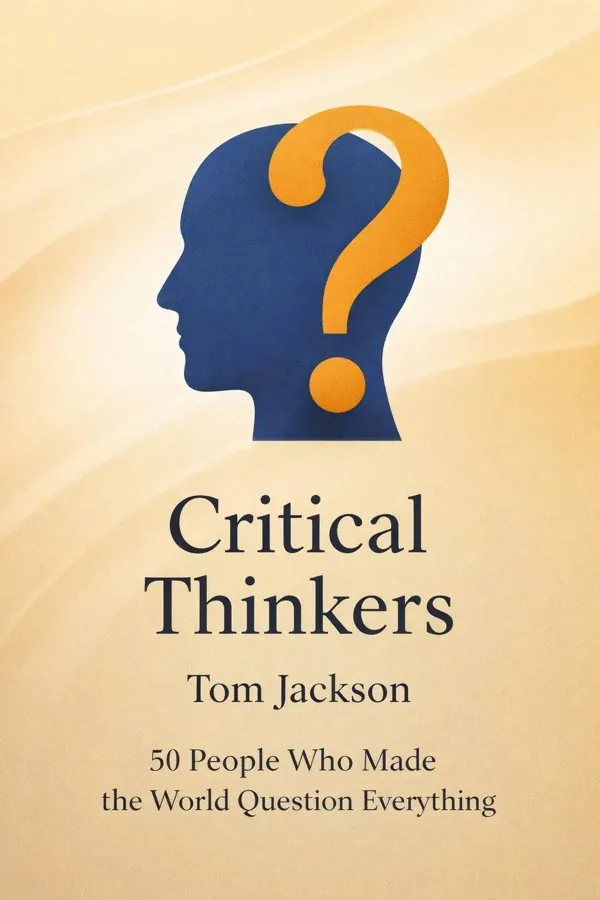
Critical Thinkers: 50 People Who Made the World Question Everything: Summary & Key Insights
by Tom Jackson
 10 min8 chaptersAudio available
Key Takeaways from Critical Thinkers: 50 People Who Made the World Question Everything
Civilizations advance not when people memorize accepted truths, but when someone dares to ask whether those truths deserve acceptance at all.
A brilliant mind is useless if it is afraid to think aloud.
The most powerful insight in Jackson’s approach is that critical thinking does not belong to one discipline.
Authority becomes dangerous when it stops expecting to be questioned.
People do not usually look for truth; they look for confirmation.
What Is Critical Thinkers: 50 People Who Made the World Question Everything About?
Critical Thinkers: 50 People Who Made the World Question Everything by Tom Jackson is a great_ideas book. What happens when someone refuses to accept the obvious answer? Tom Jackson’s Critical Thinkers: 50 People Who Made the World Question Everything is a lively intellectual tour through the minds that disrupted certainty and changed history. Spanning philosophy, science, politics, religion, and social thought, the book introduces fifty influential figures whose ideas challenged inherited beliefs and forced societies to rethink truth, power, morality, and human nature. Rather than presenting thinking as an abstract academic exercise, Jackson shows how bold questions reshape entire civilizations. The book matters because it reminds us that progress rarely begins with agreement. It begins with doubt, curiosity, contradiction, and the courage to ask what everyone else has overlooked. In an age crowded with noise, ideology, and misinformation, revisiting the habits of great thinkers is more than educational—it is practical. Jackson, a prolific nonfiction author known for making complex topics accessible, brings clarity, historical context, and narrative energy to each profile. The result is an engaging guide not only to famous names, but to the enduring methods of inquiry that help readers think more carefully, independently, and honestly about the world.
This FizzRead summary covers all 8 key chapters of Critical Thinkers: 50 People Who Made the World Question Everything in approximately 10 minutes, distilling the most important ideas, arguments, and takeaways from Tom Jackson's work. Also available as an audio summary and Key Quotes Podcast.
Critical Thinkers: 50 People Who Made the World Question Everything
What happens when someone refuses to accept the obvious answer? Tom Jackson’s Critical Thinkers: 50 People Who Made the World Question Everything is a lively intellectual tour through the minds that disrupted certainty and changed history. Spanning philosophy, science, politics, religion, and social thought, the book introduces fifty influential figures whose ideas challenged inherited beliefs and forced societies to rethink truth, power, morality, and human nature. Rather than presenting thinking as an abstract academic exercise, Jackson shows how bold questions reshape entire civilizations.
The book matters because it reminds us that progress rarely begins with agreement. It begins with doubt, curiosity, contradiction, and the courage to ask what everyone else has overlooked. In an age crowded with noise, ideology, and misinformation, revisiting the habits of great thinkers is more than educational—it is practical. Jackson, a prolific nonfiction author known for making complex topics accessible, brings clarity, historical context, and narrative energy to each profile. The result is an engaging guide not only to famous names, but to the enduring methods of inquiry that help readers think more carefully, independently, and honestly about the world.
Who Should Read Critical Thinkers: 50 People Who Made the World Question Everything?
This book is perfect for anyone interested in great_ideas and looking to gain actionable insights in a short read. Whether you're a student, professional, or lifelong learner, the key ideas from Critical Thinkers: 50 People Who Made the World Question Everything by Tom Jackson will help you think differently.
- ✓Readers who enjoy great_ideas and want practical takeaways
- ✓Professionals looking to apply new ideas to their work and life
- ✓Anyone who wants the core insights of Critical Thinkers: 50 People Who Made the World Question Everything in just 10 minutes
Want the full summary?
Get instant access to this book summary and 100K+ more with Fizz Moment.
Get Free SummaryAvailable on App Store • Free to download
Key Chapters
Civilizations advance not when people memorize accepted truths, but when someone dares to ask whether those truths deserve acceptance at all. One of the central lessons of Critical Thinkers is that intellectual progress begins with discomfort. The figures in Jackson’s book did not become influential because they had easy answers; they became influential because they challenged assumptions so deeply rooted that questioning them seemed dangerous, absurd, or even immoral.
From Socrates probing Athenian certainty to Galileo confronting accepted cosmology, critical thinking appears here as an act of disciplined doubt. The point is not skepticism for its own sake. It is the recognition that beliefs—especially popular ones—must be tested. Jackson’s portraits reveal that many world-changing thinkers began with simple but destabilizing questions: How do we know this is true? Who benefits from this belief? What if the opposite were possible? Those questions opened pathways to modern science, political liberty, ethical reform, and psychological insight.
This idea has immediate relevance today. In workplaces, teams often repeat outdated processes because “that’s how it’s always been done.” In public life, people inherit opinions from their social group without examining evidence. In personal decisions, individuals cling to narratives about success, identity, or relationships that may no longer serve them. Critical thinkers interrupt these patterns by slowing down and examining premises.
A practical application is to build a habit of assumption-checking. Before accepting a claim, identify what must be true for that claim to hold. If someone says a policy will solve a problem, ask what evidence supports that prediction. If a long-held personal belief shapes your choices, ask where it came from and whether it still fits reality.
Actionable takeaway: each day, choose one “obvious” belief—your own or someone else’s—and ask three questions about it: What evidence supports it, what evidence challenges it, and what happens if it is wrong?
A brilliant mind is useless if it is afraid to think aloud. Jackson’s book makes clear that critical thought is not merely an intellectual skill; it is a moral and social act that often demands courage. Many of the thinkers featured did not simply analyze ideas in comfort. They faced ridicule, exile, censorship, imprisonment, or social rejection because their conclusions threatened authorities, traditions, or common prejudices.
This matters because people often imagine critical thinking as detached and purely rational. But the history of ideas shows that reason must operate in environments shaped by power. A thinker may see flaws in a system, but speaking up can carry real costs. Whether challenging monarchy, church doctrine, racial hierarchy, economic exploitation, or gender norms, the most influential minds were often confronting institutions with strong incentives to suppress dissent.
Jackson’s profiles show that courage takes different forms. Sometimes it is public confrontation, as with reformers and revolutionaries. Sometimes it is patient persistence, as with scientists gathering evidence over years in the face of mockery. Sometimes it is intellectual honesty: admitting uncertainty, revising one’s position, or refusing to defend a convenient falsehood.
In modern life, this lesson applies far beyond famous debates. Employees may notice unethical practices but remain silent to protect careers. Students may repeat fashionable opinions instead of testing them. Citizens may avoid politically inconvenient truths because truth threatens tribal belonging. Critical thinking becomes transformative only when paired with the willingness to endure discomfort.
You can practice this by identifying one area in your life where silence protects convenience. Perhaps a meeting rewards consensus over truth, or a friend group treats one narrative as untouchable. Start small: voice a clarifying question, request evidence, or respectfully introduce an alternative interpretation.
Actionable takeaway: once this week, speak one honest, well-reasoned thought that you would usually keep to yourself—not to provoke, but to improve clarity, fairness, or truth.
The most powerful insight in Jackson’s approach is that critical thinking does not belong to one discipline. It appears in philosophy, astronomy, biology, political theory, economics, psychology, and social reform. By placing fifty diverse figures in one volume, the book reveals a pattern: transformative thinking emerges whenever someone applies disciplined inquiry to the deepest assumptions of a field.
This broad scope is important because readers often separate kinds of knowledge too sharply. They may think scientists deal in facts, philosophers in abstractions, and activists in emotion. Jackson shows that genuine breakthroughs often cross these boundaries. Darwin reshaped biology, but his work also altered theology and human self-understanding. Marx examined economics, yet his analysis changed politics and social struggle. Freud proposed ideas about the mind that influenced culture far beyond clinical practice. Wollstonecraft’s critique of gender inequality was philosophical, political, and deeply practical at once.
The book demonstrates that great thinkers do more than accumulate information. They create new frameworks. A framework changes what counts as a valid question, what evidence matters, and what future inquiry becomes possible. Once heliocentrism took hold, astronomy changed. Once democratic rights were articulated differently, politics changed. Once unconscious motivation was proposed, interpretations of behavior changed.
For readers, the practical lesson is to stop confining critical thought to “big” issues or specialized experts. The same method works in everyday problem-solving. If sales are falling, perhaps the issue is not marketing but product design. If a child struggles in school, the problem may not be effort but environment. If a social conflict keeps recurring, the real issue may be incentives rather than personalities.
Actionable takeaway: when facing a problem, ask not just “How do I fix it?” but “What field or framework am I using to define it—and what happens if I redefine the problem from another angle?”
People do not usually look for truth; they look for confirmation. One of the strongest threads running through Jackson’s gallery of thinkers is the insistence that evidence matters most when it threatens what we already believe. Scientific and philosophical revolutions often occurred because someone took observations seriously even when those observations contradicted cherished assumptions.
Galileo’s telescopic findings, Darwin’s naturalistic explanations, and later psychological or social theorists all disrupted settled views by forcing people to confront inconvenient evidence. Jackson’s treatment highlights a crucial distinction: critical thinkers are not simply opinionated. They are willing to let reality revise them. That is why they remain influential. Their method prizes argument, observation, coherence, and testability over loyalty to tradition or ideology.
This lesson is especially urgent now because information abundance can create evidence avoidance. People can assemble selective facts to support almost any conclusion. Confirmation bias, partisan filtering, and social media incentives reward certainty over revision. The result is not more knowledge, but more defensive belief. Critical thinking asks for the opposite discipline: seek the strongest opposing case, not the weakest.
In everyday decision-making, this principle can improve judgment dramatically. Before launching a business idea, look for reasons it might fail. Before making a health decision, compare high-quality evidence instead of relying on anecdotes. Before entering an argument, state what evidence would change your mind. Doing so turns debate into inquiry.
A practical tool is the “disconfirmation checklist.” For any major belief or decision, ask: What evidence am I ignoring? What would my smartest critic say? What result would prove me wrong? This simple habit reduces overconfidence and improves clarity.
Actionable takeaway: for your next important decision, spend at least ten minutes gathering evidence against your preferred conclusion before committing to it.
The way we describe reality often determines the range of realities we can imagine. Although many thinkers in Jackson’s book are remembered for grand systems or discoveries, another subtle lesson emerges from their work: concepts and language are tools that shape thought itself. When a thinker introduces a new distinction, definition, or vocabulary, they are not merely labeling the world—they are reorganizing it.
Philosophers have long understood this. Socrates exposed sloppy thinking through questioning. Enlightenment thinkers clarified rights, consent, and sovereignty in ways that changed political possibilities. Psychologists and social critics gave names to internal drives, prejudice, and social structures, making invisible forces discussable. Once a concept exists, it can be argued about, refined, taught, and acted upon.
This matters because much confusion persists not from lack of intelligence, but from vague language. People argue fiercely while using the same word to mean different things: freedom, justice, equality, truth, progress. Critical thinkers slow down and define terms. They ask what exactly is being claimed and what assumptions the words carry. Better language does not guarantee better conclusions, but it makes hidden confusion visible.
The practical applications are immediate. In a workplace dispute, people may differ not on goals, but on what “urgent” or “successful” means. In relationships, conflict often shrinks when terms like respect, support, or commitment are clarified. In public debate, asking for precise definitions often reveals whether a claim is substantive or rhetorical.
One useful habit is conceptual translation. If someone makes a sweeping claim, restate it in concrete terms. Replace abstractions with observable examples. Ask: What would this look like in practice? What exactly counts as evidence here? Precision turns emotional fog into analyzable thought.
Actionable takeaway: the next time a debate becomes heated, pause and define the two most important terms before continuing. Better definitions often produce better thinking.
A person who never examines their own mind is easily governed by it. Jackson’s collection does not only celebrate public revolutionaries; it also points toward an inward dimension of critical thought. Many major thinkers asked not just how society works, but how belief, desire, fear, and identity shape perception. In that sense, critical thinking begins at home—in the unseen habits of the self.
Socrates’ call to examine life, Augustine’s introspective reflections, Freud’s theories of unconscious motive, and later moral and existential thinkers all suggest that human beings are not transparent to themselves. We rationalize. We protect ego. We confuse habit with conviction. We mistake social conditioning for personal truth. Without self-examination, intelligence can become a tool for self-deception.
This idea is practical because modern life encourages constant reaction but little reflection. People move rapidly from headline to headline, task to task, opinion to opinion. Yet the quality of our judgments depends heavily on whether we notice our own biases, emotional triggers, and inherited scripts. Why does a certain criticism feel intolerable? Why do we dismiss one kind of evidence quickly but not another? Why are some beliefs tied to identity rather than reason?
Self-examination does not mean endless doubt or paralysis. It means learning to separate observation from impulse. Journaling, reflective reading, meditation, and difficult conversation can all strengthen this capacity. Leaders who understand their own defensiveness make better decisions. Citizens who recognize tribal loyalties think more independently. Individuals who notice recurring patterns gain room to change them.
A simple exercise is to track your certainty. Whenever you feel immediately sure about a person, issue, or event, ask what emotion is traveling with that certainty. Often the answer reveals more than the conclusion itself.
Actionable takeaway: for one week, write down one strong opinion each day and note the emotion, experience, or identity attachment that may be reinforcing it.
The mark of serious thought is not perfect confidence but the ability to change. Jackson’s book honors influential minds, yet one of its implicit lessons is that intellectual greatness is often tied to revision. Even the most celebrated thinkers were part of evolving conversations, not final destinations. Some corrected earlier traditions; others were later corrected themselves. This ongoing revision is not a weakness of critical thinking—it is its strength.
Too often, people imagine thinkers as authorities to quote rather than methods to emulate. But the history Jackson presents shows a more dynamic process. New evidence, new historical conditions, and new conceptual tools continually reopen old questions. Some once-radical ideas become mainstream; some celebrated theories prove incomplete or wrong. What endures is not infallibility, but the disciplined willingness to reexamine.
This is deeply relevant in any era of polarization. People feel pressure to sound certain, consistent, and unwavering. Yet certainty can become vanity. A more mature intellectual posture is conditional confidence: holding beliefs firmly enough to act, but lightly enough to revise. This makes learning possible. It also improves relationships, since many conflicts escalate because people defend old positions simply to avoid appearing inconsistent.
In practical settings, revision is a competitive advantage. Businesses improve when leaders admit a failed strategy quickly. Students learn faster when they treat mistakes as feedback. In personal life, growth often begins when someone says, “I used to think this, but I now see more clearly.” That statement is not defeat; it is development.
Try creating a “belief update” practice. Once a month, identify one opinion that has changed or should change based on better evidence or reflection. Record why. Over time, this builds humility and a more honest relationship with knowledge.
Actionable takeaway: name one belief you hold strongly and write down what specific evidence or experience would cause you to revise it.
All Chapters in Critical Thinkers: 50 People Who Made the World Question Everything
About the Author
Tom Jackson is a British author, editor, and popular science writer known for making complex subjects accessible to general readers. He has written extensively on science, history, technology, nature, and big ideas, producing books that combine educational value with clear, engaging storytelling. Jackson is especially recognized for his ability to distill large topics into approachable formats without losing their intellectual substance. His works often explore the people, discoveries, and concepts that have shaped human understanding. In Critical Thinkers, he brings that talent to the history of ideas, introducing readers to influential minds across centuries and disciplines. His writing appeals to curious readers who want reliable, readable overviews of challenging subjects.
Get This Summary in Your Preferred Format
Read or listen to the Critical Thinkers: 50 People Who Made the World Question Everything summary by Tom Jackson anytime, anywhere. FizzRead offers multiple formats so you can learn on your terms — all free.
Available formats: App · Audio · PDF · EPUB — All included free with FizzRead
Download Critical Thinkers: 50 People Who Made the World Question Everything PDF and EPUB Summary
Key Quotes from Critical Thinkers: 50 People Who Made the World Question Everything
“Civilizations advance not when people memorize accepted truths, but when someone dares to ask whether those truths deserve acceptance at all.”
“A brilliant mind is useless if it is afraid to think aloud.”
“The most powerful insight in Jackson’s approach is that critical thinking does not belong to one discipline.”
“Authority becomes dangerous when it stops expecting to be questioned.”
“People do not usually look for truth; they look for confirmation.”
Frequently Asked Questions about Critical Thinkers: 50 People Who Made the World Question Everything
Critical Thinkers: 50 People Who Made the World Question Everything by Tom Jackson is a great_ideas book that explores key ideas across 8 chapters. What happens when someone refuses to accept the obvious answer? Tom Jackson’s Critical Thinkers: 50 People Who Made the World Question Everything is a lively intellectual tour through the minds that disrupted certainty and changed history. Spanning philosophy, science, politics, religion, and social thought, the book introduces fifty influential figures whose ideas challenged inherited beliefs and forced societies to rethink truth, power, morality, and human nature. Rather than presenting thinking as an abstract academic exercise, Jackson shows how bold questions reshape entire civilizations. The book matters because it reminds us that progress rarely begins with agreement. It begins with doubt, curiosity, contradiction, and the courage to ask what everyone else has overlooked. In an age crowded with noise, ideology, and misinformation, revisiting the habits of great thinkers is more than educational—it is practical. Jackson, a prolific nonfiction author known for making complex topics accessible, brings clarity, historical context, and narrative energy to each profile. The result is an engaging guide not only to famous names, but to the enduring methods of inquiry that help readers think more carefully, independently, and honestly about the world.
You Might Also Like


Browse by Category
Ready to read Critical Thinkers: 50 People Who Made the World Question Everything?
Get the full summary and 100K+ more books with Fizz Moment.