
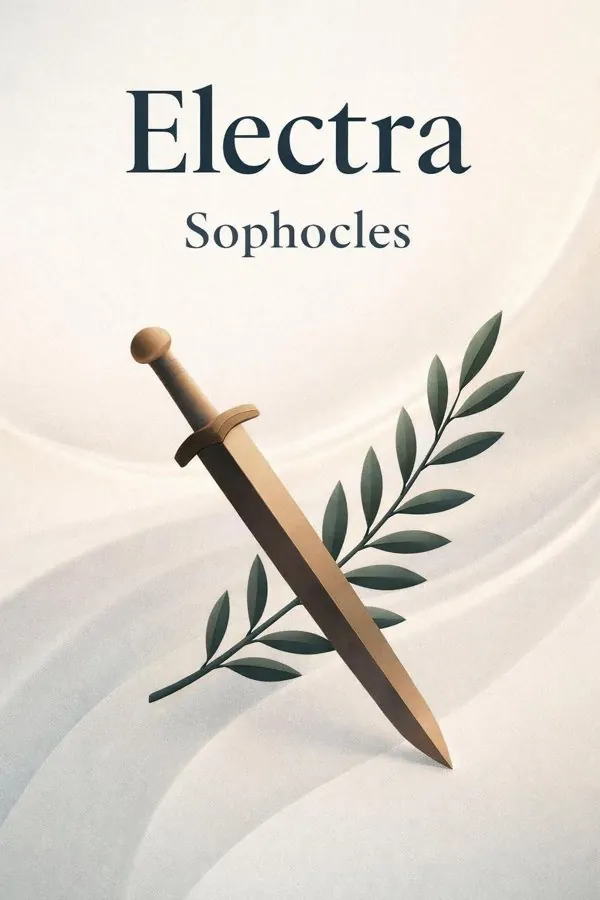
Electra: Summary & Key Insights
by Sophocles
 10 min6 chaptersAudio available
What Is Electra About?
Electra by Sophocles is a classics book spanning 6 pages. Electra is one of Sophocles’ most powerful tragedies, dramatizing the vengeance of Electra and her brother Orestes for the murder of their father, Agamemnon, by their mother, Clytemnestra, and her lover, Aegisthus. The play explores themes of justice, familial loyalty, and moral conflict, standing as one of the finest examples of ancient Greek tragedy.
This FizzRead summary covers all 6 key chapters of Electra in approximately 10 minutes, distilling the most important ideas, arguments, and takeaways from Sophocles's work. Also available as an audio summary and Key Quotes Podcast.
Electra
Electra is one of Sophocles’ most powerful tragedies, dramatizing the vengeance of Electra and her brother Orestes for the murder of their father, Agamemnon, by their mother, Clytemnestra, and her lover, Aegisthus. The play explores themes of justice, familial loyalty, and moral conflict, standing as one of the finest examples of ancient Greek tragedy.
Who Should Read Electra?
This book is perfect for anyone interested in classics and looking to gain actionable insights in a short read. Whether you're a student, professional, or lifelong learner, the key ideas from Electra by Sophocles will help you think differently.
- ✓Readers who enjoy classics and want practical takeaways
- ✓Professionals looking to apply new ideas to their work and life
- ✓Anyone who wants the core insights of Electra in just 10 minutes
Want the full summary?
Get instant access to this book summary and 100K+ more with Fizz Moment.
Get Free SummaryAvailable on App Store • Free to download
Key Chapters
When the play opens, the Mycenaean palace looms like a tomb. Within its walls, I let the audience witness a daughter who has made lamentation her daily breath. Electra emerges in relentless mourning, unwashed, unclothed in finery, her voice a dirge that never ends. She grieves not only the death of her father, Agamemnon, but the desecration of his honor — slain by the hand that once shared his bed. That act has unmoored the world she knew. Now her mother sits crowned beside her lover, Aegisthus, and Electra lives like a prisoner beneath their roof, sustained only by her defiance.
In shaping her solitude, I wanted to portray how devotion, when stripped of hope, curdles into a sacred kind of madness. Her complaints, repeated and ritualized, transform grief into resistance. Each invocation of her father’s name reasserts a moral claim upon the world — that wickedness cannot stand uncorrected. When the chorus of Mycenaean women enters, they answer her cries not with reproach but with compassion. They see in her ceaseless mourning both a wound and a warning: a reminder that beneath royal silence festers a crime still unanswered.
Yet even compassion isolates her further. The chorus, bound by fear, dares only to sympathize, not to act. Electra’s isolation thus deepens; she stands apart from all, refusing consolation, refusing compromise. Her grief becomes moral territory, a place where she alone still honors the dead king, keeping alive the memory that others wish to forget. In that refusal lies her nobility — and her doom.
Through the arrival of Chrysothemis, Electra’s sister, I sought to embody the gentler human instinct: the longing for survival through submission. Chrysothemis fears the wrath of their mother and Aegisthus, and counsels her sister to bow to necessity — to live quietly, to avoid punishment. Her reasoning is practical, even compassionate; she believes endurance is the wiser virtue. In contrast, Electra’s words blaze. She calls her sister’s prudence cowardice and her compliance, betrayal.
In composing their dialogue, I wanted to expose the tension between private integrity and public safety. Chrysothemis’ moderation springs from the logic of the everyday — one must suffer what one cannot change. But Electra’s spirit refuses that arithmetic. She measures life by moral consistency alone: to be silent, she insists, is to consent. Through their contrast, I invite the audience to question whether justice can ever coexist with obedience under moral corruption.
Each sister mirrors a possible path for humankind when faced with moral atrocity. Chrysothemis offers the peace of compromise; Electra, the agony of truth. Yet only in Electra’s agony does the ancient moral order find its champion. She would rather die unreconciled than live dishonored. In her defiance, I sought to give voice to the idea that one soul, steadfast in its reverence for justice, can become the axis upon which the wheel of fate turns.
+ 4 more chapters — available in the FizzRead app
All Chapters in Electra
About the Author
Sophocles (c. 496–406 BCE) was one of the three great tragedians of ancient Greece, alongside Aeschylus and Euripides. He wrote over 120 plays, of which seven survive in complete form. His innovations in dramatic structure and character development profoundly influenced the evolution of Western drama.
Get This Summary in Your Preferred Format
Read or listen to the Electra summary by Sophocles anytime, anywhere. FizzRead offers multiple formats so you can learn on your terms — all free.
Available formats: App · Audio · PDF · EPUB — All included free with FizzRead
Download Electra PDF and EPUB Summary
Key Quotes from Electra
“When the play opens, the Mycenaean palace looms like a tomb.”
“Through the arrival of Chrysothemis, Electra’s sister, I sought to embody the gentler human instinct: the longing for survival through submission.”
Frequently Asked Questions about Electra
Electra by Sophocles is a classics book that explores key ideas across 6 chapters. Electra is one of Sophocles’ most powerful tragedies, dramatizing the vengeance of Electra and her brother Orestes for the murder of their father, Agamemnon, by their mother, Clytemnestra, and her lover, Aegisthus. The play explores themes of justice, familial loyalty, and moral conflict, standing as one of the finest examples of ancient Greek tragedy.
More by Sophocles
You Might Also Like



Browse by Category
Ready to read Electra?
Get the full summary and 100K+ more books with Fizz Moment.