
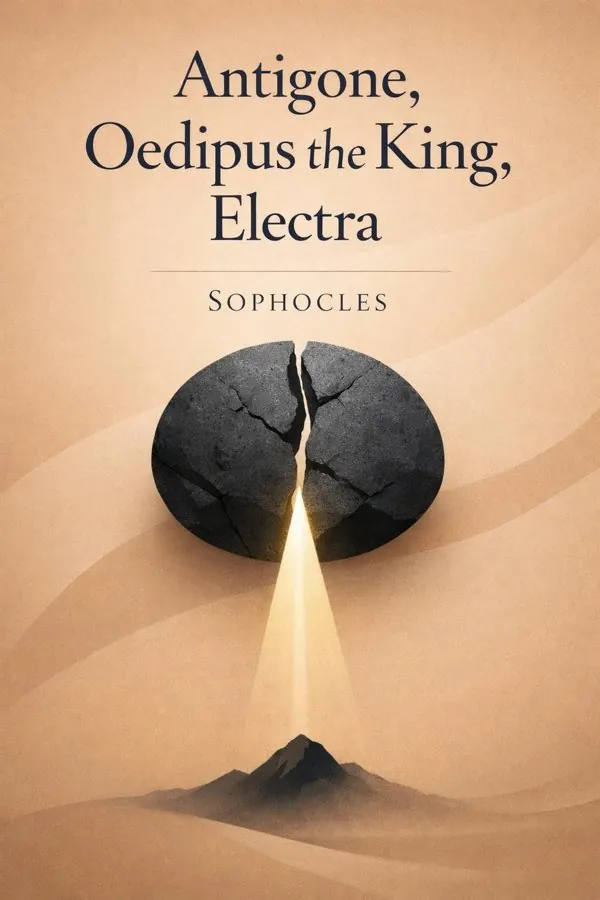
Antigone, Oedipus the King, Electra: Summary & Key Insights
by Sophocles
 10 min3 chaptersAudio available
What Is Antigone, Oedipus the King, Electra About?
Antigone, Oedipus the King, Electra by Sophocles is a classics book spanning 3 pages. This Oxford World's Classics edition brings together three of Sophocles’ greatest tragedies—Antigone, Oedipus the King, and Electra—each exploring themes of fate, justice, and moral responsibility. The volume includes an authoritative translation, introduction, and notes that provide historical and literary context for modern readers.
This FizzRead summary covers all 3 key chapters of Antigone, Oedipus the King, Electra in approximately 10 minutes, distilling the most important ideas, arguments, and takeaways from Sophocles's work. Also available as an audio summary and Key Quotes Podcast.
Antigone, Oedipus the King, Electra
This Oxford World's Classics edition brings together three of Sophocles’ greatest tragedies—Antigone, Oedipus the King, and Electra—each exploring themes of fate, justice, and moral responsibility. The volume includes an authoritative translation, introduction, and notes that provide historical and literary context for modern readers.
Who Should Read Antigone, Oedipus the King, Electra?
This book is perfect for anyone interested in classics and looking to gain actionable insights in a short read. Whether you're a student, professional, or lifelong learner, the key ideas from Antigone, Oedipus the King, Electra by Sophocles will help you think differently.
- ✓Readers who enjoy classics and want practical takeaways
- ✓Professionals looking to apply new ideas to their work and life
- ✓Anyone who wants the core insights of Antigone, Oedipus the King, Electra in just 10 minutes
Want the full summary?
Get instant access to this book summary and 100K+ more with Fizz Moment.
Get Free SummaryAvailable on App Store • Free to download
Key Chapters
When the curtain rises over Thebes, the land is scarred from civil war. The brothers Eteocles and Polynices have slain each other, and the throne falls to Creon, who decrees that Polynices—deemed a traitor—must lie unburied. The law he announces is not born of malice but of civic necessity; he believes in the order that preserves the state. And yet, in his zeal, he touches a sacred boundary: he forbids burial, a rite protected by divine command.
Antigone, sister of the fallen, refuses silence. For her, human law cannot overrule divine justice. Burial is more than tradition—it is reverence, an act demanded by the gods themselves. In her defiance, you may see rebellion, but beneath it lies devotion. She acts alone, knowing death must follow. Her courage is not reckless passion but solemn resolve. She embodies that moment every soul faces when conscience outshines fear.
Creon’s confrontation with her is the clash of two empires—the empire of the city and the empire of the spirit. He stands for stability, she for sanctity. Their dialogue is not merely argument; it is philosophy turned to flame. Both are right, and that is their tragedy. Creon holds that the state’s survival depends upon obedience; Antigone insists that justice depends upon obedience to a higher, eternal law.
When Teiresias, the prophet, enters, his words carry divine warning. He tells Creon the gods reject sacrifice because of his pride, that the city will suffer and his household will collapse under the weight of his stubbornness. Only then does Creon’s armor crack, too late to save those he loves. Antigone has hanged herself, Haemon has fallen upon his sword, and Eurydice, Creon’s wife, has taken her own life upon hearing of her son’s death.
In Antigone’s silence, and Creon’s lament, I wanted to show not victory but revelation. The tragedy lies in the delay of understanding—that we see truth only when consequence has finished its work. Antigone teaches that defiance, when born of conscience, transcends punishment. Creon teaches that power, when deaf to compassion, brings its own ruin. Between them stands humanity’s eternal choice: obedience that saves the city or defiance that saves the soul.
In this story of Oedipus, king of Thebes, knowledge itself becomes a weapon. Thebes languishes under plague, and Oedipus vows to discover its cause. He is everything a ruler should be—resolute, intelligent, beloved by the people. But the gods have written a prophecy that he cannot escape: that he will kill his father and marry his mother.
The city’s suffering drives him to summon Teiresias, who knows the hidden truth. The prophet speaks reluctantly, hinting that Oedipus himself is the source of the pollution. The king, furious, accuses both prophet and Creon of conspiracy. That rage springs not from arrogance alone but from terror; it is the reflex of a soul sensing its own destruction far in advance of reason.
As the investigation unfolds, layers of memory fall away. The messenger from Corinth brings news of his adoptive father’s death, which to Oedipus seems release from prophecy. Yet it is precisely this moment that binds his fate tighter—he learns he was not of Corinth’s royal house but found abandoned on a mountainside. The shepherd’s testimony pierces the veil at last: Oedipus himself is the child of Laius and Jocasta. The murderer he sought is none but himself.
When truth arrives, it does not come gently. Jocasta hangs herself, and Oedipus blinds his eyes, for sight has deceived him and insight demands pain. His self–inflicted blindness is not merely punishment—it is transformation. He moves from seeming wisdom to true understanding, from seeing without knowing to knowing without sight.
Through Oedipus I wished to show the paradox of human inquiry: that our pursuit of answers may lead us to truths we are unready to endure. His tragedy is universal, for every mind that asks, "Who am I?" risks discovering what cannot be undone. The gods do not play cruelty for sport; they reveal through suffering the law that governs all things—that knowledge, stripped of humility, is perilous, and sight without the heart’s wisdom is blindness itself.
+ 1 more chapters — available in the FizzRead app
All Chapters in Antigone, Oedipus the King, Electra
About the Author
Get This Summary in Your Preferred Format
Read or listen to the Antigone, Oedipus the King, Electra summary by Sophocles anytime, anywhere. FizzRead offers multiple formats so you can learn on your terms — all free.
Available formats: App · Audio · PDF · EPUB — All included free with FizzRead
Download Antigone, Oedipus the King, Electra PDF and EPUB Summary
Key Quotes from Antigone, Oedipus the King, Electra
“When the curtain rises over Thebes, the land is scarred from civil war.”
“In this story of Oedipus, king of Thebes, knowledge itself becomes a weapon.”
Frequently Asked Questions about Antigone, Oedipus the King, Electra
Antigone, Oedipus the King, Electra by Sophocles is a classics book that explores key ideas across 3 chapters. This Oxford World's Classics edition brings together three of Sophocles’ greatest tragedies—Antigone, Oedipus the King, and Electra—each exploring themes of fate, justice, and moral responsibility. The volume includes an authoritative translation, introduction, and notes that provide historical and literary context for modern readers.
More by Sophocles
You Might Also Like





Browse by Category
Ready to read Antigone, Oedipus the King, Electra?
Get the full summary and 100K+ more books with Fizz Moment.