
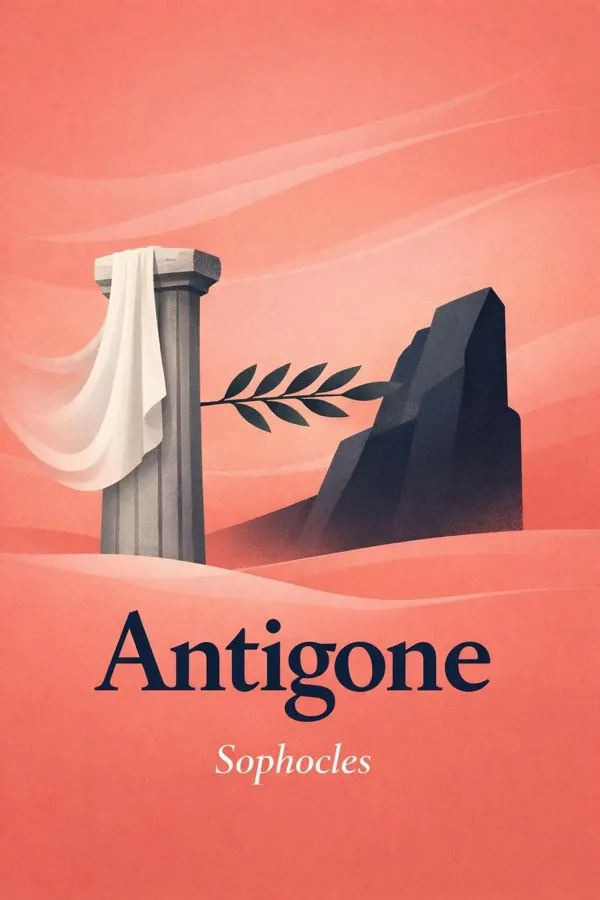
Antigone: Summary & Key Insights
by Sophocles
 10 min9 chaptersAudio available
Key Takeaways from Antigone
Sometimes the most important decisions are made before the world is even watching.
Power often sounds most confident when it is most afraid.
A law can command obedience without earning moral legitimacy.
The greatest danger in leadership is not strength, but the inability to be corrected.
There are moments when accepting punishment becomes part of the message.
What Is Antigone About?
Antigone by Sophocles is a classics book spanning 5 pages. What happens when obedience to the state demands betrayal of the soul? Sophocles’s Antigone, first performed around 441 BCE, stages that question with unforgettable force. Set in the aftermath of civil war in Thebes, the play follows Antigone as she defies King Creon’s order forbidding the burial of her brother Polynices. To Creon, the decree protects civic order; to Antigone, it violates divine law, family duty, and basic human dignity. From that collision comes one of the most enduring tragedies in world literature. Antigone matters because it never stays safely in the ancient past. Its conflicts still shape modern life: conscience versus law, public power versus private morality, political rigidity versus compassion, and the cost of speaking when silence is safer. Sophocles writes with exceptional authority as one of ancient Greece’s greatest tragedians, transforming a mythic story into a profound study of leadership, justice, grief, and pride. The play is compact, but its moral reach is vast. Whether you read it as political drama, ethical inquiry, or emotional tragedy, Antigone remains a sharp and urgent meditation on what we owe the dead, the living, and our own convictions.
This FizzRead summary covers all 9 key chapters of Antigone in approximately 10 minutes, distilling the most important ideas, arguments, and takeaways from Sophocles's work. Also available as an audio summary and Key Quotes Podcast.
Antigone
What happens when obedience to the state demands betrayal of the soul? Sophocles’s Antigone, first performed around 441 BCE, stages that question with unforgettable force. Set in the aftermath of civil war in Thebes, the play follows Antigone as she defies King Creon’s order forbidding the burial of her brother Polynices. To Creon, the decree protects civic order; to Antigone, it violates divine law, family duty, and basic human dignity. From that collision comes one of the most enduring tragedies in world literature.
Antigone matters because it never stays safely in the ancient past. Its conflicts still shape modern life: conscience versus law, public power versus private morality, political rigidity versus compassion, and the cost of speaking when silence is safer. Sophocles writes with exceptional authority as one of ancient Greece’s greatest tragedians, transforming a mythic story into a profound study of leadership, justice, grief, and pride. The play is compact, but its moral reach is vast. Whether you read it as political drama, ethical inquiry, or emotional tragedy, Antigone remains a sharp and urgent meditation on what we owe the dead, the living, and our own convictions.
Who Should Read Antigone?
This book is perfect for anyone interested in classics and looking to gain actionable insights in a short read. Whether you're a student, professional, or lifelong learner, the key ideas from Antigone by Sophocles will help you think differently.
- ✓Readers who enjoy classics and want practical takeaways
- ✓Professionals looking to apply new ideas to their work and life
- ✓Anyone who wants the core insights of Antigone in just 10 minutes
Want the full summary?
Get instant access to this book summary and 100K+ more with Fizz Moment.
Get Free SummaryAvailable on App Store • Free to download
Key Chapters
Sometimes the most important decisions are made before the world is even watching. Antigone begins not with a battlefield or royal proclamation, but with a private conversation between two sisters standing in the shadow of catastrophe. Their brothers, Eteocles and Polynices, have killed each other in civil war. Creon, the new ruler of Thebes, has ordered that Eteocles be honored with burial while Polynices, branded a traitor, must remain unburied. In the ancient Greek world, denying burial was not merely a political punishment. It was a spiritual violation that endangered the dead and dishonored the family.
Antigone immediately sees the decree as intolerable. To her, no king has the authority to override the sacred obligations owed to kin and to the gods. Ismene, by contrast, fears the consequences. She is not heartless; she is realistic. She knows that women in Thebes hold little power and that disobeying Creon will almost certainly mean death. Their exchange introduces one of the play’s deepest tensions: is moral courage defined by action at any cost, or can prudence also be a form of wisdom?
This opening scene matters because it shows that tragedy begins in interpretation. Antigone and Ismene are looking at the same facts, yet they understand duty differently. The scene also reminds us that ethical choices rarely arrive in ideal conditions. We often act under fear, grief, confusion, and unequal power.
In modern life, this dilemma appears whenever people must decide whether to challenge an unjust policy at work, defend a vulnerable family member, or speak against a harmful institutional rule. Not everyone can act in the same way, but everyone must decide what they can live with.
Actionable takeaway: When facing a moral conflict, ask yourself not only, “What is safest?” but also, “What obligation would I betray if I stayed silent?”
A law can command obedience without earning moral legitimacy. That is the heart of Antigone’s confrontation with Creon. After she performs burial rites for Polynices, however briefly, she is arrested and brought before the king. Creon expects denial, fear, or pleading. Instead, Antigone calmly admits what she has done and refuses to apologize. Her reasoning is direct: Creon’s edict is temporary and human, but the laws of the gods are unwritten, eternal, and higher than any ruler’s command.
This is the intellectual center of the play. Antigone is not simply rebellious by temperament. She is making a claim about the structure of justice itself. Some obligations, she argues, exist prior to the state. Burial, reverence for the dead, and loyalty to family are not privileges granted by government. They are sacred duties. Creon hears this as an attack on sovereignty. To him, if subjects can choose which laws to obey, the city will collapse.
Sophocles does not reduce the conflict to good versus evil. Antigone’s certainty gives her tremendous strength, but it also hardens her. Creon’s insistence on law reflects a genuine concern for civic order, but it becomes tyrannical because he cannot imagine that authority might have limits. The tragedy unfolds because both defend principles that contain truth, yet one principle without balance destroys the whole.
In contemporary life, this issue appears in debates about civil disobedience, conscientious objection, whistleblowing, and human rights. When institutions demand actions that violate conscience, people must decide whether legality is enough. History often honors those who refused immoral commands, even when their societies condemned them at the time.
Actionable takeaway: If a rule conflicts with a core moral principle, do not ask only whether disobedience is costly. Ask whether obedience would make you complicit in what you believe is wrong.
There are moments when accepting punishment becomes part of the message. After Antigone is caught, she does not hide behind excuses, blame others, or seek sympathy. She claims full responsibility for burying Polynices and stands before Creon as a moral witness. Her courage lies not only in breaking the law, but in refusing to let the meaning of her action be rewritten by power.
This scene deepens Antigone beyond the image of a rebellious heroine. She knows the likely outcome, yet she insists that death is preferable to betraying sacred duty. Her language elevates the issue from personal preference to universal principle. In doing so, she transforms from a grieving sister into a symbolic challenger of unjust authority. Sophocles shows how resistance can become public truth-telling: a single person standing openly for what a regime wants hidden.
At the same time, the scene reveals the emotional cost of such witness. Antigone’s bravery isolates her. Ismene tries to share responsibility, perhaps out of guilt or love, but Antigone rejects the offer because Ismene did not act when it mattered. The exchange is painful. It reminds us that integrity can produce loneliness, and that people under pressure do not always extend grace even to those closest to them.
Modern parallels are easy to find. Consider whistleblowers who expose wrongdoing and then face retaliation, activists arrested for nonviolent protest, or employees who refuse to carry out harmful instructions. Their public accountability often matters as much as the original act. By accepting consequences, they force others to see the moral stakes more clearly.
Still, Sophocles does not sentimentalize defiance. Witness is powerful, but it is costly, and its effects are unpredictable. Heroism does not spare anyone from suffering.
Actionable takeaway: If you must oppose something unjust, define clearly what you are standing for, because courage has greater power when its purpose is unmistakable.
Reason often speaks softly, and pride often refuses to hear it. Haemon, Creon’s son and Antigone’s betrothed, enters the drama as perhaps the play’s most balanced voice. He begins respectfully, assuring his father of loyalty, but gradually urges him to reconsider Antigone’s punishment. Haemon reports that the people of Thebes quietly sympathize with her. He argues that a ruler should not assume he alone possesses truth. Trees that bend in a storm survive; those that resist completely are uprooted.
This exchange is one of the play’s finest studies of intergenerational conflict and failed dialogue. Haemon does not begin in rebellion. He tries persuasion, tact, and political realism. But Creon hears disagreement as disobedience and interprets his son’s defense of Antigone as weakness or female manipulation. In response, the conversation escalates from counsel to accusation, from reason to rupture.
Sophocles highlights a painful truth: authoritarian behavior destroys relationships long before it produces visible catastrophe. Creon’s inability to listen does not simply harm the state. It corrodes his family. He reduces his son to an adversary and sees love as a threat to control. Leadership without humility becomes emotionally barren.
The scene also demonstrates that public decisions always have private victims. Creon thinks he is enforcing policy, but he is also deciding the fate of his son’s future, his family’s trust, and the emotional fabric of his house. Institutions often separate policy from people; tragedy reconnects them.
In everyday life, Haemon’s plea resembles what happens when colleagues, children, partners, or friends try to offer corrective feedback. The real test of authority is whether it can absorb honest dissent without retaliation.
Actionable takeaway: When someone close to you challenges your decision respectfully, treat that moment as an opportunity, not a threat. Listening early can prevent losses that apology later cannot repair.
Even the bravest convictions do not cancel grief. As Antigone is led to the cave where she will be entombed alive, the play slows into lament. She has spoken with iron certainty before Creon, but now Sophocles lets us see her as a young woman cut off from marriage, children, ordinary life, and the future she might have had. She compares herself to mythic figures and mourns that she goes to death neither fully alive nor properly dead.
This passage matters because it rescues Antigone from becoming a mere symbol. She is not only conscience or resistance; she is a person paying a human price. Tragedy gains its power from this doubleness. A decision can be morally admirable and still devastating. The modern urge to divide choices into winning and losing, right and wrong, heroic and foolish, breaks down here. Antigone may be right in principle, yet the suffering remains immense.
Her lament also raises hard questions about recognition. Antigone believes she is being punished for honoring the gods, yet she also longs to be seen, understood, and justified. Human beings rarely act from pure abstraction. Even noble sacrifice often contains a desire for witness, memory, and meaning.
In practical terms, this scene speaks to anyone who has endured the loneliness that can follow difficult ethical choices: leaving a corrupt workplace, ending loyalty to a destructive group, caring for a family member at personal cost, or speaking truths that alter relationships permanently. Doing the right thing does not always feel triumphant. Sometimes it feels like exile.
Actionable takeaway: If you choose a painful but principled path, make space to grieve what that choice costs. Moral clarity and emotional sorrow can coexist without contradiction.
Warnings are only useful to those willing to hear them in time. The blind prophet Tiresias enters when the moral and political crisis has nearly reached its breaking point. He tells Creon that the gods reject Thebes’s rituals because Polynices remains unburied and because Antigone, still living, has been sealed in a tomb. In effect, Creon has confused categories that the sacred order keeps distinct: the dead must be buried, and the living must not be treated as corpses.
At first Creon responds as he has to everyone else: with suspicion and anger. He accuses Tiresias of corruption and manipulation. But the chorus, more alarmed now, urges him to reconsider. Finally, fear cracks his certainty. He decides to bury Polynices and free Antigone. The reversal comes, but too late. Antigone has hanged herself. Haemon, discovering her body, attempts to kill Creon and then takes his own life. When Creon returns with Haemon’s corpse, he learns that his wife Eurydice has also died by suicide, cursing him with her final words.
This sequence reveals one of tragedy’s harshest lessons: recognition delayed can become indistinguishable from failure. Creon does eventually understand, but wisdom arrives after the damage is irreversible. Sophocles thereby warns that stubbornness is not corrected simply by later regret. Timing matters in ethics. Justice postponed can become injustice completed.
The scene also challenges the common hope that one apology or policy reversal can undo systemic harm. In personal life, leadership, and politics, delayed responsiveness often multiplies suffering. Refusing to listen early creates conditions where repair becomes impossible.
Actionable takeaway: Do not wait for overwhelming proof before correcting a harmful decision. If multiple trustworthy voices raise the same concern, act while change can still save something.
A classic survives because it keeps finding new audiences in new forms of crisis. Antigone continues to matter because its central conflicts never disappear. The play asks whether the state has limits, whether conscience can justify disobedience, whether leaders can govern without humility, and whether family loyalty can coexist with civic duty. None of these questions belong only to ancient Thebes.
Readers encounter Antigone today in contexts as varied as law, political theory, religion, feminism, leadership studies, and psychology. Some see Antigone as a defender of universal moral law. Others read her as a figure of resistance to patriarchal power, since Creon’s rage is sharpened by the fact that a woman has challenged him publicly. Still others focus on grief: the play begins in a family already broken by inherited violence, and nearly every decision emerges from unresolved mourning.
The drama also offers a practical framework for interpreting conflict. First, it reminds us that institutions need rules, but rules alone cannot define justice. Second, it shows that private relationships are never insulated from public power. Third, it teaches that listening is not weakness; it is a condition of wise authority. Finally, it insists that moral courage matters, even when it does not produce happy outcomes.
For modern readers, Antigone can illuminate workplace ethics, civil resistance, family disputes, and public leadership. When a policy seems efficient but inhumane, when loyalty to a group demands silence, or when a leader mistakes criticism for betrayal, Sophocles provides a language for understanding what is at stake.
Actionable takeaway: Use Antigone as a diagnostic tool: when conflict arises, identify the competing duties involved, ask who is not being heard, and examine whether pride is turning disagreement into disaster.
All Chapters in Antigone
About the Author
Sophocles (c. 496–406 BCE) was an ancient Greek playwright from Colonus, near Athens, and is widely regarded as one of the greatest tragedians in literary history. Alongside Aeschylus and Euripides, he helped define classical Greek tragedy. Sophocles is believed to have written more than 120 plays, though only seven survive complete today, including Antigone, Oedipus Rex, and Oedipus at Colonus. He was celebrated in his own lifetime for his dramatic skill and is known for deepening character psychology, refining plot structure, and expanding the role of dialogue in tragedy. His works explore fate, power, moral responsibility, and human suffering with remarkable clarity and emotional force. More than two millennia later, Sophocles remains essential reading for anyone interested in literature, philosophy, and the enduring complexity of human choice.
Get This Summary in Your Preferred Format
Read or listen to the Antigone summary by Sophocles anytime, anywhere. FizzRead offers multiple formats so you can learn on your terms — all free.
Available formats: App · Audio · PDF · EPUB — All included free with FizzRead
Download Antigone PDF and EPUB Summary
Key Quotes from Antigone
“Sometimes the most important decisions are made before the world is even watching.”
“Power often sounds most confident when it is most afraid.”
“A law can command obedience without earning moral legitimacy.”
“The greatest danger in leadership is not strength, but the inability to be corrected.”
“There are moments when accepting punishment becomes part of the message.”
Frequently Asked Questions about Antigone
Antigone by Sophocles is a classics book that explores key ideas across 9 chapters. What happens when obedience to the state demands betrayal of the soul? Sophocles’s Antigone, first performed around 441 BCE, stages that question with unforgettable force. Set in the aftermath of civil war in Thebes, the play follows Antigone as she defies King Creon’s order forbidding the burial of her brother Polynices. To Creon, the decree protects civic order; to Antigone, it violates divine law, family duty, and basic human dignity. From that collision comes one of the most enduring tragedies in world literature. Antigone matters because it never stays safely in the ancient past. Its conflicts still shape modern life: conscience versus law, public power versus private morality, political rigidity versus compassion, and the cost of speaking when silence is safer. Sophocles writes with exceptional authority as one of ancient Greece’s greatest tragedians, transforming a mythic story into a profound study of leadership, justice, grief, and pride. The play is compact, but its moral reach is vast. Whether you read it as political drama, ethical inquiry, or emotional tragedy, Antigone remains a sharp and urgent meditation on what we owe the dead, the living, and our own convictions.
More by Sophocles
You Might Also Like






Browse by Category
Ready to read Antigone?
Get the full summary and 100K+ more books with Fizz Moment.