
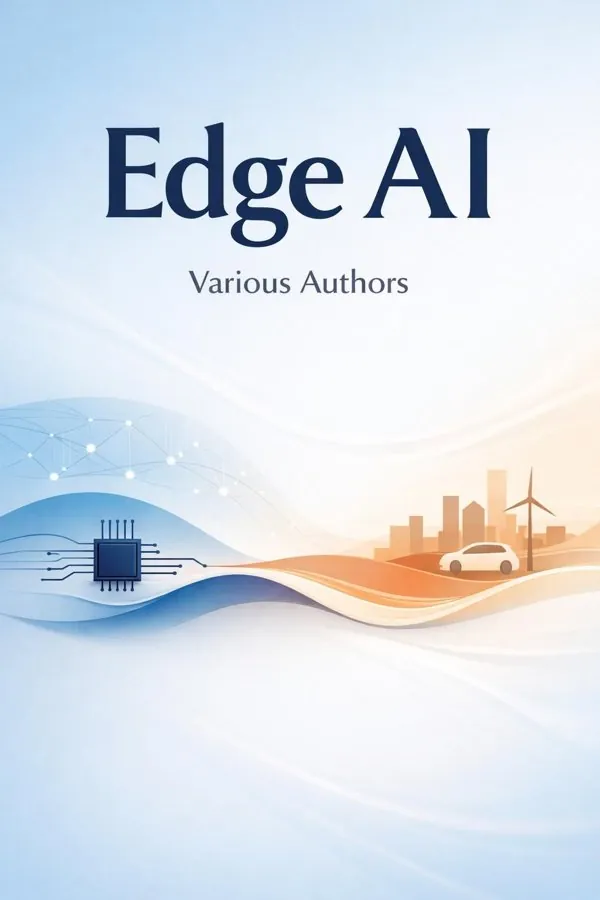
Edge AI: Convergence of Edge Computing and Artificial Intelligence: Summary & Key Insights
 10 min9 chaptersAudio available
Key Takeaways from Edge AI: Convergence of Edge Computing and Artificial Intelligence
A useful way to understand edge AI is to ask a simple question: what happens when intelligence arrives too late?
The smartest model in the world is useless if it cannot run reliably on the device that needs it.
One of edge AI’s most compelling promises is that data does not always need to leave the place where it is born.
In edge AI, speed is not a luxury feature; it is often the difference between usefulness and failure.
Technology becomes meaningful when it solves real problems, and edge AI proves its worth most clearly in concrete operational settings.
What Is Edge AI: Convergence of Edge Computing and Artificial Intelligence About?
Edge AI: Convergence of Edge Computing and Artificial Intelligence by Various Authors is a ai_ml book spanning 6 pages. Edge AI: Convergence of Edge Computing and Artificial Intelligence examines one of the most important shifts in modern computing: moving intelligence away from distant cloud servers and directly onto devices, sensors, machines, and local gateways. Instead of sending every piece of data across the internet for analysis, edge AI systems can interpret information where it is generated, enabling faster decisions, lower bandwidth use, stronger privacy, and more resilient performance. The book explains the technological foundations behind this transition, from hardware accelerators and embedded systems to machine learning frameworks, federated learning, and real-time deployment strategies. It also shows why the topic matters now, as industries such as healthcare, manufacturing, transportation, and consumer IoT increasingly depend on immediate, autonomous responses. Written by contributing researchers and engineers working across artificial intelligence, distributed systems, and embedded computing, the book combines technical depth with practical relevance. Their collective expertise gives readers a grounded view of both the promise and the complexity of building intelligent systems at the edge.
This FizzRead summary covers all 9 key chapters of Edge AI: Convergence of Edge Computing and Artificial Intelligence in approximately 10 minutes, distilling the most important ideas, arguments, and takeaways from Various Authors's work. Also available as an audio summary and Key Quotes Podcast.
Edge AI: Convergence of Edge Computing and Artificial Intelligence
Edge AI: Convergence of Edge Computing and Artificial Intelligence examines one of the most important shifts in modern computing: moving intelligence away from distant cloud servers and directly onto devices, sensors, machines, and local gateways. Instead of sending every piece of data across the internet for analysis, edge AI systems can interpret information where it is generated, enabling faster decisions, lower bandwidth use, stronger privacy, and more resilient performance. The book explains the technological foundations behind this transition, from hardware accelerators and embedded systems to machine learning frameworks, federated learning, and real-time deployment strategies. It also shows why the topic matters now, as industries such as healthcare, manufacturing, transportation, and consumer IoT increasingly depend on immediate, autonomous responses. Written by contributing researchers and engineers working across artificial intelligence, distributed systems, and embedded computing, the book combines technical depth with practical relevance. Their collective expertise gives readers a grounded view of both the promise and the complexity of building intelligent systems at the edge.
Who Should Read Edge AI: Convergence of Edge Computing and Artificial Intelligence?
This book is perfect for anyone interested in ai_ml and looking to gain actionable insights in a short read. Whether you're a student, professional, or lifelong learner, the key ideas from Edge AI: Convergence of Edge Computing and Artificial Intelligence by Various Authors will help you think differently.
- ✓Readers who enjoy ai_ml and want practical takeaways
- ✓Professionals looking to apply new ideas to their work and life
- ✓Anyone who wants the core insights of Edge AI: Convergence of Edge Computing and Artificial Intelligence in just 10 minutes
Want the full summary?
Get instant access to this book summary and 100K+ more with Fizz Moment.
Get Free SummaryAvailable on App Store • Free to download
Key Chapters
A useful way to understand edge AI is to ask a simple question: what happens when intelligence arrives too late? For years, the dominant model of artificial intelligence depended on the cloud. Devices collected data, transmitted it to centralized servers, and waited for models running in large data centers to return predictions. This approach worked well for many analytics tasks, but it created major limitations whenever timing, connectivity, privacy, or scale became critical. A self-driving car cannot wait for a round trip to a remote server before reacting to a pedestrian. A factory robot cannot pause production because of network congestion. A health monitor cannot afford to lose insight when the internet drops. The historical evolution described in the book shows how the explosive growth of IoT devices, improvements in embedded processors, and the increasing demand for real-time intelligence pushed AI out of the cloud and closer to the physical world. Edge AI emerged not as a replacement for cloud computing, but as a response to the practical failures of cloud-only systems. In many modern architectures, the cloud still trains large models, coordinates fleets of devices, and stores long-term data, while the edge performs fast local inference and immediate decision-making. This shift represents a broader change in computing philosophy: intelligence should be distributed according to where it creates the most value. The practical lesson is clear. When evaluating any AI application, start by mapping its tolerance for delay, bandwidth usage, and connectivity risk. If decisions must happen instantly or reliably in the field, edge deployment should be a core design choice, not an afterthought.
The smartest model in the world is useless if it cannot run reliably on the device that needs it. At the heart of edge AI architecture is the fusion of embedded systems engineering with machine learning design. The book emphasizes that edge systems must balance competing constraints: computational performance, memory footprint, power consumption, network availability, cost, and physical durability. Unlike cloud servers, edge devices operate in highly variable environments. A surveillance camera may face poor lighting and weather. An industrial sensor may run continuously in heat and vibration. A wearable device must preserve battery life while still producing useful predictions. As a result, architecture is never just about model accuracy. It is about total system fitness. The book explains layered edge architectures that include sensors for data collection, on-device processors for inference, local gateways for coordination, and cloud backends for model updates and analytics. It also explores the role of specialized chips such as NPUs, TPUs, GPUs, and microcontrollers optimized for low-power machine learning. A practical example is a smart factory in which individual machines detect anomalies locally, send only critical alerts to a plant gateway, and then forward aggregated data to the cloud for broader optimization. This architecture reduces network traffic while preserving responsiveness. The broader insight is that successful edge AI requires co-design: hardware, software, models, and communication patterns must be planned together. The actionable takeaway is to avoid treating deployment as the final step of AI development. Instead, define device constraints, operating conditions, and system responsibilities at the beginning so that the architecture and the model evolve as one integrated solution.
One of edge AI’s most compelling promises is that data does not always need to leave the place where it is born. That matters because the more personal, sensitive, or operationally critical the data is, the more dangerous centralized collection becomes. The book highlights privacy and security as central motivations for edge intelligence, especially in sectors such as healthcare, finance, industrial operations, and smart homes. A voice assistant that processes wake words locally exposes less personal speech to remote servers. A hospital device that analyzes medical signals on-site reduces the risks associated with transmitting raw patient data. An industrial edge controller that keeps operational patterns local protects proprietary manufacturing processes. Yet edge computing does not automatically solve security. Devices in the field can be physically tampered with, infected, or spoofed. Model theft, adversarial attacks, insecure firmware, and unencrypted communication all introduce new vulnerabilities. This is where federated learning becomes especially important. Instead of sending raw data to a central server, devices train or fine-tune models locally and share only model updates, which are then aggregated into a global model. While not a perfect privacy solution, federated learning can significantly reduce exposure of sensitive data while still enabling collective learning across many devices. Consider mobile keyboards that improve next-word prediction using distributed updates from millions of phones without uploading every typed sentence. The key idea is that trust in edge AI depends on both architectural restraint and strong security engineering. The practical takeaway is to design privacy and security as foundational features: minimize raw data movement, encrypt communication, secure hardware and firmware, and evaluate whether federated or hybrid learning strategies fit the sensitivity of your application.
In edge AI, speed is not a luxury feature; it is often the difference between usefulness and failure. The book explains that latency reduction is one of the primary reasons to run models near the source of data. Every trip to a distant server adds delay, and in many settings even milliseconds matter. Autonomous vehicles must continuously interpret camera feeds, radar, and lidar in real time. Smart traffic systems need instant responses to congestion or hazards. Industrial safety systems must detect anomalies before machinery is damaged or workers are harmed. But low latency alone is not enough. Most edge devices also face strict power limits. A drone, wearable, sensor node, or remote agricultural monitor cannot consume energy as if it were a data center server. This creates a central tension in edge AI: how do you deliver fast, accurate intelligence within a tiny energy budget? The book explores several methods, including lightweight model architectures, model pruning, quantization, event-driven processing, and hardware acceleration. For example, a battery-powered wildlife camera might remain mostly inactive until motion is detected, then run a compressed image classification model on-device to identify animals and transmit only important results. This avoids both constant power draw and unnecessary bandwidth use. The broader lesson is that edge AI performance should be measured multidimensionally, not just by benchmark accuracy. Response time, joules per inference, uptime, and communication overhead matter just as much. The actionable takeaway is to define performance in context. If your application runs on a constrained device, optimize for the full operating envelope by profiling latency, power use, and reliability alongside predictive quality.
Technology becomes meaningful when it solves real problems, and edge AI proves its worth most clearly in concrete operational settings. The book surveys how edge intelligence is transforming industries by enabling local perception, decision-making, and automation. In IoT environments, edge AI helps smart devices respond immediately to environmental changes without saturating networks with raw data. In manufacturing, machine vision systems inspect products on production lines in real time, while predictive maintenance models detect unusual vibration or temperature patterns before breakdowns occur. In healthcare, wearable and bedside devices can monitor vital signs continuously and flag concerning anomalies even when network connectivity is inconsistent. In retail, smart shelves and cameras support inventory tracking and customer flow analysis. In agriculture, field sensors and drones monitor crops locally, allowing irrigation or pest responses to happen faster and more efficiently. In transportation, connected vehicles and roadside systems process data at the edge to support safety and traffic optimization. What unites these use cases is not merely convenience, but operational immediacy. Edge AI shortens the path from observation to action. It also helps organizations reduce cloud costs by transmitting insights instead of constant raw streams. Yet the book cautions that not every application should move entirely to the edge. Some tasks require global context, large-scale retraining, or historical analysis best handled centrally. The strongest implementations use a hybrid model, assigning immediate decisions to the edge and strategic intelligence to the cloud. The practical takeaway is to evaluate applications based on where value is created. If the biggest gains come from faster local action, reduced bandwidth, or data sovereignty, edge AI likely offers a strong advantage.
A recurring challenge in edge AI is that most state-of-the-art models are born in environments very different from where they must eventually live. Researchers train deep neural networks on powerful clusters with abundant memory and compute, but deployment often targets cameras, gateways, phones, microcontrollers, or robots with severe limitations. The book underscores that bridging this gap requires model optimization, not merely model transfer. Techniques such as pruning remove redundant parameters, quantization lowers numerical precision to reduce memory and computation, knowledge distillation transfers capability from a large model to a smaller one, and neural architecture search can help discover designs tailored to hardware constraints. These methods are not theoretical extras; they are often the reason an edge system becomes feasible at all. A practical example is facial recognition for secure access control. A model that works well in the lab may be too large and slow for an embedded camera. Through quantization and pruning, engineers can dramatically reduce inference time and power consumption while preserving acceptable accuracy. Similar strategies allow keyword spotting on smart speakers, defect detection on factory cameras, and gesture recognition on wearable devices. The deeper message is that deployment performance depends on the relationship between model and hardware. A smaller, optimized model that runs reliably in real time often creates more business value than a larger, more accurate one that cannot meet operational constraints. The actionable takeaway is to treat compression and optimization as part of mainstream AI development. Build evaluation pipelines that test size, speed, and energy use early, and choose the simplest model that solves the real-world problem under actual device conditions.
The future of AI is not edge versus cloud, but edge with cloud in a coordinated continuum. The book makes a strong case that intelligent systems work best when computation is distributed across layers according to their strengths. Edge devices are ideal for immediate sensing and inference. Gateways or local servers can aggregate data from multiple devices, manage orchestration, and perform heavier analytics close to the source. The cloud remains valuable for large-scale training, fleet-wide monitoring, long-term storage, and cross-site optimization. This layered approach helps organizations avoid the false choice between complete decentralization and total centralization. Consider a logistics network with smart cameras in warehouses, AI-enabled handheld scanners, and centralized planning software. Devices on the floor identify package issues in real time, a local hub coordinates facility operations, and the cloud analyzes patterns across all warehouses to improve routing and staffing. Each layer contributes something different, and the overall system becomes faster and more robust than any one-layer design. The continuum model also improves resilience. If connectivity is lost, edge devices can continue core operations. When connectivity returns, selected data and updates can synchronize upstream. This architecture is especially valuable in remote sites, mobile environments, or safety-critical systems. The key insight is that intelligence should flow across levels rather than be trapped in one place. The practical takeaway is to assign responsibilities deliberately: local layers should handle time-sensitive tasks and basic autonomy, while centralized layers should focus on coordination, learning at scale, and strategic optimization. A well-designed system makes each layer do what it does best.
Many AI projects fail not because the model is weak, but because the operational system around it is incomplete. The book emphasizes that edge AI is not a one-time deployment exercise; it is an ongoing lifecycle challenge. Once models leave the lab and spread across thousands of devices, teams must manage versioning, software updates, monitoring, performance drift, fault recovery, and hardware heterogeneity. A model that works on one chipset may behave differently on another. Environmental conditions can gradually degrade accuracy. New data patterns can make yesterday’s assumptions obsolete. In edge settings, these problems are amplified by physical distance, intermittent connectivity, and the sheer diversity of devices. This is why edge MLOps becomes essential. Organizations need pipelines for testing models on target hardware, rolling out updates safely, tracking performance in the field, and triggering retraining when data distributions change. A fleet of smart retail cameras, for example, may need staged deployment of a new object-detection model, remote rollback in case of error, and continuous monitoring to detect regional performance differences. Without these operational controls, even a technically strong model can become untrustworthy at scale. The deeper lesson is that reliability in edge AI depends as much on maintenance as on initial design. The actionable takeaway is to plan the full lifecycle before deployment: define update strategies, observability metrics, fallback modes, and device management processes so that your edge AI system can adapt safely as conditions evolve.
Every transformative technology arrives with a seductive narrative, and edge AI is no exception. The book’s final contribution is its willingness to confront the field’s real limitations. Edge AI promises speed, privacy, and autonomy, but those benefits come with trade-offs. Devices at the edge are constrained in compute, storage, and power. Managing distributed intelligence is complex. Security expands from protecting one cloud environment to defending thousands or millions of endpoints. Data can become fragmented across devices, making global learning more difficult. Standardization is still uneven across hardware platforms, software frameworks, and communication protocols. There is also a risk of overestimating what small models can do in the wild, especially when environments are noisy, dynamic, or safety-critical. Yet the book remains optimistic because the trajectory is clear. Advances in specialized AI chips, TinyML, federated learning, neuromorphic computing, and more efficient architectures are steadily expanding what edge devices can achieve. The next phase will likely involve increasingly collaborative systems in which devices learn locally, coordinate regionally, and improve globally. We may also see stronger regulation around privacy, transparency, and safety, pushing edge AI toward more trustworthy design. The central insight is that progress will come not from hype, but from disciplined engineering and realistic system thinking. The practical takeaway is to approach edge AI strategically: embrace its advantages where they solve real constraints, remain honest about its limits, and build systems that can evolve as hardware, models, and governance mature.
All Chapters in Edge AI: Convergence of Edge Computing and Artificial Intelligence
About the Author
The authors of Edge AI: Convergence of Edge Computing and Artificial Intelligence are a collective of researchers, engineers, and technical practitioners working across artificial intelligence, embedded systems, distributed computing, and IoT infrastructure. Their backgrounds span both academia and industry, giving the book a perspective that is at once theoretical and practical. This multidisciplinary expertise is especially important in edge AI, a field that demands knowledge of machine learning models, specialized hardware, networking, security, and real-world deployment. Rather than approaching the topic from a single discipline, the contributors examine it from multiple angles, including architecture, optimization, privacy, and applications. Their combined experience helps make the book a credible guide to how intelligent systems are being redesigned for a world where computation increasingly happens at the edge.
Get This Summary in Your Preferred Format
Read or listen to the Edge AI: Convergence of Edge Computing and Artificial Intelligence summary by Various Authors anytime, anywhere. FizzRead offers multiple formats so you can learn on your terms — all free.
Available formats: App · Audio · PDF · EPUB — All included free with FizzRead
Download Edge AI: Convergence of Edge Computing and Artificial Intelligence PDF and EPUB Summary
Key Quotes from Edge AI: Convergence of Edge Computing and Artificial Intelligence
“A useful way to understand edge AI is to ask a simple question: what happens when intelligence arrives too late?”
“The smartest model in the world is useless if it cannot run reliably on the device that needs it.”
“One of edge AI’s most compelling promises is that data does not always need to leave the place where it is born.”
“In edge AI, speed is not a luxury feature; it is often the difference between usefulness and failure.”
“Technology becomes meaningful when it solves real problems, and edge AI proves its worth most clearly in concrete operational settings.”
Frequently Asked Questions about Edge AI: Convergence of Edge Computing and Artificial Intelligence
Edge AI: Convergence of Edge Computing and Artificial Intelligence by Various Authors is a ai_ml book that explores key ideas across 9 chapters. Edge AI: Convergence of Edge Computing and Artificial Intelligence examines one of the most important shifts in modern computing: moving intelligence away from distant cloud servers and directly onto devices, sensors, machines, and local gateways. Instead of sending every piece of data across the internet for analysis, edge AI systems can interpret information where it is generated, enabling faster decisions, lower bandwidth use, stronger privacy, and more resilient performance. The book explains the technological foundations behind this transition, from hardware accelerators and embedded systems to machine learning frameworks, federated learning, and real-time deployment strategies. It also shows why the topic matters now, as industries such as healthcare, manufacturing, transportation, and consumer IoT increasingly depend on immediate, autonomous responses. Written by contributing researchers and engineers working across artificial intelligence, distributed systems, and embedded computing, the book combines technical depth with practical relevance. Their collective expertise gives readers a grounded view of both the promise and the complexity of building intelligent systems at the edge.
More by Various Authors




You Might Also Like

Life 3.0
Max Tegmark
10 min
Superintelligence
Nick Bostrom
10 min
TensorFlow in Action
Thushan Ganegedara
10 min
AI Made Simple: A Beginner’s Guide to Generative AI, ChatGPT, and the Future of Work
Rajeev Kapur
10 min
AI Snake Oil
Arvind Narayanan, Sayash Kapoor
10 min
AI Superpowers: China, Silicon Valley, and the New World Order
Kai-Fu Lee
10 minBrowse by Category
Ready to read Edge AI: Convergence of Edge Computing and Artificial Intelligence?
Get the full summary and 100K+ more books with Fizz Moment.