
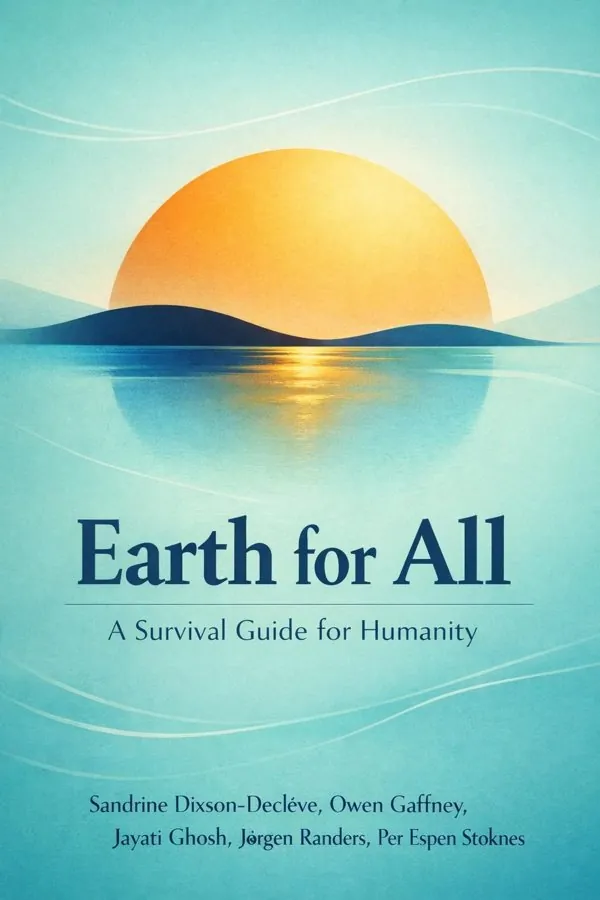
Earth for All: A Survival Guide for Humanity: Summary & Key Insights
by Sandrine Dixson-Declève, Owen Gaffney, Jayati Ghosh, Jørgen Randers, Per Espen Stoknes
 10 min9 chaptersAudio available
What Is Earth for All: A Survival Guide for Humanity About?
Earth for All: A Survival Guide for Humanity by Sandrine Dixson-Declève, Owen Gaffney, Jayati Ghosh, Jørgen Randers, Per Espen Stoknes is a environment book spanning 9 pages. Earth for All is a report by the Club of Rome that presents a roadmap for transforming the global economy to ensure well-being for all within planetary boundaries. It models two scenarios—Too Little Too Late and The Giant Leap—showing how policy choices in inequality, energy, food, gender, and poverty can determine humanity’s future. The book calls for urgent systemic change to achieve a sustainable and equitable world by 2050.
This FizzRead summary covers all 9 key chapters of Earth for All: A Survival Guide for Humanity in approximately 10 minutes, distilling the most important ideas, arguments, and takeaways from Sandrine Dixson-Declève, Owen Gaffney, Jayati Ghosh, Jørgen Randers, Per Espen Stoknes's work. Also available as an audio summary and Key Quotes Podcast.
Earth for All: A Survival Guide for Humanity
Earth for All is a report by the Club of Rome that presents a roadmap for transforming the global economy to ensure well-being for all within planetary boundaries. It models two scenarios—Too Little Too Late and The Giant Leap—showing how policy choices in inequality, energy, food, gender, and poverty can determine humanity’s future. The book calls for urgent systemic change to achieve a sustainable and equitable world by 2050.
Who Should Read Earth for All: A Survival Guide for Humanity?
This book is perfect for anyone interested in environment and looking to gain actionable insights in a short read. Whether you're a student, professional, or lifelong learner, the key ideas from Earth for All: A Survival Guide for Humanity by Sandrine Dixson-Declève, Owen Gaffney, Jayati Ghosh, Jørgen Randers, Per Espen Stoknes will help you think differently.
- ✓Readers who enjoy environment and want practical takeaways
- ✓Professionals looking to apply new ideas to their work and life
- ✓Anyone who wants the core insights of Earth for All: A Survival Guide for Humanity in just 10 minutes
Want the full summary?
Get instant access to this book summary and 100K+ more with Fizz Moment.
Get Free SummaryAvailable on App Store • Free to download
Key Chapters
When the Club of Rome published *The Limits to Growth* in 1972, it sent a shockwave through the global conversation. Using then-novel computer modeling, that report projected how unchecked growth in population, consumption, and industrial output could destabilize Earth’s systems. The message was not one of fatalism but of foresight: if humanity continued on a path of exponential consumption, we would eventually hit ecological and social limits.
Half a century later, the warnings of that earlier report echo louder than ever. By 2022, we had already crossed several planetary boundaries. Global warming, deforestation, soil depletion, and species loss show the unmistakable fingerprint of “too much, too fast.” Yet paradoxically, billions still lack basic needs. This paradox—ecological overshoot amid human deprivation—forms the heart of *Earth for All*’s analysis.
Where *The Limits to Growth* emphasized physical constraints, *Earth for All* adds a profound social and political dimension: inequity itself has become a planetary destabilizer. A system that concentrates wealth and power in the hands of a few cannot sustain collective prosperity. Thus our task now is not to plead for smaller growth, but for better growth—growth in well-being, equality, and ecological balance. We build upon the Club of Rome’s legacy, updating its vision for an era defined not by scarcity alone, but by the need for justice.
When we look clearly at the current state of the world, we see patterns that cannot be separated. Inequality is not a side effect of progress—it is a structural outcome of the way our economies are organized. The richest ten percent own most of the wealth, while the poorest struggle to meet daily needs. This disparity undermines trust, amplifies social unrest, and erodes democratic legitimacy.
Simultaneously, Earth’s natural systems are being depleted faster than they can regenerate. Climate change fuels migration, hunger, and conflict. Biodiversity loss weakens the resilience of the ecosystems that sustain us. These interlocking crises drive each other in a feedback loop that no nation can solve alone.
We call this integrated pattern of crisis the “polycrisis.” It captures how financial fragility, environmental stress, and social fracture merge into one global challenge. In *Earth for All*, we do not treat these as separate policy silos. Instead, we model the Earth system as a complex, interdependent whole—an economy nested within society, nested within the biosphere. Only by reforming all layers together can humanity avoid collapse and enter an era of shared well-being.
+ 7 more chapters — available in the FizzRead app
All Chapters in Earth for All: A Survival Guide for Humanity
About the Authors
The authors are members of the Earth4All initiative and the Club of Rome, including economists, scientists, and sustainability experts such as Sandrine Dixson-Declève, Owen Gaffney, Jayati Ghosh, Jørgen Randers, and Per Espen Stoknes, who have long worked on global sustainability and systems transformation.
Get This Summary in Your Preferred Format
Read or listen to the Earth for All: A Survival Guide for Humanity summary by Sandrine Dixson-Declève, Owen Gaffney, Jayati Ghosh, Jørgen Randers, Per Espen Stoknes anytime, anywhere. FizzRead offers multiple formats so you can learn on your terms — all free.
Available formats: App · Audio · PDF · EPUB — All included free with FizzRead
Download Earth for All: A Survival Guide for Humanity PDF and EPUB Summary
Key Quotes from Earth for All: A Survival Guide for Humanity
“When the Club of Rome published *The Limits to Growth* in 1972, it sent a shockwave through the global conversation.”
“When we look clearly at the current state of the world, we see patterns that cannot be separated.”
Frequently Asked Questions about Earth for All: A Survival Guide for Humanity
Earth for All: A Survival Guide for Humanity by Sandrine Dixson-Declève, Owen Gaffney, Jayati Ghosh, Jørgen Randers, Per Espen Stoknes is a environment book that explores key ideas across 9 chapters. Earth for All is a report by the Club of Rome that presents a roadmap for transforming the global economy to ensure well-being for all within planetary boundaries. It models two scenarios—Too Little Too Late and The Giant Leap—showing how policy choices in inequality, energy, food, gender, and poverty can determine humanity’s future. The book calls for urgent systemic change to achieve a sustainable and equitable world by 2050.
You Might Also Like

A Life on Our Planet: My Witness Statement and a Vision for the Future
David Attenborough
10 min
A Sky Full Of Birds
Matt Merritt
10 min
Carbon Zero: Imagining Cities That Can Save the Planet
Alex Steffen
10 min
Eaarth: Making a Life on a Tough New Planet
Bill McKibben
10 min
The Social Contract and Environmental Governance
Various Editors
10 min
The Wild Places
Robert Macfarlane
10 minBrowse by Category
Ready to read Earth for All: A Survival Guide for Humanity?
Get the full summary and 100K+ more books with Fizz Moment.