
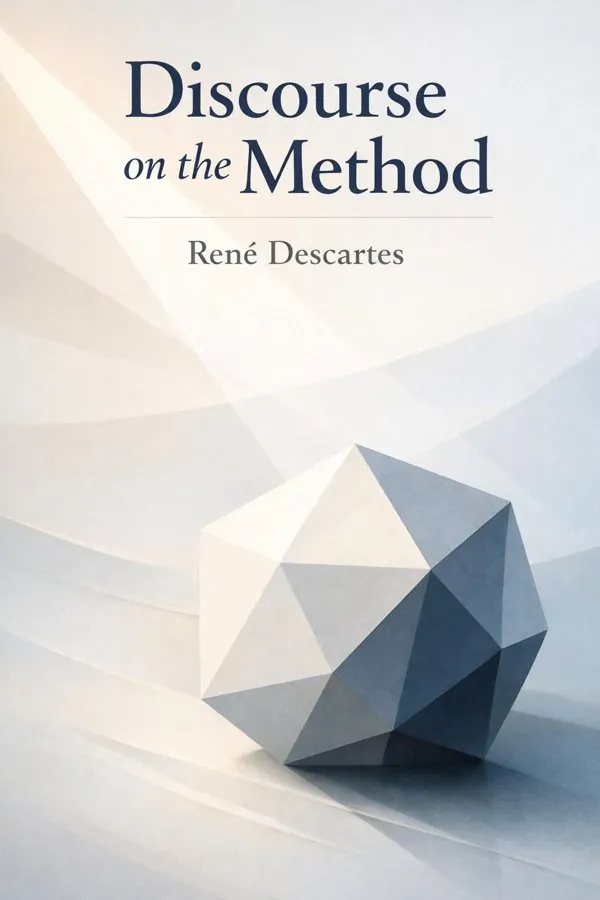
Discourse on the Method: For Conducting One's Reason Well and for Seeking Truth in the Sciences: Summary & Key Insights
 10 min6 chaptersAudio available
What Is Discourse on the Method: For Conducting One's Reason Well and for Seeking Truth in the Sciences About?
Discourse on the Method: For Conducting One's Reason Well and for Seeking Truth in the Sciences by René Descartes is a western_phil book spanning 6 pages. First published in 1637, René Descartes’s 'Discourse on the Method' is one of the foundational works of modern philosophy. In this treatise, Descartes outlines his method for attaining true knowledge through reason and systematic doubt. The work introduces his famous dictum 'I think, therefore I am' and lays the groundwork for rationalism and the scientific method. This Penguin Classics edition presents the text in English translation with scholarly notes and introduction.
This FizzRead summary covers all 6 key chapters of Discourse on the Method: For Conducting One's Reason Well and for Seeking Truth in the Sciences in approximately 10 minutes, distilling the most important ideas, arguments, and takeaways from René Descartes's work. Also available as an audio summary and Key Quotes Podcast.
Discourse on the Method: For Conducting One's Reason Well and for Seeking Truth in the Sciences
First published in 1637, René Descartes’s 'Discourse on the Method' is one of the foundational works of modern philosophy. In this treatise, Descartes outlines his method for attaining true knowledge through reason and systematic doubt. The work introduces his famous dictum 'I think, therefore I am' and lays the groundwork for rationalism and the scientific method. This Penguin Classics edition presents the text in English translation with scholarly notes and introduction.
Who Should Read Discourse on the Method: For Conducting One's Reason Well and for Seeking Truth in the Sciences?
This book is perfect for anyone interested in western_phil and looking to gain actionable insights in a short read. Whether you're a student, professional, or lifelong learner, the key ideas from Discourse on the Method: For Conducting One's Reason Well and for Seeking Truth in the Sciences by René Descartes will help you think differently.
- ✓Readers who enjoy western_phil and want practical takeaways
- ✓Professionals looking to apply new ideas to their work and life
- ✓Anyone who wants the core insights of Discourse on the Method: For Conducting One's Reason Well and for Seeking Truth in the Sciences in just 10 minutes
Want the full summary?
Get instant access to this book summary and 100K+ more with Fizz Moment.
Get Free SummaryAvailable on App Store • Free to download
Key Chapters
I remember well my years of study—the pain of mastering ancient languages, the rigid systems of disputation, the endless commentaries on Aristotle and the Schoolmen. I emerged not ignorant, but unsatisfied. The wisdom of the centuries seemed more concerned with defending tradition than with discovering truth. I had been shown what men thought, not what was certain. So, I resolved to test knowledge by my own reason alone.
I saw that the sciences, though rich in facts, lacked unity and method. Each was founded upon assumptions no one questioned; conclusions were piled on uncertain premises. This conviction grew stronger when I traveled and encountered the practical judgments of ordinary men—how they reasoned with clarity when experience guided them more than abstract rules. Education imparted knowledge, but not discernment. The mind must learn to separate what it knows from what it merely believes.
That realization marked my beginning: I determined to abandon the books and turn to my own thought, as if I had never learned anything. I wanted to reconstruct knowledge from foundations that could not be shaken, to find certainty through reason rather than authority. This resolve was not rebellion, but renewal—a declaration that human understanding must be rebuilt on firm ground. I understood that traditions, however venerable, may bind us more than enlighten us; that true wisdom requires liberation from borrowed opinions.
Thus began my method—an inquiry meant not to scorn past learning but to surpass it by placing the clarity of reason above the blindness of habit. For only reason, rightly conducted, can pierce illusion and lead the mind to truth.
When I withdrew into the solitude that fosters reflection, I sought a method that would make me certain. My studies in mathematics gave me a model—clarity, precision, and deduction from simple truths. From these reflections emerged four guiding rules that became the pillars of my reasoning.
First, never accept anything as true unless you perceive it clearly and distinctly. Doubt all uncertain things—no matter how revered their origin or widespread their acceptance. If any belief can be imagined as false, it cannot serve as the foundation of science.
Second, divide each problem into as many parts as possible, breaking down complexity into elements small enough that they may be mastered. The human mind understands best when it proceeds from the simple to the complex.
Third, order thoughts carefully, beginning with the simplest and most intuitive objects, and gradually ascending to more composite truths. This structure ensures continuity and coherence, linking each step logically to the last.
Finally, review thoroughly—make enumerations so complete and surveys so general that nothing is omitted. Method is not haste; it is careful, exact exploration.
These four rules were not inventions for formal logic; they were guides for life and inquiry alike. They taught me precision in thinking, restraint in judgment, and thoroughness in understanding. When applied consistently, they turned ordinary reasoning into science. Each of us possesses natural reason; the method only disciplines it. It is a compass directing thought from uncertainty to discovery, from confusion to clarity.
+ 4 more chapters — available in the FizzRead app
All Chapters in Discourse on the Method: For Conducting One's Reason Well and for Seeking Truth in the Sciences
About the Author
René Descartes (1596–1650) was a French philosopher, mathematician, and scientist, often regarded as the father of modern philosophy. His emphasis on reason and methodical doubt profoundly influenced Western thought. Descartes also made major contributions to mathematics, particularly in developing analytic geometry, and to physics and metaphysics.
Get This Summary in Your Preferred Format
Read or listen to the Discourse on the Method: For Conducting One's Reason Well and for Seeking Truth in the Sciences summary by René Descartes anytime, anywhere. FizzRead offers multiple formats so you can learn on your terms — all free.
Available formats: App · Audio · PDF · EPUB — All included free with FizzRead
Download Discourse on the Method: For Conducting One's Reason Well and for Seeking Truth in the Sciences PDF and EPUB Summary
Key Quotes from Discourse on the Method: For Conducting One's Reason Well and for Seeking Truth in the Sciences
“I remember well my years of study—the pain of mastering ancient languages, the rigid systems of disputation, the endless commentaries on Aristotle and the Schoolmen.”
“When I withdrew into the solitude that fosters reflection, I sought a method that would make me certain.”
Frequently Asked Questions about Discourse on the Method: For Conducting One's Reason Well and for Seeking Truth in the Sciences
Discourse on the Method: For Conducting One's Reason Well and for Seeking Truth in the Sciences by René Descartes is a western_phil book that explores key ideas across 6 chapters. First published in 1637, René Descartes’s 'Discourse on the Method' is one of the foundational works of modern philosophy. In this treatise, Descartes outlines his method for attaining true knowledge through reason and systematic doubt. The work introduces his famous dictum 'I think, therefore I am' and lays the groundwork for rationalism and the scientific method. This Penguin Classics edition presents the text in English translation with scholarly notes and introduction.
More by René Descartes
You Might Also Like
A Little History of Philosophy
Nigel Warburton
10 min
Areopagitica
John Milton
10 min
How To Think Like A Philosopher: Essential Principles For Clear Thinking
Peter Cave
10 min
Language, Truth and Logic
A. J. Ayer
10 min
The Age of Reason
Thomas Paine
10 min
The Essays
Michel De Montaigne
10 minBrowse by Category
Ready to read Discourse on the Method: For Conducting One's Reason Well and for Seeking Truth in the Sciences?
Get the full summary and 100K+ more books with Fizz Moment.