
René Descartes Books
René Descartes (1596–1650) was a French philosopher, mathematician, and scientist, often regarded as the father of modern philosophy. His emphasis on reason and methodical doubt profoundly influenced Western thought.
Known for: Discourse on the Method: For Conducting One's Reason Well and for Seeking Truth in the Sciences, Meditations on First Philosophy
Books by René Descartes
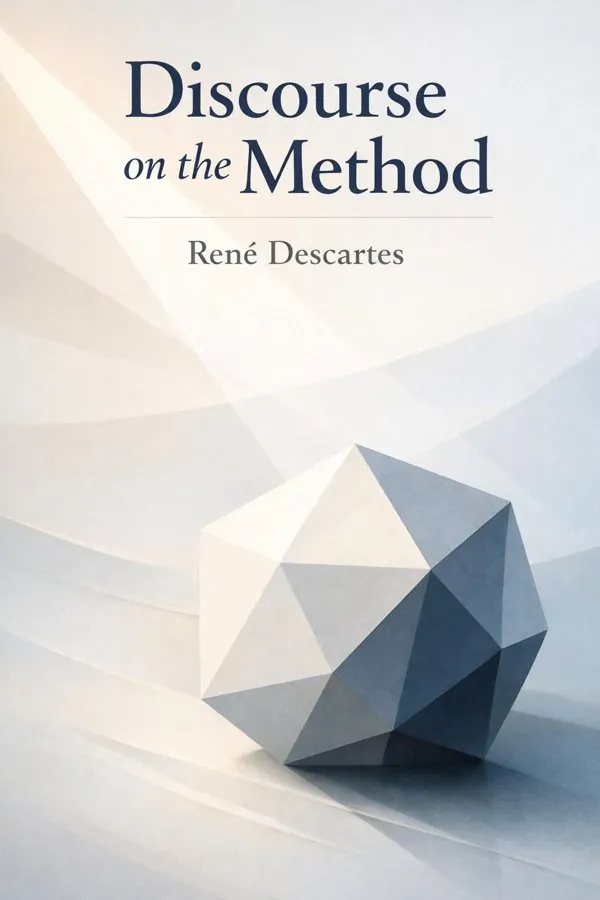
Discourse on the Method: For Conducting One's Reason Well and for Seeking Truth in the Sciences
First published in 1637, René Descartes’s 'Discourse on the Method' is one of the foundational works of modern philosophy. In this treatise, Descartes outlines his method for attaining true knowledge ...

Meditations on First Philosophy
What can we truly know if every belief we hold might be mistaken? In Meditations on First Philosophy, René Descartes turns that unsettling question into one of the most influential philosophical inves...
Key Insights from René Descartes
Part I: On Education and the Limitations of Scholastic Learning
I remember well my years of study—the pain of mastering ancient languages, the rigid systems of disputation, the endless commentaries on Aristotle and the Schoolmen. I emerged not ignorant, but unsatisfied. The wisdom of the centuries seemed more concerned with defending tradition than with discover...
From Discourse on the Method: For Conducting One's Reason Well and for Seeking Truth in the Sciences
Part II: The Four Rules of Method
When I withdrew into the solitude that fosters reflection, I sought a method that would make me certain. My studies in mathematics gave me a model—clarity, precision, and deduction from simple truths. From these reflections emerged four guiding rules that became the pillars of my reasoning. First, ...
From Discourse on the Method: For Conducting One's Reason Well and for Seeking Truth in the Sciences
Methodical Doubt and Radical Skepticism
The search for certainty sometimes begins by destroying confidence. Descartes opens the First Meditation with a startling decision: he will treat as false anything that can be doubted, not because he wants to become a skeptic forever, but because he wants to discover whether any belief can survive t...
From Meditations on First Philosophy
The Self Revealed Through Thinking
When everything else collapses, the act of questioning remains. In the Second Meditation, Descartes discovers his first certainty: even if he is deceived about the world, his body, and mathematics, he cannot be deceived into being nothing while he is thinking. Doubting, affirming, denying, imagining...
From Meditations on First Philosophy
God as the Source of Certainty
A fragile mind cannot build a stable world without a trustworthy foundation. In the Third Meditation, Descartes asks where his ideas come from and whether any of them can lead beyond the self. Among his ideas is the idea of an infinite, perfect being—God. Descartes argues that this idea cannot have ...
From Meditations on First Philosophy
Why Human Beings Fall Into Error
Error is not proof that reason is worthless; it is often proof that we use it badly. In the Fourth Meditation, Descartes confronts an obvious problem: if God is perfect and not a deceiver, why do human beings make mistakes? His answer lies in the relation between intellect and will. The intellect is...
From Meditations on First Philosophy
About René Descartes
René Descartes (1596–1650) was a French philosopher, mathematician, and scientist, often regarded as the father of modern philosophy. His emphasis on reason and methodical doubt profoundly influenced Western thought. Descartes also made major contributions to mathematics, particularly in developing ...
Read more
René Descartes (1596–1650) was a French philosopher, mathematician, and scientist, often regarded as the father of modern philosophy. His emphasis on reason and methodical doubt profoundly influenced Western thought. Descartes also made major contributions to mathematics, particularly in developing ...
René Descartes (1596–1650) was a French philosopher, mathematician, and scientist, often regarded as the father of modern philosophy. His emphasis on reason and methodical doubt profoundly influenced Western thought. Descartes also made major contributions to mathematics, particularly in developing analytic geometry, and to physics and metaphysics.


Frequently Asked Questions
René Descartes (1596–1650) was a French philosopher, mathematician, and scientist, often regarded as the father of modern philosophy. His emphasis on reason and methodical doubt profoundly influenced Western thought.
Read René Descartes's books in 15 minutes
Get AI-powered summaries with key insights from 2 books by René Descartes.