
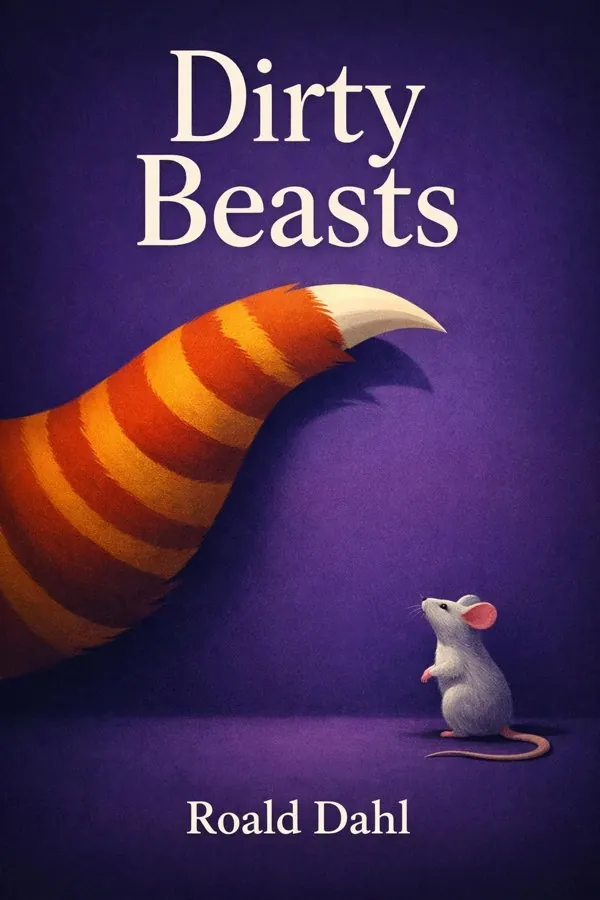
Dirty Beasts: Summary & Key Insights
by Roald Dahl
 10 min9 chaptersAudio available
Key Takeaways from Dirty Beasts
The most unsettling creatures are not always the fiercest—they may be the ones that start thinking.
Power looks impressive until it is fenced in.
Many disasters begin with curiosity and end in regret.
Charm is often most dangerous when it looks harmless.
Some creatures terrify us not because they are large, but because they make consequences immediate.
What Is Dirty Beasts About?
Dirty Beasts by Roald Dahl is a classics book spanning 9 pages. Dirty Beasts is Roald Dahl at his most gleefully unruly: a short collection of comic poems in which animals refuse to behave the way polite stories expect them to. First published in 1983, the book turns familiar creatures into cunning plotters, petty avengers, survivors, and tricksters. A pig becomes dangerously intelligent, a lion loses his grandeur, and seemingly harmless beasts reveal startling powers. The result is a poetry collection that feels playful on the surface yet slyly satirical underneath. What makes the book matter is not just its humor, but its method. Dahl delights in upsetting assumptions: beauty hides unpleasantness, weakness becomes strength, and human confidence is often exposed as foolish. Children enjoy the outrageous rhymes, twists, and cartoonish shocks; adults notice the mockery of vanity, greed, cruelty, and smugness. That double appeal is one reason Dahl remains such an enduring voice. As one of the twentieth century’s most beloved writers for young readers, Dahl brought together musical language, dark wit, and a fearless instinct for mischief. Dirty Beasts showcases those talents in miniature, offering a fast, funny, and surprisingly sharp reminder that the wild world—and human nature—rarely stays tidy for long.
This FizzRead summary covers all 9 key chapters of Dirty Beasts in approximately 10 minutes, distilling the most important ideas, arguments, and takeaways from Roald Dahl's work. Also available as an audio summary and Key Quotes Podcast.
Dirty Beasts
Dirty Beasts is Roald Dahl at his most gleefully unruly: a short collection of comic poems in which animals refuse to behave the way polite stories expect them to. First published in 1983, the book turns familiar creatures into cunning plotters, petty avengers, survivors, and tricksters. A pig becomes dangerously intelligent, a lion loses his grandeur, and seemingly harmless beasts reveal startling powers. The result is a poetry collection that feels playful on the surface yet slyly satirical underneath.
What makes the book matter is not just its humor, but its method. Dahl delights in upsetting assumptions: beauty hides unpleasantness, weakness becomes strength, and human confidence is often exposed as foolish. Children enjoy the outrageous rhymes, twists, and cartoonish shocks; adults notice the mockery of vanity, greed, cruelty, and smugness. That double appeal is one reason Dahl remains such an enduring voice.
As one of the twentieth century’s most beloved writers for young readers, Dahl brought together musical language, dark wit, and a fearless instinct for mischief. Dirty Beasts showcases those talents in miniature, offering a fast, funny, and surprisingly sharp reminder that the wild world—and human nature—rarely stays tidy for long.
Who Should Read Dirty Beasts?
This book is perfect for anyone interested in classics and looking to gain actionable insights in a short read. Whether you're a student, professional, or lifelong learner, the key ideas from Dirty Beasts by Roald Dahl will help you think differently.
- ✓Readers who enjoy classics and want practical takeaways
- ✓Professionals looking to apply new ideas to their work and life
- ✓Anyone who wants the core insights of Dirty Beasts in just 10 minutes
Want the full summary?
Get instant access to this book summary and 100K+ more with Fizz Moment.
Get Free SummaryAvailable on App Store • Free to download
Key Chapters
The most unsettling creatures are not always the fiercest—they may be the ones that start thinking. In Dirty Beasts, Dahl introduces a pig who is no passive farm animal waiting for slaughter. Instead, he begins to reason, to compare his own future with the habits of the people around him, and to ask why he should quietly accept an end designed by others. That shift from dumb livestock to calculating mind is both hilarious and faintly alarming.
The poem works because it overturns a familiar hierarchy. Humans assume superiority because they plan, justify, and consume without guilt. Dahl gives the pig those same abilities, and suddenly the animal world looks less innocent and more strategic. The joke is dark, but the point is clear: intelligence changes everything. Once a creature recognizes its situation, obedience becomes unlikely.
This idea extends far beyond the farmyard. Children reading the poem learn that stories are more exciting when the weak are not merely victims. Adults may see an allegory about power: those at the bottom are often underestimated until they begin to understand the system trapping them. In classrooms, this poem can spark discussions about empathy, perspective, and why we casually dismiss beings we think are simple.
In daily life, the poem also encourages us to examine our assumptions. We often label people, animals, or situations too quickly. Dahl’s pig reminds us that hidden motives and hidden intelligence can exist anywhere.
Actionable takeaway: question any neat story in which one side is naturally clever and the other side is naturally helpless.
Power looks impressive until it is fenced in. Dahl’s lion is not presented as a majestic symbol of untouchable strength, but as a creature whose glamour fades when circumstances change. By placing the so-called king of beasts in captivity, Dahl strips away the mythology that usually surrounds him. What remains is not nobility, but frustration, confinement, and absurdity.
This reversal is a signature Dahl move. He delights in taking grand reputations and puncturing them with a pin. The lion, who normally inspires awe, becomes an emblem of how quickly status can vanish once control is removed. The poem reminds readers that power often depends as much on setting as on inherent greatness. A lion in the wild is fearsome; a lion in a cage is a spectacle. Context matters.
The lesson applies to human life just as sharply. Many people appear commanding because systems support them: a title, a uniform, a platform, a social role. Change the environment, and their authority may shrink. That does not mean all power is fake, but it does mean reputation is fragile. Dahl’s humor makes this truth digestible, especially for young readers who are beginning to question the authority figures and symbols around them.
Practically, the poem invites readers to look beyond appearances. The loudest, biggest, or most decorated presence in a room is not always the most secure. Teachers, parents, and discussion groups can use the lion poem to explore how institutions shape identity and how performance often disguises vulnerability.
Actionable takeaway: whenever something seems powerful, ask what conditions are sustaining that power—and what happens if those conditions disappear.
Many disasters begin with curiosity and end in regret. In Dahl’s poem about the porcupine and the unfortunate child, the comedy comes from a simple truth children know well: not everything that looks intriguing is safe to grab, poke, or cuddle. The porcupine becomes the perfect symbol of consequences delivered instantly and memorably.
Dahl’s genius lies in refusing to preach in the usual gentle, moralizing way. Instead of offering a tidy warning, he stages a comic collision between innocence and reality. The child is not evil, only reckless or uninformed; the porcupine is not malicious, only built to defend itself. The humor comes from the mismatch between expectation and outcome. A fluffy-seeming creature turns into a painful lesson.
This poem captures an important aspect of childhood learning: some lessons stick because they sting. The world contains boundaries, and not all of them are announced politely in advance. That insight is useful for readers of any age. Adults, too, repeatedly mishandle situations because they mistake novelty for harmlessness—whether in relationships, technology, money, or social behavior.
In practical terms, the poem can open conversations about respecting limits. Parents might use it to discuss animals and bodily autonomy. Teachers can use it to talk about cause and effect. More broadly, it reminds us that caution is not cowardice; it is often an intelligent response to reality.
Dahl makes that wisdom enjoyable by dressing it in exaggeration and rhyme. The result is a memorable warning disguised as mischief.
Actionable takeaway: before rushing toward something interesting, pause long enough to ask what protective quills it might be hiding.
Charm is often most dangerous when it looks harmless. Dahl’s crocodile, with its deceptive grin and theatrical patience, represents the predator who does not need to chase loudly because seduction and timing do the work. Instead of roaring aggression, we get smooth menace—a smiling face concealing appetite.
This makes the crocodile one of the collection’s most useful symbols. Dahl understands that children quickly grasp exaggeration, but they also recognize insincerity. The crocodile is funny because he is so openly false to the reader, even if not to his victim. We watch the performance unfold and understand that politeness, attractiveness, or calmness can be tools rather than virtues.
The poem therefore teaches a subtle form of literacy: reading beneath surfaces. Not everyone who appears welcoming is safe, and not every pleasant invitation deserves trust. That message can be applied in age-appropriate ways. For children, it may mean being careful around strangers, manipulative peers, or situations that seem too easy. For adults, it speaks to advertising, office politics, online scams, and social charm used strategically.
Dahl never turns this into a dry lesson. He keeps the energy comic, the rhythm brisk, and the twist satisfyingly wicked. Yet underneath the laughter lies a durable insight about judgment. The crocodile’s grin is memorable precisely because it captures the unsettling gap between appearance and intention.
Readers can apply this poem by becoming more observant. Instead of reacting only to tone, they can examine patterns: what does this person want, what follows the friendliness, and who benefits? That habit of inquiry is a lifelong skill.
Actionable takeaway: enjoy charm, but never let a pleasing surface stop you from asking what appetite may be lurking behind it.
Some creatures terrify us not because they are large, but because they make consequences immediate. Dahl’s scorpion embodies that principle. Small, tense, and armed with a sting, it turns carelessness into punishment with shocking speed. In his comic universe, the scorpion becomes more than an insect-like menace; it becomes a figure of abrupt justice.
The effectiveness of this poem lies in compression. A scorpion is a compact threat, and Dahl mirrors that with tight comic escalation. There is very little distance between mistake and result. That structure creates laughter, but it also dramatizes an important reality: some choices do not allow for leisurely correction. Touch the wrong thing, provoke the wrong force, ignore the wrong warning, and the reply is immediate.
This theme resonates in modern life. We often assume we can reverse anything later—send the message, cut the corner, ignore the rule, trust that consequences will take time. The scorpion poem reminds us that not all systems are forgiving. Some errors bite back at once. That does not make the world cruel; it makes it responsive.
For young readers, the poem reinforces attentiveness and respect for danger without becoming solemn. For adults, it can be read as a comic metaphor for reputational harm, legal trouble, broken trust, or risky habits. A tiny action can trigger outsized effects.
Dahl’s gift is to let the scorpion stay funny while still carrying symbolic force. The creature’s sting becomes a lesson in proportion: never underestimate what seems small.
Actionable takeaway: treat minor warnings seriously, because the smallest sources of danger can deliver the fastest and most unforgettable consequences.
The funniest rebellions often begin with refusal. In Dahl’s treatment of the cow, the joke comes from an animal that does not calmly submit to the expectations humans place upon it. The cow, usually imagined as placid and compliant, becomes instead a figure of resistance, exposing how much of human convenience depends on animals behaving exactly as required.
This is classic Dahl territory: he takes an ordinary creature associated with passivity and gives it agency. Once the cow stops cooperating with the script, everything around it looks absurd. Human beings suddenly seem entitled, presumptuous, and faintly ridiculous for assuming nature exists to serve tidy routines. The poem thus becomes more than a comic sketch. It is a satire of expectation itself.
Readers can connect this idea to everyday life. We all rely on silent systems—people, tools, institutions, habits—that we barely notice until they stop functioning on command. The rebellious cow becomes a symbol of what happens when the supposedly reliable refuses. Children may see a gleeful animal prank; adults may recognize an allegory about labor, obedience, or domestic routine.
There is also a deeper emotional lesson here. We often mistake gentleness for agreement. A calm presence can still possess limits, preferences, and intelligence. Respect requires recognizing that others, even those we think of as accommodating, are not simply extensions of our needs.
Used practically, the poem encourages gratitude and better observation. Instead of assuming cooperation, we can notice the structures that make our lives comfortable and treat them with more awareness—whether those structures are people, ecosystems, or routines.
Actionable takeaway: stop treating reliability as entitlement, and pay attention to what you assume will always cooperate with your plans.
Revenge is ugly, but in comedy it can be irresistibly satisfying. Dahl’s wasp captures that uneasy pleasure perfectly. Tiny, irritable, and capable of outsized discomfort, the wasp represents the form of justice that is not noble or balanced, but immediate, petty, and memorable. It is the ideal comic avenger.
What makes this poem work is its sense of proportion gone wrong. A wasp is small enough to dismiss, yet anyone who has been stung knows how quickly it can dominate a moment. Dahl delights in that inversion. The insignificant becomes central; the smug become frantic. Readers laugh because arrogance is punctured so efficiently.
The emotional truth underneath the humor is important. Many of Dahl’s poems give readers the fantasy that bad behavior will not go unanswered. The wasp delivers that fantasy in miniature. It suggests that mockery, cruelty, or carelessness may receive a sharp reply from an unexpected source. Children often enjoy this because it feels fairer than the real world, where consequences are inconsistent.
Still, the poem also hints that revenge is chaotic. A wasp does not weigh evidence or aim for moral perfection. It reacts. That makes it funny, but it also makes it a useful way to discuss emotional impulsiveness. In life, stinging back may feel good for a moment, yet it rarely produces wisdom.
Readers can apply this by distinguishing between justice and retaliation. The fantasy of payback can be entertaining without becoming a model for action. Dahl lets us enjoy the sting from a safe distance.
Actionable takeaway: relish the comic idea of instant payback, but in real life choose responses that solve the problem instead of merely spreading the pain.
Children do not need stories to be gentle; they need them to be honest in a form they can handle. One of Dirty Beasts’s greatest achievements is how it uses rhyme and laughter to make unsettling material approachable. Predators, pain, trickery, humiliation, and danger all appear in these poems, yet the buoyant language keeps fear from becoming overwhelming.
Dahl understood that humor is not the opposite of darkness; it is one of the best tools for engaging with it. By exaggerating violence into absurdity and turning danger into rhythmic play, he allows readers to confront frightening ideas without being crushed by them. This is especially valuable in childhood, when the world often feels unpredictable and full of hidden rules. A funny poem can turn anxiety into mastery.
That technique also explains why Dahl’s work continues to appeal across generations. Adults recognize how carefully he controls tone. He knows exactly how far to push discomfort before releasing it in a rhyme, twist, or comic image. The result is emotional balance: readers feel the thrill of danger while remaining protected by style.
Practically, this insight helps us think about literature, parenting, and education. Shielding readers from every dark idea can make them less prepared, not more. Stories like Dirty Beasts model a better approach: acknowledge unpleasant realities, but shape them with imagination. Humor creates room for conversation.
For anyone introducing children to poetry, this collection is also a reminder that verse need not be solemn or decorative. It can be energetic, wicked, and psychologically useful all at once.
Actionable takeaway: use humor not to deny uncomfortable truths, but to create a safe way to face and discuss them.
All Chapters in Dirty Beasts
About the Author
Roald Dahl (1916–1990) was one of the most influential writers of children’s literature in the twentieth century. Born in Wales to Norwegian parents, he first worked as a pilot and intelligence officer before becoming a full-time writer. Dahl created a body of work famous for its wild imagination, dark humor, verbal energy, and deep sympathy for children facing unfair or absurd adult worlds. His best-known books include Charlie and the Chocolate Factory, Matilda, The BFG, James and the Giant Peach, and Fantastic Mr Fox. He also wrote short stories, screenplays, and poetry, often blending comedy with menace in a style that remains instantly recognizable. Dirty Beasts reflects many of his signature strengths: playful language, wicked reversals, and a delight in turning the ordinary into something shocking and funny.
Get This Summary in Your Preferred Format
Read or listen to the Dirty Beasts summary by Roald Dahl anytime, anywhere. FizzRead offers multiple formats so you can learn on your terms — all free.
Available formats: App · Audio · PDF · EPUB — All included free with FizzRead
Download Dirty Beasts PDF and EPUB Summary
Key Quotes from Dirty Beasts
“The most unsettling creatures are not always the fiercest—they may be the ones that start thinking.”
“Power looks impressive until it is fenced in.”
“Many disasters begin with curiosity and end in regret.”
“Charm is often most dangerous when it looks harmless.”
“Some creatures terrify us not because they are large, but because they make consequences immediate.”
Frequently Asked Questions about Dirty Beasts
Dirty Beasts by Roald Dahl is a classics book that explores key ideas across 9 chapters. Dirty Beasts is Roald Dahl at his most gleefully unruly: a short collection of comic poems in which animals refuse to behave the way polite stories expect them to. First published in 1983, the book turns familiar creatures into cunning plotters, petty avengers, survivors, and tricksters. A pig becomes dangerously intelligent, a lion loses his grandeur, and seemingly harmless beasts reveal startling powers. The result is a poetry collection that feels playful on the surface yet slyly satirical underneath. What makes the book matter is not just its humor, but its method. Dahl delights in upsetting assumptions: beauty hides unpleasantness, weakness becomes strength, and human confidence is often exposed as foolish. Children enjoy the outrageous rhymes, twists, and cartoonish shocks; adults notice the mockery of vanity, greed, cruelty, and smugness. That double appeal is one reason Dahl remains such an enduring voice. As one of the twentieth century’s most beloved writers for young readers, Dahl brought together musical language, dark wit, and a fearless instinct for mischief. Dirty Beasts showcases those talents in miniature, offering a fast, funny, and surprisingly sharp reminder that the wild world—and human nature—rarely stays tidy for long.
More by Roald Dahl
You Might Also Like

Browse by Category
Ready to read Dirty Beasts?
Get the full summary and 100K+ more books with Fizz Moment.