
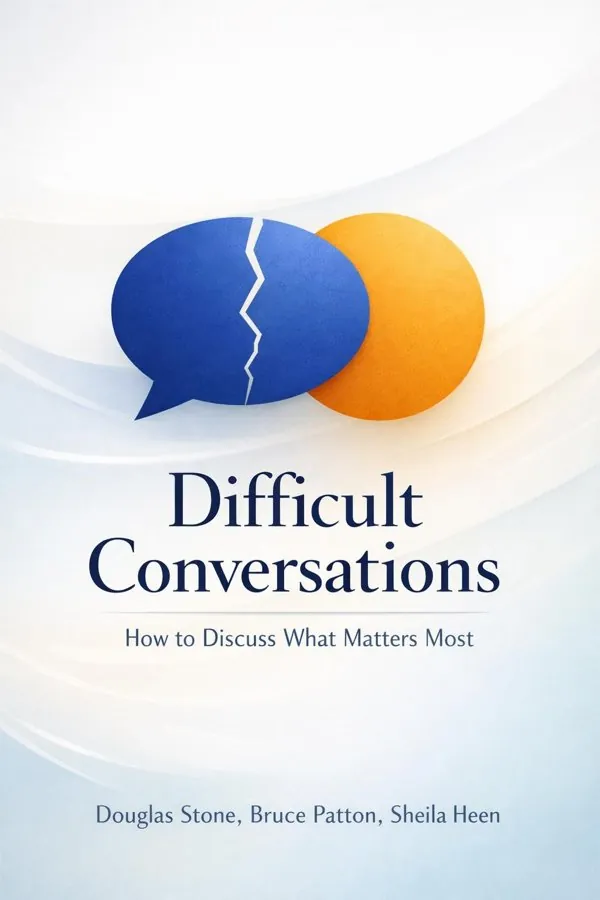
Difficult Conversations: How to Discuss What Matters Most: Summary & Key Insights
by Douglas Stone, Bruce Patton, Sheila Heen
 10 min7 chaptersAudio available
What Is Difficult Conversations: How to Discuss What Matters Most About?
Difficult Conversations: How to Discuss What Matters Most by Douglas Stone, Bruce Patton, Sheila Heen is a communication book spanning 7 pages. This book provides a practical framework for handling tough conversations with clarity and empathy. Drawing on years of research at the Harvard Negotiation Project, the authors explain how to navigate emotionally charged discussions, understand underlying interests, and transform conflict into productive dialogue. It offers tools to manage emotions, listen effectively, and express oneself without escalating tension.
This FizzRead summary covers all 7 key chapters of Difficult Conversations: How to Discuss What Matters Most in approximately 10 minutes, distilling the most important ideas, arguments, and takeaways from Douglas Stone, Bruce Patton, Sheila Heen's work. Also available as an audio summary and Key Quotes Podcast.
Difficult Conversations: How to Discuss What Matters Most
This book provides a practical framework for handling tough conversations with clarity and empathy. Drawing on years of research at the Harvard Negotiation Project, the authors explain how to navigate emotionally charged discussions, understand underlying interests, and transform conflict into productive dialogue. It offers tools to manage emotions, listen effectively, and express oneself without escalating tension.
Who Should Read Difficult Conversations: How to Discuss What Matters Most?
This book is perfect for anyone interested in communication and looking to gain actionable insights in a short read. Whether you're a student, professional, or lifelong learner, the key ideas from Difficult Conversations: How to Discuss What Matters Most by Douglas Stone, Bruce Patton, Sheila Heen will help you think differently.
- ✓Readers who enjoy communication and want practical takeaways
- ✓Professionals looking to apply new ideas to their work and life
- ✓Anyone who wants the core insights of Difficult Conversations: How to Discuss What Matters Most in just 10 minutes
Want the full summary?
Get instant access to this book summary and 100K+ more with Fizz Moment.
Get Free SummaryAvailable on App Store • Free to download
Key Chapters
When most people think of a difficult conversation, they think of the words exchanged. They focus on what they said or what the other person said. But the truth is that what we say is only the outer shell of something much deeper. Beneath every difficult conversation are three layers that unfold simultaneously: the ‘What Happened?’ conversation, the ‘Feelings’ conversation, and the ‘Identity’ conversation.
The first, the ‘What Happened?’ layer, reflects our differing stories about what has occurred or is occurring. We each see events through the lens of our experiences, assumptions, and interpretations. It is not that one person sees accurately and another distorts; it is that human perception itself is selective. When we argue about what “really” happened, we are often just comparing two subjective realities.
The second layer is the ‘Feelings’ conversation. Every interaction that matters evokes emotions—frustration, hurt, hope, fear, pride, or disappointment. Yet in many cultures, expressing feelings seems dangerous or unprofessional, so we suppress them. But unspoken feelings leak out in tone, defensiveness, and silence. They are not side issues; they are the very heart of most conflicts.
Finally, there’s the ‘Identity’ conversation. This layer runs deepest. Every difficult discussion touches some sense of who we are—our competence, worthiness, or moral identity. When we feel accused, dismissed, or invalidated, it’s not only our position in the moment that’s threatened but our self-concept.
Recognizing these three layers transforms how we approach communication. Instead of debating facts, complaining about tone, or defending ego, we can step back and see how each layer interacts. Our task is not to eliminate difficulty but to meet it with awareness—to learn from the stories, feelings, and identities at play.
At the surface level, conflicts often seem to revolve around what happened: “You said you’d finish the project by Thursday.” “No, I said I’d try.” Yet rarely are we arguing just about facts. We are arguing about meanings—what intentions lay behind actions, and who deserves blame. Understanding the ‘What Happened?’ conversation requires us to unpack three intertwined assumptions.
First, we assume we know the truth. Our natural inclination is to believe our story is *the* story. But as social psychologists have demonstrated repeatedly, perception is not neutral. We each select data that confirms what we already expect to see. Our interpretations are colored by our expectations. To break free, we must shift from the stance of certainty to curiosity. Instead of insisting, “You’re wrong,” ask, “Help me understand how you see it.” This simple move can shift the energy from argument to exploration.
Second, we confuse intentions with impact. Often we feel hurt and assume the other person meant to hurt us. Yet impact and intention are not the same. The fact that you felt dismissed does not mean the other intended to dismiss you. It helps immensely to separate these. When someone reacts defensively, it may be because they feel misunderstood. Acknowledging the distinction—“I know you didn’t intend to upset me, but this is how it affected me”—creates space for understanding rather than accusation.
Finally, we fall into the trap of blame. Blame asks, “Who’s at fault?” and locks us into defensiveness. In contrast, the contribution system asks, “How did each of us contribute to the situation?” This reframing is empowering. Blame isolates; contribution connects. Once we see that outcomes arise from interaction, both parties can begin to think jointly about change.
When we accept that our version of events is just one story among several, we enter the conversation with humility. That humility is not weakness—it is strength. It allows us to move from debating the past to learning from it, from casting judgment to creating shared meaning.
+ 5 more chapters — available in the FizzRead app
All Chapters in Difficult Conversations: How to Discuss What Matters Most
About the Authors
Douglas Stone, Bruce Patton, and Sheila Heen are affiliated with the Harvard Negotiation Project. They are experts in negotiation, communication, and conflict resolution, and have taught at Harvard Law School and advised organizations worldwide on improving dialogue and collaboration.
Get This Summary in Your Preferred Format
Read or listen to the Difficult Conversations: How to Discuss What Matters Most summary by Douglas Stone, Bruce Patton, Sheila Heen anytime, anywhere. FizzRead offers multiple formats so you can learn on your terms — all free.
Available formats: App · Audio · PDF · EPUB — All included free with FizzRead
Download Difficult Conversations: How to Discuss What Matters Most PDF and EPUB Summary
Key Quotes from Difficult Conversations: How to Discuss What Matters Most
“When most people think of a difficult conversation, they think of the words exchanged.”
“At the surface level, conflicts often seem to revolve around what happened: “You said you’d finish the project by Thursday.”
Frequently Asked Questions about Difficult Conversations: How to Discuss What Matters Most
Difficult Conversations: How to Discuss What Matters Most by Douglas Stone, Bruce Patton, Sheila Heen is a communication book that explores key ideas across 7 chapters. This book provides a practical framework for handling tough conversations with clarity and empathy. Drawing on years of research at the Harvard Negotiation Project, the authors explain how to navigate emotionally charged discussions, understand underlying interests, and transform conflict into productive dialogue. It offers tools to manage emotions, listen effectively, and express oneself without escalating tension.
More by Douglas Stone, Bruce Patton, Sheila Heen
You Might Also Like

Magic Words: The Science and Secrets Behind Seven Words That Motivate, Engage, and Influence
Tim David
10 min
Talking Across The Divide: How to Communicate with People You Disagree with and Maybe Even Change the World
Justin Lee
10 min
The Exceptional Presenter: A Proven Formula to Open Up! and Own the Room
Timothy J. Koegel
10 min
4 Essential Keys to Effective Communication in Love, Life, Work--Anywhere!: Including the 12-Day Communication Challenge!
Bento C. Leal III
10 min
Active Listening Techniques: 30 Practical Tools to Hone Your Communication Skills
Nisha Gupta
10 min
Bargaining for Advantage: Negotiation Strategies for Reasonable People
G. Richard Shell
10 minFeatured In
Browse by Category
Ready to read Difficult Conversations: How to Discuss What Matters Most?
Get the full summary and 100K+ more books with Fizz Moment.