
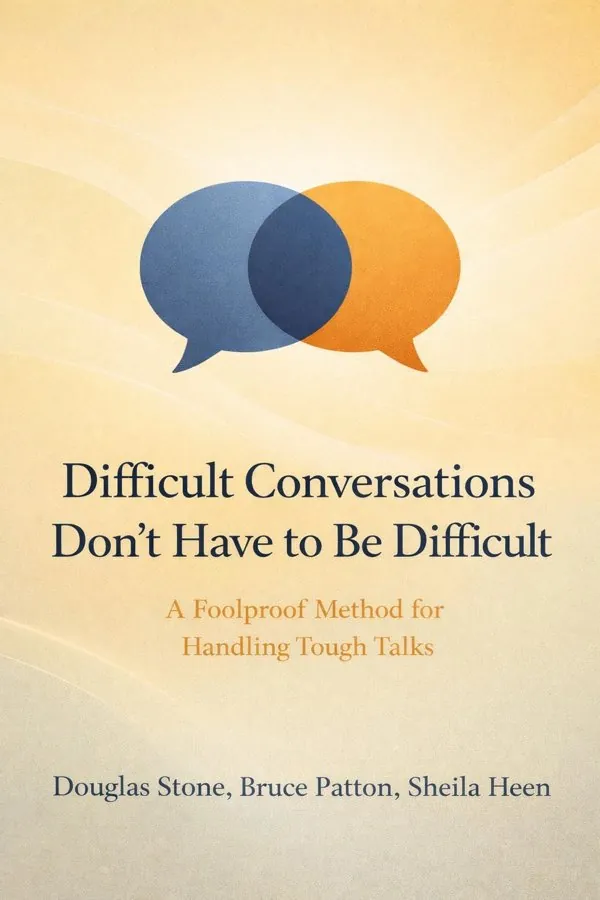
Difficult Conversations Don't Have to Be Difficult: A Foolproof Method for Handling Tough Talks: Summary & Key Insights
by Douglas Stone, Bruce Patton, Sheila Heen
 10 min7 chaptersAudio available
What Is Difficult Conversations Don't Have to Be Difficult: A Foolproof Method for Handling Tough Talks About?
Difficult Conversations Don't Have to Be Difficult: A Foolproof Method for Handling Tough Talks by Douglas Stone, Bruce Patton, Sheila Heen is a communication book spanning 7 pages. This book provides a practical framework for managing challenging conversations with confidence and empathy. Drawing on years of research at the Harvard Negotiation Project, the authors explain how to navigate emotional triggers, uncover underlying interests, and transform conflict into productive dialogue. It offers tools to handle workplace disputes, family disagreements, and sensitive feedback with clarity and respect.
This FizzRead summary covers all 7 key chapters of Difficult Conversations Don't Have to Be Difficult: A Foolproof Method for Handling Tough Talks in approximately 10 minutes, distilling the most important ideas, arguments, and takeaways from Douglas Stone, Bruce Patton, Sheila Heen's work. Also available as an audio summary and Key Quotes Podcast.
Difficult Conversations Don't Have to Be Difficult: A Foolproof Method for Handling Tough Talks
This book provides a practical framework for managing challenging conversations with confidence and empathy. Drawing on years of research at the Harvard Negotiation Project, the authors explain how to navigate emotional triggers, uncover underlying interests, and transform conflict into productive dialogue. It offers tools to handle workplace disputes, family disagreements, and sensitive feedback with clarity and respect.
Who Should Read Difficult Conversations Don't Have to Be Difficult: A Foolproof Method for Handling Tough Talks?
This book is perfect for anyone interested in communication and looking to gain actionable insights in a short read. Whether you're a student, professional, or lifelong learner, the key ideas from Difficult Conversations Don't Have to Be Difficult: A Foolproof Method for Handling Tough Talks by Douglas Stone, Bruce Patton, Sheila Heen will help you think differently.
- ✓Readers who enjoy communication and want practical takeaways
- ✓Professionals looking to apply new ideas to their work and life
- ✓Anyone who wants the core insights of Difficult Conversations Don't Have to Be Difficult: A Foolproof Method for Handling Tough Talks in just 10 minutes
Want the full summary?
Get instant access to this book summary and 100K+ more with Fizz Moment.
Get Free SummaryAvailable on App Store • Free to download
Key Chapters
When most people think about a “difficult conversation,” they focus on what was said. But words are just the surface. The quality of any interaction is determined by the structure underlying it. In truth, every difficult conversation involves three intertwined talks: the facts, the feelings, and the identity.
The first layer—the facts—reflects how we each interpret events. Everyone perceives reality through a unique lens shaped by experience, assumptions, and interpretation. Rather than asking who’s right, it’s wiser to see that we’re all speaking from different subjective realities.
The second layer is emotional. Any important exchange carries emotion—anger, hurt, hope, fear, pride, or disappointment. Many cultures label emotion as irrational or unprofessional, teaching us to suppress it. Yet feelings don’t vanish; they surface through tone, defensiveness, or retreat. Emotions aren’t secondary issues—they’re often the heart of conflict.
Finally comes identity—the deepest layer. Every hard conversation tests our sense of who we are: our competence, worth, and moral integrity. When we feel judged or misunderstood, it’s not just our position that feels attacked—it’s our self-worth.
Recognizing these three dimensions transforms how we communicate. Instead of arguing facts, reacting to tone, or defending ego, we learn to notice how all three interact. The goal isn’t to eliminate difficulty but to face it consciously—to learn from others’ stories, emotions, and identities.
On the surface, most conflicts seem factual. “You said you’d finish the project by Thursday.” “No, I said I’d try.” But what we’re really debating is meaning—the intention behind behavior and who’s to blame when things go wrong. Understanding the facts conversation begins with clearing up three common traps.
First, we assume we already know the truth. Each of us believes our version is the correct one. In reality, perception is selective; we notice what confirms our expectations. The true shift is from certainty to curiosity. Rather than insisting, “You’re wrong,” ask, “Can you help me understand how you see this?” That simple curiosity turns argument into exploration.
Second, we confuse intention with impact. When we’re hurt, we tend to assume the other person meant to do it. But emotions and intentions aren’t the same. Separating the two dissolves many misunderstandings: “I know you may not have meant to upset me, but that’s how it felt.” Such acknowledgment replaces accusation with understanding.
Lastly, we fall into the blame trap. Blame asks, “Whose fault is it?” A contribution mindset asks, “How did each of us play a part?” Blame breeds defensiveness; contribution breeds connection. Seeing outcomes as shared products enables both sides to learn and move forward together. It shifts us from defending the past to creating meaning for the future.
+ 5 more chapters — available in the FizzRead app
All Chapters in Difficult Conversations Don't Have to Be Difficult: A Foolproof Method for Handling Tough Talks
About the Authors
Douglas Stone, Bruce Patton, and Sheila Heen are affiliated with the Harvard Negotiation Project. They are experts in negotiation, communication, and conflict resolution, and have co-authored several influential works on effective dialogue and mediation.
Get This Summary in Your Preferred Format
Read or listen to the Difficult Conversations Don't Have to Be Difficult: A Foolproof Method for Handling Tough Talks summary by Douglas Stone, Bruce Patton, Sheila Heen anytime, anywhere. FizzRead offers multiple formats so you can learn on your terms — all free.
Available formats: App · Audio · PDF · EPUB — All included free with FizzRead
Download Difficult Conversations Don't Have to Be Difficult: A Foolproof Method for Handling Tough Talks PDF and EPUB Summary
Key Quotes from Difficult Conversations Don't Have to Be Difficult: A Foolproof Method for Handling Tough Talks
“When most people think about a “difficult conversation,” they focus on what was said.”
“On the surface, most conflicts seem factual.”
Frequently Asked Questions about Difficult Conversations Don't Have to Be Difficult: A Foolproof Method for Handling Tough Talks
Difficult Conversations Don't Have to Be Difficult: A Foolproof Method for Handling Tough Talks by Douglas Stone, Bruce Patton, Sheila Heen is a communication book that explores key ideas across 7 chapters. This book provides a practical framework for managing challenging conversations with confidence and empathy. Drawing on years of research at the Harvard Negotiation Project, the authors explain how to navigate emotional triggers, uncover underlying interests, and transform conflict into productive dialogue. It offers tools to handle workplace disputes, family disagreements, and sensitive feedback with clarity and respect.
More by Douglas Stone, Bruce Patton, Sheila Heen
You Might Also Like

Magic Words: The Science and Secrets Behind Seven Words That Motivate, Engage, and Influence
Tim David
10 min
Talking Across The Divide: How to Communicate with People You Disagree with and Maybe Even Change the World
Justin Lee
10 min
The Exceptional Presenter: A Proven Formula to Open Up! and Own the Room
Timothy J. Koegel
10 min
4 Essential Keys to Effective Communication in Love, Life, Work--Anywhere!: Including the 12-Day Communication Challenge!
Bento C. Leal III
10 min
Active Listening Techniques: 30 Practical Tools to Hone Your Communication Skills
Nisha Gupta
10 min
Bargaining for Advantage: Negotiation Strategies for Reasonable People
G. Richard Shell
10 minFeatured In
Browse by Category
Ready to read Difficult Conversations Don't Have to Be Difficult: A Foolproof Method for Handling Tough Talks?
Get the full summary and 100K+ more books with Fizz Moment.