
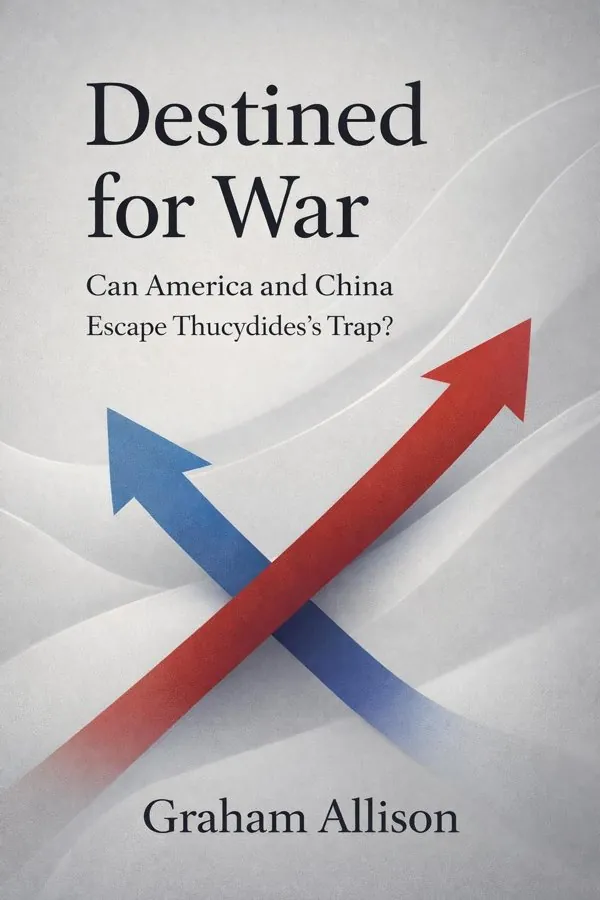
Destined for War: Can America and China Escape Thucydides’s Trap?: Summary & Key Insights
 10 min5 chaptersAudio available
What Is Destined for War: Can America and China Escape Thucydides’s Trap? About?
Destined for War: Can America and China Escape Thucydides’s Trap? by Graham Allison is a politics book spanning 5 pages. In this influential work, Graham Allison examines the historical pattern known as the 'Thucydides Trap,' where a rising power threatens to displace an established one, often leading to war. Drawing on case studies from ancient Greece to modern times, Allison analyzes the strategic tensions between the United States and China, exploring whether conflict is inevitable or avoidable through wise statecraft and mutual understanding.
This FizzRead summary covers all 5 key chapters of Destined for War: Can America and China Escape Thucydides’s Trap? in approximately 10 minutes, distilling the most important ideas, arguments, and takeaways from Graham Allison's work. Also available as an audio summary and Key Quotes Podcast.
Destined for War: Can America and China Escape Thucydides’s Trap?
In this influential work, Graham Allison examines the historical pattern known as the 'Thucydides Trap,' where a rising power threatens to displace an established one, often leading to war. Drawing on case studies from ancient Greece to modern times, Allison analyzes the strategic tensions between the United States and China, exploring whether conflict is inevitable or avoidable through wise statecraft and mutual understanding.
Who Should Read Destined for War: Can America and China Escape Thucydides’s Trap??
This book is perfect for anyone interested in politics and looking to gain actionable insights in a short read. Whether you're a student, professional, or lifelong learner, the key ideas from Destined for War: Can America and China Escape Thucydides’s Trap? by Graham Allison will help you think differently.
- ✓Readers who enjoy politics and want practical takeaways
- ✓Professionals looking to apply new ideas to their work and life
- ✓Anyone who wants the core insights of Destined for War: Can America and China Escape Thucydides’s Trap? in just 10 minutes
Want the full summary?
Get instant access to this book summary and 100K+ more with Fizz Moment.
Get Free SummaryAvailable on App Store • Free to download
Key Chapters
Thucydides’s account of the Peloponnesian War provides the anchor of my argument. His observation—that the growth of Athenian power and the resulting fear in Sparta made conflict inevitable—offers a timeless model of how structural stress drives states into confrontation. It wasn’t a single event or misjudgment that caused the war; it was a deeper shift in the balance of power, magnified by human emotion and misperception.
Throughout history, similar dynamics have recurred. When one nation rises rapidly—economically, militarily, psychologically—it provokes anxiety in the dominant power. That anxiety breeds defensive measures, alliances, and often provocations that the rising power interprets as hostility. Each side begins acting to protect itself, which the other sees as aggression. Thus the trap tightens.
In the classical case, Athens’s pride and ambition brought it into direct competition with the conservative, cautious Sparta. The result was three decades of conflict that destroyed both. My purpose in revisiting that ancient story is not to romanticize it but to show that the logic Thucydides described remains embedded in human nature and the structure of international politics. When a nation feels its survival and honor are threatened by a rising challenger, reason easily gives way to fear.
Understanding this dynamic is crucial because it liberates us from overly simplistic narratives of good versus evil or democracy versus autocracy. It reminds us that even rational actors can fall into irrational outcomes when structural pressures grow unbearable. To escape the trap, therefore, both sides must first acknowledge that they are in one.
In my research at Harvard, my team examined sixteen major cases over the past five centuries in which a rising power threatened to displace a ruling one. The results are sobering: twelve ended in war. These include the rivalry between France and Britain in the 17th and 18th centuries, between Britain and Germany before World War I, and between Japan and the United States in the 1940s. Only four transitions—such as the peaceful shift of global leadership from Britain to the United States in the early 20th century—avoided conflict.
The common thread is structural stress combined with psychological factors: fear in the ruling power, hubris in the rising one. War has often emerged not because leaders were reckless but because they were trapped by circumstances larger than themselves. Trade disturbances, regional crises, or simple miscalculations created sparks that ignited mounting tension.
Learning from these examples is essential. In each peaceful transition, flexibility played a decisive role. Britain’s acceptance of American ascendancy was facilitated by cultural closeness, overlapping interests, and external threats that made cooperation rational. Similarly, the Cold War between the United States and the Soviet Union—though dangerous—ended without direct conflict because nuclear deterrence forced restraint.
History gives no guarantees, but it offers patterns. If leaders can internalize these lessons—understand the trap, anticipate its triggers, and design institutions to absorb pressure—they can change outcomes. To see the future clearly, we must first see how often the past has repeated itself.
+ 3 more chapters — available in the FizzRead app
All Chapters in Destined for War: Can America and China Escape Thucydides’s Trap?
About the Author
Graham Allison is an American political scientist and professor at Harvard University’s John F. Kennedy School of Government. He is known for his work on decision-making in government and international relations, including his seminal study of the Cuban Missile Crisis. Allison has served as an advisor to multiple U.S. administrations and is a leading voice on U.S.-China relations.
Get This Summary in Your Preferred Format
Read or listen to the Destined for War: Can America and China Escape Thucydides’s Trap? summary by Graham Allison anytime, anywhere. FizzRead offers multiple formats so you can learn on your terms — all free.
Available formats: App · Audio · PDF · EPUB — All included free with FizzRead
Download Destined for War: Can America and China Escape Thucydides’s Trap? PDF and EPUB Summary
Key Quotes from Destined for War: Can America and China Escape Thucydides’s Trap?
“Thucydides’s account of the Peloponnesian War provides the anchor of my argument.”
“In my research at Harvard, my team examined sixteen major cases over the past five centuries in which a rising power threatened to displace a ruling one.”
Frequently Asked Questions about Destined for War: Can America and China Escape Thucydides’s Trap?
Destined for War: Can America and China Escape Thucydides’s Trap? by Graham Allison is a politics book that explores key ideas across 5 chapters. In this influential work, Graham Allison examines the historical pattern known as the 'Thucydides Trap,' where a rising power threatens to displace an established one, often leading to war. Drawing on case studies from ancient Greece to modern times, Allison analyzes the strategic tensions between the United States and China, exploring whether conflict is inevitable or avoidable through wise statecraft and mutual understanding.
More by Graham Allison
You Might Also Like
Antifa: The Anti-Fascist Handbook
Mark Bray
10 min
Attack from Within: How Disinformation Is Sabotaging America
Barbara McQuade
10 min
Coercion, Capital, and European States, AD 990–1992
Charles Tilly
10 min
Digital Democracy: Concepts, Methodologies, Tools, and Applications
Various Authors
10 min
Fascism
Stanley G. Payne
10 min
Fire And Fury: Inside The Trump White House
Michael Wolff
10 minBrowse by Category
Ready to read Destined for War: Can America and China Escape Thucydides’s Trap??
Get the full summary and 100K+ more books with Fizz Moment.