
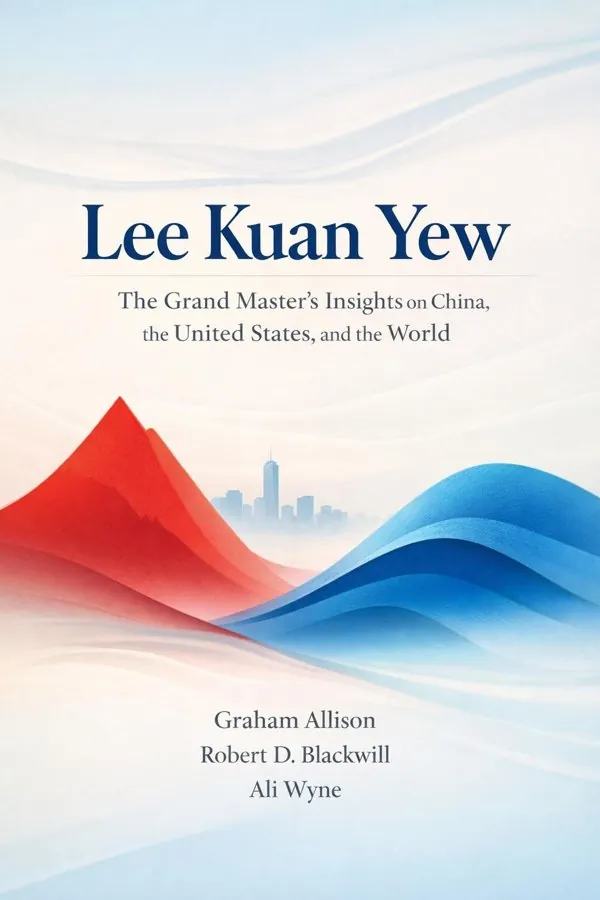
Lee Kuan Yew: The Grand Master's Insights on China, the United States, and the World: Summary & Key Insights
by Graham Allison, Robert D. Blackwill, Ali Wyne
 10 min9 chaptersAudio available
What Is Lee Kuan Yew: The Grand Master's Insights on China, the United States, and the World About?
Lee Kuan Yew: The Grand Master's Insights on China, the United States, and the World by Graham Allison, Robert D. Blackwill, Ali Wyne is a politics book spanning 9 pages. This book presents a collection of insights and reflections from Lee Kuan Yew, Singapore’s founding Prime Minister, on global affairs, leadership, and the future of nations. Drawing from extensive interviews and speeches, it captures his pragmatic worldview and strategic thinking on China’s rise, U.S. power, and the dynamics of international relations.
This FizzRead summary covers all 9 key chapters of Lee Kuan Yew: The Grand Master's Insights on China, the United States, and the World in approximately 10 minutes, distilling the most important ideas, arguments, and takeaways from Graham Allison, Robert D. Blackwill, Ali Wyne's work. Also available as an audio summary and Key Quotes Podcast.
Lee Kuan Yew: The Grand Master's Insights on China, the United States, and the World
This book presents a collection of insights and reflections from Lee Kuan Yew, Singapore’s founding Prime Minister, on global affairs, leadership, and the future of nations. Drawing from extensive interviews and speeches, it captures his pragmatic worldview and strategic thinking on China’s rise, U.S. power, and the dynamics of international relations.
Who Should Read Lee Kuan Yew: The Grand Master's Insights on China, the United States, and the World?
This book is perfect for anyone interested in politics and looking to gain actionable insights in a short read. Whether you're a student, professional, or lifelong learner, the key ideas from Lee Kuan Yew: The Grand Master's Insights on China, the United States, and the World by Graham Allison, Robert D. Blackwill, Ali Wyne will help you think differently.
- ✓Readers who enjoy politics and want practical takeaways
- ✓Professionals looking to apply new ideas to their work and life
- ✓Anyone who wants the core insights of Lee Kuan Yew: The Grand Master's Insights on China, the United States, and the World in just 10 minutes
Want the full summary?
Get instant access to this book summary and 100K+ more with Fizz Moment.
Get Free SummaryAvailable on App Store • Free to download
Key Chapters
My perspective on politics is rooted in survival. Having led Singapore from a poor tropical backwater into one of the world’s most prosperous societies, I learned that success begins with realism. Nations do not survive by wishful thinking; they survive by adapting to shifting power realities. Ideals are important, but they must be anchored in facts. The essence of governance is to recognize constraints—the limits imposed by geography, population, and resources—and then to work relentlessly to overcome them through discipline and ingenuity.
I have often been called a pragmatist, and rightly so. Pragmatism, to me, is simply the courage to see things as they are. In Southeast Asia, realism is not cynicism; it is self-defense. Small states must understand the ambitions of larger powers and align themselves carefully. Singapore’s success came not from military might but from intelligence—anticipating trends, building institutions of quality, and staying neutral enough to engage both superpowers. A leader who cannot read the global chessboard is doomed to be a pawn on it.
I regard history as a rigorous teacher. The Cold War, decolonization, and globalization each taught hard lessons: ideology can destroy nations; competence rescues them. Communism promised equality but delivered poverty. Democracy, when coupled with meritocracy and pragmatic planning, can deliver prosperity. Hence, I built a system that prizes ability and integrity over popularity. Reality always wins over rhetoric. And the key to enduring leadership is understanding the limits of power—when to push, when to pause, and when to pivot.
China’s rise in the past four decades is the most remarkable geopolitical event of our era. I watched it closely, from Mao’s ideological fervor to Deng Xiaoping’s opening of the economy. Deng was China’s true revolutionary in practice. He understood that communism without economic growth is unsustainable. When he declared that it does not matter whether a cat is black or white, as long as it catches mice, he articulated pure pragmatism—the same principle I used to guide Singapore.
China’s leaders have since pursued modernization relentlessly. They are intelligent, methodical, and willing to learn from others, including Singapore. But China will not simply imitate; it will adapt foreign lessons to its own civilizational frame. Its governance model—central control combined with economic flexibility—reflects an ancient meritocracy reshaped for modern competition. Many in the West misunderstand this blend, thinking that economic liberalization will lead inevitably to political democratization. I do not believe that. The Chinese Communist Party will evolve, not collapse. As long as it delivers growth, stability, and national pride, it will retain popular legitimacy.
Yet we must not romanticize China’s future. Its demography is aging, its environment strained, and its political system burdened by corruption. Its military ambitions must be balanced by prudence. I have told Chinese leaders that soft power matters: the respect of neighbors is won through example, not coercion. The challenge for China will be how to avoid arrogance as its power grows. The world will accommodate China’s rise if it plays a responsible role. If not, fear will turn accommodation into resistance. The choice lies with Beijing.
+ 7 more chapters — available in the FizzRead app
All Chapters in Lee Kuan Yew: The Grand Master's Insights on China, the United States, and the World
About the Authors
Graham Allison is a political scientist and professor at Harvard University, known for his work on decision-making and U.S. foreign policy. Robert D. Blackwill is a diplomat and senior fellow at the Council on Foreign Relations. Ali Wyne is a policy analyst specializing in U.S.-China relations and global strategy.
Get This Summary in Your Preferred Format
Read or listen to the Lee Kuan Yew: The Grand Master's Insights on China, the United States, and the World summary by Graham Allison, Robert D. Blackwill, Ali Wyne anytime, anywhere. FizzRead offers multiple formats so you can learn on your terms — all free.
Available formats: App · Audio · PDF · EPUB — All included free with FizzRead
Download Lee Kuan Yew: The Grand Master's Insights on China, the United States, and the World PDF and EPUB Summary
Key Quotes from Lee Kuan Yew: The Grand Master's Insights on China, the United States, and the World
“My perspective on politics is rooted in survival.”
“China’s rise in the past four decades is the most remarkable geopolitical event of our era.”
Frequently Asked Questions about Lee Kuan Yew: The Grand Master's Insights on China, the United States, and the World
Lee Kuan Yew: The Grand Master's Insights on China, the United States, and the World by Graham Allison, Robert D. Blackwill, Ali Wyne is a politics book that explores key ideas across 9 chapters. This book presents a collection of insights and reflections from Lee Kuan Yew, Singapore’s founding Prime Minister, on global affairs, leadership, and the future of nations. Drawing from extensive interviews and speeches, it captures his pragmatic worldview and strategic thinking on China’s rise, U.S. power, and the dynamics of international relations.
You Might Also Like
Antifa: The Anti-Fascist Handbook
Mark Bray
10 min
Attack from Within: How Disinformation Is Sabotaging America
Barbara McQuade
10 min
Coercion, Capital, and European States, AD 990–1992
Charles Tilly
10 min
Digital Democracy: Concepts, Methodologies, Tools, and Applications
Various Authors
10 min
Fascism
Stanley G. Payne
10 min
Fire And Fury: Inside The Trump White House
Michael Wolff
10 minBrowse by Category
Ready to read Lee Kuan Yew: The Grand Master's Insights on China, the United States, and the World?
Get the full summary and 100K+ more books with Fizz Moment.