
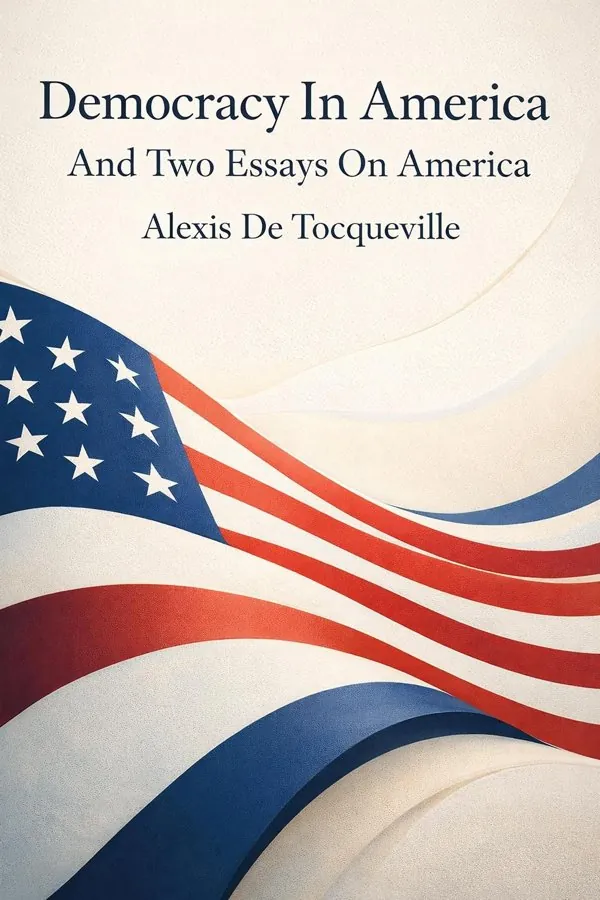
Democracy In America And Two Essays On America: Summary & Key Insights
 10 min9 chaptersAudio available
Key Takeaways from Democracy In America And Two Essays On America
A nation’s future often hides in its beginnings.
Democracy becomes real not when people vote occasionally, but when they govern constantly.
One of democracy’s hardest problems is scale.
Freedom needs barriers as much as it needs permission.
A democracy without organized participation quickly becomes either apathetic or dangerous.
What Is Democracy In America And Two Essays On America About?
Democracy In America And Two Essays On America by Alexis De Tocqueville is a politics book spanning 12 pages. What happens when equality becomes the defining fact of social life? That is the central question Alexis de Tocqueville set out to answer when he traveled through the United States in 1831. Officially, he came to study prisons. In reality, he was examining something far larger: the political and moral future of the modern world. Democracy In America is the result of that inquiry, a sweeping analysis of American institutions, habits, religion, law, local government, and public opinion. In this edition, the two additional essays on America deepen his reflections on the character of the young republic and the forces shaping its development. What makes this book endure is not simply its portrait of nineteenth-century America, but its diagnosis of democracy itself. Tocqueville saw both promise and danger in the rise of equality: more participation, mobility, and dignity on one hand; conformity, mediocrity, and soft despotism on the other. As a French aristocrat witnessing the decline of old Europe, he wrote with urgency, intelligence, and unusual balance. His work remains essential for anyone seeking to understand democratic culture, political polarization, civic life, and the fragile relationship between freedom and equality.
This FizzRead summary covers all 9 key chapters of Democracy In America And Two Essays On America in approximately 10 minutes, distilling the most important ideas, arguments, and takeaways from Alexis De Tocqueville's work. Also available as an audio summary and Key Quotes Podcast.
Democracy In America And Two Essays On America
What happens when equality becomes the defining fact of social life? That is the central question Alexis de Tocqueville set out to answer when he traveled through the United States in 1831. Officially, he came to study prisons. In reality, he was examining something far larger: the political and moral future of the modern world. Democracy In America is the result of that inquiry, a sweeping analysis of American institutions, habits, religion, law, local government, and public opinion. In this edition, the two additional essays on America deepen his reflections on the character of the young republic and the forces shaping its development.
What makes this book endure is not simply its portrait of nineteenth-century America, but its diagnosis of democracy itself. Tocqueville saw both promise and danger in the rise of equality: more participation, mobility, and dignity on one hand; conformity, mediocrity, and soft despotism on the other. As a French aristocrat witnessing the decline of old Europe, he wrote with urgency, intelligence, and unusual balance. His work remains essential for anyone seeking to understand democratic culture, political polarization, civic life, and the fragile relationship between freedom and equality.
Who Should Read Democracy In America And Two Essays On America?
This book is perfect for anyone interested in politics and looking to gain actionable insights in a short read. Whether you're a student, professional, or lifelong learner, the key ideas from Democracy In America And Two Essays On America by Alexis De Tocqueville will help you think differently.
- ✓Readers who enjoy politics and want practical takeaways
- ✓Professionals looking to apply new ideas to their work and life
- ✓Anyone who wants the core insights of Democracy In America And Two Essays On America in just 10 minutes
Want the full summary?
Get instant access to this book summary and 100K+ more with Fizz Moment.
Get Free SummaryAvailable on App Store • Free to download
Key Chapters
A nation’s future often hides in its beginnings. Tocqueville argues that to understand American democracy, you must start not with the Revolution, but with the social and religious foundations laid in colonial New England. The Puritans were not democrats in the modern sense, yet they helped create conditions in which democratic habits could flourish. They brought with them a strong moral seriousness, a respect for literacy, a tradition of self-government, and a belief that communities could organize themselves around shared principles.
Tocqueville is especially interested in how these settlers combined two impulses that might seem opposed: religious faith and political liberty. Their communities were disciplined, but they were also participatory. Local affairs were handled close to home. Citizens learned responsibility not as an abstraction but as a daily practice. This mattered because democracy, in Tocqueville’s view, does not survive on laws alone. It needs habits, customs, and beliefs that train people to use freedom well.
You can see the relevance of this insight today in any society trying to build democratic institutions from scratch. Constitutions and elections matter, but they are not enough. If citizens lack civic habits, trust, and a shared commitment to public life, democracy remains fragile. Even in workplaces, schools, or neighborhood associations, durable participation usually grows from a culture that values responsibility and mutual accountability.
Tocqueville��s lesson is practical: if you want to strengthen democracy, do not focus only on national politics. Invest in the cultural and local foundations that teach people how to govern themselves.
Democracy becomes real not when people vote occasionally, but when they govern constantly. Tocqueville was struck by how thoroughly the principle of popular sovereignty shaped American life. In Europe, the idea that authority comes from the people was still contested and often revolutionary. In America, it had become ordinary. Citizens did not merely authorize power from a distance; they exercised it through local institutions, elections, juries, and public debate.
For Tocqueville, this diffusion of authority was one of America’s defining strengths. Townships, counties, and states gave citizens repeated opportunities to participate in governance. This frequent involvement trained people in public reasoning and made politics feel like a shared responsibility rather than a remote spectacle. Democracy was not confined to grand national moments. It lived in school boards, road maintenance, public meetings, and courts.
Yet Tocqueville also saw a tension. When the people are the source of all authority, public opinion can become overwhelming. Citizens may come to assume that majority sentiment is morally decisive. This can energize political life, but it can also silence dissent and reduce independent judgment.
Modern democracies face the same challenge. Social media, online campaigns, and constant polling create the appearance of popular rule, but they do not always deepen citizenship. True self-government requires more than expression; it requires institutions that channel participation into responsibility. A neighborhood council with real authority may do more for democracy than a thousand angry posts.
The takeaway is simple: treat democracy as a practice, not just a principle. Seek out ways to participate in institutions where your voice carries duties as well as rights.
One of democracy’s hardest problems is scale. How can a large nation remain free without becoming chaotic, and how can local communities remain powerful without tearing the nation apart? Tocqueville admired the American federal system because it offered a practical answer. It divided power between national and state governments, allowing the union to handle common interests while leaving many everyday matters to local authorities.
This structure, in his view, did more than solve a technical problem. It preserved liberty by preventing excessive concentration of power. Citizens could feel attached to both the nation and their immediate community because each level of government had a meaningful role. The federal system also encouraged experimentation. Different states could try different policies, and local governments could respond more directly to the needs of their populations.
Tocqueville recognized that federalism is not automatically harmonious. It depends on political habits, constitutional respect, and a willingness to accept divided authority. Where those habits are weak, disputes over jurisdiction can become destructive. But where they are strong, federalism creates a buffer against centralization and gives democracy room to breathe.
The contemporary relevance is obvious. In large, diverse societies, national solutions are often necessary, but overcentralization can leave citizens feeling powerless and unheard. Federal arrangements, decentralization, and empowered municipalities can make politics more flexible and responsive. Even organizations can learn from this principle: teams function better when decisions are made at the right level rather than hoarded at the top.
Actionable takeaway: when evaluating any political system, ask not only who holds power, but how widely and intelligently that power is distributed.
Freedom needs barriers as much as it needs permission. Tocqueville paid close attention to the American judiciary because he believed courts played a crucial role in moderating democracy’s impulses. Unlike monarchies, where restraint often came from hereditary institutions, democracies must build restraint into their legal order. Judges help do this by interpreting law, defending constitutional limits, and slowing sudden political passions.
Tocqueville saw the legal profession as an important conservative force within a democratic society. Lawyers and judges tend to respect precedent, procedure, and formal reasoning. That can frustrate popular impatience, but it can also protect liberty. In a system where majorities are powerful, courts offer minorities and individuals a forum where argument matters more than popularity.
This does not mean Tocqueville wanted judges to rule society. His point is subtler: democracy works better when legal institutions cultivate habits of restraint. A society that values only immediate majority will can become unstable or unjust. The rule of law teaches citizens that not everything should be decided by passion, speed, or numerical advantage.
You can see this principle whenever independent courts defend civil rights, review executive overreach, or insist on due process in highly emotional cases. The same idea applies outside politics too. Healthy organizations rely on procedures and standards that outlast the moods of the moment.
Tocqueville’s practical lesson is to respect institutions that slow decision-making for good reason. When public feeling runs high, ask whether a process protects fairness, even if it delays the result you want.
A democracy without organized participation quickly becomes either apathetic or dangerous. Tocqueville observed that Americans formed associations for nearly everything: politics, religion, commerce, education, reform, and local improvement. This impressed him because associations taught citizens how to act together without waiting for the state. They transformed isolated individuals into a public capable of initiative.
Political parties, though often noisy and self-interested, also served a purpose. Tocqueville distinguished between great parties driven by fundamental principles and smaller parties focused on personalities or administration. Both could be messy, but they kept political conflict within institutional channels. Better organized rivalry than suppressed resentment.
Associational life mattered even more. When citizens create voluntary groups, they learn compromise, leadership, persuasion, and shared responsibility. These habits protect democracy from two opposite threats: passivity and centralization. If people do nothing together, the state expands to fill the vacuum. If they only act through the state, they lose the capacity for self-organization.
This insight is urgently modern. Many democracies today suffer from weakening civic institutions, declining trust, and rising loneliness. People complain about politics but do less together in local life. Tocqueville would likely see this as a warning sign. Democracy depends not only on voting, but on the spaces between the individual and the state.
Actionable takeaway: join or build one institution that requires cooperation with others. A civic group, parent association, volunteer network, union, or local board can strengthen both your community and your democratic instincts.
The freest societies often survive because not everything is left to politics. Tocqueville famously argued that religion played a stabilizing role in American democracy, not by governing directly, but by shaping morals, limits, and meaning. He was impressed that religion and liberty appeared less hostile in America than in Europe. Instead of functioning as an arm of the state, religion often existed alongside political freedom and helped sustain it.
His point was not narrowly theological. Tocqueville believed democracies need moral frameworks that encourage self-restraint. When equality weakens traditional hierarchies, individuals gain independence but may also drift toward selfishness or moral confusion. Shared beliefs and customs can counterbalance that tendency by teaching obligations beyond personal interest. Religion, in his account, helped moderate materialism, support family life, and remind citizens that freedom requires discipline.
At the same time, Tocqueville warned against mixing religious authority too closely with political power. Once religion becomes a faction, it risks losing its moral credibility. Its strength in a democracy comes from guiding conscience rather than controlling the state.
This lesson remains important even in secular societies. Whether the source is religion, ethical tradition, civic education, or shared norms, democracies need institutions that cultivate character. Laws can prohibit wrongdoing, but they cannot generate trust, honesty, or sacrifice on their own.
The takeaway: defend the moral and cultural institutions that teach responsibility. A free society needs citizens who can govern themselves before they attempt to govern others.
Democracy promises freedom, yet Tocqueville saw that it can also create new forms of pressure. His idea of the tyranny of the majority is one of the book’s most enduring warnings. In aristocratic societies, power is concentrated in elites. In democratic societies, the danger is different: the majority may impose not only laws, but opinions, manners, and assumptions so forcefully that dissent becomes socially costly.
Tocqueville was struck by how public opinion in America could discipline individuals even without formal censorship. People might be legally free to speak, yet hesitate to do so if they feared isolation, ridicule, or political punishment. This kind of pressure is especially powerful in egalitarian societies, where individuals often seek approval from peers rather than deference to superiors.
His concern feels strikingly contemporary. Today, majoritarian pressure can spread through news cycles, partisan ecosystems, and digital platforms where reputations rise and fall instantly. A person may have legal rights and still feel unable to express an unpopular view. Tocqueville’s insight is that liberty requires more than constitutional guarantees. It requires cultural tolerance for disagreement and institutions that protect minority voices.
That does not mean every dissenting view is wise. It means a healthy democracy must allow criticism, experimentation, and independent judgment. Without that, majority rule hardens into intellectual conformity.
Actionable takeaway: when your side seems obviously correct, pause and ask whether opposing views are being answered fairly or merely shamed into silence. Democracies remain free when disagreement is protected, not just permitted on paper.
The same equality that empowers citizens can also separate them from one another. Tocqueville introduces a subtle but profound idea: democratic peoples are prone to individualism. By this he does not mean selfishness in the crude sense, but a tendency for people to withdraw into private life, focusing on family, career, and personal comfort while neglecting broader civic obligations. As old hierarchies weaken, individuals become more independent, but they may also become more detached.
This isolation creates a paradox. Democracy says that power belongs to all, yet citizens may become too absorbed in their own concerns to exercise that power meaningfully. If enough people retreat, public life is left to bureaucracies, demagogues, or highly organized minorities. Tocqueville believed associations, local government, and civic participation were the best antidotes. These institutions draw individuals out of private life and remind them that their fate is tied to others.
His warning is especially relevant in affluent societies where convenience and entertainment make withdrawal easy. People can become politically expressive without being civically engaged. They comment on public affairs while doing little that binds them to a common world.
The practical application is broad. Neighborhood problem-solving, school involvement, volunteering, and local deliberation all counter democratic isolation. These are not sentimental extras. They are the training grounds of liberty.
Takeaway: notice where private comfort has replaced public responsibility in your own life. Then choose one recurring civic commitment that reconnects you to a wider community.
Political systems do not merely distribute power; they shape how people think, feel, work, and imagine the future. Tocqueville’s deepest argument is that democracy is not just a form of government but a social condition defined by increasing equality. This democratic condition alters everything: family relations, ambition, education, religion, literature, class structure, and the very psychology of citizens.
Compared with aristocratic societies, democratic ones are more fluid, practical, and restless. People become less attached to inherited rank and more focused on mobility, improvement, and material well-being. That can energize innovation and widen opportunity. But it can also encourage short-term thinking, mediocrity, and a relentless chase for comfort. Tocqueville feared that if democratic people pursued equality and security above all else, they might eventually accept a soft despotism: a paternal, centralized power that manages life for passive citizens.
The two essays on America reinforce this wider perspective by showing Tocqueville’s interest in the national character, territorial expansion, race, and the broader social tendencies of the republic. He was not writing a travel diary. He was tracing the direction of modern civilization.
This is why the book still matters. Tocqueville helps readers see democracy as an evolving moral and social environment, not just a constitution. To understand a democracy, you must ask what kind of people it produces.
Final takeaway: guard liberty by paying attention to culture as much as politics. The future of democracy depends not only on institutions, but on the character and habits of democratic citizens.
All Chapters in Democracy In America And Two Essays On America
About the Author
Alexis De Tocqueville (1805–1859) was a French political thinker, historian, and pioneering social analyst whose work became central to the study of democracy. Born into an aristocratic family in post-revolutionary France, he witnessed a society struggling to reconcile liberty, equality, and political instability. In 1831, he traveled to the United States with Gustave de Beaumont, officially to study prisons, but the journey became the basis for his most famous work, Democracy In America. Tocqueville combined sharp observation with philosophical depth, examining not just laws and institutions but also customs, beliefs, and social behavior. His writing influenced political science, sociology, and liberal thought, and he remains one of the most insightful interpreters of democratic society and its enduring tensions.
Get This Summary in Your Preferred Format
Read or listen to the Democracy In America And Two Essays On America summary by Alexis De Tocqueville anytime, anywhere. FizzRead offers multiple formats so you can learn on your terms — all free.
Available formats: App · Audio · PDF · EPUB — All included free with FizzRead
Download Democracy In America And Two Essays On America PDF and EPUB Summary
Key Quotes from Democracy In America And Two Essays On America
“A nation’s future often hides in its beginnings.”
“Democracy becomes real not when people vote occasionally, but when they govern constantly.”
“One of democracy’s hardest problems is scale.”
“Freedom needs barriers as much as it needs permission.”
“A democracy without organized participation quickly becomes either apathetic or dangerous.”
Frequently Asked Questions about Democracy In America And Two Essays On America
Democracy In America And Two Essays On America by Alexis De Tocqueville is a politics book that explores key ideas across 9 chapters. What happens when equality becomes the defining fact of social life? That is the central question Alexis de Tocqueville set out to answer when he traveled through the United States in 1831. Officially, he came to study prisons. In reality, he was examining something far larger: the political and moral future of the modern world. Democracy In America is the result of that inquiry, a sweeping analysis of American institutions, habits, religion, law, local government, and public opinion. In this edition, the two additional essays on America deepen his reflections on the character of the young republic and the forces shaping its development. What makes this book endure is not simply its portrait of nineteenth-century America, but its diagnosis of democracy itself. Tocqueville saw both promise and danger in the rise of equality: more participation, mobility, and dignity on one hand; conformity, mediocrity, and soft despotism on the other. As a French aristocrat witnessing the decline of old Europe, he wrote with urgency, intelligence, and unusual balance. His work remains essential for anyone seeking to understand democratic culture, political polarization, civic life, and the fragile relationship between freedom and equality.
More by Alexis De Tocqueville
You Might Also Like

Antifa: The Anti-Fascist Handbook
Mark Bray
10 min
Attack from Within: How Disinformation Is Sabotaging America
Barbara McQuade
10 min
Coercion, Capital, and European States, AD 990–1992
Charles Tilly
10 min
Digital Democracy: Concepts, Methodologies, Tools, and Applications
Various Authors
10 min
Fascism
Stanley G. Payne
10 min
Fire And Fury: Inside The Trump White House
Michael Wolff
10 minBrowse by Category
Ready to read Democracy In America And Two Essays On America?
Get the full summary and 100K+ more books with Fizz Moment.