
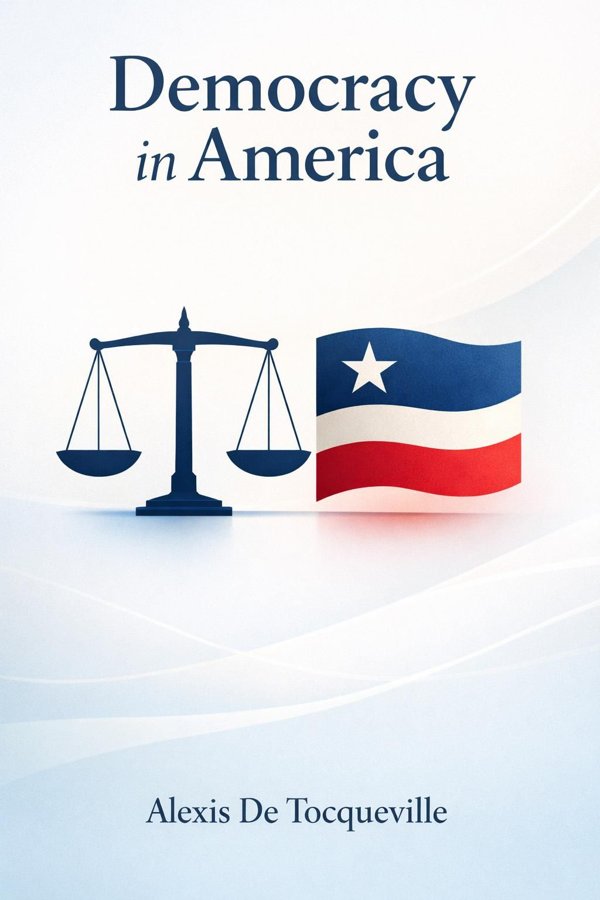
Democracy in America: Summary & Key Insights
 10 min9 chaptersAudio available
Key Takeaways from Democracy in America
Every political order carries the memory of its birth.
Democracy is most real not when people celebrate it in speeches, but when they practice it in ordinary affairs.
Large democracies survive when power is divided carefully enough to preserve both common purpose and local independence.
Freedom depends not only on elections, but on institutions that slow power down.
A democracy weakens when citizens face power alone.
What Is Democracy in America About?
Democracy in America by Alexis De Tocqueville is a politics book spanning 12 pages. Few books have explained democracy with as much clarity, foresight, and psychological depth as Alexis de Tocqueville’s Democracy in America. Written after his journey through the United States in the early 1830s, the book is far more than a travel account. It is an ambitious study of how democratic society works: what institutions protect freedom, what habits sustain self-government, and what moral dangers arise when equality becomes the defining passion of an age. Tocqueville examines local government, religion, the courts, parties, public opinion, civic associations, and the social character of democratic people. He admired America not because it was perfect, but because it revealed the promises and risks of modern equality more clearly than Europe did. As a French aristocrat living through the upheavals of post-revolutionary Europe, Tocqueville brought both distance and urgency to his analysis. His insights into majority power, individualism, soft despotism, and the tension between liberty and equality remain strikingly relevant today. This is a foundational work for understanding democratic politics, modern society, and the fragile conditions of freedom.
This FizzRead summary covers all 9 key chapters of Democracy in America in approximately 10 minutes, distilling the most important ideas, arguments, and takeaways from Alexis De Tocqueville's work. Also available as an audio summary and Key Quotes Podcast.
Democracy in America
Few books have explained democracy with as much clarity, foresight, and psychological depth as Alexis de Tocqueville’s Democracy in America. Written after his journey through the United States in the early 1830s, the book is far more than a travel account. It is an ambitious study of how democratic society works: what institutions protect freedom, what habits sustain self-government, and what moral dangers arise when equality becomes the defining passion of an age. Tocqueville examines local government, religion, the courts, parties, public opinion, civic associations, and the social character of democratic people. He admired America not because it was perfect, but because it revealed the promises and risks of modern equality more clearly than Europe did. As a French aristocrat living through the upheavals of post-revolutionary Europe, Tocqueville brought both distance and urgency to his analysis. His insights into majority power, individualism, soft despotism, and the tension between liberty and equality remain strikingly relevant today. This is a foundational work for understanding democratic politics, modern society, and the fragile conditions of freedom.
Who Should Read Democracy in America?
This book is perfect for anyone interested in politics and looking to gain actionable insights in a short read. Whether you're a student, professional, or lifelong learner, the key ideas from Democracy in America by Alexis De Tocqueville will help you think differently.
- ✓Readers who enjoy politics and want practical takeaways
- ✓Professionals looking to apply new ideas to their work and life
- ✓Anyone who wants the core insights of Democracy in America in just 10 minutes
Want the full summary?
Get instant access to this book summary and 100K+ more with Fizz Moment.
Get Free SummaryAvailable on App Store • Free to download
Key Chapters
Every political order carries the memory of its birth. Tocqueville argues that to understand American democracy, one must begin with the social and moral conditions established long before independence. In New England especially, the early settlers brought with them religious seriousness, local self-rule, literacy, legal habits, and a powerful belief that communities could govern themselves. These foundations mattered because institutions do not appear out of nowhere; they grow from customs, beliefs, and everyday practices. America’s democratic success, in Tocqueville’s view, was not simply the result of a constitution written later, but of a social state already inclined toward relative equality and participation. Unlike Europe, where aristocratic hierarchy had shaped political life for centuries, the United States developed under conditions where inherited rank was weaker and ordinary citizens had greater room to act. This gave democratic habits unusual strength. The lesson reaches beyond history. Societies often focus on formal reforms while neglecting the deeper cultural conditions that make those reforms work. A constitution may promise liberty, but without habits of trust, responsibility, education, and local initiative, liberty becomes fragile. You can see this in modern organizations as well: a workplace with flat rules but no culture of accountability rarely feels truly participatory. Tocqueville’s point is that political freedom is sustained by social character before it is protected by law. Actionable takeaway: when evaluating any democracy, look first at its civic habits, educational norms, and local culture, because institutions endure only when daily life prepares people to use them well.
Democracy is most real not when people celebrate it in speeches, but when they practice it in ordinary affairs. Tocqueville saw in America a striking fact: sovereignty truly resided in the people, not only in theory but in the structure of everyday government. Citizens voted, served on juries, attended town meetings, joined committees, and influenced local administration. Political power was dispersed through daily participation rather than concentrated in distant elites. This mattered because self-government is a learned skill. People become capable of liberty by exercising it repeatedly in small matters before confronting larger national questions. Tocqueville was especially impressed by the township, where ordinary Americans handled schools, roads, policing, and public works. Such local involvement fostered competence, ownership, and public spirit. It also made citizens less passive. In centralized systems, people often complain about government while expecting others to fix everything. In democratic systems with active local life, people are more likely to treat public problems as shared responsibilities. This insight remains deeply relevant. Neighborhood associations, school boards, city councils, and local elections may seem less glamorous than national politics, but they are often where democratic character is formed. Even in digital life, communities work better when members participate in moderation, rule-setting, and collective problem-solving rather than merely consuming outcomes. Tocqueville teaches that popular sovereignty is not just a principle of legitimacy; it is a habit of involvement. Actionable takeaway: strengthen your understanding of democracy by engaging one level closer to home—follow a local issue, attend a public meeting, or contribute to a community organization where your participation has visible consequences.
Large democracies survive when power is divided carefully enough to preserve both common purpose and local independence. Tocqueville viewed the American federal system as one of the great political inventions of modern times because it solved a difficult problem: how can a vast country remain united without smothering liberty under centralized authority? The answer was a layered structure in which local, state, and national governments each held distinct powers. This arrangement allowed public life to operate at multiple levels. Matters affecting everyone could be handled nationally, while many concerns remained close to the people most affected by them. Tocqueville admired this not only for its efficiency, but for its moral effects. Federalism prevents citizens from becoming dependent on a single political center. It multiplies opportunities for participation, experimentation, and correction. If one state adopts a poor policy, another may offer a better model. If national passions become intense, local institutions can preserve continuity. In modern terms, this is the value of decentralized decision-making. Whether in politics, education, or business, systems that allow local adaptation often prove more resilient than those governed entirely from the top. Yet Tocqueville also recognized the tension: too much fragmentation can weaken national purpose, especially in moments of crisis. Federalism works when citizens accept both shared identity and local responsibility. It is a discipline of balance, not a mechanical formula. Today, debates over central control versus local autonomy continue in public health, education, policing, and technology governance. Actionable takeaway: when assessing a policy problem, ask which level of decision-making is best suited to it, and favor arrangements that preserve accountability close to the people while still coordinating what must be handled in common.
Freedom depends not only on elections, but on institutions that slow power down. Tocqueville believed the American judiciary played an essential role in preserving liberty because judges brought legal discipline into democratic life. Courts could not replace the people, but they could channel popular will through constitutional forms and established procedures. In a democracy, majorities are powerful; they can legislate quickly, moralize aggressively, and pressure dissenters. The judiciary serves as a counterweight by insisting that power operate through law rather than impulse. Tocqueville also saw lawyers and judges as carriers of a quasi-aristocratic spirit within democracy. By this he meant they valued precedent, technical reasoning, and continuity—qualities that temper the volatility of popular passions. Far from being anti-democratic, such restraint protects democracy from self-destruction. The jury system impressed him for a related reason: it did not merely decide cases, it educated citizens. Serving on juries taught ordinary people responsibility, evidence-based judgment, and respect for legal procedure. In this sense, law was a civic school. The modern application is broad. Democratic cultures need institutions that reward patience, process, and constitutional thinking. When legal norms erode, public life becomes more tribal and more arbitrary. This is visible whenever leaders try to discredit courts simply for imposing limits. Tocqueville reminds us that free societies require guardians of form as well as expressions of popular will. Actionable takeaway: judge democratic health not only by voter turnout or election results, but by whether courts, legal procedures, and independent institutions still command public respect when they constrain immediate political desires.
A democracy weakens when citizens face power alone. One of Tocqueville’s most original insights is that associations—political, religious, commercial, charitable, and civic—are indispensable to freedom. Americans, he observed, had an unusual tendency to form groups whenever they wanted to solve a problem, defend an interest, spread an idea, or improve community life. This habit mattered because democratic equality can isolate individuals. When people no longer belong to fixed hierarchies, they may gain independence, but they also risk becoming socially fragmented and politically powerless. Associations bridge that gap. They teach cooperation, leadership, compromise, and public initiative. They also prevent the state from becoming the only effective organizer of collective action. Tocqueville distinguished between political parties and civic associations, yet he valued both when they helped citizens organize peacefully around shared concerns. Parties can channel conflict into lawful competition; associations can convert private concerns into public action. In modern society, these mediating institutions include nonprofits, unions, advocacy groups, parent organizations, professional bodies, and even well-run online communities. Where such bodies are strong, citizens are better able to resist concentration of power and pursue common goals. Where they are weak, people either retreat into private life or demand that centralized authorities solve every problem. Tocqueville’s insight helps explain why lonely, disconnected societies often become politically brittle. Freedom is sustained not only by rights on paper, but by habits of joining with others. Actionable takeaway: if you care about a public issue, do not stop at private opinion—join, build, or support an association that turns concern into organized civic action.
Political freedom cannot survive on political mechanisms alone. Tocqueville was struck by the fact that religion in America, though formally separate from government, still exerted immense influence over moral life. He did not argue that democracy requires a theocracy, nor that religion should dominate politics. Instead, he believed religion and mores—shared moral habits, customs, and beliefs—help discipline the desires that democracy can unleash. Equality encourages individuals to seek material comfort and personal independence. Without moral limits, this pursuit can slide into selfishness, short-term thinking, and indifference to the common good. Religion, in Tocqueville’s account, provides a horizon beyond immediate self-interest. It teaches restraint, duty, and the dignity of obligations that do not come from the state. Just as important, mores shape how people use freedom. Laws can prohibit some abuses, but customs influence what citizens admire, tolerate, or condemn. A society with healthy mores can preserve liberty even with imperfect laws; one with corrupted mores will struggle even under excellent institutions. The wider lesson is that values matter politically even when they are not legislated. Families, schools, congregations, and civic traditions all contribute to the moral ecology of democracy. In secular societies, similar functions may be performed by ethical traditions, professional norms, and civic education. Tocqueville’s deeper point is that liberty depends on self-restraint as much as legal protection. Actionable takeaway: support the moral institutions—religious or secular—that teach responsibility, honesty, and service, because democratic freedom is strongest when citizens govern themselves inwardly as well as politically.
The gravest danger in democracy may come not from kings, but from the people themselves. Tocqueville’s famous warning about the tyranny of the majority goes beyond electoral dominance. He feared a social condition in which majority opinion becomes so powerful that dissenters are not merely outvoted but intellectually and morally intimidated. In aristocracies, power is concentrated in a few hands; in democracies, it can be diffused through public opinion so thoroughly that independent thought becomes difficult. Tocqueville observed that Americans enjoyed broad political liberty, yet often showed strong pressure toward conformity. People hesitated to challenge prevailing views because they feared isolation more than punishment. This insight remains startlingly modern. Social media outrage, ideological sorting, and reputational shaming all reveal how majorities can discipline minorities without formal censorship. Tocqueville did not reject democracy because of this danger; he insisted that democracies must create protections against it. Free press, independent courts, decentralized institutions, and a vibrant associational life all help preserve space for dissent. So does a cultural commitment to intellectual humility. A majority may have the right to govern, but not the right to silence inquiry. This distinction is essential. Societies become less free when consensus hardens into moral coercion. Tocqueville teaches that liberty includes the ability to think, speak, and organize against prevailing opinion without being treated as illegitimate. Actionable takeaway: practice democratic courage by engaging opposing views fairly, defending lawful dissent even when you dislike it, and resisting the urge to treat disagreement as disloyalty.
The greatest democratic danger may arrive gently, under the banner of comfort and care. Tocqueville argued that equality fosters a new kind of individualism: not selfishness in the crude sense, but a tendency for people to withdraw into private life, focusing on family, work, and personal advancement while neglecting wider civic duties. As social ranks flatten, individuals no longer feel tied to inherited communities or obligations. This can be liberating, but it also weakens public spirit. When citizens retreat into private satisfactions, they leave a vacuum that an administrative state is tempted to fill. Tocqueville famously imagined a form of soft despotism in which power does not openly terrorize people, but manages them paternalistically—regulating, guiding, and relieving them of responsibility until they become politically passive. Such a regime may preserve elections and rights while gradually reducing citizens to dependent spectators. This idea has enduring relevance. Modern people often trade autonomy for convenience, security, or frictionless services, whether from governments, corporations, or digital platforms. The risk is not dramatic oppression but diminished agency. Tocqueville’s remedy was civic participation, local responsibility, and voluntary association. People stay free by doing difficult things together, not by outsourcing all burdens upward. Democratic citizenship requires effort, inconvenience, and a willingness to care about public matters beyond one’s private circle. Actionable takeaway: resist passive dependence by taking responsibility in at least one shared sphere—community, school, workplace, or local government—where your effort helps preserve the habit of self-rule.
History may push societies toward equality, but it does not determine whether equality will coexist with freedom. Tocqueville believed the democratic age was advancing across the modern world, and he treated this movement as both powerful and largely irreversible. The key question, then, was not whether democracy would come, but what kind of democracy people would build. Equality can support justice, dignity, and broad participation; it can also encourage mediocrity, conformity, materialism, and centralization. The outcome depends on character, institutions, and civic education. Tocqueville constantly compares democratic and aristocratic societies to clarify this point. Aristocracies may cultivate excellence, continuity, and honor, but they rest on inequality. Democracies expand social mobility and moral equality, yet they can flatten ambition and weaken independent judgment. He does not simply choose one over the other. Instead, he asks how democratic societies might preserve the best human qualities once associated with aristocratic life—greatness of soul, public spirit, and intellectual independence—without restoring hereditary privilege. This remains one of the book’s deepest contributions. It is not enough for democracy to be fair procedurally; it must also form citizens capable of freedom. That means educating judgment, rewarding initiative, and honoring public service. The future of democracy is therefore not secured by historical optimism alone. It depends on choices made in schools, institutions, families, media, and civic culture. Actionable takeaway: treat democracy as a moral project as well as a political system, and invest in habits—reading, deliberation, service, and local involvement—that build citizens equal not only in rights, but in responsibility.
All Chapters in Democracy in America
About the Author
Alexis de Tocqueville (1805–1859) was a French political thinker, historian, and statesman best known for his penetrating analysis of democracy and modern society. Born into an aristocratic family marked by the upheavals of the French Revolution, he developed an early interest in the forces transforming Europe. In 1831, he traveled to the United States with Gustave de Beaumont, officially to study the prison system, but the trip became the basis for his most famous work, Democracy in America. Tocqueville combined sharp observation, historical awareness, and philosophical depth to examine liberty, equality, religion, law, and civic life. He also wrote The Old Regime and the Revolution and served in French public life. Today, he is regarded as one of the most important interpreters of democracy in the modern world.
Get This Summary in Your Preferred Format
Read or listen to the Democracy in America summary by Alexis De Tocqueville anytime, anywhere. FizzRead offers multiple formats so you can learn on your terms — all free.
Available formats: App · Audio · PDF · EPUB — All included free with FizzRead
Download Democracy in America PDF and EPUB Summary
Key Quotes from Democracy in America
“Every political order carries the memory of its birth.”
“Democracy is most real not when people celebrate it in speeches, but when they practice it in ordinary affairs.”
“Large democracies survive when power is divided carefully enough to preserve both common purpose and local independence.”
“Freedom depends not only on elections, but on institutions that slow power down.”
“A democracy weakens when citizens face power alone.”
Frequently Asked Questions about Democracy in America
Democracy in America by Alexis De Tocqueville is a politics book that explores key ideas across 9 chapters. Few books have explained democracy with as much clarity, foresight, and psychological depth as Alexis de Tocqueville’s Democracy in America. Written after his journey through the United States in the early 1830s, the book is far more than a travel account. It is an ambitious study of how democratic society works: what institutions protect freedom, what habits sustain self-government, and what moral dangers arise when equality becomes the defining passion of an age. Tocqueville examines local government, religion, the courts, parties, public opinion, civic associations, and the social character of democratic people. He admired America not because it was perfect, but because it revealed the promises and risks of modern equality more clearly than Europe did. As a French aristocrat living through the upheavals of post-revolutionary Europe, Tocqueville brought both distance and urgency to his analysis. His insights into majority power, individualism, soft despotism, and the tension between liberty and equality remain strikingly relevant today. This is a foundational work for understanding democratic politics, modern society, and the fragile conditions of freedom.
More by Alexis De Tocqueville
You Might Also Like

Antifa: The Anti-Fascist Handbook
Mark Bray
10 min
Attack from Within: How Disinformation Is Sabotaging America
Barbara McQuade
10 min
Coercion, Capital, and European States, AD 990–1992
Charles Tilly
10 min
Digital Democracy: Concepts, Methodologies, Tools, and Applications
Various Authors
10 min
Fascism
Stanley G. Payne
10 min
Fire And Fury: Inside The Trump White House
Michael Wolff
10 minBrowse by Category
Ready to read Democracy in America?
Get the full summary and 100K+ more books with Fizz Moment.