
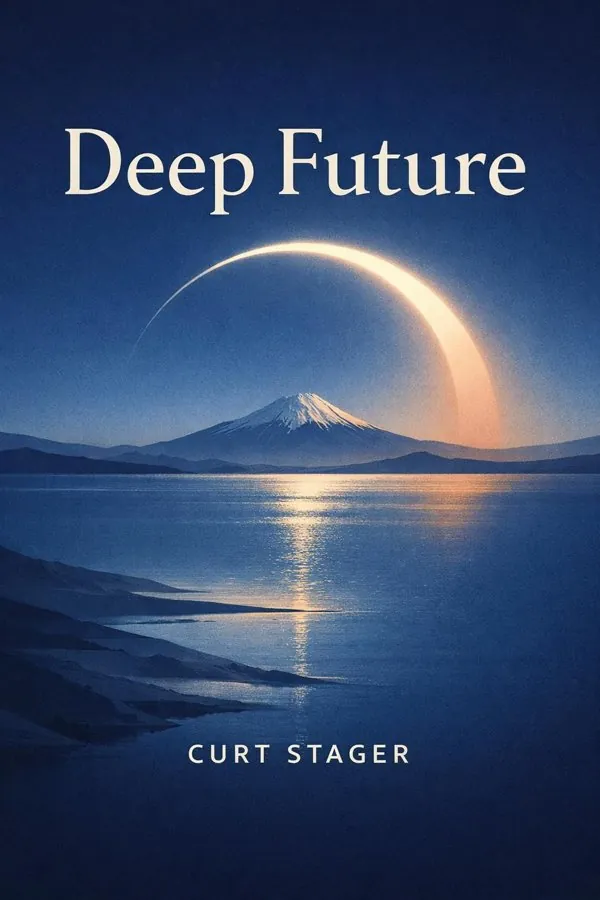
Deep Future: The Next 100,000 Years of Life on Earth: Summary & Key Insights
by Curt Stager
 10 min9 chaptersAudio available
What Is Deep Future: The Next 100,000 Years of Life on Earth About?
Deep Future: The Next 100,000 Years of Life on Earth by Curt Stager is a environment book spanning 9 pages. In Deep Future, scientist Curt Stager explores Earth's long-term environmental future, drawing on geological and climate history to project how human actions will shape the planet over the next 100,000 years. The book blends science and storytelling to reveal how climate change, evolution, and human choices intertwine across deep time.
This FizzRead summary covers all 9 key chapters of Deep Future: The Next 100,000 Years of Life on Earth in approximately 10 minutes, distilling the most important ideas, arguments, and takeaways from Curt Stager's work. Also available as an audio summary and Key Quotes Podcast.
Deep Future: The Next 100,000 Years of Life on Earth
In Deep Future, scientist Curt Stager explores Earth's long-term environmental future, drawing on geological and climate history to project how human actions will shape the planet over the next 100,000 years. The book blends science and storytelling to reveal how climate change, evolution, and human choices intertwine across deep time.
Who Should Read Deep Future: The Next 100,000 Years of Life on Earth?
This book is perfect for anyone interested in environment and looking to gain actionable insights in a short read. Whether you're a student, professional, or lifelong learner, the key ideas from Deep Future: The Next 100,000 Years of Life on Earth by Curt Stager will help you think differently.
- ✓Readers who enjoy environment and want practical takeaways
- ✓Professionals looking to apply new ideas to their work and life
- ✓Anyone who wants the core insights of Deep Future: The Next 100,000 Years of Life on Earth in just 10 minutes
Want the full summary?
Get instant access to this book summary and 100K+ more with Fizz Moment.
Get Free SummaryAvailable on App Store • Free to download
Key Chapters
To understand our future, we must first look back. The Earth has always been a planet of change, and its climate has danced to rhythms that are far older than humanity. In my work as a paleoecologist, I’ve sifted through lake sediments and ice cores that bear witness to these movements. They tell stories of glacial ages and interglacial warmth, of deserts transforming into savannas, and of oceans rising and falling in response to subtle shifts in orbit and atmosphere. This grand record reminds us that climate is not static—it is a living system that responds to cosmic, chemical, and biological cues.
For millions of years, the Earth’s climate has cycled through cold and warm epochs governed by Milankovitch cycles—variations in orbital tilt and eccentricity that alter how sunlight reaches the planet’s surface. These cycles, combined with changes in atmospheric CO₂ and feedback mechanisms such as ice-albedo and ocean circulation, have sculpted the familiar patterns of ice ages and interglacial intervals. However, the natural pace of these transformations unfolds over tens of thousands of years. By contrast, human civilization has accelerated change into mere centuries. Understanding that rhythm—how slow it naturally is, and how abruptly we’ve nudged it—sets the stage for comprehending our unique moment in geological history.
Our species has become a geological agent. This realization forms one of the most profound pivots in environmental science. When we burn fossil fuels, we are not merely disturbing the air of today; we are reshaping the biosphere for millennia to come. The CO₂ that escapes into the sky remains active in the climate system for tens of thousands of years, cycling through oceans, rocks, and living organisms. In the long-term record, the spike of carbon we’ve released will appear as a thin but sharp anomaly—a chemical signature marking the Anthropocene, our distinct layer in Earth’s history.
In the book, I unfold how the human impact has altered fundamental balances that kept planetary climate relatively stable for the past 10,000 years. Even the mild Holocene, the epoch during which agriculture and civilization arose, owes its benign warmth to delicate feedbacks in carbon exchange. Yet our massive addition of carbon—through industrial emissions, deforestation, and cement production—has shifted those balances dramatically. The energy we unleash is not temporary; it persists and spreads through deep reservoirs. Recognizing this scale of influence should transform how we perceive responsibility. We are no longer passive observers of climate cycles; we are participants writing a new climatic chapter.
+ 7 more chapters — available in the FizzRead app
All Chapters in Deep Future: The Next 100,000 Years of Life on Earth
About the Author
Curt Stager is a paleoecologist, educator, and science communicator. He teaches at Paul Smith’s College in New York and has contributed to publications such as National Geographic and Fast Company. His research focuses on climate change and the long-term interactions between humans and the natural world.
Get This Summary in Your Preferred Format
Read or listen to the Deep Future: The Next 100,000 Years of Life on Earth summary by Curt Stager anytime, anywhere. FizzRead offers multiple formats so you can learn on your terms — all free.
Available formats: App · Audio · PDF · EPUB — All included free with FizzRead
Download Deep Future: The Next 100,000 Years of Life on Earth PDF and EPUB Summary
Key Quotes from Deep Future: The Next 100,000 Years of Life on Earth
“To understand our future, we must first look back.”
“Our species has become a geological agent.”
Frequently Asked Questions about Deep Future: The Next 100,000 Years of Life on Earth
Deep Future: The Next 100,000 Years of Life on Earth by Curt Stager is a environment book that explores key ideas across 9 chapters. In Deep Future, scientist Curt Stager explores Earth's long-term environmental future, drawing on geological and climate history to project how human actions will shape the planet over the next 100,000 years. The book blends science and storytelling to reveal how climate change, evolution, and human choices intertwine across deep time.
You Might Also Like
A Life on Our Planet: My Witness Statement and a Vision for the Future
David Attenborough
10 min
A Sky Full Of Birds
Matt Merritt
10 min
Carbon Zero: Imagining Cities That Can Save the Planet
Alex Steffen
10 min
Eaarth: Making a Life on a Tough New Planet
Bill McKibben
10 min
The Social Contract and Environmental Governance
Various Editors
10 min
The Wild Places
Robert Macfarlane
10 minBrowse by Category
Ready to read Deep Future: The Next 100,000 Years of Life on Earth?
Get the full summary and 100K+ more books with Fizz Moment.