
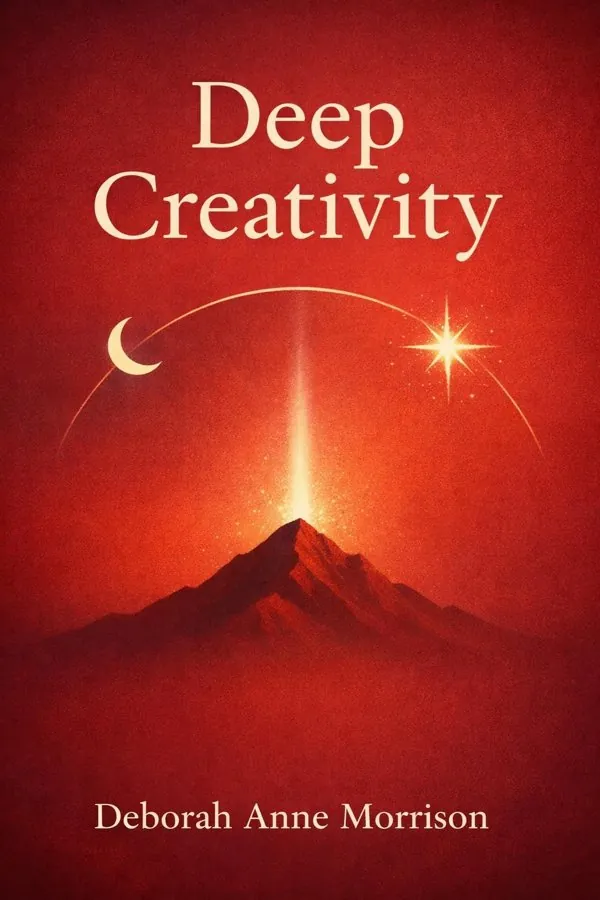
Deep Creativity: Seven Ways to Spark Your Creative Genius: Summary & Key Insights
 10 min10 chaptersAudio available
Key Takeaways from Deep Creativity: Seven Ways to Spark Your Creative Genius
Creativity becomes deeper when we stop seeing it as self-expression alone and start recognizing it as dialogue with something larger than the conscious mind.
Imagination is not an escape from reality; it is one of the ways reality becomes deeper, more meaningful, and more alive.
Some of the most important creative decisions are made before we can fully justify them.
Inspiration is often romanticized as a lightning strike, but Morrison shows that it more often arrives to those who have prepared themselves to receive it.
Insight is the moment when fragments suddenly organize into meaning.
What Is Deep Creativity: Seven Ways to Spark Your Creative Genius About?
Deep Creativity: Seven Ways to Spark Your Creative Genius by Deborah Anne Morrison is a creativity book spanning 10 pages. Creativity is often treated as a talent reserved for artists, inventors, or rare geniuses. In Deep Creativity: Seven Ways to Spark Your Creative Genius, Deborah Anne Morrison argues for something far more expansive: creativity is a profound human capacity rooted in the psyche, the body, and the spirit. This book is not just about producing original work. It is about accessing deeper layers of awareness that allow authentic expression, insight, and personal transformation to emerge. Morrison draws from Jungian psychology, neuroscience, and transpersonal theory to show that creative living begins within. Rather than reducing creativity to technique or productivity, she presents it as a developmental path shaped by imagination, intuition, inspiration, insight, integration, illumination, and transformation. Each pathway helps readers understand how inner experience becomes meaningful outer action. What makes the book especially valuable is Morrison’s authority at the intersection of psychology and creative practice. As a psychologist and researcher of creativity, she offers a framework that is both intellectually grounded and spiritually resonant. For anyone who feels blocked, disconnected, or hungry for deeper originality, this book offers a richer way to understand where creativity truly comes from.
This FizzRead summary covers all 10 key chapters of Deep Creativity: Seven Ways to Spark Your Creative Genius in approximately 10 minutes, distilling the most important ideas, arguments, and takeaways from Deborah Anne Morrison's work. Also available as an audio summary and Key Quotes Podcast.
Deep Creativity: Seven Ways to Spark Your Creative Genius
Creativity is often treated as a talent reserved for artists, inventors, or rare geniuses. In Deep Creativity: Seven Ways to Spark Your Creative Genius, Deborah Anne Morrison argues for something far more expansive: creativity is a profound human capacity rooted in the psyche, the body, and the spirit. This book is not just about producing original work. It is about accessing deeper layers of awareness that allow authentic expression, insight, and personal transformation to emerge.
Morrison draws from Jungian psychology, neuroscience, and transpersonal theory to show that creative living begins within. Rather than reducing creativity to technique or productivity, she presents it as a developmental path shaped by imagination, intuition, inspiration, insight, integration, illumination, and transformation. Each pathway helps readers understand how inner experience becomes meaningful outer action.
What makes the book especially valuable is Morrison’s authority at the intersection of psychology and creative practice. As a psychologist and researcher of creativity, she offers a framework that is both intellectually grounded and spiritually resonant. For anyone who feels blocked, disconnected, or hungry for deeper originality, this book offers a richer way to understand where creativity truly comes from.
Who Should Read Deep Creativity: Seven Ways to Spark Your Creative Genius?
This book is perfect for anyone interested in creativity and looking to gain actionable insights in a short read. Whether you're a student, professional, or lifelong learner, the key ideas from Deep Creativity: Seven Ways to Spark Your Creative Genius by Deborah Anne Morrison will help you think differently.
- ✓Readers who enjoy creativity and want practical takeaways
- ✓Professionals looking to apply new ideas to their work and life
- ✓Anyone who wants the core insights of Deep Creativity: Seven Ways to Spark Your Creative Genius in just 10 minutes
Want the full summary?
Get instant access to this book summary and 100K+ more with Fizz Moment.
Get Free SummaryAvailable on App Store • Free to download
Key Chapters
Creativity becomes deeper when we stop seeing it as self-expression alone and start recognizing it as dialogue with something larger than the conscious mind. Morrison builds her framework on Jungian psychology, especially Jung’s ideas of the collective unconscious, archetypes, symbols, and individuation. In her view, creative work often arises from psychic material that has not yet reached full awareness. Images, fantasies, dreams, sudden fascinations, and emotional tensions can all be messages from the deeper psyche trying to take form.
This perspective changes how we think about originality. A creative idea is not always manufactured through effortful thinking; it may also be discovered by listening inwardly. Archetypal themes such as rebirth, shadow, heroism, longing, or union show up in stories, artworks, inventions, and life choices because they belong to shared human patterns. When creators become more attentive to these patterns, their work gains emotional power and symbolic resonance.
Morrison also links creativity to individuation, Jung’s term for becoming more fully oneself. The creative process can reveal hidden fears, unlived desires, and disowned aspects of identity. A writer who repeatedly returns to themes of exile, for example, may be exploring an inner conflict about belonging. A leader drawn to visionary projects may be answering a deeper call toward meaning.
Practically, this means paying attention to dreams, recurring images, emotional reactions, and symbolic motifs in your work. Keep a journal of patterns that repeat across your ideas and experiences. Instead of dismissing them, ask what they might be trying to express. Actionable takeaway: treat your creative life as an exploration of the unconscious, and begin recording symbols, dreams, and recurring themes to uncover the deeper source of your originality.
Imagination is not an escape from reality; it is one of the ways reality becomes deeper, more meaningful, and more alive. Morrison presents imagination as the threshold faculty that allows us to perceive possibility beyond habit and literal thinking. Rather than viewing imagination as childish fantasy, she frames it as a disciplined inner capacity for image-making, symbolic perception, and creative recombination.
Through imagination, we can hold multiple realities at once: what is, what could be, and what wants to emerge. This makes imagination essential not only for artists, but for therapists, entrepreneurs, teachers, and anyone trying to solve human problems. A designer imagines new forms. A parent imagines a different way of relating to a child. A person in crisis imagines a life beyond present limitations.
Morrison suggests that imagination works best when it is cultivated, not forced. Daydreaming, visual journaling, active imagination, contemplative reading, and immersion in metaphor-rich art all expand inner range. If you never give yourself space away from tasks, schedules, and performance demands, imagination shrinks into utility. But when you attend to images, moods, and symbols, the psyche begins to offer fresh material.
A practical example is creative problem-solving. Instead of asking, “What is the correct answer?” ask, “What image captures this problem?” or “If this situation were a story, what would happen next?” These questions bypass rigid logic and invite surprising insight. Even professionals in analytical fields can use visual thinking, mind-mapping, or scenario-building to access more original ideas.
Actionable takeaway: create a daily imagination practice of at least ten minutes by sketching, freewriting, visualizing, or engaging a symbolic prompt, and use it to loosen the grip of habitual thinking.
Some of the most important creative decisions are made before we can fully justify them. Morrison describes intuition as a subtle mode of knowing that precedes rational analysis. It is not irrationality, nor is it mystical guesswork detached from reality. Rather, intuition is the psyche’s capacity to synthesize patterns, emotional cues, implicit knowledge, and inner resonance into a felt sense of direction.
In creativity, intuition often appears as a hunch, an attraction, an unease, or a sudden certainty about what fits. A musician senses the next phrase before composing it consciously. A researcher feels that an unusual connection is worth exploring. A writer knows a character is false before understanding why. These moments arise because the mind is processing more than conscious thought can articulate.
Morrison emphasizes that intuition grows stronger when people learn to distinguish it from fear, fantasy, and impulse. Intuition tends to feel quiet, clear, and grounded, even when it points toward risk. Fear, by contrast, is often noisy, urgent, and defensive. Developing intuition therefore requires self-awareness. Meditation, body scanning, reflective journaling, and careful review of past decisions help people notice what genuine inner knowing feels like.
Practical application matters here. Before making a creative decision, pause and ask: what does my body register? What feels expansive? What feels constricted? If you are developing a project, notice which ideas continue to draw your energy over time. Intuition is often confirmed through repeated inner return.
Morrison does not reject reason; she places intuition and analysis in partnership. Intuition offers direction, and reason helps shape execution. Actionable takeaway: before your next major creative choice, pause for silent reflection, notice your felt response, write it down, and compare it with your logical analysis rather than choosing one mode over the other.
Inspiration is often romanticized as a lightning strike, but Morrison shows that it more often arrives to those who have prepared themselves to receive it. Inspiration is the energizing force that animates creative work with freshness, intensity, and meaning. It can come through nature, art, conversation, grief, love, dreams, sacred experience, or sudden encounters with beauty. Yet inspiration is not entirely random. It is invited by receptivity.
This idea matters because many people wait passively for inspiration and then conclude they are not creative when nothing happens. Morrison argues that inspiration emerges in relationship to attention. When we move too quickly, numb ourselves with distraction, or reduce every activity to output, we become less available to the experiences that stir creation. Inspiration requires openness to wonder, emotion, and mystery.
A practical implication is that creative discipline includes cultivating encounters that awaken us. Reading poetry, walking without headphones, visiting galleries, spending time in silence, listening deeply to music, or engaging in meaningful dialogue can all replenish the source. A therapist may find inspiration through a client’s metaphor. A business founder may discover it while observing a simple human frustration. A painter may receive it from light falling across an ordinary room.
Morrison also suggests that inspiration carries responsibility. It is not enough to be moved; one must respond. Capture ideas immediately. Build rituals that honor arrival, such as carrying a notebook, recording voice memos, or beginning work at the same hour each day when you are most open.
Actionable takeaway: design an inspiration ecology by protecting regular spaces for beauty, stillness, and observation, and keep a reliable system for capturing ideas the moment they appear.
Insight is the moment when fragments suddenly organize into meaning. Morrison treats insight as one of the central turning points in deep creativity because it bridges unconscious incubation and conscious understanding. Long before an insight becomes visible, the mind has often been working beneath awareness, linking memories, emotions, symbols, and information into a new configuration. What feels sudden is usually the culmination of hidden inner work.
This matters because people often misjudge the creative process. They assume progress only counts when it is visible and linear. Morrison reminds us that confusion, uncertainty, and incubation are not failures. They are often necessary conditions for breakthrough. When we stop forcing answers and allow material to ripen, insight becomes more likely.
Examples appear in every domain. A scientist sees a new pattern in data after stepping away from a problem. A novelist discovers the true motive of a character while washing dishes. A manager realizes that a recurring team conflict is really about trust, not communication. These insights can feel revelatory because they simplify complexity without reducing it.
To support insight, Morrison encourages oscillation between immersion and distance. Study the problem intensely, then walk, rest, dream, or do something manual. Reflective practices such as journaling, drawing conceptual maps, or talking ideas through with a trusted listener can also reveal hidden structure. Importantly, insight is not only intellectual; it may also involve emotional truth, moral clarity, or symbolic recognition.
Actionable takeaway: when you feel stuck, stop pushing for immediate answers and instead alternate focused work with deliberate incubation, then record any patterns or realizations that surface after stepping back.
A creative breakthrough means little if it remains disconnected from the rest of life. Morrison’s idea of integration is what distinguishes deep creativity from isolated flashes of brilliance. Integration is the process of bringing insights, intuitions, emotions, and symbolic discoveries into coherent relationship with one’s identity, habits, values, and actions. Without integration, creativity can remain chaotic, inflated, or unsustainable.
This stage is psychologically important because the creative process often activates conflicting inner forces. New ideas can challenge existing roles, relationships, and self-concepts. A corporate professional may discover a longing for painting. A successful academic may realize her most alive work is public storytelling. A parent may sense that a neglected artistic self needs expression. Integration asks how these truths can be lived rather than merely admired.
Morrison’s Jungian background is evident here. Deep creativity requires meeting shadow material as well as gifts. Creative blocks may hide fear of judgment, unresolved grief, perfectionism, or anger. Integration means acknowledging these elements and finding ways to work with them consciously. It may involve therapy, reflective writing, honest conversation, boundary-setting, or redesigning one’s schedule so creative life has real space.
There is also a practical dimension. Integration turns insight into routine. If your creativity matters, it must show up on the calendar, in your environment, and in your choices. You may need to simplify commitments, build rituals, or allow your work to evolve publicly before it feels fully formed.
Actionable takeaway: identify one recent creative insight and ask what concrete change in your schedule, environment, relationships, or self-understanding would allow that insight to become part of your actual life.
Not every creative act is valuable because it is useful; some are valuable because they reveal truth, beauty, or sacred depth. Morrison uses illumination to describe moments when creativity discloses a larger sense of meaning. Illumination is more than solving a problem or finishing a project. It is a heightened state in which the world feels interconnected, symbols become radiant, and one’s work seems aligned with something profound.
This is where Morrison’s transpersonal perspective becomes especially clear. She suggests that creativity can open experiences of transcendence, awe, and spiritual participation. A poet may feel language arrive from beyond the ordinary self. A scientist may experience wonder at the elegance of discovery. A gardener, dancer, teacher, or caregiver may enter a state where action feels luminous and deeply right. These moments do not belong only to elite creators; they are part of human consciousness at its most awake.
Why does this matter? Because modern culture often reduces creativity to innovation, branding, or measurable output. Morrison expands the frame. Illumination reminds us that creative work can heal, connect, and re-enchant life. It can help people experience purpose, reverence, and inner coherence.
Practically, illumination cannot be commanded, but it can be welcomed. Practices of contemplation, solitude, ritual, and wholehearted presence make us more available to it. So does honoring the symbolic and emotional dimensions of our work instead of focusing only on external results. Even simple acts, such as writing a reflection after a meaningful creative session, can help preserve the depth of such experiences.
Actionable takeaway: after your next deeply engaging creative moment, pause to ask not just what you made, but what larger meaning, truth, or sense of connection the experience revealed.
The most powerful creative work does not merely produce objects; it changes the person creating them. Morrison presents transformation as the culminating pathway of deep creativity. Through sustained engagement with imagination, intuition, inspiration, insight, integration, and illumination, individuals are gradually reshaped. They become more aware, more honest, more whole, and more capable of expressing their deepest nature.
Transformation happens because the creative process is inherently developmental. It asks us to confront uncertainty, vulnerability, limitation, and possibility. To create authentically, we must often let go of old identities and inherited expectations. A person who begins writing may discover long-silenced grief. Someone launching a meaningful venture may outgrow the need for approval. An artist may learn that the real work is not impressing others but becoming truthful.
Morrison emphasizes that this transformation is not always comfortable. Deep creativity can dismantle false certainty before it offers renewal. It can expose shadow elements, challenge ego-driven ambition, and demand patience with ambiguity. Yet this is precisely why it matters. Creativity becomes a path of inner evolution, not just personal output.
In practical terms, transformation can be tracked through changes in courage, perception, and alignment. Are you more willing to take meaningful risks? Do you trust your inner life more? Are your choices increasingly consistent with what feels alive and true? These are signs that creativity is affecting the whole person.
Actionable takeaway: define one way your creative practice is changing you as a person, not just what it helps you produce, and commit to nurturing that inner shift with regular reflection and honest self-assessment.
Mystery and biology are not enemies; understanding the brain can deepen rather than diminish our appreciation of creativity. Morrison incorporates neuroscience to show that creative experience involves identifiable mental processes, including association, incubation, attention switching, emotional salience, and integration across brain networks. This gives her model a useful balance: creativity remains profound, but it is not vague.
One important implication is that the brain needs both focused and diffuse modes of thinking. Concentrated attention helps with craft, revision, and problem definition. More relaxed states, such as walking, showering, resting, or drifting into reverie, support associative thinking and unexpected connections. Many breakthroughs occur not during intense effort alone, but when the mind is allowed to wander productively.
Morrison also highlights the role of emotion and embodiment. Creative ideas that matter to us are more likely to capture attention and memory. Stress, fear, and perfectionism can inhibit experimentation by pushing the brain toward defensiveness and narrow control. Safety, curiosity, play, and meaningful challenge help open the conditions for novelty.
These findings have everyday applications. If you are stuck, changing environments, taking a break, or shifting from words to images can reset cognition. If your inner critic is overwhelming, shorter sessions, low-stakes drafts, or collaborative brainstorming can reduce threat. Sleep, movement, and recovery are not interruptions to creativity; they are part of its infrastructure.
Morrison’s broader point is that creative genius is not a magical trait possessed by a few, but a capacity that can be strengthened through practice and conditions. Actionable takeaway: structure your creative work to include cycles of focus, rest, movement, and play so your brain has the range it needs for both disciplined execution and breakthrough thinking.
Insight without application fades quickly, which is why Morrison ends with a strong emphasis on practice. Deep creativity becomes real when it is embodied in habits, environments, relationships, and forms of work. Many people admire creativity in theory while living in ways that continuously suppress it through overcommitment, distraction, perfectionism, and lack of attention. Morrison calls readers to make creativity a lived discipline.
Embodied practice begins with rhythm. Creative life rarely thrives on occasional emotional surges alone. It needs recurring containers: a morning writing ritual, a weekly studio session, a contemplative walk, a monthly reflection review, or a dedicated space where unfinished ideas can remain visible. Small but repeated acts are often more transformative than dramatic bursts.
She also encourages readers to match practices to temperament. Some people generate through solitude; others through dialogue. Some need visual stimuli, while others need silence. Some work best in long immersive sessions, others in short consistent intervals. Deep creativity is personal, so the goal is not to imitate another creator’s routine but to discover conditions under which your own psyche becomes most alive.
Practical applications extend beyond art. Teams can use reflective pauses before strategy sessions. Educators can invite imagination through metaphor and storytelling. Therapists can use image-making and dream work. Professionals in any field can ask more generative questions, create more spacious workflows, and value depth alongside efficiency.
Actionable takeaway: choose one sustainable creative ritual for the next two weeks, protect it as non-negotiable, and observe how regular embodied practice changes not just your output, but your sense of aliveness and connection.
All Chapters in Deep Creativity: Seven Ways to Spark Your Creative Genius
About the Author
Deborah Anne Morrison is a Canadian author, psychologist, and creativity researcher whose work explores the intersection of psychology, spirituality, and human development. She is particularly known for drawing on Jungian and transpersonal psychology to examine how imagination, intuition, symbolism, and inner transformation shape the creative process. Rather than treating creativity as a narrow artistic gift, Morrison presents it as a fundamental human capacity connected to individuation, meaning, and personal growth. Her writing appeals to readers interested in both the theory and lived experience of creativity, blending intellectual depth with reflective insight. In Deep Creativity, she brings together psychological research, spiritual inquiry, and practical guidance to help readers understand creative genius as something that can be awakened through deeper self-awareness and disciplined inner attention.
Get This Summary in Your Preferred Format
Read or listen to the Deep Creativity: Seven Ways to Spark Your Creative Genius summary by Deborah Anne Morrison anytime, anywhere. FizzRead offers multiple formats so you can learn on your terms — all free.
Available formats: App · Audio · PDF · EPUB — All included free with FizzRead
Download Deep Creativity: Seven Ways to Spark Your Creative Genius PDF and EPUB Summary
Key Quotes from Deep Creativity: Seven Ways to Spark Your Creative Genius
“Creativity becomes deeper when we stop seeing it as self-expression alone and start recognizing it as dialogue with something larger than the conscious mind.”
“Imagination is not an escape from reality; it is one of the ways reality becomes deeper, more meaningful, and more alive.”
“Some of the most important creative decisions are made before we can fully justify them.”
“Inspiration is often romanticized as a lightning strike, but Morrison shows that it more often arrives to those who have prepared themselves to receive it.”
“Insight is the moment when fragments suddenly organize into meaning.”
Frequently Asked Questions about Deep Creativity: Seven Ways to Spark Your Creative Genius
Deep Creativity: Seven Ways to Spark Your Creative Genius by Deborah Anne Morrison is a creativity book that explores key ideas across 10 chapters. Creativity is often treated as a talent reserved for artists, inventors, or rare geniuses. In Deep Creativity: Seven Ways to Spark Your Creative Genius, Deborah Anne Morrison argues for something far more expansive: creativity is a profound human capacity rooted in the psyche, the body, and the spirit. This book is not just about producing original work. It is about accessing deeper layers of awareness that allow authentic expression, insight, and personal transformation to emerge. Morrison draws from Jungian psychology, neuroscience, and transpersonal theory to show that creative living begins within. Rather than reducing creativity to technique or productivity, she presents it as a developmental path shaped by imagination, intuition, inspiration, insight, integration, illumination, and transformation. Each pathway helps readers understand how inner experience becomes meaningful outer action. What makes the book especially valuable is Morrison’s authority at the intersection of psychology and creative practice. As a psychologist and researcher of creativity, she offers a framework that is both intellectually grounded and spiritually resonant. For anyone who feels blocked, disconnected, or hungry for deeper originality, this book offers a richer way to understand where creativity truly comes from.
You Might Also Like
Dimensions Of Creativity
Margaret A. Boden
10 min
How to Fly a Horse: The Secret History of Creation, Invention, and Discovery
Kevin Ashton
10 min
Imagine: How Creativity Works
Jonah Lehrer
10 min
The Accidental Creative: How to Be Brilliant at a Moment's Notice
Todd Henry
10 min
The Origins of Creativity
Edward O. Wilson
10 min
Wired to Create: Unraveling the Mysteries of the Creative Mind
Scott Barry Kaufman, Carolyn Gregoire
10 minBrowse by Category
Ready to read Deep Creativity: Seven Ways to Spark Your Creative Genius?
Get the full summary and 100K+ more books with Fizz Moment.