
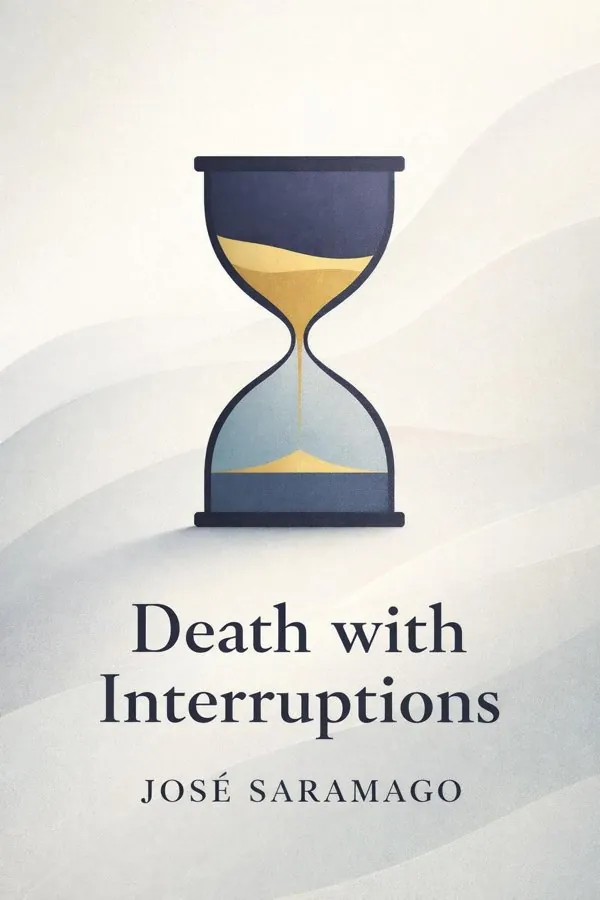
Death with Interruptions: Summary & Key Insights
 10 min8 chaptersAudio available
Key Takeaways from Death with Interruptions
The most disturbing revolutions do not begin with explosions; they begin with an absence.
Religions often promise meaning beyond death, but what happens when death itself disappears?
A society’s values become clearest when its systems stop working.
When reality becomes absurd, bureaucracies rarely become wise; they become procedural.
When death returns, it does not come back as a storm but as a secretary.
What Is Death with Interruptions About?
Death with Interruptions by José Saramago is a classics book spanning 5 pages. What would happen if death simply decided not to come to work? In Death with Interruptions, José Saramago begins with that deceptively simple question and turns it into a brilliant, unsettling exploration of modern society. In an unnamed country, people stop dying overnight. At first, this seems like a miracle: no funerals, no final goodbyes, no terminal endings. But the triumph quickly curdles into crisis. Hospitals fill with patients who cannot recover yet cannot die. Families are trapped caring for loved ones suspended in endless suffering. The state, the Church, the funeral industry, and even organized crime scramble to adapt to a world whose deepest assumptions have collapsed. Saramago, winner of the Nobel Prize in Literature, was uniquely equipped to write this kind of fable. His fiction blends satire, philosophy, political insight, and emotional precision, exposing the absurdities hidden inside ordinary institutions. Here, with his unmistakable irony and humane intelligence, he asks not only why death frightens us, but also why mortality gives structure, urgency, and meaning to life. Death with Interruptions matters because it transforms an impossible premise into a profound reflection on how we live, what we value, and what happens when the end no longer arrives.
This FizzRead summary covers all 8 key chapters of Death with Interruptions in approximately 10 minutes, distilling the most important ideas, arguments, and takeaways from José Saramago's work. Also available as an audio summary and Key Quotes Podcast.
Death with Interruptions
What would happen if death simply decided not to come to work? In Death with Interruptions, José Saramago begins with that deceptively simple question and turns it into a brilliant, unsettling exploration of modern society. In an unnamed country, people stop dying overnight. At first, this seems like a miracle: no funerals, no final goodbyes, no terminal endings. But the triumph quickly curdles into crisis. Hospitals fill with patients who cannot recover yet cannot die. Families are trapped caring for loved ones suspended in endless suffering. The state, the Church, the funeral industry, and even organized crime scramble to adapt to a world whose deepest assumptions have collapsed.
Saramago, winner of the Nobel Prize in Literature, was uniquely equipped to write this kind of fable. His fiction blends satire, philosophy, political insight, and emotional precision, exposing the absurdities hidden inside ordinary institutions. Here, with his unmistakable irony and humane intelligence, he asks not only why death frightens us, but also why mortality gives structure, urgency, and meaning to life. Death with Interruptions matters because it transforms an impossible premise into a profound reflection on how we live, what we value, and what happens when the end no longer arrives.
Who Should Read Death with Interruptions?
This book is perfect for anyone interested in classics and looking to gain actionable insights in a short read. Whether you're a student, professional, or lifelong learner, the key ideas from Death with Interruptions by José Saramago will help you think differently.
- ✓Readers who enjoy classics and want practical takeaways
- ✓Professionals looking to apply new ideas to their work and life
- ✓Anyone who wants the core insights of Death with Interruptions in just 10 minutes
Want the full summary?
Get instant access to this book summary and 100K+ more with Fizz Moment.
Get Free SummaryAvailable on App Store • Free to download
Key Chapters
The most disturbing revolutions do not begin with explosions; they begin with an absence. In Death with Interruptions, the central shock is not a plague or war, but the quiet disappearance of death itself. At midnight on New Year’s Day in an unnamed country, no one dies anymore. The terminally ill remain alive, the elderly do not pass on, and people expected to die simply continue in a suspended state. What first sounds like humanity’s oldest dream quickly reveals itself as a civic, moral, and emotional nightmare.
Saramago uses this premise to expose how deeply death structures daily life. Hospitals depend on death to free beds. retirement systems depend on generational turnover. Families depend, however painfully, on the finality that allows grief to begin and eventually settle. Once that final threshold vanishes, society loses one of its hidden organizing principles. People do not become healthier; they become stuck. The novel reminds us that immortality without vitality is not a blessing, but a prolonged crisis.
The brilliance of this idea lies in how ordinary the consequences feel. Bureaucracies panic. Politicians issue statements. News media sensationalize. Citizens oscillate between wonder and dread. Saramago shows that the impossible becomes believable when filtered through institutions behaving exactly as they usually do: defensively, opportunistically, and with limited imagination.
In practical terms, the novel invites readers to question where they assume permanence in their own lives. We often think we want endless time, yet much of our meaning comes from limits: deadlines, life stages, endings, commitments. Without endings, choices lose shape.
Actionable takeaway: Reflect on one area of your life where limits create value—whether in relationships, work, or personal goals—and treat that boundary not as a curse, but as a source of meaning.
Religions often promise meaning beyond death, but what happens when death itself disappears? Saramago turns this question into one of the novel’s sharpest satirical tools. In the unnamed country, the end of dying creates not only a social crisis but a theological one. If no one dies, what becomes of heaven, resurrection, judgment, salvation, or the entire spiritual architecture built around mortality? The Church, faced with a miracle that undermines its own doctrine, responds not with serene wisdom but with anxious self-preservation.
Saramago’s point is not merely to mock religion. It is to show that institutions, even sacred ones, can become dependent on the problems they claim to solve. Death has long provided religion with urgency. It gives shape to questions of sin, redemption, and the afterlife. Remove death, and those questions no longer arrive in the same form. The Church’s unease reveals an uncomfortable truth: beliefs are not only spiritual commitments, but also social systems with vested interests.
This idea extends beyond religion. Any institution may unconsciously rely on fear, scarcity, or crisis to justify its existence. Insurance industries need risk. security industries need danger. Political movements often need enemies. Saramago asks readers to notice when a system is truly serving people and when it is protecting its own relevance.
On a personal level, the novel also raises a subtler question: do we only ask life’s deepest questions when forced by mortality? Many people postpone reflection until illness, grief, or aging interrupts routine. Yet wisdom need not wait for emergency.
Actionable takeaway: Examine one belief system or institution you trust and ask a difficult question—does it primarily help people flourish, or does it partly depend on keeping them afraid? Use that same question on your own habits of meaning-making.
When reality becomes absurd, bureaucracies rarely become wise; they become procedural. One of Saramago’s funniest and most incisive insights is that governments respond to the disappearance of death not by confronting its philosophical depth, but by generating committees, statements, policies, and carefully worded public messaging. The machinery of administration grinds on, trying to domesticate an event that exceeds every category it possesses.
This is not simply comic exaggeration. Bureaucracy exists to standardize, classify, and regulate. But some experiences—death, love, catastrophe, moral ambiguity—resist standardization. The state can count bodies, issue certificates, modify pensions, and police borders, yet it cannot truly absorb the meaning of a world in which no one dies. Saramago uses this mismatch to reveal both the usefulness and limits of institutions. We need systems to coordinate society, but systems often become ridiculous when they attempt to govern what is existential rather than administrative.
The novel’s satire remains contemporary because modern life is saturated with procedural thinking. We respond to burnout with productivity tools, to loneliness with apps, to grief with paperwork, and to ethical dilemmas with compliance language. Saramago reminds us that management is not the same as understanding.
For readers, this idea has a practical edge. It encourages skepticism toward the illusion that every human problem can be solved through optimization. Sometimes what is needed is not another form, policy, or metric, but deeper moral clarity and direct human presence.
At the same time, Saramago is not anti-organization. He shows that structure matters; chaos is worse. His warning is against mistaking administrative competence for wisdom.
Actionable takeaway: The next time you face a deeply human problem, ask whether you are over-managing it. Pair necessary logistics with one non-bureaucratic response: a conversation, a ritual, an honest reflection, or an act of care.
When death returns, it does not come back as a storm but as a secretary. In the novel’s second major movement, death resumes her work in a revised and oddly courteous form: people now receive violet letters warning them that they will die in seven days. This change is brilliantly unsettling. Death becomes more humane, more organized, and more personal—yet no less terrifying. Advance notice transforms dying into a scheduled event, forcing individuals and institutions to prepare with eerie efficiency.
Saramago uses this device to examine how foreknowledge alters human behavior. If you knew the exact week of your death, would you use the time to reconcile, confess, settle practical matters, panic, or deny reality? The seven-day letter creates a compressed version of what mortality always does in secret. Death gives shape to priorities by making time visible.
The letters also satirize modern communication. Even the ultimate mystery is translated into a deliverable notice. Bureaucratic politeness surrounds annihilation. But beneath the irony lies a serious insight: certainty does not necessarily produce peace. In many cases, it creates new forms of anxiety, performance, and social pressure. People do not magically become wise because the deadline is explicit.
This idea applies to everyday life more than it first appears. We rarely know our exact end, but we constantly live under hidden deadlines—aging parents, children growing up, careers shifting, bodies changing. Saramago suggests that mortality is already sending us letters; we simply prefer not to read them.
Actionable takeaway: Write your own symbolic seven-day letter. If a major chapter of your life ended in a week, what would deserve your attention first? Let those answers guide your priorities now, before any official notice arrives.
The novel’s boldest move is to turn death from a concept into a character. As the story progresses, death becomes personified: not as a monstrous force, but as a being capable of curiosity, hesitation, and eventually vulnerability. When one of her letters repeatedly fails to reach its recipient, a cellist, death becomes fascinated. She observes him, enters his life, and gradually encounters something that disrupts her absolute function: intimacy.
This shift changes the novel’s tone from public satire to intimate fable. Saramago suggests that even the most impersonal systems may be altered by singular human encounter. Death, who has treated humanity as a collective process, is forced to face one person in his irreducible particularity. The cellist is not important because he is heroic. He matters because he is ordinary, and it is precisely this ordinary humanity that unsettles death’s certainty.
The deeper insight is that love resists abstraction. Bureaucracies deal in categories; love notices the person. Ideologies deal in masses; love attends to the singular life. Even death, imagined as the ultimate abstraction, is changed when she cannot remain emotionally detached.
Practically, this idea reminds us how human relationships interrupt mechanized living. In work, politics, and social systems, people are often reduced to roles, data points, or functions. To truly encounter another person is to complicate convenience and awaken moral imagination.
Saramago does not romanticize this entirely. Love does not erase mortality, and tenderness does not solve every structural problem. But it does reveal that the most powerful transformations often begin not with theories, but with attention.
Actionable takeaway: Choose one person in your life you may be treating too functionally—as a role, obligation, or routine—and make one effort to encounter them more personally through listening, presence, or care.
Human beings often speak as if death steals meaning from life, but Saramago argues the opposite: death may be one of meaning’s necessary conditions. The novel repeatedly shows that once death disappears, life does not become richer by default. Instead, choices become distorted, institutions lose coherence, and suffering stretches without resolution. It is not death alone that gives life value, but finitude—the fact that time, energy, and existence are limited.
Without limits, urgency weakens. Why reconcile today if there is always tomorrow? Why build, decide, commit, or forgive if time never closes? Saramago reveals that endings do not merely destroy narratives; they complete them. Mortality forces sequence, proportion, and seriousness. It turns life from endless continuation into a shaped experience.
This insight matters because many modern habits encourage us to imagine life as indefinitely extendable. We postpone rest, postpone joy, postpone difficult conversations, postpone creative risks. We live as though time were elastic. The novel punctures that illusion. It reminds us that mortality is not only a biological fact but a moral teacher.
To apply this idea does not mean becoming morbid. It means allowing finitude to clarify priorities. A person aware of limits may become less trivial, less deferential to meaningless demands, and more attentive to what matters. The awareness of death can deepen gratitude rather than diminish it.
Saramago’s genius lies in making this philosophical point through absurd social realism instead of abstract argument. By showing the chaos of a deathless world, he helps readers see the hidden wisdom of life’s natural boundaries.
Actionable takeaway: Identify one meaningful action you have been postponing because you assume there will be plenty of time. Do it this week, and let your limited time become a reason for action rather than avoidance.
People rarely understand themselves best in solemn language; often they need satire. One of Saramago’s greatest strengths is his ability to make readers laugh at institutions, habits, and hypocrisies that are otherwise too familiar to notice. In Death with Interruptions, absurdity is not decorative. It is diagnostic. By exaggerating the consequences of a world without death, Saramago shows how governments protect appearances, how religious authorities defend relevance, how businesses monetize crisis, and how ordinary people adapt morally compromising practices with alarming speed.
Satire works here because it avoids simplistic villainy. No one group fully causes the chaos. Instead, nearly everyone behaves according to recognizable incentives: self-interest, fear, habit, ideology, convenience. The result is uncomfortable because it feels true. Human beings are not consistently noble or monstrous; they are improvisers who rationalize almost anything once conditions change.
This insight has practical value in civic life. Satire trains readers to notice the gap between official language and actual behavior. A government may speak of dignity while hiding logistical failure. A family may speak of love while quietly wishing for relief. A society may praise life while neglecting the labor of caregiving. Saramago asks readers to look beneath declarations and examine structures, incentives, and consequences.
At a personal level, the novel also encourages humility. It is easy to mock institutions from a distance, but Saramago implies that each reader participates in similar evasions. We all maintain narratives that make our compromises feel necessary.
Actionable takeaway: When you encounter polished public language—whether from politics, business, media, or even yourself—ask one satirical question: what practical interests are hiding beneath these noble words? That habit can sharpen both judgment and honesty.
All Chapters in Death with Interruptions
About the Author
José Saramago (1922–2010) was a Portuguese novelist, essayist, and playwright whose work earned worldwide acclaim for its originality, moral seriousness, and unmistakable style. Raised in a poor rural family, he worked in a variety of professions before establishing himself as a major literary voice. His fiction often begins with an unusual premise and develops into a profound exploration of politics, religion, ethics, and human fragility. Known for long, flowing sentences and a narrative voice rich in irony, Saramago wrote landmark novels such as Blindness, The Gospel According to Jesus Christ, All the Names, and Death with Interruptions. In 1998, he received the Nobel Prize in Literature, recognized for parables that illuminate reality with imagination, compassion, and skepticism. He remains one of the most influential European novelists of the modern era.
Get This Summary in Your Preferred Format
Read or listen to the Death with Interruptions summary by José Saramago anytime, anywhere. FizzRead offers multiple formats so you can learn on your terms — all free.
Available formats: App · Audio · PDF · EPUB — All included free with FizzRead
Download Death with Interruptions PDF and EPUB Summary
Key Quotes from Death with Interruptions
“The most disturbing revolutions do not begin with explosions; they begin with an absence.”
“Religions often promise meaning beyond death, but what happens when death itself disappears?”
“A society’s values become clearest when its systems stop working.”
“When reality becomes absurd, bureaucracies rarely become wise; they become procedural.”
“When death returns, it does not come back as a storm but as a secretary.”
Frequently Asked Questions about Death with Interruptions
Death with Interruptions by José Saramago is a classics book that explores key ideas across 8 chapters. What would happen if death simply decided not to come to work? In Death with Interruptions, José Saramago begins with that deceptively simple question and turns it into a brilliant, unsettling exploration of modern society. In an unnamed country, people stop dying overnight. At first, this seems like a miracle: no funerals, no final goodbyes, no terminal endings. But the triumph quickly curdles into crisis. Hospitals fill with patients who cannot recover yet cannot die. Families are trapped caring for loved ones suspended in endless suffering. The state, the Church, the funeral industry, and even organized crime scramble to adapt to a world whose deepest assumptions have collapsed. Saramago, winner of the Nobel Prize in Literature, was uniquely equipped to write this kind of fable. His fiction blends satire, philosophy, political insight, and emotional precision, exposing the absurdities hidden inside ordinary institutions. Here, with his unmistakable irony and humane intelligence, he asks not only why death frightens us, but also why mortality gives structure, urgency, and meaning to life. Death with Interruptions matters because it transforms an impossible premise into a profound reflection on how we live, what we value, and what happens when the end no longer arrives.
More by José Saramago
You Might Also Like

Browse by Category
Ready to read Death with Interruptions?
Get the full summary and 100K+ more books with Fizz Moment.