
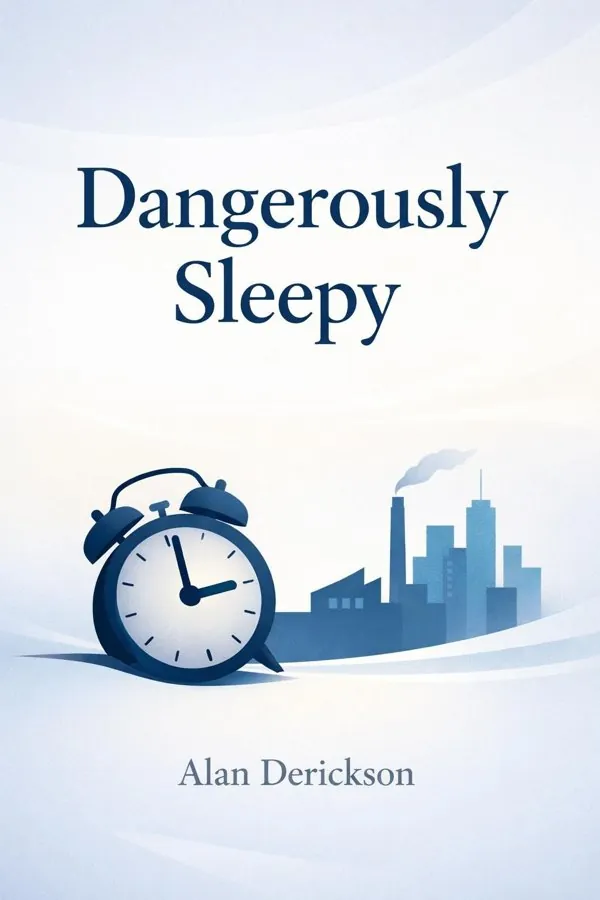
Dangerously Sleepy: Overworked Americans and the Cult of Manly Wakefulness: Summary & Key Insights
 10 min10 chaptersAudio available
Key Takeaways from Dangerously Sleepy: Overworked Americans and the Cult of Manly Wakefulness
A society reveals its values by what it asks people to sacrifice, and industrial America asked workers to sacrifice sleep.
Knowledge alone does not change behavior, especially when it threatens deeply held social ideals.
Even reform movements can preserve the values they claim to challenge.
Nothing legitimizes sacrifice more quickly than war, and wartime America turned sleeplessness into proof of patriotic manhood.
After the wars, sleeplessness did not disappear; it simply put on a suit.
What Is Dangerously Sleepy: Overworked Americans and the Cult of Manly Wakefulness About?
Dangerously Sleepy: Overworked Americans and the Cult of Manly Wakefulness by Alan Derickson is a sociology book spanning 10 pages. Why do so many Americans treat exhaustion as a badge of honor rather than a warning sign? In Dangerously Sleepy, historian Alan Derickson traces the deep roots of that mindset, showing how sleep deprivation became tied to ideals of masculinity, ambition, and national progress in the United States. Rather than treating sleeplessness as a purely modern problem caused by smartphones and busy schedules, Derickson reveals a much longer story—one shaped by industrial labor, military discipline, medical debates, corporate culture, and gender expectations. Across more than a century of American life, men were often praised for pushing through fatigue, staying alert at all costs, and proving their worth through endurance. The result was not simply a cultural attitude but a public health problem with serious consequences. Derickson is especially well qualified to tell this story. A historian of labor, health, and medicine, he brings together archival research and social analysis to explain how overwork became normalized and why its harms were so often ignored. This is a powerful book for anyone trying to understand the hidden costs of productivity culture.
This FizzRead summary covers all 10 key chapters of Dangerously Sleepy: Overworked Americans and the Cult of Manly Wakefulness in approximately 10 minutes, distilling the most important ideas, arguments, and takeaways from Alan Derickson's work. Also available as an audio summary and Key Quotes Podcast.
Dangerously Sleepy: Overworked Americans and the Cult of Manly Wakefulness
Why do so many Americans treat exhaustion as a badge of honor rather than a warning sign? In Dangerously Sleepy, historian Alan Derickson traces the deep roots of that mindset, showing how sleep deprivation became tied to ideals of masculinity, ambition, and national progress in the United States. Rather than treating sleeplessness as a purely modern problem caused by smartphones and busy schedules, Derickson reveals a much longer story—one shaped by industrial labor, military discipline, medical debates, corporate culture, and gender expectations. Across more than a century of American life, men were often praised for pushing through fatigue, staying alert at all costs, and proving their worth through endurance. The result was not simply a cultural attitude but a public health problem with serious consequences. Derickson is especially well qualified to tell this story. A historian of labor, health, and medicine, he brings together archival research and social analysis to explain how overwork became normalized and why its harms were so often ignored. This is a powerful book for anyone trying to understand the hidden costs of productivity culture.
Who Should Read Dangerously Sleepy: Overworked Americans and the Cult of Manly Wakefulness?
This book is perfect for anyone interested in sociology and looking to gain actionable insights in a short read. Whether you're a student, professional, or lifelong learner, the key ideas from Dangerously Sleepy: Overworked Americans and the Cult of Manly Wakefulness by Alan Derickson will help you think differently.
- ✓Readers who enjoy sociology and want practical takeaways
- ✓Professionals looking to apply new ideas to their work and life
- ✓Anyone who wants the core insights of Dangerously Sleepy: Overworked Americans and the Cult of Manly Wakefulness in just 10 minutes
Want the full summary?
Get instant access to this book summary and 100K+ more with Fizz Moment.
Get Free SummaryAvailable on App Store • Free to download
Key Chapters
A society reveals its values by what it asks people to sacrifice, and industrial America asked workers to sacrifice sleep. Derickson shows that in the nineteenth century, as factories expanded and time discipline tightened, sleep increasingly came to be seen not as a biological necessity but as an obstacle to output. Employers prized punctuality, continuous effort, and bodily endurance. Men in particular were expected to prove themselves through stamina, accepting long hours and irregular schedules as evidence of responsibility and toughness.
This shift mattered because it changed the moral meaning of fatigue. Instead of interpreting exhaustion as a signal that labor conditions were harmful, many Americans learned to view it as a personal challenge to overcome. Wakefulness became associated with diligence, manliness, and upward mobility. In workshops, rail yards, and mills, the ability to keep going despite tiredness was admired, even when it increased the risk of mistakes, accidents, and chronic illness.
Derickson’s insight helps explain why modern overwork still feels virtuous. The roots of “hustle culture” lie in older industrial ideas that linked productivity to character. When employees answer emails late into the night or boast about needing little sleep, they are reenacting a much older script.
A practical application is to examine workplace norms rather than blaming individual weakness. If teams reward constant availability, people will suppress their need for rest. A healthier culture begins by recognizing sleep as a condition of safe, sustainable work.
Actionable takeaway: Audit the unspoken rules in your workplace or household and identify where exhaustion is being rewarded instead of questioned.
Knowledge alone does not change behavior, especially when it threatens deeply held social ideals. In the late nineteenth and early twentieth centuries, scientists and physicians began studying sleep, fatigue, and nervous strain with greater precision. Researchers examined reaction time, industrial accidents, reduced efficiency, and the physiological effects of overexertion. Their findings often suggested a simple truth: tired bodies perform worse and suffer more.
Yet Derickson shows that these scientific insights rarely overturned the broader celebration of hard-driving wakefulness. Medical expertise was filtered through economic interests and cultural assumptions. Employers often used science selectively, adopting efficiency measures that increased output while neglecting recommendations that required shorter hours or slower pace. Meanwhile, physicians could pathologize individual workers without confronting the labor systems producing widespread exhaustion.
This tension remains familiar today. Many organizations publicly acknowledge the importance of sleep while continuing to reward overextension. Wellness campaigns coexist with unreasonable deadlines, night shifts, and constant digital connectivity. The result is a gap between what people know and what institutions actually permit.
Derickson’s historical account reminds readers that public understanding of sleep has long been shaped by power. Evidence about fatigue is never purely neutral; it becomes meaningful only when organizations are willing to act on it. Schools, hospitals, transportation systems, and corporate offices still face this challenge.
Actionable takeaway: When discussing burnout or sleep health, move beyond awareness and ask what policies—scheduling, staffing, response times, shift design—must change for the science to matter.
Even reform movements can preserve the values they claim to challenge. During the Progressive Era, Americans increasingly worried about industrial efficiency, workplace accidents, and social disorder. Reformers sought better labor standards, stronger public institutions, and healthier cities. Yet Derickson shows that these efforts often stopped short of directly confronting the cultural glorification of wakefulness, especially among men.
Many reformers accepted the premise that productive citizenship required disciplined self-control and steady effort. Their concern was often not with overwork itself but with the inefficiencies and social costs it produced. In other words, fatigue became a problem when it reduced output, increased accidents, or weakened military readiness—not necessarily when it damaged workers’ lives. This was a limited critique, because it left intact the idea that rest must justify itself in economic terms.
The Progressive Era therefore produced a mixed legacy. On one hand, it encouraged research into labor conditions and public health. On the other, it helped institutionalize managerial approaches that treated workers as systems to be optimized. Rest was valued instrumentally rather than humanely.
This pattern still appears in modern conversations about burnout. Organizations may endorse recovery because rested employees are more productive, creative, or profitable. That is better than ignoring fatigue altogether, but it remains incomplete if people are not recognized as deserving rest in their own right.
Actionable takeaway: In conversations about work reform, insist on both arguments—sleep improves performance, but more importantly, people are not machines and deserve rest regardless of output.
Nothing legitimizes sacrifice more quickly than war, and wartime America turned sleeplessness into proof of patriotic manhood. Derickson explains that during World War I and World War II, military demands intensified older ideals of masculine endurance. Soldiers, pilots, sailors, medics, and war-production workers were expected to function under prolonged stress and reduced rest. Staying awake became associated not only with toughness but with duty to the nation.
Military institutions did study fatigue because exhausted personnel make dangerous errors. But even as the armed forces recognized the limits of human endurance, wartime culture celebrated men who pushed past those limits. Civilian propaganda and industrial mobilization reinforced the message. Workers on the home front were praised for long shifts and continuous production, while leisure and sleep could be framed as indulgent when the nation was under threat.
This matters beyond military history because war helped normalize emergency habits in civilian life. Once a culture learns to admire nonstop effort in exceptional circumstances, those expectations can survive after the emergency ends. Corporate deadlines, startup culture, and professional prestige often borrow the language of mission, urgency, and sacrifice from wartime models.
The practical lesson is that “temporary” periods of intense work can leave permanent cultural residue. Teams that normalize all-hands urgency may keep operating in crisis mode long after the crisis passes.
Actionable takeaway: Treat sustained emergency schedules as genuinely exceptional, and build explicit recovery periods after peak demand rather than allowing crisis norms to become everyday expectations.
After the wars, sleeplessness did not disappear; it simply put on a suit. Derickson describes how postwar corporate America carried forward older ideals of masculine wakefulness, now tied less to factory endurance and more to executive ambition, white-collar professionalism, and middle-class success. The ideal worker was alert, dependable, always available, and emotionally controlled. Men climbing corporate ladders proved commitment by stretching their hours and subordinating bodily needs to career goals.
This phase is important because it shows that overwork is not only a blue-collar story. Fatigue migrated into offices, sales culture, management tracks, and professional occupations. The rewards were symbolic as well as financial. Long hours suggested seriousness, authority, and competitive drive. Sleep, by contrast, could be quietly coded as complacency or lack of edge.
Derickson helps readers see how class and gender fused in these expectations. The corporate man was meant to provide, lead, and absorb pressure without complaint. This image shaped households too, often relying on women’s unpaid labor to sustain men’s careers while leaving little room to question the social costs.
Today’s knowledge workers still live with this inheritance. Laptop work and remote access have extended the office into evenings and weekends, making wakefulness more continuous and less visible. The old time clock has been replaced by the expectation of perpetual responsiveness.
Actionable takeaway: Separate commitment from availability by defining clear work boundaries, response windows, and performance measures that reward results rather than exhaustion theater.
One of the most revealing moves in modern society is turning a structural problem into a personal condition. Derickson shows how fatigue increasingly became medicalized across the twentieth century. Tiredness was discussed through diagnoses, treatments, stimulants, sleep aids, and specialized expertise. On one level, this reflected real advances in medicine. Sleep disorders, stress-related conditions, and occupational hazards deserved careful clinical attention.
But medicalization also had a political effect: it shifted focus away from the work regimes and cultural demands generating mass exhaustion. If fatigue is framed mainly as a disorder of the individual body, then solutions center on managing symptoms—coffee, pills, therapy, better habits—rather than changing hours, staffing levels, economic insecurity, or gendered expectations. A worker suffering from chronic sleep loss may be told to improve sleep hygiene while still facing impossible schedules.
Derickson does not reject medicine; instead, he shows its limitations when detached from social analysis. This is especially relevant today, when burnout and sleep problems are often treated through apps, supplements, and self-optimization. These tools can help, but they easily become substitutes for reform.
A practical example is shift work in health care or transportation. Teaching workers coping strategies matters, yet it is inadequate if the underlying schedules remain hazardous. The same logic applies to students, gig workers, parents, and professionals.
Actionable takeaway: When confronting persistent fatigue, ask two questions at once—what support does the individual need now, and what system is making this level of exhaustion seem normal?
New tools often promise freedom, but they can just as easily lengthen the workday. Derickson traces how technological change altered the rhythms of sleep and wakefulness in American life. Electric lighting, faster transportation, mass communications, and later digital technologies reduced the natural limits that once forced many activities to stop. Night became colonized by production, commerce, entertainment, and administrative work.
What makes this development so powerful is that technology did not simply enable more activity; it reshaped expectations. If lights, machines, phones, and networks make round-the-clock responsiveness possible, institutions quickly begin to treat it as reasonable. Workers may feel they should answer at any hour, stay informed continuously, or treat rest as downtime to be minimized. The culture of wakefulness becomes embedded in devices and infrastructures.
Derickson’s history complicates the common belief that sleep problems are just a byproduct of personal screen addiction. The deeper issue is social organization. Technology is designed and deployed within systems that reward immediacy, speed, and constant access. That is why individual discipline alone rarely solves the problem.
Modern examples are everywhere: logistics networks operating overnight, remote workers in multiple time zones, health professionals charting after shifts, and parents tethered to work through phones. The challenge is not to reject technology but to govern its use.
Actionable takeaway: Create technology boundaries that restore real off-hours—disable nonurgent notifications, define communication cutoffs, and resist cultures that treat connectivity as obligation.
Sleep became dangerous not only because of economics but because of identity. One of Derickson’s central arguments is that American masculinity has long been tied to wakefulness, endurance, and the suppression of bodily limits. Men were encouraged to equate tiredness with softness and to display self-mastery by pushing through fatigue. In this framework, needing rest threatened one’s image as productive, dependable, and strong.
This gender coding shaped workplaces, military life, sports, family roles, and everyday self-understanding. Men who admitted exhaustion risked seeming weak or unreliable, while those who kept going earned status. The cultural message was subtle but forceful: real men do not stop. Even when women also endured overwork, the rhetoric of manly wakefulness gave sleeplessness a distinctive symbolic role in male identity.
Derickson’s analysis remains highly relevant because many men still struggle to treat sleep as legitimate care rather than surrender. This can affect how they manage parenting, illness, aging, and emotional stress. It can also influence leaders who model overwork for entire organizations.
A practical application is to rethink the stories used to define responsibility. Strength can mean setting limits, protecting health, and refusing unsafe expectations. Teams, families, and institutions need role models who show that competence includes recovery.
Actionable takeaway: Challenge any language—at work, at home, or in yourself—that treats rest as weakness, and replace it with a more mature definition of strength: sustainability, judgment, and self-respect.
The cost of sleepless culture is never purely private. Derickson emphasizes that chronic fatigue has broad public consequences, from workplace injuries and transportation accidents to cardiovascular strain, impaired judgment, emotional volatility, and reduced quality of life. When a society normalizes exhaustion, it increases risk not only for the overworked individual but for coworkers, families, patients, passengers, and communities.
This public health perspective is crucial because it moves the conversation beyond lifestyle preference. Sleep is not like a hobby one may choose to neglect. It is a shared safety issue. A drowsy truck driver, resident physician, machine operator, or police officer does not bear fatigue alone; others live with the consequences. Derickson’s historical approach shows that these dangers were often visible long before institutions responded adequately.
The same logic applies outside traditional labor settings. Sleep-deprived parents, students, and caregivers may suffer mistakes, conflict, and long-term health erosion. Communities with long commutes, shift-heavy employment, and economic insecurity often face compounded sleep burdens. In this sense, sleep inequality is also social inequality.
For policymakers and organizational leaders, the book suggests that fatigue should be treated like any other systemic hazard. Better scheduling, transportation rules, staffing protections, and public education all matter. So do economic policies that reduce the pressure to hold multiple jobs or remain constantly available.
Actionable takeaway: Reframe sleep in civic terms—ask not only “Am I tired?” but “What risks are created when our institutions depend on exhausted people functioning flawlessly?”
The most unsettling lesson of Derickson’s book is that the cult of wakefulness did not end with industrialization or the mid-century office. It evolved. Contemporary Americans live amid persistent pressure to be reachable, efficient, and resilient, often under conditions of economic precarity and digital overstimulation. The language may now include productivity hacks, performance metrics, wellness branding, and side hustles, but the underlying moral script is familiar: worthy people keep going.
Derickson helps readers see continuity where many assume novelty. Today’s exhaustion is shaped by old beliefs about masculinity, self-discipline, national vigor, and success. What has changed is the form. Instead of factory whistles, there are smartphones. Instead of only visible physical strain, there is invisible cognitive overload. Instead of simple long hours, there is fragmentation—late-night checking, broken sleep, irregular schedules, and the inability to fully disconnect.
This historical awareness can be liberating. If sleeplessness is culturally produced, it can also be culturally challenged. Organizations can redesign expectations. Families can revise norms. Individuals can stop interpreting fatigue as moral failure and start reading it as information.
The book ultimately calls for a broader ethic of humane productivity—one that recognizes limits, values care, and rejects the myth that relentless wakefulness proves worth. That is not laziness. It is social maturity.
Actionable takeaway: Use history to question the present—when you feel pressure to overwork, ask whether the demand is truly necessary or simply the latest version of an old and harmful ideal.
All Chapters in Dangerously Sleepy: Overworked Americans and the Cult of Manly Wakefulness
About the Author
Alan Derickson is an American historian whose work centers on labor, health, medicine, and social policy. He is particularly interested in how working conditions, public institutions, and cultural beliefs shape patterns of illness and well-being. Across his scholarship, Derickson has examined occupational health, the social history of medicine, and the human costs of economic systems that demand constant productivity. In Dangerously Sleepy, he brings these interests together to explore the historical roots of American sleep deprivation and the cultural ideal of “manly wakefulness.” His writing is valued for linking archival research with urgent contemporary questions about burnout, overwork, and public health. Derickson’s work is especially useful for readers who want to understand health not only as a medical issue, but also as a product of labor practices, gender expectations, and social values.
Get This Summary in Your Preferred Format
Read or listen to the Dangerously Sleepy: Overworked Americans and the Cult of Manly Wakefulness summary by Alan Derickson anytime, anywhere. FizzRead offers multiple formats so you can learn on your terms — all free.
Available formats: App · Audio · PDF · EPUB — All included free with FizzRead
Download Dangerously Sleepy: Overworked Americans and the Cult of Manly Wakefulness PDF and EPUB Summary
Key Quotes from Dangerously Sleepy: Overworked Americans and the Cult of Manly Wakefulness
“A society reveals its values by what it asks people to sacrifice, and industrial America asked workers to sacrifice sleep.”
“Knowledge alone does not change behavior, especially when it threatens deeply held social ideals.”
“Even reform movements can preserve the values they claim to challenge.”
“Nothing legitimizes sacrifice more quickly than war, and wartime America turned sleeplessness into proof of patriotic manhood.”
“After the wars, sleeplessness did not disappear; it simply put on a suit.”
Frequently Asked Questions about Dangerously Sleepy: Overworked Americans and the Cult of Manly Wakefulness
Dangerously Sleepy: Overworked Americans and the Cult of Manly Wakefulness by Alan Derickson is a sociology book that explores key ideas across 10 chapters. Why do so many Americans treat exhaustion as a badge of honor rather than a warning sign? In Dangerously Sleepy, historian Alan Derickson traces the deep roots of that mindset, showing how sleep deprivation became tied to ideals of masculinity, ambition, and national progress in the United States. Rather than treating sleeplessness as a purely modern problem caused by smartphones and busy schedules, Derickson reveals a much longer story—one shaped by industrial labor, military discipline, medical debates, corporate culture, and gender expectations. Across more than a century of American life, men were often praised for pushing through fatigue, staying alert at all costs, and proving their worth through endurance. The result was not simply a cultural attitude but a public health problem with serious consequences. Derickson is especially well qualified to tell this story. A historian of labor, health, and medicine, he brings together archival research and social analysis to explain how overwork became normalized and why its harms were so often ignored. This is a powerful book for anyone trying to understand the hidden costs of productivity culture.
You Might Also Like
Between the World and Me
Ta-Nehisi Coates
10 min
Half the Sky
Nicholas D. Kristof, Sheryl WuDunn
10 min
Men Explain Things To Me
Rebecca Solnit
10 min
Rational Ritual
Michael Suk-Young Chwe
10 min
The New Jim Crow
Michelle Alexander
10 min
Beyond Culture
Edward T. Hall
10 minBrowse by Category
Ready to read Dangerously Sleepy: Overworked Americans and the Cult of Manly Wakefulness?
Get the full summary and 100K+ more books with Fizz Moment.