
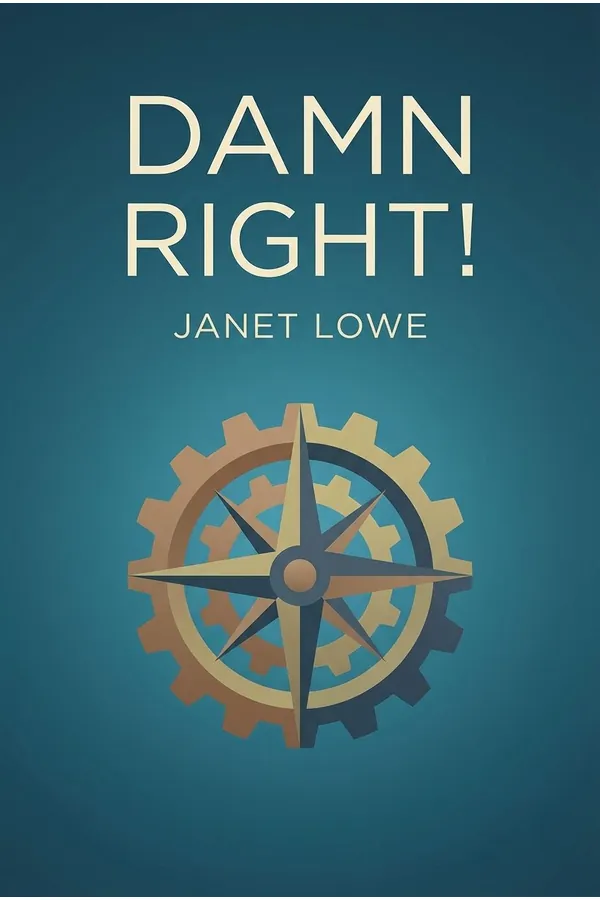
Damn Right! Behind the Scenes with Berkshire Hathaway Billionaire Charlie Munger: Summary & Key Insights
by Janet Lowe
 10 min9 chaptersAudio available
Key Takeaways from Damn Right! Behind the Scenes with Berkshire Hathaway Billionaire Charlie Munger
Great thinkers are rarely formed by talent alone; they are shaped by the values and environments that train them to see the world clearly.
Career reinvention looks risky from the outside, but from the inside it often begins with a simple realization: your current path no longer matches your deepest strengths.
Most bad decisions do not come from low intelligence; they come from using too narrow a lens.
Exceptional partnerships are not built on sameness; they are built on complementary strengths and shared principles.
In a world obsessed with short-term wins, Charlie Munger’s career demonstrates that ethics are not a sentimental luxury but a practical advantage.
What Is Damn Right! Behind the Scenes with Berkshire Hathaway Billionaire Charlie Munger About?
Damn Right! Behind the Scenes with Berkshire Hathaway Billionaire Charlie Munger by Janet Lowe is a biographies book spanning 7 pages. Janet Lowe’s Damn Right! is far more than a standard business biography. It is a close study of Charlie Munger, the famously sharp-minded vice chairman of Berkshire Hathaway and Warren Buffett’s indispensable intellectual partner. While Buffett often receives the spotlight, Lowe shows that Munger helped shape the philosophy that made Berkshire extraordinary: buying excellent businesses, thinking independently, and making decisions with ruthless rationality. The book traces Munger’s journey from his Omaha upbringing to his legal career, his move into investing, and his emergence as one of the most respected minds in capitalism. What makes this biography especially valuable is that it does not present Munger as a mythic genius detached from ordinary life. Instead, Lowe examines his habits of thought, his reading discipline, his resilience through personal hardship, and his commitment to ethics and clear reasoning. Her background as a financial journalist and biographer of major investing figures gives the book both credibility and accessibility. For readers interested in investing, decision-making, leadership, or lifelong learning, Damn Right! offers a practical portrait of how great judgment is built over time.
This FizzRead summary covers all 9 key chapters of Damn Right! Behind the Scenes with Berkshire Hathaway Billionaire Charlie Munger in approximately 10 minutes, distilling the most important ideas, arguments, and takeaways from Janet Lowe's work. Also available as an audio summary and Key Quotes Podcast.
Damn Right! Behind the Scenes with Berkshire Hathaway Billionaire Charlie Munger
Janet Lowe’s Damn Right! is far more than a standard business biography. It is a close study of Charlie Munger, the famously sharp-minded vice chairman of Berkshire Hathaway and Warren Buffett’s indispensable intellectual partner. While Buffett often receives the spotlight, Lowe shows that Munger helped shape the philosophy that made Berkshire extraordinary: buying excellent businesses, thinking independently, and making decisions with ruthless rationality. The book traces Munger’s journey from his Omaha upbringing to his legal career, his move into investing, and his emergence as one of the most respected minds in capitalism.
What makes this biography especially valuable is that it does not present Munger as a mythic genius detached from ordinary life. Instead, Lowe examines his habits of thought, his reading discipline, his resilience through personal hardship, and his commitment to ethics and clear reasoning. Her background as a financial journalist and biographer of major investing figures gives the book both credibility and accessibility. For readers interested in investing, decision-making, leadership, or lifelong learning, Damn Right! offers a practical portrait of how great judgment is built over time.
Who Should Read Damn Right! Behind the Scenes with Berkshire Hathaway Billionaire Charlie Munger?
This book is perfect for anyone interested in biographies and looking to gain actionable insights in a short read. Whether you're a student, professional, or lifelong learner, the key ideas from Damn Right! Behind the Scenes with Berkshire Hathaway Billionaire Charlie Munger by Janet Lowe will help you think differently.
- ✓Readers who enjoy biographies and want practical takeaways
- ✓Professionals looking to apply new ideas to their work and life
- ✓Anyone who wants the core insights of Damn Right! Behind the Scenes with Berkshire Hathaway Billionaire Charlie Munger in just 10 minutes
Want the full summary?
Get instant access to this book summary and 100K+ more with Fizz Moment.
Get Free SummaryAvailable on App Store • Free to download
Key Chapters
Great thinkers are rarely formed by talent alone; they are shaped by the values and environments that train them to see the world clearly. Charlie Munger’s early life in Omaha, Nebraska, gave him precisely that kind of foundation. He grew up in a modest Midwestern culture that rewarded honesty, self-reliance, discipline, and frugality. These values later became central to both his business philosophy and personal conduct. Omaha also happened to be the childhood city of Warren Buffett, creating an early geographical connection between two men who would later redefine long-term investing.
Munger’s youth was not glamorous, but it was formative. He learned to think practically, avoid unnecessary waste, and respect competence over appearances. Those habits matter because the investing world often tempts people with fashion, noise, and ego. Munger’s upbringing trained him in the opposite direction. He learned that enduring success usually comes from sound judgment, patience, and integrity rather than flashiness.
Lowe also shows that Munger’s education extended beyond classrooms. He developed a broad curiosity about history, science, law, and human behavior. This intellectual appetite became one of his defining traits. Even before he became known for mental models, he was already building the habit of looking beyond narrow categories. He did not want to know only one profession or one discipline; he wanted to understand how the world worked.
In practical terms, this idea applies to anyone building a career or making decisions. Your background may not determine your destiny, but your early values strongly influence how you respond to opportunities, setbacks, and temptations. A person grounded in discipline and honesty usually has an advantage when complexity and pressure arrive.
Actionable takeaway: Identify three values from your upbringing or environment that can strengthen your decision-making, and consciously use them as filters for work, money, and relationships.
Career reinvention looks risky from the outside, but from the inside it often begins with a simple realization: your current path no longer matches your deepest strengths. Charlie Munger began as a successful lawyer, and by conventional standards he had every reason to stay there. Law provided status, income, and respectability. Yet Munger recognized that while he was capable in law, his real advantage lay in analysis, judgment, and capital allocation. He was drawn toward investing not because it was glamorous, but because it rewarded independent thinking.
Lowe presents this shift as a rational evolution rather than an impulsive leap. Munger observed that markets are full of emotional behavior, bad incentives, and poor reasoning. For someone committed to logic and patience, that creates opportunity. He did not leave law because he disliked work. He left because he saw a field where better thinking could produce extraordinary returns. Over time, he moved from legal practice into investment partnerships and then into a larger role in the business world.
This transition also reveals a key Munger principle: avoid clinging to a path just because you have already invested time in it. Many people stay in careers they have outgrown because they fear uncertainty or want to justify past effort. Munger understood that sunk costs should not govern future choices. If a better long-term path exists, rationality demands considering it seriously.
The lesson reaches beyond finance. A teacher may discover strengths in product design. A consultant may realize she is better suited to entrepreneurship. A manager may see that his best value lies in strategy rather than operations. The important question is not, “What have I done so far?” but, “Where does my reasoning suggest I can create the most value now?”
Actionable takeaway: Review your current career through the lens of comparative advantage and ask where your natural strengths, not your past commitments, point you next.
Most bad decisions do not come from low intelligence; they come from using too narrow a lens. One of Charlie Munger’s most famous contributions is his insistence on a latticework of mental models. Rather than relying on expertise from a single field, he believed people should borrow the best big ideas from multiple disciplines, including economics, psychology, mathematics, biology, engineering, and history. Reality is complex, so decisions improve when we examine problems from several angles.
Lowe explains that Munger did not treat mental models as abstract theory. He used them as practical tools. Opportunity cost helps compare alternatives. Incentives explain behavior. Probability encourages better risk assessment. Inversion reveals hidden dangers by asking what could cause failure instead of only what could bring success. Compounding shows how small advantages build over long periods. By combining these models, Munger developed judgment that was both flexible and grounded.
This approach is powerful because it protects against oversimplification. A business may look attractive financially, but psychology might reveal a reckless CEO. A promising strategy may make sense mathematically, but history may show that similar efforts failed due to regulation or human error. Munger’s method reduces blind spots.
For everyday use, mental models are not limited to billion-dollar investments. If you are hiring someone, think about incentives, base rates, and trust. If you are making a health decision, use probability, second-order effects, and long-term compounding. If you are managing time, consider opportunity cost and bottlenecks. The goal is not to memorize jargon but to build a richer toolkit for thinking.
Munger’s real insight is that wisdom is interdisciplinary. People who insist on seeing every problem through one professional lens often miss what matters most.
Actionable takeaway: Build a personal list of ten mental models you use repeatedly, and before making any major decision, force yourself to examine it through at least three of them.
Exceptional partnerships are not built on sameness; they are built on complementary strengths and shared principles. Charlie Munger’s relationship with Warren Buffett is one of the most successful collaborations in business history, and Lowe shows why it worked so well. Both men valued rationality, integrity, and independence of thought. But Munger brought something distinct to the table: he pushed Buffett beyond the strict bargain-hunting approach inherited from Benjamin Graham and toward the purchase of outstanding businesses at fair prices.
That shift changed Berkshire Hathaway profoundly. Instead of focusing only on statistically cheap assets, the pair increasingly sought companies with durable competitive advantages, excellent management, and strong economics over long periods. This meant that quality, not just price, became central. Munger’s influence helped shape the idea that a wonderful business can be worth much more than a merely cheap one.
Their partnership also demonstrates the value of intellectual honesty. They challenged each other, debated ideas, and avoided ego-driven conflict. Neither needed to dominate every conversation. They were united by a larger goal: making sound decisions. In many organizations, collaboration fails because people protect status rather than pursue truth. Buffett and Munger created a culture where disagreement improved thinking instead of threatening identity.
This has practical applications for teams, founders, and executives. The best partner is not someone who mirrors your strengths, but someone who strengthens your weaknesses while sharing your values. A visionary may need an operator. A creative founder may need a skeptical capital allocator. A fast mover may need a patient risk assessor. Shared ethics matter, but cognitive diversity matters too.
Lowe’s portrait makes clear that Berkshire’s success was not the product of one superstar and one sidekick. It was the product of a durable intellectual alliance.
Actionable takeaway: Evaluate your key professional relationships and ask whether they are based on comfort or true complementarity; seek collaborators who improve your reasoning, not just agree with it.
In a world obsessed with short-term wins, Charlie Munger’s career demonstrates that ethics are not a sentimental luxury but a practical advantage. Lowe emphasizes that Munger saw capitalism as a moral arena as well as an economic one. He respected markets, enterprise, and competition, but he also believed strongly that trust, fairness, and responsibility are essential to lasting success. Businesses built on deception or manipulation may prosper briefly, but they eventually undermine themselves.
Munger’s views on ethics were not abstract speeches detached from commerce. They informed his judgment about managers, partners, and investments. He looked for people who were candid, capable, and principled. If the character of leadership was questionable, that was a warning sign. Numbers alone were never enough. A business can produce attractive returns for a while even under poor ethical leadership, but the hidden risks are often enormous: regulatory trouble, reputational damage, employee disengagement, and strategic drift.
This perspective is especially relevant today. Companies often chase growth by using aggressive sales tactics, opaque pricing, or incentives that encourage harmful behavior. Munger repeatedly pointed out that incentives shape outcomes. If people are rewarded for the wrong things, bad conduct should not be surprising. Ethical systems require thoughtful design.
Individuals can apply this lesson too. In careers, reputations compound just like money. A person known for reliability and honesty becomes easier to trust with responsibility. That trust opens doors. By contrast, one compromised decision can do lasting damage.
Lowe suggests that part of Munger’s durability came from refusing to separate intelligence from character. He admired competence, but he did not consider it enough on its own. Sound judgment includes moral judgment.
Actionable takeaway: When evaluating any job, investment, or partnership, ask not only whether it is profitable, but whether its incentives and leadership encourage conduct you would be proud to be associated with.
One of the most underestimated forms of ambition is the desire to keep learning long after success becomes optional. Charlie Munger is often described as an investor, but Janet Lowe makes clear that he was equally a student of the world. He read constantly, crossed disciplinary boundaries, and treated curiosity as both pleasure and duty. This habit did more than make him well informed; it gave him a compounding advantage in judgment.
Munger did not read merely to confirm what he already believed. He read to update, challenge, and expand his thinking. That mindset is rare. Many accomplished people become trapped by their own expertise. Once they gain status in one domain, they stop exploring. Munger moved in the opposite direction. He believed that understanding human misjudgment, scientific principles, historical patterns, and institutional behavior would make him a better investor and a wiser person.
The practical relevance is enormous. In a rapidly changing world, static knowledge loses value. What endures is the capacity to learn across domains and adapt. A marketer who studies behavioral psychology gains an edge. A founder who reads history may recognize patterns of boom and bust. A physician who understands incentives can better navigate health systems. Curiosity widens your map of reality.
Lowe also shows that Munger’s learning was joyful, not performative. He did not pursue knowledge to impress others. He pursued it because understanding itself was rewarding. That attitude matters because sustainable learning depends on genuine interest, not external pressure.
For modern readers, the temptation is to consume fragments: headlines, short clips, quick opinions. Munger’s life argues for depth instead. Serious reading builds the patience and intellectual structure needed for serious decisions.
Actionable takeaway: Create a weekly learning habit that includes reading outside your profession, and choose one unfamiliar field each month to explore for its decision-making value.
Character becomes visible not when life is smooth, but when hardship threatens to narrow your spirit. Charlie Munger’s life included painful personal losses and major setbacks, and Lowe does not ignore them. Instead, she shows how adversity shaped his emotional strength, perspective, and independence. Munger endured divorce, financial pressure in earlier years, and the devastating death of a child. These experiences did not make him cynical. They deepened his toughness without erasing his humanity.
This aspect of the biography matters because business books often present success as a clean upward line. Munger’s story is more realistic. Achievement coexisted with grief, uncertainty, and recovery. He continued to work, think, build, and learn even when circumstances were harsh. His resilience was not loud or theatrical. It was expressed through steady action, discipline, and a refusal to indulge self-pity.
Lowe suggests that this emotional steadiness informed his investing style. Someone who has confronted real pain is often less likely to panic over temporary volatility or status anxiety. Munger learned to distinguish what truly matters from what merely feels urgent. That perspective is powerful in both life and business. It supports patience, proportion, and better judgment under pressure.
Readers can apply this lesson by reframing adversity as training in clarity. A failed project, a job loss, or a personal setback can become either a permanent identity wound or a source of deeper strength. The difference often lies in whether you respond with bitterness or disciplined adaptation.
Munger’s resilience also reminds us that wisdom is not just intellectual. It includes emotional durability, humility before reality, and the ability to continue functioning when life is unfair.
Actionable takeaway: In your next setback, write down what is truly within your control, what lesson the experience offers, and what steady next step you can take without drama.
Most people overestimate the value of constant action and underestimate the power of waiting well. A core theme in Charlie Munger’s life and work is disciplined selectivity. He did not believe that intelligence required nonstop movement. In investing, he preferred to wait for rare, high-conviction opportunities rather than chase every possible gain. This patience was not passivity. It was strategic restraint rooted in understanding the difference between activity and results.
Lowe highlights how unusual this mindset is. Markets, media, and corporate cultures all reward motion. They encourage people to comment, trade, react, and prove they are busy. Munger rejected that impulse. He believed that if you know what matters, you can ignore a vast amount of noise. Berkshire Hathaway became known for making relatively few major decisions compared with many active investors, yet those decisions were often extremely consequential.
This principle applies in many contexts. In hiring, choosing one exceptional candidate can matter more than rushing to fill a role. In strategy, saying no to ten mediocre opportunities may preserve resources for one transformative move. In personal finance, avoiding foolish risks often contributes more to wealth than chasing clever tactics.
Selective action also depends on preparation. Munger could wait because he had spent years building judgment. Patience without insight becomes procrastination; patience with readiness becomes power. That is why deep learning, broad models, and emotional control all support this idea.
One of Munger’s recurring messages was that you do not need to swing at every pitch. This metaphor captures both humility and confidence. You admit that many opportunities are not for you, and you trust that enough good ones will appear if you remain prepared.
Actionable takeaway: Define your criteria for a truly high-quality opportunity in work, investing, or life, and commit to ignoring options that do not clearly meet that standard.
The final measure of a remarkable life is not only what was accumulated, but what way of thinking was left behind. Janet Lowe portrays Charlie Munger’s legacy as far larger than his net worth or corporate title. He helped build one of the greatest business records in modern history, but his lasting influence comes from the principles he articulated and embodied: multidisciplinary thinking, integrity, patience, rationality, and relentless learning. He became a model not simply for investors, but for anyone trying to think better in a noisy world.
Munger’s public talks, shareholder meetings, and sharp aphorisms reached audiences far beyond Berkshire Hathaway. People admired not just what he knew, but how he reasoned. He encouraged readers, business leaders, and students to confront cognitive bias, respect evidence, and avoid self-deception. In that sense, his legacy is educational. He invited others to upgrade their minds.
Lowe also makes clear that Munger influenced Berkshire culturally. His standards for quality, ethics, and intellectual seriousness helped define the institution. A great organization is shaped not just by strategy, but by the mental habits of its leaders. Munger’s fingerprints are visible in Berkshire’s long-term orientation and resistance to fashionable thinking.
For readers, the deepest lesson may be that a legacy of thought can outlast any transaction. You may never run a conglomerate or allocate billions, but you can still cultivate judgment that benefits colleagues, family, and community. Influence does not require fame. It requires consistency in how you think and act.
Munger’s life suggests that wisdom compounds when it is practiced, shared, and anchored in character.
Actionable takeaway: Decide which principles you want to be known for in ten years, then align your decisions today so your legacy becomes the natural result of your habits.
All Chapters in Damn Right! Behind the Scenes with Berkshire Hathaway Billionaire Charlie Munger
About the Author
Janet Lowe was an American author and journalist known for writing clear, engaging biographies of influential business leaders and investors. She built a strong reputation by making complex financial ideas understandable to general readers while preserving the depth needed by serious students of business. Among her best-known subjects were Warren Buffett, Benjamin Graham, and Charlie Munger, figures whose ideas helped shape modern investing. Lowe’s work often combined careful research, narrative storytelling, and practical interpretation, allowing readers to see both the personality and the philosophy behind public success. In Damn Right!, she brings those strengths to a portrait of Charlie Munger that is both informative and readable. Her writing remains valued by readers interested in finance, leadership, and the human side of great decision-makers.
Get This Summary in Your Preferred Format
Read or listen to the Damn Right! Behind the Scenes with Berkshire Hathaway Billionaire Charlie Munger summary by Janet Lowe anytime, anywhere. FizzRead offers multiple formats so you can learn on your terms — all free.
Available formats: App · Audio · PDF · EPUB — All included free with FizzRead
Download Damn Right! Behind the Scenes with Berkshire Hathaway Billionaire Charlie Munger PDF and EPUB Summary
Key Quotes from Damn Right! Behind the Scenes with Berkshire Hathaway Billionaire Charlie Munger
“Great thinkers are rarely formed by talent alone; they are shaped by the values and environments that train them to see the world clearly.”
“Career reinvention looks risky from the outside, but from the inside it often begins with a simple realization: your current path no longer matches your deepest strengths.”
“Most bad decisions do not come from low intelligence; they come from using too narrow a lens.”
“Exceptional partnerships are not built on sameness; they are built on complementary strengths and shared principles.”
“In a world obsessed with short-term wins, Charlie Munger’s career demonstrates that ethics are not a sentimental luxury but a practical advantage.”
Frequently Asked Questions about Damn Right! Behind the Scenes with Berkshire Hathaway Billionaire Charlie Munger
Damn Right! Behind the Scenes with Berkshire Hathaway Billionaire Charlie Munger by Janet Lowe is a biographies book that explores key ideas across 9 chapters. Janet Lowe’s Damn Right! is far more than a standard business biography. It is a close study of Charlie Munger, the famously sharp-minded vice chairman of Berkshire Hathaway and Warren Buffett’s indispensable intellectual partner. While Buffett often receives the spotlight, Lowe shows that Munger helped shape the philosophy that made Berkshire extraordinary: buying excellent businesses, thinking independently, and making decisions with ruthless rationality. The book traces Munger’s journey from his Omaha upbringing to his legal career, his move into investing, and his emergence as one of the most respected minds in capitalism. What makes this biography especially valuable is that it does not present Munger as a mythic genius detached from ordinary life. Instead, Lowe examines his habits of thought, his reading discipline, his resilience through personal hardship, and his commitment to ethics and clear reasoning. Her background as a financial journalist and biographer of major investing figures gives the book both credibility and accessibility. For readers interested in investing, decision-making, leadership, or lifelong learning, Damn Right! offers a practical portrait of how great judgment is built over time.
You Might Also Like

An American Marriage
Tayari Jones
10 min
Benjamin Franklin: An American Life
Walter Isaacson
10 min
I Know Why The Caged Bird Sings
Maya Angelou
10 min
Long Walk to Freedom
Nelson Mandela
10 min
Persepolis
Marjane Satrapi
10 min
Surely You're Joking, Mr. Feynman!
Richard P. Feynman
10 minBrowse by Category
Ready to read Damn Right! Behind the Scenes with Berkshire Hathaway Billionaire Charlie Munger?
Get the full summary and 100K+ more books with Fizz Moment.