
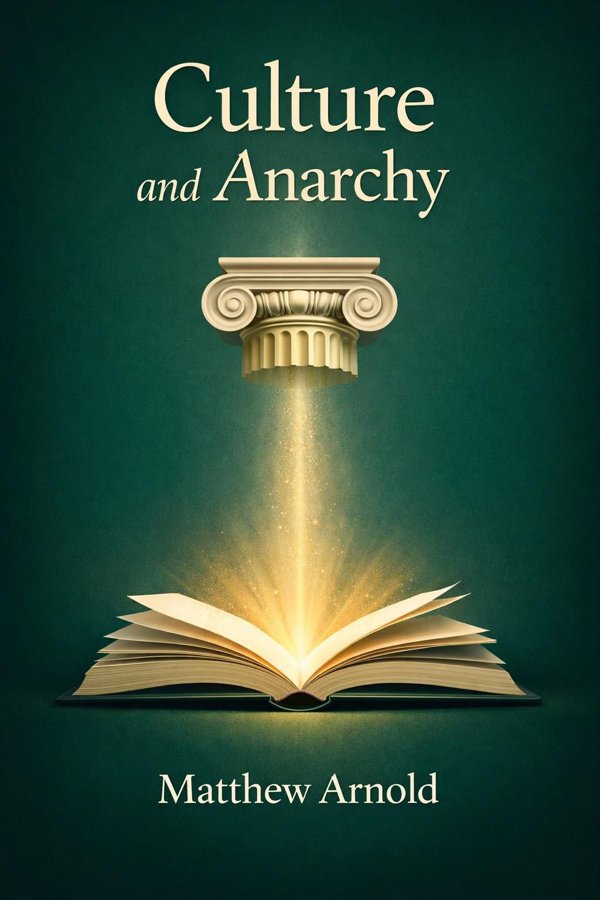
Culture and Anarchy: Summary & Key Insights
 10 min6 chaptersAudio available
What Is Culture and Anarchy About?
Culture and Anarchy by Matthew Arnold is a civilization book spanning 6 pages. Culture and Anarchy is a collection of essays by the English poet and cultural critic Matthew Arnold, first published in 1869. The work explores the role of culture in society, arguing that true culture is the pursuit of human perfection through the study of the best that has been thought and said. Arnold contrasts culture with anarchy, which he associates with the lack of moral and intellectual order in modern industrial society. The book is a foundational text in Victorian cultural criticism and remains influential in discussions of education, morality, and social progress.
This FizzRead summary covers all 6 key chapters of Culture and Anarchy in approximately 10 minutes, distilling the most important ideas, arguments, and takeaways from Matthew Arnold's work. Also available as an audio summary and Key Quotes Podcast.
Culture and Anarchy
Culture and Anarchy is a collection of essays by the English poet and cultural critic Matthew Arnold, first published in 1869. The work explores the role of culture in society, arguing that true culture is the pursuit of human perfection through the study of the best that has been thought and said. Arnold contrasts culture with anarchy, which he associates with the lack of moral and intellectual order in modern industrial society. The book is a foundational text in Victorian cultural criticism and remains influential in discussions of education, morality, and social progress.
Who Should Read Culture and Anarchy?
This book is perfect for anyone interested in civilization and looking to gain actionable insights in a short read. Whether you're a student, professional, or lifelong learner, the key ideas from Culture and Anarchy by Matthew Arnold will help you think differently.
- ✓Readers who enjoy civilization and want practical takeaways
- ✓Professionals looking to apply new ideas to their work and life
- ✓Anyone who wants the core insights of Culture and Anarchy in just 10 minutes
Want the full summary?
Get instant access to this book summary and 100K+ more with Fizz Moment.
Get Free SummaryAvailable on App Store • Free to download
Key Chapters
Culture, in its essence, is the union of two qualities: sweetness and light. Sweetness implies beauty, gentleness, harmony—those aspects of life that broaden our sympathies and refine our sensibilities. Light signifies reason, intelligence, the clear apprehension of truth. When united, they form the true spirit of culture. This phrase, borrowed from Swift, captures my conviction that culture aims not merely at knowing, but at becoming whole—harmonizing intellect and feeling, reason and charm, fairness and grace.
In England, however, I observe the opposite tendency. The utilitarian spirit reigns. We exalt machinery—the means—above the ends of human development. Whether in our politics, religion, or education, we prize activity over contemplation, doing over being. Our middle class prides itself on practicality and moral earnestness but neglects beauty and breadth. The aristocracy prizes good manners but lacks intellectual light. The working classes, energetic and sincere, often mistake self-assertion for progress. In all these, sweetness and light are divided and impoverished.
True culture demands a different ideal. It asks us to rise above sectarianism, to look beyond class and creed, and to cultivate disinterestedness—an openness to truth beyond personal advantage. This disinterested pursuit of perfection is what can transform the raw energies of society into harmony. Only through such culture can a people escape narrowness and attain, not merely wealth or power, but nobility of spirit and the calm of an ordered life.
England, proud of its liberties, has come to exalt the notion of 'doing as one likes' as the highest good. Yet beneath this liberty lies danger. The unchecked assertion of individual will, when untempered by reason or culture, becomes not freedom but anarchy. Our institutions, our press, our politics often celebrate independence of action without independence of judgment. Thus, we make every man his own law, and the result is confusion and strife.
I write not to disparage liberty, but to define its limits. True liberty is the power to choose the best, guided by reason and conscience. Culture, therefore, is the necessary balance—it reminds us that we are not isolated atoms, but parts of a greater order. Without this guiding light, the national life disintegrates into warring interests, each shouting for its own gratification. Our newspapers inflame prejudice and self-will; our reformers trumpet principles without understanding their foundation. We must recover the sense that freedom is not the end, but the means, toward human perfection. Culture alone can show us this, by teaching us to seek reason, not impulse; harmony, not chaos.
+ 4 more chapters — available in the FizzRead app
All Chapters in Culture and Anarchy
About the Author
Matthew Arnold (1822–1888) was an English poet, essayist, and cultural critic. He is best known for his poetry, including 'Dover Beach', and for his influential prose works on culture, education, and society. As an inspector of schools, Arnold advocated for educational reform and the moral improvement of society through culture. His writings helped shape modern literary criticism and the concept of culture as a moral and intellectual ideal.
Get This Summary in Your Preferred Format
Read or listen to the Culture and Anarchy summary by Matthew Arnold anytime, anywhere. FizzRead offers multiple formats so you can learn on your terms — all free.
Available formats: App · Audio · PDF · EPUB — All included free with FizzRead
Download Culture and Anarchy PDF and EPUB Summary
Key Quotes from Culture and Anarchy
“Culture, in its essence, is the union of two qualities: sweetness and light.”
“England, proud of its liberties, has come to exalt the notion of 'doing as one likes' as the highest good.”
Frequently Asked Questions about Culture and Anarchy
Culture and Anarchy by Matthew Arnold is a civilization book that explores key ideas across 6 chapters. Culture and Anarchy is a collection of essays by the English poet and cultural critic Matthew Arnold, first published in 1869. The work explores the role of culture in society, arguing that true culture is the pursuit of human perfection through the study of the best that has been thought and said. Arnold contrasts culture with anarchy, which he associates with the lack of moral and intellectual order in modern industrial society. The book is a foundational text in Victorian cultural criticism and remains influential in discussions of education, morality, and social progress.
You Might Also Like
The Structure of Scientific Revolutions
Thomas S. Kuhn
10 min
Genius
Harold Bloom
10 min
A Cultural History of the Medieval Age
Various Editors
10 min
A History of God: The 4,000-Year Quest of Judaism, Christianity and Islam
Karen Armstrong
10 min
A History of the World in 10½ Chapters
Julian Barnes
10 min
A Short History of Progress
Ronald Wright
10 minBrowse by Category
Ready to read Culture and Anarchy?
Get the full summary and 100K+ more books with Fizz Moment.