
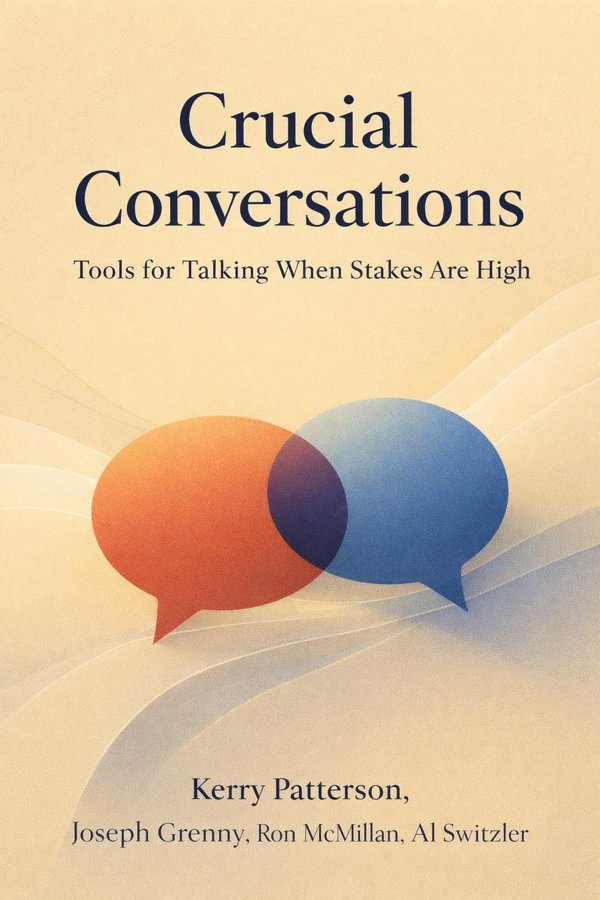
Crucial Conversations: Tools for Talking When Stakes Are High: Summary & Key Insights
by Kerry Patterson, Joseph Grenny, Ron McMillan, Al Switzler
 10 min10 chaptersAudio available
Key Takeaways from Crucial Conversations: Tools for Talking When Stakes Are High
The most important conversations are often the ones we are least prepared to handle.
When people feel unsafe, conversation collapses; when conversation collapses, bad decisions follow.
The quality of a conversation depends heavily on the motives you bring into it.
Most people notice the content of a conversation but miss the conditions that shape it.
People can discuss almost anything if they feel safe enough.
What Is Crucial Conversations: Tools for Talking When Stakes Are High About?
Crucial Conversations: Tools for Talking When Stakes Are High by Kerry Patterson, Joseph Grenny, Ron McMillan, Al Switzler is a communication book spanning 11 pages. Some conversations change everything. A tense discussion with a partner, a difficult performance review, a disagreement with a colleague, or a moment when trust has been damaged can shape relationships, careers, and even personal identity. Crucial Conversations: Tools for Talking When Stakes Are High is a practical guide to handling those moments well. The book focuses on situations where opinions differ, emotions run strong, and the outcome matters deeply. In these high-pressure exchanges, people often fall into silence or violence: they either withdraw and avoid the issue, or they push too hard and damage the relationship. The authors show how to stay calm, create safety, and keep dialogue open so that people can solve problems without sacrificing honesty or respect. Kerry Patterson, Joseph Grenny, Ron McMillan, and Al Switzler built their work through years of research into communication, leadership, and behavior change. Their methods have been used in workplaces, families, schools, and organizations around the world. The result is a highly actionable book that helps readers speak persuasively, listen generously, and turn difficult conversations into opportunities for trust, clarity, and better results.
This FizzRead summary covers all 10 key chapters of Crucial Conversations: Tools for Talking When Stakes Are High in approximately 10 minutes, distilling the most important ideas, arguments, and takeaways from Kerry Patterson, Joseph Grenny, Ron McMillan, Al Switzler's work. Also available as an audio summary and Key Quotes Podcast.
Crucial Conversations: Tools for Talking When Stakes Are High
Some conversations change everything. A tense discussion with a partner, a difficult performance review, a disagreement with a colleague, or a moment when trust has been damaged can shape relationships, careers, and even personal identity. Crucial Conversations: Tools for Talking When Stakes Are High is a practical guide to handling those moments well. The book focuses on situations where opinions differ, emotions run strong, and the outcome matters deeply. In these high-pressure exchanges, people often fall into silence or violence: they either withdraw and avoid the issue, or they push too hard and damage the relationship. The authors show how to stay calm, create safety, and keep dialogue open so that people can solve problems without sacrificing honesty or respect. Kerry Patterson, Joseph Grenny, Ron McMillan, and Al Switzler built their work through years of research into communication, leadership, and behavior change. Their methods have been used in workplaces, families, schools, and organizations around the world. The result is a highly actionable book that helps readers speak persuasively, listen generously, and turn difficult conversations into opportunities for trust, clarity, and better results.
Who Should Read Crucial Conversations: Tools for Talking When Stakes Are High?
This book is perfect for anyone interested in communication and looking to gain actionable insights in a short read. Whether you're a student, professional, or lifelong learner, the key ideas from Crucial Conversations: Tools for Talking When Stakes Are High by Kerry Patterson, Joseph Grenny, Ron McMillan, Al Switzler will help you think differently.
- ✓Readers who enjoy communication and want practical takeaways
- ✓Professionals looking to apply new ideas to their work and life
- ✓Anyone who wants the core insights of Crucial Conversations: Tools for Talking When Stakes Are High in just 10 minutes
Want the full summary?
Get instant access to this book summary and 100K+ more with Fizz Moment.
Get Free SummaryAvailable on App Store • Free to download
Key Chapters
The most important conversations are often the ones we are least prepared to handle. A discussion becomes crucial when three conditions appear at once: stakes are high, opinions vary, and emotions run strong. In those moments, people stop behaving normally. They defend, exaggerate, shut down, interrupt, avoid, or say things they later regret. The first skill, then, is not persuasion but recognition. You need to notice when a routine exchange has entered dangerous territory.
The authors explain that our bodies usually detect this shift before our minds do. You may feel your stomach tighten, your heart race, or your breathing change. Those physical signals are early warnings that the conversation matters more than it first seemed. For example, a simple discussion about project deadlines may actually be about respect, power, or trust. A minor disagreement with a spouse about money may really concern security, values, or long-term commitment. If you fail to see that a conversation has become crucial, you will likely rely on your default habits, which are often ineffective under pressure.
This idea matters because awareness creates choice. Once you identify the moment, you can slow down, avoid automatic reactions, and become intentional about how you communicate. Instead of escalating conflict or retreating into silence, you can shift into a more skillful mode. The conversation may still be difficult, but it no longer has to be destructive.
A practical application is to ask yourself three questions whenever tension rises: Are emotions getting stronger? Are we disagreeing more sharply? Does this outcome matter a lot? If the answer is yes, treat the moment as crucial and proceed with care.
Actionable takeaway: Learn your personal warning signs and use them as a cue to pause, breathe, and consciously switch from reacting to leading the conversation.
When people feel unsafe, conversation collapses; when conversation collapses, bad decisions follow. One of the book’s central ideas is that dialogue is the free flow of meaning between people. It is not mere politeness, argument, or compromise. True dialogue occurs when everyone can add their views to a shared pool of meaning, and that richer pool leads to better understanding, smarter decisions, and stronger commitment.
Why is this so powerful? Because no individual sees the whole picture. Each person brings experiences, fears, assumptions, data, and values. When those perspectives are shared openly, groups think more clearly and relationships become more honest. But when people censor themselves, attack others, or pretend agreement, important information disappears. Teams make flawed decisions because dissent was hidden. Couples repeat the same conflicts because real feelings were never named. Managers misread employees because people do not feel safe enough to speak.
The authors argue that the goal in a crucial conversation is not to win. It is to get all relevant meaning on the table without destroying mutual respect. Imagine a team deciding whether to launch a product early. One person worries about quality, another about market timing, and another about budget. If the loudest voice dominates, the group may move fast but make a poor choice. If all views are aired and examined, the decision improves and people are more likely to support it.
Dialogue also changes the emotional climate. When people feel heard, defensiveness decreases. They become more willing to listen in return. In that sense, dialogue is both a communication tool and a trust-building process.
Actionable takeaway: In your next high-stakes discussion, focus less on proving your point and more on building a shared pool of meaning where every relevant perspective can be heard.
The quality of a conversation depends heavily on the motives you bring into it. Before you talk about anyone else’s behavior, you need to examine your own intent. The authors call this skill “starting with heart.” It means getting clear about what you really want for yourself, for the other person, and for the relationship. Without that clarity, people often enter crucial conversations with hidden agendas: to punish, to embarrass, to win, to avoid blame, or to force agreement. Those motives leak into tone, wording, and body language, even when the words sound reasonable.
Starting with heart requires deep honesty. Ask yourself: What do I truly want here? Do I want a solution or just validation? Do I want to strengthen the relationship or simply prove I am right? What do I want in the long term, not just in this emotional moment? These questions help shift you out of reactive thinking and into purposeful communication.
This principle is especially useful when you feel wronged. Suppose your manager overlooked your contributions in a meeting. You may want to confront them harshly or withdraw in resentment. But if you begin by identifying your real goal, perhaps you realize you want recognition, a better working relationship, and clarity about future expectations. That intention leads to a very different conversation than one driven by anger alone.
The book also encourages refusing the “fool’s choice,” the false belief that you must choose between candor and kindness, or between honesty and peace. Starting with heart helps you pursue both truth and respect at the same time.
Actionable takeaway: Before any difficult discussion, write down three things you want: for yourself, for the other person, and for the relationship. Let those goals guide your words.
Most people notice the content of a conversation but miss the conditions that shape it. The authors urge readers to “learn to look,” meaning pay attention not only to what is being said but also to whether dialogue is breaking down. The clearest sign of breakdown is the disappearance of safety. When people no longer feel respected or believe the conversation serves a shared purpose, they stop contributing honestly.
This breakdown usually takes two forms: silence and violence. Silence includes masking, avoiding, or withdrawing. Violence includes controlling, labeling, attacking, or exaggerating. Both are attempts to protect oneself when the conversation feels threatening. For example, an employee who fears retaliation may politely agree while privately resisting. A partner who feels unheard may raise their voice, use absolutes, or bring up unrelated past failures. In both cases, the visible behavior is less important than the underlying fact: safety has collapsed.
Learning to look means becoming observant in real time. Are people suddenly quieter? More sarcastic? Defensive? Repetitive? Are they changing the subject or becoming overly certain? These are clues that the conversation is no longer about problem-solving but about self-protection. Skilled communicators notice these shifts early and respond to the process before returning to the issue itself.
This skill matters because facts alone rarely solve high-stakes conflicts. If safety is low, even excellent evidence will be ignored. But if safety is restored, difficult truths can be discussed productively. In practice, that may mean pausing and saying, “I think we’re both getting defensive. Can we step back for a moment?” That simple intervention can rescue a conversation from collapse.
Actionable takeaway: During tense discussions, monitor for signs of silence or violence. When you see them, stop debating content and address safety first.
People can discuss almost anything if they feel safe enough. According to the authors, safety rests on two foundations: mutual purpose and mutual respect. Mutual purpose means others believe you care about a shared outcome, not just your own agenda. Mutual respect means they believe you value them as a person, even when you disagree strongly. If either element is missing, dialogue suffers.
This idea is transformative because many hard conversations fail not because the issue is unsolvable, but because one person feels threatened, dismissed, or manipulated. Imagine telling a friend you are concerned about their drinking. If they think your goal is to judge or control them, they will likely resist. But if they see that your purpose is shared well-being and that your respect remains intact, they are much more likely to listen. Similarly, in a workplace disagreement, a colleague may reject useful feedback if it sounds like an attack on competence or status.
The authors offer practical tools for rebuilding safety. Apologize when you have acted disrespectfully. Use contrasting to clarify what you do and do not intend, such as: “I’m not trying to question your commitment; I do want us to look at what happened and prevent it next time.” And when purposes differ, work toward a mutual purpose by identifying a larger objective both sides can support.
Creating safety does not mean being soft or vague. It means making it easier for truth to be heard. You can hold firm standards, express disappointment, or raise sensitive issues while still communicating respect and shared intent.
Actionable takeaway: Before tackling a difficult topic, explicitly state your mutual purpose and show respect. People open up faster when they know you are with them, not against them.
Between what happens and how you react, there is a hidden step: the story you tell yourself. The authors explain that emotions are not created by events alone but by the interpretations we attach to them. Someone interrupts you in a meeting, and within seconds you may construct a story: they do not respect me, they are trying to undermine me, they always do this. That story drives the emotion, which then shapes your response.
This insight gives you back power. If you can examine the story, you can influence the feeling and the action that follows. The book recommends separating facts from conclusions. Facts are observable: “She interrupted me twice before I finished.” Stories are your interpretation: “She thinks my ideas are stupid.” When people confuse the two, they act on assumptions as if they were certainties.
Mastering your stories is not about denying emotion or becoming passive. It is about questioning whether your first interpretation is the most accurate or useful one. Maybe the other person was anxious, rushed, or trying to help. Maybe your conclusion is partly true, but not the whole picture. By revisiting your story, you reduce defensiveness and become more curious.
This is especially useful in recurring conflicts. A spouse coming home late may trigger a story of neglect. A manager’s brief email may trigger a story of criticism. If you challenge the story before confronting the person, your tone changes dramatically. Instead of accusation, you ask questions. Instead of certainty, you seek clarity.
The authors also note that some stories are especially dangerous, including villain stories, victim stories, and helpless stories. These simplify reality and justify unhelpful behavior.
Actionable takeaway: When you feel strong emotion, pause and ask, “What are the facts, and what story am I telling myself about them?”
Many people either soften their message so much that nothing changes or deliver it so bluntly that the other person shuts down. Crucial Conversations offers a middle path through a method called STATE: Share your facts, Tell your story, Ask for others’ paths, Talk tentatively, and Encourage testing. This framework helps you express difficult truths clearly while keeping dialogue open.
The sequence matters. Start with facts because they are less inflammatory than conclusions. For example, instead of saying, “You are unreliable,” say, “The last three reports came in after the agreed deadline.” Then tell your story: “I’m beginning to worry that deadlines are not a priority.” After that, invite the other person’s perspective: “How do you see it?” This transforms the conversation from accusation to joint examination.
Talking tentatively does not mean being weak. It means presenting your view as a perspective, not as an unquestionable verdict. Phrases like “I’m wondering if…” or “One possibility is…” signal confidence without arrogance. Encouraging testing means sincerely inviting disagreement. If people sense that you only want compliance, they will censor themselves. If they believe honest input is welcome, they contribute more openly.
This approach works in professional and personal settings alike. A parent can discuss a teenager’s behavior without immediate blame. A leader can challenge a team member while preserving dignity. A partner can raise concerns about shared finances without turning the conversation into a character attack.
The deeper lesson is that truth lands better when it is delivered with discipline. You do not need to choose between honesty and relationship. Structure helps you do both.
Actionable takeaway: In your next difficult conversation, begin with observable facts, explain your interpretation, and then genuinely ask for the other person’s view.
Listening becomes most valuable when it is hardest to do. In crucial conversations, people often prepare rebuttals instead of seeking understanding. The authors argue that if you want dialogue, you must actively help others share what they think and feel, especially when their views differ from yours. This is not passive listening. It is disciplined curiosity.
The book suggests several tools: ask, mirror, paraphrase, and prime. Ask to invite more information, especially when someone is hesitant. Mirror to reflect what you observe emotionally, such as, “You seem frustrated.” Paraphrase to test your understanding: “So you’re saying the timeline felt unrealistic from the beginning.” Prime when the other person stays silent by gently offering a possible feeling or meaning: “Are you worried this will reflect badly on your team?” These moves show respect and help bring hidden concerns into the open.
This matters because people often behave poorly when they feel misunderstood or trapped. A hostile colleague may actually feel excluded. A withdrawn spouse may fear conflict. A resistant employee may have information you do not. When you explore others’ paths, you discover not just what they think but why they think it. That understanding creates options that would otherwise remain invisible.
Importantly, curiosity does not require agreement. You can disagree strongly and still work hard to understand the other person’s reasoning. In fact, the authors suggest that the best way to return to persuasion is through listening first. Once people feel heard, they become more open to hearing you.
Actionable takeaway: When someone becomes emotional or resistant, resist the urge to counter immediately. Ask a sincere question, reflect what you notice, and help them fully express their side before responding.
A productive conversation is not complete until it leads to clear action. Many difficult discussions feel satisfying in the moment because everyone finally spoke honestly, yet nothing changes afterward. The authors emphasize that after dialogue, people must decide how they will move forward. Otherwise, ambiguity returns, assumptions multiply, and old problems reappear.
This principle is especially important in teams and families where repeated conflict often stems from unclear expectations. A manager may think a conversation about accountability solved the issue, while the employee leaves unsure of the exact next steps. A couple may talk deeply about household responsibilities but never define who will do what by when. In both cases, dialogue created understanding, but not execution.
The book outlines several ways groups can move to action, such as command, consult, vote, and consensus. The right method depends on the context. Not every decision requires full agreement, but every decision does require clarity. Who owns the next step? What is the deadline? How will progress be measured? When will you revisit the issue? These practical details transform insight into results.
This chapter also reveals a broader truth: communication is not separate from performance. The quality of your conversations shapes the quality of your outcomes. Relationships improve when expectations are explicit, commitments are mutual, and follow-through is visible.
A simple example is a team conflict over meeting preparation. After discussing frustrations, the group can agree that agendas will be sent 24 hours in advance, each member will review assigned materials, and the team will reassess in two weeks. That level of specificity prevents the conversation from evaporating.
Actionable takeaway: End important conversations by defining who will do what by when, and how you will confirm that the agreement has been carried out.
Communication skills are easy to admire in theory and hard to apply under stress. That is why one of the book’s most practical contributions is showing how these tools work in especially difficult situations: when the other person gets angry, shuts down, has more power, acts abusively, or repeatedly avoids accountability. The authors do not promise perfect outcomes. Instead, they help readers stay effective when the conversation feels least manageable.
A key lesson is integration. In real life, you rarely use one skill at a time. You notice a crucial moment, check your motives, monitor safety, challenge your story, share facts, invite the other person’s view, and then move toward action. These skills reinforce one another. For example, when talking to a defensive boss, you might start with heart to clarify your goal, use contrasting to create safety, share concrete facts rather than accusations, and ask for their perspective before discussing solutions. That combined approach is far more effective than either silence or confrontation.
The book is also realistic about setbacks. Even skilled communicators sometimes become defensive, emotional, or unclear. What matters is recovery. If you lose your temper, apologize and return to mutual purpose. If the other person withdraws, restore safety before pushing further. If you discover your assumptions were wrong, adjust. Mastery is not perfection but repeated correction.
Perhaps the most encouraging message is that crucial conversations are learnable. You do not have to remain trapped in the habits you absorbed from family, culture, or workplace norms. With practice, difficult conversations can become less threatening and more constructive.
Actionable takeaway: Before your next high-stakes interaction, briefly rehearse the full sequence: notice the moment, check your motive, create safety, share facts, invite their view, and define next steps.
All Chapters in Crucial Conversations: Tools for Talking When Stakes Are High
About the Authors
Kerry Patterson, Joseph Grenny, Ron McMillan, and Al Switzler are bestselling authors, researchers, and leadership consultants best known for their work on communication, influence, and organizational performance. They are the team behind Crucial Learning, formerly VitalSmarts, a company that has trained individuals and organizations around the world in high-stakes communication and behavior change. Their work draws on years of research into what separates effective communicators and leaders from those who struggle under pressure. In addition to Crucial Conversations, they have coauthored other influential books on accountability and influence, including Crucial Accountability and Influencer. Their writing is respected for combining research-based insights with practical tools that readers can apply immediately in workplaces, families, and everyday relationships.
Get This Summary in Your Preferred Format
Read or listen to the Crucial Conversations: Tools for Talking When Stakes Are High summary by Kerry Patterson, Joseph Grenny, Ron McMillan, Al Switzler anytime, anywhere. FizzRead offers multiple formats so you can learn on your terms — all free.
Available formats: App · Audio · PDF · EPUB — All included free with FizzRead
Download Crucial Conversations: Tools for Talking When Stakes Are High PDF and EPUB Summary
Key Quotes from Crucial Conversations: Tools for Talking When Stakes Are High
“The most important conversations are often the ones we are least prepared to handle.”
“When people feel unsafe, conversation collapses; when conversation collapses, bad decisions follow.”
“The quality of a conversation depends heavily on the motives you bring into it.”
“Most people notice the content of a conversation but miss the conditions that shape it.”
“People can discuss almost anything if they feel safe enough.”
Frequently Asked Questions about Crucial Conversations: Tools for Talking When Stakes Are High
Crucial Conversations: Tools for Talking When Stakes Are High by Kerry Patterson, Joseph Grenny, Ron McMillan, Al Switzler is a communication book that explores key ideas across 10 chapters. Some conversations change everything. A tense discussion with a partner, a difficult performance review, a disagreement with a colleague, or a moment when trust has been damaged can shape relationships, careers, and even personal identity. Crucial Conversations: Tools for Talking When Stakes Are High is a practical guide to handling those moments well. The book focuses on situations where opinions differ, emotions run strong, and the outcome matters deeply. In these high-pressure exchanges, people often fall into silence or violence: they either withdraw and avoid the issue, or they push too hard and damage the relationship. The authors show how to stay calm, create safety, and keep dialogue open so that people can solve problems without sacrificing honesty or respect. Kerry Patterson, Joseph Grenny, Ron McMillan, and Al Switzler built their work through years of research into communication, leadership, and behavior change. Their methods have been used in workplaces, families, schools, and organizations around the world. The result is a highly actionable book that helps readers speak persuasively, listen generously, and turn difficult conversations into opportunities for trust, clarity, and better results.
More by Kerry Patterson, Joseph Grenny, Ron McMillan, Al Switzler
You Might Also Like

Magic Words: The Science and Secrets Behind Seven Words That Motivate, Engage, and Influence
Tim David
10 min
Talking Across The Divide: How to Communicate with People You Disagree with and Maybe Even Change the World
Justin Lee
10 min
The Exceptional Presenter: A Proven Formula to Open Up! and Own the Room
Timothy J. Koegel
10 min
4 Essential Keys to Effective Communication in Love, Life, Work--Anywhere!: Including the 12-Day Communication Challenge!
Bento C. Leal III
10 min
Active Listening Techniques: 30 Practical Tools to Hone Your Communication Skills
Nisha Gupta
10 min
Bargaining for Advantage: Negotiation Strategies for Reasonable People
G. Richard Shell
10 minFeatured In
Browse by Category
Ready to read Crucial Conversations: Tools for Talking When Stakes Are High?
Get the full summary and 100K+ more books with Fizz Moment.