
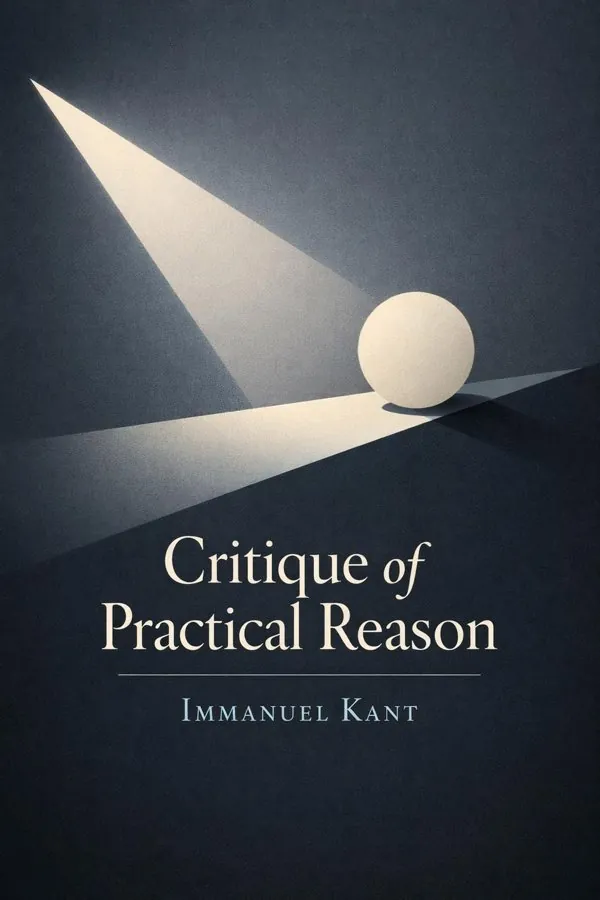
Critique of Practical Reason: Summary & Key Insights
 10 min6 chaptersAudio available
What Is Critique of Practical Reason About?
Critique of Practical Reason by Immanuel Kant is a western_phil book spanning 6 pages. First published in 1788, Immanuel Kant’s 'Critique of Practical Reason' is the second of his three major critiques and a cornerstone of modern moral philosophy. In this work, Kant develops the principles of practical reason, introducing the concept of the categorical imperative and exploring the foundations of moral law. He argues that moral obligations arise from reason itself rather than from empirical or theological sources, establishing a rational basis for ethics and human freedom.
This FizzRead summary covers all 6 key chapters of Critique of Practical Reason in approximately 10 minutes, distilling the most important ideas, arguments, and takeaways from Immanuel Kant's work. Also available as an audio summary and Key Quotes Podcast.
Critique of Practical Reason
First published in 1788, Immanuel Kant’s 'Critique of Practical Reason' is the second of his three major critiques and a cornerstone of modern moral philosophy. In this work, Kant develops the principles of practical reason, introducing the concept of the categorical imperative and exploring the foundations of moral law. He argues that moral obligations arise from reason itself rather than from empirical or theological sources, establishing a rational basis for ethics and human freedom.
Who Should Read Critique of Practical Reason?
This book is perfect for anyone interested in western_phil and looking to gain actionable insights in a short read. Whether you're a student, professional, or lifelong learner, the key ideas from Critique of Practical Reason by Immanuel Kant will help you think differently.
- ✓Readers who enjoy western_phil and want practical takeaways
- ✓Professionals looking to apply new ideas to their work and life
- ✓Anyone who wants the core insights of Critique of Practical Reason in just 10 minutes
Want the full summary?
Get instant access to this book summary and 100K+ more with Fizz Moment.
Get Free SummaryAvailable on App Store • Free to download
Key Chapters
At the heart of all moral consideration lies the question: what makes a will good? The essence of goodness in the will cannot depend upon what it produces—the results, intentions fulfilled, or happiness achieved—for those are contingent upon forces beyond our control. It must lie solely in *the principle of volition* itself. A good will acts from duty, not merely in accordance with duty. Imagine a benefactor who helps others because it pleases him, versus one who does so because reason tells him it is right; only the latter exemplifies moral worth.
In everyday life, we might mistake acts of kindness or prudence for moral virtue, yet even clever or benevolent deeds lose their moral significance if their motivation is grounded in inclination. It is precisely when duty commands against inclination—when the moral law stands opposed to our desires—that the purity of will is revealed. Duty, in this sense, is not a burden but the manifestation of autonomy: it is the expression of reason legislating to itself.
The good will is unique because it finds its value not in achieving happiness but in being *unconditionally good*. Happiness is the natural satisfaction of desire; duty is the rational command of law. In choosing according to duty, a rational being participates in the universal legislation of morality. Only by detaching moral worth from empirical outcomes can we affirm an ethics grounded in freedom and not in necessity.
When I formulated the moral law, I sought a principle that could guide every rational being without dependence on circumstance. This is what I called the *categorical imperative*. Unlike hypothetical imperatives, which say, 'If you want this, then do that,' the categorical imperative commands absolutely, without reference to any end. Its form is: 'Act only according to that maxim whereby you can at the same time will that it should become a universal law.'
To understand its force, imagine asking yourself whether your principle of action could serve as a law for all rational beings. If the answer leads to contradiction—if your maxim cannot be universalized—then it is morally impermissible. Lying, for example, cannot be rationally universalized, for if everyone lied, the concept of truth would collapse, and the very act of lying would lose meaning. The categorical imperative thus serves as the touchstone for moral judgment: it grounds ethics not in arbitrary commandments but in the logical consistency of reason itself.
This imperative is not external coercion but self-legislation. Each rational will is a lawgiver in the kingdom of ends—a community of rational beings who respect one another as autonomous moral agents. To obey the categorical imperative is therefore to respect your own rational nature and that of others. It is the moral expression of freedom and equality, binding not through fear of punishment or hope for reward, but through reverence for the law that reason gives.
+ 4 more chapters — available in the FizzRead app
All Chapters in Critique of Practical Reason
About the Author
Immanuel Kant (1724–1804) was a German philosopher of the Enlightenment and one of the most influential figures in Western philosophy. His three Critiques—of Pure Reason, of Practical Reason, and of Judgment—laid the groundwork for modern epistemology, ethics, and metaphysics, shaping philosophical thought for centuries.
Get This Summary in Your Preferred Format
Read or listen to the Critique of Practical Reason summary by Immanuel Kant anytime, anywhere. FizzRead offers multiple formats so you can learn on your terms — all free.
Available formats: App · Audio · PDF · EPUB — All included free with FizzRead
Download Critique of Practical Reason PDF and EPUB Summary
Key Quotes from Critique of Practical Reason
“At the heart of all moral consideration lies the question: what makes a will good?”
“When I formulated the moral law, I sought a principle that could guide every rational being without dependence on circumstance.”
Frequently Asked Questions about Critique of Practical Reason
Critique of Practical Reason by Immanuel Kant is a western_phil book that explores key ideas across 6 chapters. First published in 1788, Immanuel Kant’s 'Critique of Practical Reason' is the second of his three major critiques and a cornerstone of modern moral philosophy. In this work, Kant develops the principles of practical reason, introducing the concept of the categorical imperative and exploring the foundations of moral law. He argues that moral obligations arise from reason itself rather than from empirical or theological sources, establishing a rational basis for ethics and human freedom.
More by Immanuel Kant
You Might Also Like
A Little History of Philosophy
Nigel Warburton
10 min
Areopagitica
John Milton
10 min
How To Think Like A Philosopher: Essential Principles For Clear Thinking
Peter Cave
10 min
Language, Truth and Logic
A. J. Ayer
10 min
The Age of Reason
Thomas Paine
10 min
The Essays
Michel De Montaigne
10 minBrowse by Category
Ready to read Critique of Practical Reason?
Get the full summary and 100K+ more books with Fizz Moment.