

Creativity, Inc.: Summary & Key Insights
by Ed Catmull
 10 min9 chaptersAudio available
Key Takeaways from Creativity, Inc.
Big creative achievements often begin as improbable obsessions.
Great organizations are rarely born from a perfect plan.
A brilliant idea is only the beginning; what matters is whether a team can improve weak early versions into something extraordinary.
Honest feedback is uncomfortable, but without it, creative organizations slowly drift into mediocrity.
Failure is painful, but false success can be even more dangerous.
What Is Creativity, Inc. About?
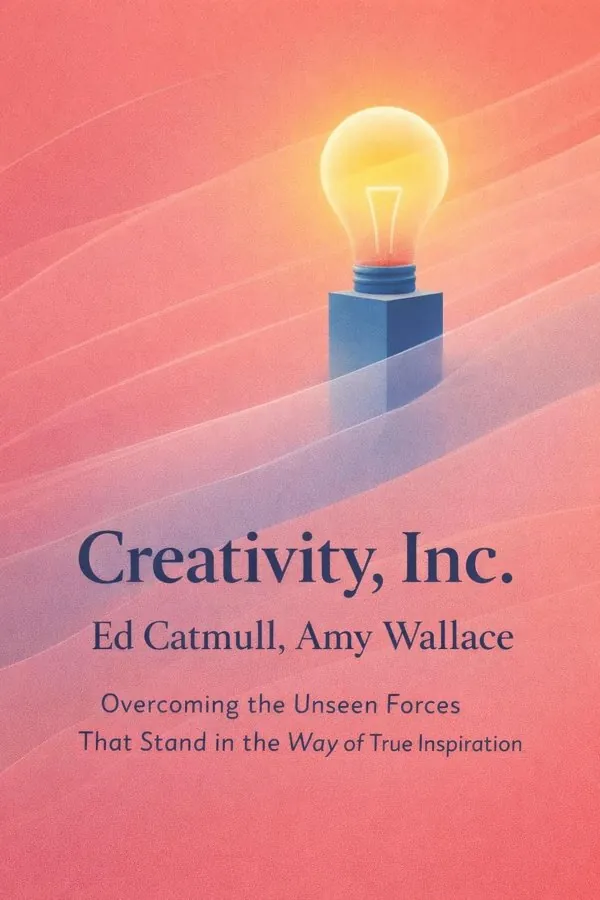
Creativity, Inc. by Ed Catmull is a leadership book published in 2014 spanning 5 pages. Creativity, Inc. is a leadership book about what it really takes to build an organization where original ideas can survive, improve, and eventually become great work. Written by Ed Catmull, co-founder of Pixar and former president of both Pixar Animation Studios and Walt Disney Animation Studios, the book combines memoir, management philosophy, and hard-earned lessons from one of the most consistently innovative companies in the world. Rather than presenting creativity as a mysterious gift possessed by a few talented people, Catmull argues that creativity depends on the environment leaders create: the quality of communication, the willingness to confront problems early, and the ability to learn from failure without becoming paralyzed by it. Through stories about Pixar’s formation, the making of Toy Story, internal conflicts, production setbacks, and Disney’s revitalization, Catmull shows how fragile creative excellence is—and how easily success can breed complacency. This book matters because it replaces vague advice about innovation with practical principles for managing talented people, protecting candor, and building systems that support risk-taking. For leaders, founders, and creative professionals, it is both inspiring and deeply useful.
This FizzRead summary covers all 9 key chapters of Creativity, Inc. in approximately 10 minutes, distilling the most important ideas, arguments, and takeaways from Ed Catmull's work. Also available as an audio summary and Key Quotes Podcast.
Creativity, Inc.
Creativity, Inc. is a leadership book about what it really takes to build an organization where original ideas can survive, improve, and eventually become great work. Written by Ed Catmull, co-founder of Pixar and former president of both Pixar Animation Studios and Walt Disney Animation Studios, the book combines memoir, management philosophy, and hard-earned lessons from one of the most consistently innovative companies in the world. Rather than presenting creativity as a mysterious gift possessed by a few talented people, Catmull argues that creativity depends on the environment leaders create: the quality of communication, the willingness to confront problems early, and the ability to learn from failure without becoming paralyzed by it. Through stories about Pixar’s formation, the making of Toy Story, internal conflicts, production setbacks, and Disney’s revitalization, Catmull shows how fragile creative excellence is—and how easily success can breed complacency. This book matters because it replaces vague advice about innovation with practical principles for managing talented people, protecting candor, and building systems that support risk-taking. For leaders, founders, and creative professionals, it is both inspiring and deeply useful.
Who Should Read Creativity, Inc.?
This book is perfect for anyone interested in leadership and looking to gain actionable insights in a short read. Whether you're a student, professional, or lifelong learner, the key ideas from Creativity, Inc. by Ed Catmull will help you think differently.
- ✓Readers who enjoy leadership and want practical takeaways
- ✓Professionals looking to apply new ideas to their work and life
- ✓Anyone who wants the core insights of Creativity, Inc. in just 10 minutes
Want the full summary?
Get instant access to this book summary and 100K+ more with Fizz Moment.
Get Free SummaryAvailable on App Store • Free to download
Key Chapters
Big creative achievements often begin as improbable obsessions. For Ed Catmull, the dream was not simply to work in film or technology, but to bring the two together by making the world’s first computer-animated feature film. At a time when such a goal seemed almost absurd, Catmull was drawn to both art and science. He loved Disney animation, but he also recognized that he lacked the drawing talent to become a traditional animator. Instead of abandoning the dream, he reframed it. If he could not create films by hand, perhaps he could help invent the tools that would make a new kind of animation possible.
This early mindset is central to the book’s leadership message. Catmull’s career shows that innovation often comes from people who stand between disciplines rather than fully inside one. He studied physics and computer science, then pursued computer graphics long before the field was mature. At the University of Utah, he worked alongside pioneering thinkers who were building foundational technologies for digital imaging. These experiences taught him two lasting lessons: first, that groundbreaking work usually requires patience over many years; and second, that ambitious goals require collaboration across different forms of expertise.
In practical terms, this means leaders should pay attention to unconventional combinations of talent and interest. The future rarely emerges from rigid job descriptions. A software engineer interested in design, a marketer fascinated by data science, or a teacher experimenting with storytelling may become a source of breakthrough ideas because they connect worlds others keep separate.
The actionable takeaway: identify one long-term vision that feels bigger than your current capabilities, then start building the skills, relationships, and cross-disciplinary exposure that could make it possible over time.
Great organizations are rarely born from a perfect plan. Pixar emerged through a messy chain of events involving research labs, filmmaking technology, entrepreneurial risk, and the persistence of people who believed in a future others could not yet see. Catmull first worked in the computer division of Lucasfilm, where the team focused on digital tools for filmmaking. The original mission was technical, not primarily about becoming a storytelling studio. Yet over time, the technology and the people using it began to point toward something larger.
This evolution matters because many leaders assume strategy must be linear. Catmull’s story suggests otherwise. Pixar did not begin with full clarity about what it would become. It gradually discovered its identity through experimentation, partnership, and adaptation. The arrival of John Lasseter brought artistic vision that transformed technical possibility into emotional storytelling. Later, Steve Jobs provided crucial financial support and strategic belief during years when the company struggled. Without any one of these elements—technical invention, artistic imagination, or business persistence—Pixar might have disappeared.
The practical lesson is that innovative organizations often emerge from the tension between capabilities and purpose. A team may start by building tools, solving a narrow problem, or serving a different market, then uncover a much more powerful direction as new people and perspectives enter. Leaders should therefore avoid over-defining identity too early. Instead, they should ask what hidden potential exists in the intersection of current strengths.
For example, a healthcare startup might discover it is not merely a software vendor but a behavior-change company. A media brand might realize its deeper strength lies in community, not content production alone.
The actionable takeaway: examine your team’s origins and assets, then ask what larger mission becomes possible when technology, talent, and customer need are viewed together rather than separately.
A brilliant idea is only the beginning; what matters is whether a team can improve weak early versions into something extraordinary. The making of Toy Story demonstrated one of Catmull’s most important beliefs: early drafts are supposed to be flawed. Pixar’s first feature was historic, but it was also full of uncertainty, creative tension, and painful revisions. The team had technical ambition and storytelling talent, yet the film did not work automatically just because smart people were involved.
One of the hardest lessons in creative work is that quality does not emerge fully formed. At Pixar, rough story reels, awkward scenes, and failed concepts were not signs that the project was doomed; they were part of the path toward excellence. Catmull emphasizes that people often confuse the quality of a first version with the quality of the team. In reality, strong teams generate lots of imperfect material and then refine it through feedback, iteration, and trust.
This principle applies far beyond filmmaking. In product development, the first prototype may be clumsy. In writing, the first draft may be scattered. In leadership, a new strategy may look incomplete before real-world testing reveals what works. The danger comes when organizations expect immediate polish and punish visible imperfection. That pressure drives people to play safe, hide issues, and defend weak work rather than improve it.
Pixar succeeded because it built a process that assumed imperfection and focused on revision. The goal was not to avoid mistakes but to detect and address them quickly. Teams were expected to keep shaping the work until the emotional core, narrative structure, and technical execution aligned.
The actionable takeaway: separate the judgment of early output from the judgment of people, and create review cycles that make revision normal rather than embarrassing.
Honest feedback is uncomfortable, but without it, creative organizations slowly drift into mediocrity. Catmull argues that one of the leader’s most important jobs is to create an environment where people can tell each other the truth, especially when the truth is inconvenient. At Pixar, this principle took shape in practices like the Braintrust, a group of experienced colleagues who reviewed films in progress and gave direct, unfiltered feedback.
What made the Braintrust effective was not simply that talented people were in the room. It was the structure and spirit of the conversation. Feedback was candid, but it was not coercive. The Braintrust did not impose solutions by authority. Instead, it identified problems, pushed thinking, and trusted the film’s director to decide what to do next. This distinction is crucial. Candor works only when people feel challenged without being humiliated or politically cornered.
Many organizations claim to value openness, yet hierarchy, fear, and ego distort communication. Employees hold back concerns to avoid conflict. Managers soften criticism until it becomes meaningless. Teams confuse harmony with health. Catmull warns that these habits are dangerous because problems hidden early become crises later. Candor is not a cultural luxury; it is an operational necessity.
In practical settings, leaders can foster candor by separating critique of the work from critique of the person, inviting dissent before decisions are finalized, and rewarding those who surface issues early. Meetings should not be performances where everyone protects status. They should be working sessions where reality becomes clearer.
A marketing team reviewing a campaign, for instance, should be able to say, “The concept is interesting, but the message is unclear and the audience fit is weak,” without fearing social penalties.
The actionable takeaway: build one recurring forum where peers can give direct, specific feedback on work in progress, with the shared goal of making the work better rather than defending personal pride.
Failure is painful, but false success can be even more dangerous. Catmull makes a subtle but powerful point: when a project succeeds, people often assume the process behind it was sound. In reality, good outcomes can conceal poor decisions, weak communication, or lucky escapes. Failure, by contrast, exposes weaknesses that organizations need to confront if they want to remain innovative.
Pixar experienced setbacks, stalled productions, and ideas that did not work. These moments were difficult, but Catmull believed they were also deeply informative. The objective was not to celebrate failure in a shallow way, but to treat it as data. When a film struggled, the team asked what the struggle revealed about the story, the process, the communication patterns, or the assumptions guiding the work. This approach prevented blame from becoming the main response.
For leaders, the key distinction is between constructive failure and destructive negligence. Constructive failure happens when capable people take thoughtful risks in pursuit of something ambitious. If leaders punish these failures harshly, they encourage caution and imitation. Over time, the organization stops discovering anything new. On the other hand, learning requires disciplined reflection. It is not enough to say, “We failed, so that’s good.” Teams must investigate why.
This idea is highly practical in business. A failed product launch may reveal unclear positioning, weak testing, or internal misalignment. A stalled hiring initiative may show that the company’s values are vague. A successful quarter may hide unsustainable workloads or customer dissatisfaction that has not surfaced yet.
The actionable takeaway: after both wins and losses, run a structured review that asks not just what happened, but what hidden process weaknesses or strengths the outcome may be masking.
The most valuable parts of innovation are often invisible at first. Catmull repeatedly argues that leadership is not about controlling creativity but about protecting the conditions in which unexpected ideas can develop. Because original work begins uncertain and fragile, it is easy for organizations to dismiss it too early in favor of predictability, efficiency, or familiar formulas.
This is one of the book’s deepest insights. Managers are often rewarded for reducing risk, increasing clarity, and enforcing consistency. Yet creative work requires periods of ambiguity. Teams need room to explore possibilities that cannot be justified by spreadsheets in the early stages. Catmull does not suggest abandoning discipline; Pixar was highly rigorous. But he insists that leaders must recognize the limits of planning when dealing with invention.
Protecting the unknown means resisting the urge to over-script every step. It means acknowledging that not all value can be measured immediately. It also means creating buffers between developing ideas and the organizational forces that would shut them down prematurely. For example, a new content series may need time to find its voice before being judged by mature-brand standards. A research project may need exploratory funding before proving commercial value. A team rethinking customer experience may need permission to test options that initially look inefficient.
Leaders can support this by asking better questions. Instead of “Can you guarantee this will work?” ask “What have we learned so far, and what needs to be true for this to become valuable?” That shift encourages inquiry rather than defensive certainty.
The actionable takeaway: identify one initiative in your organization that is still underdeveloped but promising, and deliberately give it time, protection, and thoughtful evaluation criteria instead of forcing premature proof.
Organizations love heroic narratives, but Catmull warns that relying on a few brilliant individuals is a fragile way to build lasting excellence. Pixar had extraordinary talent, yet its long-term success came not just from hiring gifted people but from designing systems that helped those people work well together. The challenge of leadership, then, is not only finding talent but constructing an environment where talent can flourish collectively.
Catmull’s view pushes back against a common myth: that great outcomes come mostly from superstar employees. In reality, even highly capable people can fail inside dysfunctional systems. Poor communication, unclear authority, political behavior, and fear of criticism can weaken the best teams. Conversely, a healthy system can elevate average initial ideas into remarkable final products through collaboration and iterative refinement.
At Pixar, processes were built to expose problems, encourage shared ownership, and maintain quality over time. Daily reviews, open discussion, and cross-functional interaction all reduced the chance that one department would become isolated from another. This kind of systemic thinking matters in any field. In a startup, product, design, and customer support need mechanisms for rapid feedback loops. In education, teachers need collaborative planning rather than isolated classrooms. In healthcare, clinical teams need structures that surface near-misses before they become disasters.
The practical implication is that when performance falters, leaders should not leap immediately to blaming or replacing people. Sometimes the real issue is that the system produces confusion, bottlenecks, or silence. Strong organizations make it easier for people to do excellent work and harder for hidden problems to persist.
The actionable takeaway: choose one recurring team frustration and map the process around it before blaming individuals; often the breakthrough comes from redesigning the system, not changing the people.
Nothing threatens a creative company more subtly than the habits formed by past success. Catmull emphasizes that when organizations achieve repeated wins, they often become less curious, less candid, and less willing to question their own assumptions. Success creates confidence, but it can also create blindness. Teams begin to trust formulas that worked before, defend existing structures, and mistake momentum for health.
This danger is especially strong in admired organizations. Praise from the outside can reduce honest self-examination inside. People stop noticing inefficiencies because results still look good. Leaders begin protecting legacy practices not because they are still effective, but because they are associated with previous victories. Catmull saw this risk at Pixar and later in the larger challenge of helping revitalize Disney Animation. The lesson is clear: maintaining excellence requires the same humility as building it.
In practical terms, this means organizations need habits that counteract complacency. Leaders should ask what would worry an outsider, where the company has become too dependent on proven methods, and what truths are becoming harder to say. They should also rotate perspectives, expose teams to fresh ideas, and revisit assumptions that have become invisible through repetition.
A business with strong sales, for example, may ignore declining customer delight because revenue still looks healthy. A successful manager may repeat the same team structure long after it has stopped fitting current challenges. A creator may rely on a signature style that once felt fresh but now feels safe.
The actionable takeaway: after every major success, hold a review focused not on celebration alone but on vulnerability—ask what nearly went wrong, what was luck, and what old assumptions now deserve to be challenged.
People do their best creative work when they feel safe enough to be honest, uncertain, and experimental. Although Catmull does not use every modern management term, much of his philosophy aligns with what is now called psychological safety. He understood that fear distorts behavior. When employees fear embarrassment, punishment, or political retaliation, they protect themselves instead of serving the work. They stay quiet about problems, avoid bold ideas, and present polished certainty even when confusion would be more useful.
Creating safety does not mean lowering standards or avoiding hard conversations. Pixar was demanding. Films were scrutinized intensely, and bad ideas were challenged. But the culture aimed to make critique survivable. People were expected to separate their identity from the current version of the work. That distinction allowed them to hear tough feedback without collapsing into defensiveness.
This principle has practical value in any leadership role. A manager can increase psychological safety by admitting mistakes publicly, asking for dissenting views, and responding calmly when someone raises a concern. A team leader can normalize phrases like “I’m not sure,” “This isn’t working yet,” and “What am I missing?” These signals invite learning rather than performance theater.
For example, in a project meeting, if a junior employee spots a major flaw in the launch plan but assumes speaking up is risky, the whole team loses. If the culture rewards issue-spotting rather than punishes it, the project improves before damage occurs.
The actionable takeaway: model vulnerability in your next team discussion by naming one uncertainty or mistake openly, then invite others to challenge assumptions without penalty.
All Chapters in Creativity, Inc.
About the Author
Ed Catmull is a computer scientist, animation executive, and one of the co-founders of Pixar Animation Studios. Trained in physics and computer science, he became an early pioneer in computer graphics and helped develop technologies that transformed filmmaking. Catmull’s long-term vision was to make feature-length computer animation possible, a goal realized with Pixar’s Toy Story, the first fully computer-animated feature film. He served as president of Pixar and later played a major leadership role at Walt Disney Animation Studios, helping guide both companies through periods of creative growth. Known for combining technical rigor with a deep respect for artistic collaboration, Catmull has received multiple Academy Awards for scientific and technical achievement. He is widely recognized as one of the most influential thinkers on leadership, innovation, and creative culture.
Get This Summary in Your Preferred Format
Read or listen to the Creativity, Inc. summary by Ed Catmull anytime, anywhere. FizzRead offers multiple formats so you can learn on your terms — all free.
Available formats: App · Audio · PDF · EPUB — All included free with FizzRead
Download Creativity, Inc. PDF and EPUB Summary
Key Quotes from Creativity, Inc.
“Big creative achievements often begin as improbable obsessions.”
“Great organizations are rarely born from a perfect plan.”
“A brilliant idea is only the beginning; what matters is whether a team can improve weak early versions into something extraordinary.”
“Honest feedback is uncomfortable, but without it, creative organizations slowly drift into mediocrity.”
“Failure is painful, but false success can be even more dangerous.”
Frequently Asked Questions about Creativity, Inc.
Creativity, Inc. by Ed Catmull is a leadership book that explores key ideas across 9 chapters. Creativity, Inc. is a leadership book about what it really takes to build an organization where original ideas can survive, improve, and eventually become great work. Written by Ed Catmull, co-founder of Pixar and former president of both Pixar Animation Studios and Walt Disney Animation Studios, the book combines memoir, management philosophy, and hard-earned lessons from one of the most consistently innovative companies in the world. Rather than presenting creativity as a mysterious gift possessed by a few talented people, Catmull argues that creativity depends on the environment leaders create: the quality of communication, the willingness to confront problems early, and the ability to learn from failure without becoming paralyzed by it. Through stories about Pixar’s formation, the making of Toy Story, internal conflicts, production setbacks, and Disney’s revitalization, Catmull shows how fragile creative excellence is—and how easily success can breed complacency. This book matters because it replaces vague advice about innovation with practical principles for managing talented people, protecting candor, and building systems that support risk-taking. For leaders, founders, and creative professionals, it is both inspiring and deeply useful.
More by Ed Catmull
You Might Also Like

Extreme Ownership
Jocko Willink
10 min
Dare to Lead
Brene Brown
10 min
Leaders Eat Last
Simon Sinek
10 min
The 21 Irrefutable Laws of Leadership
John Maxwell
10 min
Start With Why
Simon Sinek
10 min
How to Lead When You're Not in Charge
Clay Scroggins
10 minFeatured In
Browse by Category
Ready to read Creativity, Inc.?
Get the full summary and 100K+ more books with Fizz Moment.