
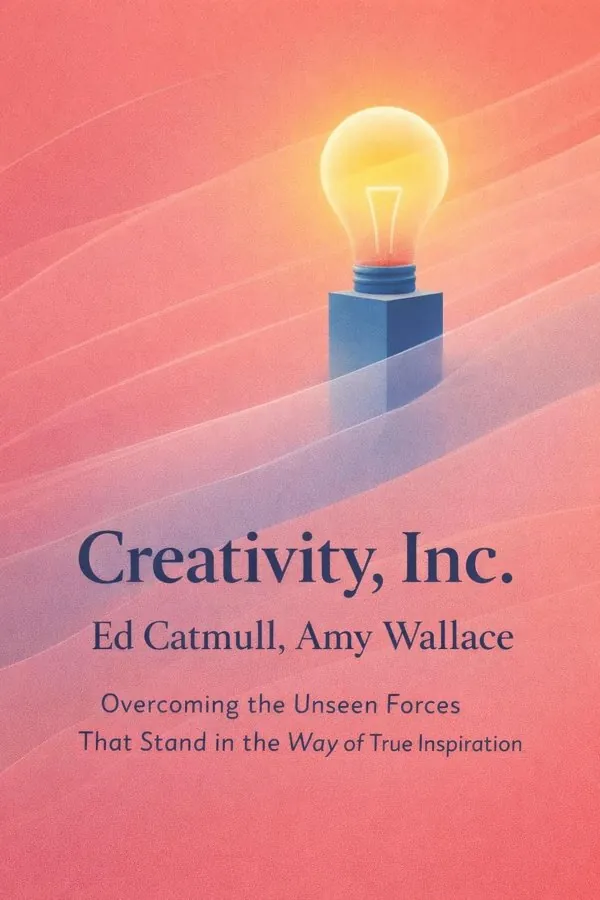
Creativity, Inc.: Overcoming the Unseen Forces That Stand in the Way of True Inspiration: Summary & Key Insights
 10 min9 chaptersAudio available
Key Takeaways from Creativity, Inc.: Overcoming the Unseen Forces That Stand in the Way of True Inspiration
A bold vision is inspiring, but vision alone rarely creates anything lasting.
Many iconic creative companies do not begin as creative companies at all.
People do not believe what leaders say about culture; they believe what leaders repeatedly reward, ignore, and tolerate.
Great work rarely emerges fully formed; it becomes great through rigorous, honest refinement.
If you want predictable outcomes, do familiar work.
What Is Creativity, Inc.: Overcoming the Unseen Forces That Stand in the Way of True Inspiration About?
Creativity, Inc.: Overcoming the Unseen Forces That Stand in the Way of True Inspiration by Ed Catmull, Amy Wallace is a leadership book spanning 12 pages. Creativity, Inc. is a leadership book about what it really takes to build an organization where original ideas can survive, improve, and eventually thrive. Written by Ed Catmull, co-founder of Pixar Animation Studios and former president of Pixar and Disney Animation, with journalist Amy Wallace, the book goes far beyond the familiar success story of Toy Story, Finding Nemo, or The Incredibles. Its deeper focus is the hidden environment behind creative achievement: trust, candor, experimentation, failure, and the systems leaders build to protect them. Catmull argues that many organizations unknowingly smother creativity through fear, hierarchy, and the illusion of control. Drawing on decades of experience in computer graphics, filmmaking, and executive leadership, he explains how Pixar developed practices that encouraged honest feedback, protected new ideas, and helped teams navigate uncertainty without losing ambition. The result is both a memoir and a management guide. For leaders, founders, managers, and anyone trying to do innovative work with other people, Creativity, Inc. offers a rare and practical look at how to nurture excellence without crushing the very spark that makes excellence possible.
This FizzRead summary covers all 9 key chapters of Creativity, Inc.: Overcoming the Unseen Forces That Stand in the Way of True Inspiration in approximately 10 minutes, distilling the most important ideas, arguments, and takeaways from Ed Catmull, Amy Wallace's work. Also available as an audio summary and Key Quotes Podcast.
Creativity, Inc.: Overcoming the Unseen Forces That Stand in the Way of True Inspiration
Creativity, Inc. is a leadership book about what it really takes to build an organization where original ideas can survive, improve, and eventually thrive. Written by Ed Catmull, co-founder of Pixar Animation Studios and former president of Pixar and Disney Animation, with journalist Amy Wallace, the book goes far beyond the familiar success story of Toy Story, Finding Nemo, or The Incredibles. Its deeper focus is the hidden environment behind creative achievement: trust, candor, experimentation, failure, and the systems leaders build to protect them. Catmull argues that many organizations unknowingly smother creativity through fear, hierarchy, and the illusion of control. Drawing on decades of experience in computer graphics, filmmaking, and executive leadership, he explains how Pixar developed practices that encouraged honest feedback, protected new ideas, and helped teams navigate uncertainty without losing ambition. The result is both a memoir and a management guide. For leaders, founders, managers, and anyone trying to do innovative work with other people, Creativity, Inc. offers a rare and practical look at how to nurture excellence without crushing the very spark that makes excellence possible.
Who Should Read Creativity, Inc.: Overcoming the Unseen Forces That Stand in the Way of True Inspiration?
This book is perfect for anyone interested in leadership and looking to gain actionable insights in a short read. Whether you're a student, professional, or lifelong learner, the key ideas from Creativity, Inc.: Overcoming the Unseen Forces That Stand in the Way of True Inspiration by Ed Catmull, Amy Wallace will help you think differently.
- ✓Readers who enjoy leadership and want practical takeaways
- ✓Professionals looking to apply new ideas to their work and life
- ✓Anyone who wants the core insights of Creativity, Inc.: Overcoming the Unseen Forces That Stand in the Way of True Inspiration in just 10 minutes
Want the full summary?
Get instant access to this book summary and 100K+ more with Fizz Moment.
Get Free SummaryAvailable on App Store • Free to download
Key Chapters
A bold vision is inspiring, but vision alone rarely creates anything lasting. One of the most powerful lessons in Creativity, Inc. is that creative ambition needs structure, patience, and technical mastery to become real. Ed Catmull’s early dream was not simply to work in film, but to make the first fully computer-animated movie at a time when the tools did not yet exist. That meant the dream could not be pursued through enthusiasm alone; it required years of building capabilities, solving hard technical problems, and staying committed when the destination was still invisible to others.
This matters because many people romanticize creativity as sudden inspiration. Catmull shows that true innovation often begins with a distant aspiration and a willingness to invest in foundations before results are obvious. In his case, that included studying physics and computer science, pioneering digital imaging techniques, and working in environments where experimentation mattered more than immediate payoff. The lesson applies beyond film. A founder who wants to reinvent education may first need to develop a better platform. A design leader who wants breakthrough products may need to improve team communication and prototyping workflows before expecting brilliance.
The broader insight is that creative success is usually built long before the public sees it. The breakthrough arrives after years of invisible preparation. Ambition becomes useful when paired with infrastructure: the right people, tools, habits, and tolerance for unfinished work.
Actionable takeaway: Identify one long-term creative goal you care about and ask what underlying systems, skills, or relationships must exist before that goal can realistically be achieved. Then start building those foundations now.
Many iconic creative companies do not begin as creative companies at all. Pixar is remembered as a storytelling powerhouse, but Catmull reminds readers that it started as a small technology group developing high-end computer graphics hardware and software. That origin story matters because it reveals how innovation often emerges through adaptation rather than straight-line planning.
Before Pixar became a studio known for emotionally resonant films, it was trying to survive as a business. The company sold machines, created tools, and searched for a viable model while also holding onto a larger belief in the future of computer animation. Steve Jobs’ involvement gave Pixar runway, but it did not erase uncertainty. The company still had to evolve from a technical experiment into a creative enterprise. That transformation happened gradually, through short films, commercials, and increasing confidence in the artistic possibilities of the technology.
For leaders, this is a reminder that early identity should not become a prison. A company can begin in one domain and grow into another if its leaders remain attentive to emerging strengths. Teams often cling too tightly to their original business model, even when evidence suggests a more promising path. Pixar succeeded not just because it had talent, but because it allowed its purpose to become clearer over time.
This idea also helps individuals. Your career may begin in analysis, engineering, or operations and later shift toward strategy, teaching, or creative direction. The first version of your work does not have to be the final one.
Actionable takeaway: Reexamine your team’s or career’s original mission and ask whether it still reflects your greatest strength, or whether a more valuable identity is waiting to be recognized.
People do not believe what leaders say about culture; they believe what leaders repeatedly reward, ignore, and tolerate. Catmull emphasizes that Pixar’s culture was not an abstract set of values posted on a wall. It was created through everyday practices that signaled respect for ideas, openness to feedback, and a shared commitment to quality.
At Pixar, environment mattered in visible and invisible ways. Physical spaces were designed to increase chance encounters and collaboration. More importantly, social norms encouraged people at every level to speak up when something was not working. The goal was not comfort but honesty in service of better work. Catmull also understood that talented people are not enough. If fear, ego, or hierarchy prevent truth from surfacing, even brilliant teams can produce weak results.
This is especially relevant in organizations that say they want innovation but punish mistakes or dissent. A manager may declare, “Bring me your ideas,” yet dismiss people the moment those ideas create inconvenience. Over time, employees learn that safety lies in silence. Pixar tried to counteract this by making candor a normal part of the creative process rather than a risky exception.
In practice, culture shows up in meeting dynamics, how failures are discussed, who gets heard, and whether unfinished work can be shown without shame. Teams become more creative when people trust that critique is meant to improve the work, not diminish the person.
Actionable takeaway: Audit the last two weeks of your leadership behavior. What did you truly reward: openness, caution, speed, politeness, truth, experimentation? Your culture is already speaking through those signals.
Great work rarely emerges fully formed; it becomes great through rigorous, honest refinement. One of the book’s most famous contributions is the concept of Pixar’s Braintrust, a group of experienced storytellers and leaders who reviewed films in progress and gave direct, unfiltered feedback. The purpose was not to impose authority but to make the work stronger.
What made the Braintrust effective was not merely intelligence; it was candor without coercion. Participants were expected to identify problems clearly, but they did not have the power to force solutions. That distinction matters. If feedback comes from people who can overrule the creators, discussion becomes political. People start defending themselves instead of investigating the problem. At Pixar, the director remained responsible for solving the issues, which preserved ownership while still allowing for brutal honesty.
This model applies to many settings. Product teams can hold review sessions where peers expose weaknesses in a prototype. Writers can use critique groups focused on diagnosis rather than personal preference. Senior leaders can create advisory circles where difficult truths are surfaced without turning every conversation into a command structure.
The deeper lesson is that creative people need both support and challenge. Praise may protect morale, but praise alone does not improve work. Candor is an act of respect when everyone is aligned around excellence. It only becomes destructive when mixed with ego, status games, or fear.
Actionable takeaway: Create one recurring feedback forum where people can discuss unfinished work honestly, with the explicit rule that the goal is to identify problems clearly while leaving ownership of solutions with the creator.
If you want predictable outcomes, do familiar work. If you want original work, you must learn to operate without full certainty. Catmull repeatedly stresses that creative projects are inherently messy. Early versions are weak, plans change, and nobody can perfectly forecast what a breakthrough idea will require. Leaders who demand clarity too early often crush the very exploration that innovation needs.
Pixar’s films did not start as polished masterpieces. They went through ugly phases, story dead ends, and painful revisions. Catmull argues that this is normal, not a sign of incompetence. Problems are not evidence that the team has failed; they are evidence that the team is engaged in difficult, meaningful work. The real danger lies in pretending uncertainty is not there. When leaders hide risks, oversimplify progress, or cling to false confidence, they make learning slower and failure costlier.
This insight is valuable in any complex environment. A startup launching a new product, a school redesigning curriculum, or a nonprofit addressing a difficult social issue cannot eliminate ambiguity. But they can build processes that help them respond to it. That means frequent review, fast iteration, open discussion of emerging problems, and realistic expectations about the nonlinearity of progress.
Creative leadership requires emotional steadiness. Teams need leaders who can acknowledge uncertainty without spreading panic, and who can maintain momentum without pretending to know everything.
Actionable takeaway: The next time a project becomes messy, resist the urge to treat confusion as failure. Instead, ask: What is this uncertainty teaching us, and what small experiment would help us learn faster?
Creative organizations often struggle with a false choice: protect artistic integrity or satisfy commercial reality. Catmull’s experience at Pixar shows that this is the wrong framing. Sustainable creativity depends on respecting both art and business, while refusing to let either dominate in a way that weakens the whole.
Pixar made films with emotional depth and technical excellence, but it also had to manage budgets, deadlines, partnerships, and distribution. Ignoring economics would have made creative freedom impossible to sustain. At the same time, reducing filmmaking to market logic would have stripped away the originality that made Pixar valuable. The challenge was not to choose one side, but to build an organization where business decisions protected the conditions for excellent creative work.
This balancing act appears in many industries. A product team must care about user delight and financial viability. A publishing company must nurture strong editorial judgment while staying commercially healthy. Even an individual freelancer faces this tension when deciding whether to chase quick-paying work or invest in projects that develop long-term distinctiveness.
Catmull’s message is that business discipline is not the enemy of creativity when it serves the mission rather than replacing it. Metrics, schedules, and strategy are useful if they help talented people make better work and ensure that the organization can continue taking risks.
Actionable takeaway: Review one major decision in your organization and ask whether commercial pressures are clarifying the work or distorting it. Then redesign the decision criteria so financial discipline supports, rather than undermines, your core creative standard.
The biggest obstacles to creativity are often not obvious. Catmull argues that leaders fail when they focus only on visible problems while ignoring the hidden forces that quietly distort behavior: fear of failure, attachment to hierarchy, defensiveness, overconfidence, and the illusion that process can eliminate risk.
This is one of the book’s central leadership insights. Many organizations look functional from the outside, yet suffer internally because people avoid conflict, withhold concerns, or protect their status instead of confronting reality. These forces are difficult to detect because they often become normalized. A team may call itself collaborative while routinely suppressing disagreement. An executive may believe she is empowering others while unconsciously dominating every conversation.
Catmull’s approach was to treat leadership as the work of uncovering and reducing these distortions. That meant designing meetings where truth could surface, paying attention to power dynamics, and reminding people that mistakes are inevitable in new work. It also meant rejecting the fantasy of total control. Leaders cannot manufacture genius on demand, but they can create conditions where people are more likely to do their best thinking.
This applies directly to managers everywhere. If your team is slow, the problem may not be laziness but fear of making the wrong call. If ideas are weak, the issue may not be talent but a culture that rewards certainty over exploration. The hidden barrier is often more important than the visible symptom.
Actionable takeaway: Ask your team anonymously, “What feels risky to say here?” The answers will reveal invisible barriers that no strategy deck or performance metric can show.
Success creates a new kind of danger: the tendency to protect past formulas instead of staying open to change. After Toy Story, Pixar had not solved creativity forever; it had simply entered a new phase where reputation, scale, and expectations could start undermining the very culture that produced its breakthrough.
Catmull is especially insightful on this point because he refuses the easy narrative that success proves a system is perfect. Growth brings complexity. More employees, more projects, and more external pressure can lead to bureaucracy, communication gaps, and complacency. Teams may begin repeating what worked before rather than discovering what the current project actually needs. Leaders may become risk-averse because they have more to lose.
Pixar’s challenge after early success was to preserve candor, experimentation, and quality while operating at a much larger scale. That required conscious effort. Processes had to evolve, but not harden into rigidity. New talent had to be integrated without diluting standards. The company had to honor past lessons without worshipping them.
This dynamic is common in growing organizations. A startup that becomes successful may lose speed. A school known for innovation may become administrative. A creator who gains an audience may start making what is expected rather than what is alive. Success can quietly turn into imitation of oneself.
Actionable takeaway: List three practices that drove your past success, then ask whether each one is still serving current reality or has become a ritual. Keep the principle, but update the practice before growth turns strength into stagnation.
No creative organization succeeds in isolation. Pixar’s relationship with Disney illustrates both the power and fragility of strategic partnerships. The collaboration brought distribution, reach, and commercial opportunity, but it also created tension over control, identity, and future direction. Catmull’s account shows that partnerships succeed when both sides respect each other’s strengths and are willing to renegotiate assumptions as conditions change.
This became especially important during periods of corporate uncertainty and later during Pixar’s deeper integration with Disney Animation. Catmull’s leadership challenge expanded from protecting Pixar’s culture to helping revive another creative institution without imposing a simplistic formula. His experience demonstrates that strong leadership in partnerships is not about defending turf at all costs. It is about clarifying what must be preserved, what can be adapted, and how trust can be rebuilt through shared purpose.
In practical terms, this idea applies to cross-functional collaboration, mergers, agency-client relationships, and even cofounder dynamics. Productive partnerships require more than contracts or incentives. They require transparent communication, mutual respect, and a willingness to confront conflict before resentment hardens. They also require humility: one side may bring technical excellence, the other market access; one may offer brand strength, the other creative renewal.
The most resilient collaborations are not static. They evolve as each party learns more about the other and about the work itself.
Actionable takeaway: In any important partnership, explicitly define three things: what each side uniquely contributes, what decisions require joint alignment, and what tensions must be discussed early rather than left to assumptions.
All Chapters in Creativity, Inc.: Overcoming the Unseen Forces That Stand in the Way of True Inspiration
About the Authors
Ed Catmull is a pioneering computer scientist, animation executive, and co-founder of Pixar Animation Studios. A major figure in the development of computer graphics, he helped lay the technical groundwork for modern digital animation before going on to lead one of the world’s most admired creative companies. Catmull later served in senior leadership roles at both Pixar and Walt Disney Animation Studios, where he became known for his thoughtful approach to innovation, culture, and creative management. Amy Wallace is an American journalist and author whose work has appeared in publications including Wired, GQ, Time, Vanity Fair, and The New York Times Magazine. Together, they combine deep firsthand leadership experience with sharp narrative storytelling in Creativity, Inc.
Get This Summary in Your Preferred Format
Read or listen to the Creativity, Inc.: Overcoming the Unseen Forces That Stand in the Way of True Inspiration summary by Ed Catmull, Amy Wallace anytime, anywhere. FizzRead offers multiple formats so you can learn on your terms — all free.
Available formats: App · Audio · PDF · EPUB — All included free with FizzRead
Download Creativity, Inc.: Overcoming the Unseen Forces That Stand in the Way of True Inspiration PDF and EPUB Summary
Key Quotes from Creativity, Inc.: Overcoming the Unseen Forces That Stand in the Way of True Inspiration
“A bold vision is inspiring, but vision alone rarely creates anything lasting.”
“Many iconic creative companies do not begin as creative companies at all.”
“People do not believe what leaders say about culture; they believe what leaders repeatedly reward, ignore, and tolerate.”
“Great work rarely emerges fully formed; it becomes great through rigorous, honest refinement.”
“If you want predictable outcomes, do familiar work.”
Frequently Asked Questions about Creativity, Inc.: Overcoming the Unseen Forces That Stand in the Way of True Inspiration
Creativity, Inc.: Overcoming the Unseen Forces That Stand in the Way of True Inspiration by Ed Catmull, Amy Wallace is a leadership book that explores key ideas across 9 chapters. Creativity, Inc. is a leadership book about what it really takes to build an organization where original ideas can survive, improve, and eventually thrive. Written by Ed Catmull, co-founder of Pixar Animation Studios and former president of Pixar and Disney Animation, with journalist Amy Wallace, the book goes far beyond the familiar success story of Toy Story, Finding Nemo, or The Incredibles. Its deeper focus is the hidden environment behind creative achievement: trust, candor, experimentation, failure, and the systems leaders build to protect them. Catmull argues that many organizations unknowingly smother creativity through fear, hierarchy, and the illusion of control. Drawing on decades of experience in computer graphics, filmmaking, and executive leadership, he explains how Pixar developed practices that encouraged honest feedback, protected new ideas, and helped teams navigate uncertainty without losing ambition. The result is both a memoir and a management guide. For leaders, founders, managers, and anyone trying to do innovative work with other people, Creativity, Inc. offers a rare and practical look at how to nurture excellence without crushing the very spark that makes excellence possible.
You Might Also Like

Extreme Ownership
Jocko Willink
10 min
Dare to Lead
Brene Brown
10 min
Leaders Eat Last
Simon Sinek
10 min
The 21 Irrefutable Laws of Leadership
John Maxwell
10 min
Start With Why
Simon Sinek
10 min
How to Lead When You're Not in Charge
Clay Scroggins
10 minBrowse by Category
Ready to read Creativity, Inc.: Overcoming the Unseen Forces That Stand in the Way of True Inspiration?
Get the full summary and 100K+ more books with Fizz Moment.