
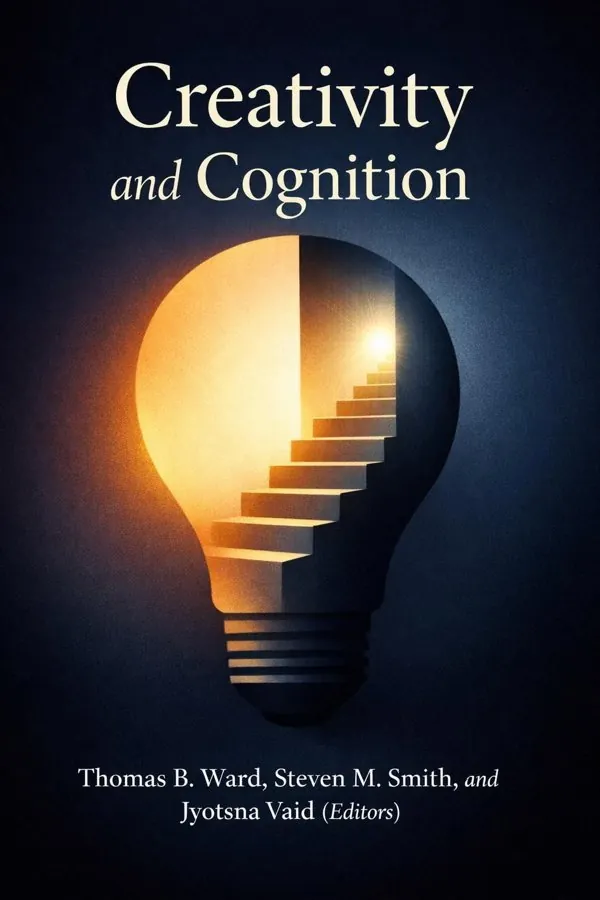
Creativity and Cognition: Summary & Key Insights
by Thomas B. Ward, Steven M. Smith, and Jyotsna Vaid (Editors)
 10 min8 chaptersAudio available
What Is Creativity and Cognition About?
Creativity and Cognition by Thomas B. Ward, Steven M. Smith, and Jyotsna Vaid (Editors) is a creativity book spanning 8 pages. This edited volume explores the intersection of creativity and cognitive science, presenting research on how creative thought processes emerge, develop, and can be supported. It includes contributions from leading scholars in psychology, design, and computer science, examining topics such as problem solving, conceptual combination, and the cognitive mechanisms underlying innovation.
This FizzRead summary covers all 8 key chapters of Creativity and Cognition in approximately 10 minutes, distilling the most important ideas, arguments, and takeaways from Thomas B. Ward, Steven M. Smith, and Jyotsna Vaid (Editors)'s work. Also available as an audio summary and Key Quotes Podcast.
Creativity and Cognition
This edited volume explores the intersection of creativity and cognitive science, presenting research on how creative thought processes emerge, develop, and can be supported. It includes contributions from leading scholars in psychology, design, and computer science, examining topics such as problem solving, conceptual combination, and the cognitive mechanisms underlying innovation.
Who Should Read Creativity and Cognition?
This book is perfect for anyone interested in creativity and looking to gain actionable insights in a short read. Whether you're a student, professional, or lifelong learner, the key ideas from Creativity and Cognition by Thomas B. Ward, Steven M. Smith, and Jyotsna Vaid (Editors) will help you think differently.
- ✓Readers who enjoy creativity and want practical takeaways
- ✓Professionals looking to apply new ideas to their work and life
- ✓Anyone who wants the core insights of Creativity and Cognition in just 10 minutes
Want the full summary?
Get instant access to this book summary and 100K+ more with Fizz Moment.
Get Free SummaryAvailable on App Store • Free to download
Key Chapters
Early research on creativity often resonated with mystery and myth. From the Romantic conception of the inspired genius to early twentieth-century personality studies, creativity was seen as an exceptional trait rather than an everyday capacity. Our field’s task was to bring this elusive phenomenon into the empirical realm that cognitive psychology had opened for other mental processes. The cognitive revolution of the mid-twentieth century reframed the mind as an information processor—a system that encodes, stores, transforms, and retrieves knowledge. Once this frame was established, new possibilities emerged for creativity research. If thought could be described in terms of representations and processes, then creativity might be understood as a distinctive mode of information transformation.
We began by mapping the cognitive tasks that precede creative products: problem representation, conceptual combination, and analogical transfer. Creativity arises not only in the generation of original ideas but also in the reinterpretation of existing knowledge structures. Integrating creativity with cognition allowed scholars to design experiments rather than rely solely on biographical methods. We could observe creative thought in the laboratory through tasks that measure fluency, flexibility, and originality, revealing measurable processes behind what once seemed inaccessible.
Historically, this integration marked a shift from seeing creativity as a personality variable to treating it as a system of cognitive behaviors. Researchers such as Ward, Smith, and Vaid argued that understanding these mechanisms would not diminish the romance of creativity; it would make it reproducible and teachable. From our perspective, comprehension does not domesticate wonder—it deepens it by allowing us to witness the complexity behind even a simple idea.
Imagine combining two words—‘bird’ and ‘horse.’ Immediately, your mind creates something resembling a pegasus, a hybrid creature both impossible and yet vividly imaginable. This is conceptual combination at work, a process central to creative cognition. When we form new ideas, we rarely start from nothing; we blend existing concepts in novel configurations. This mechanism explains how artists invent mythical creatures, scientists form new hypotheses, and entrepreneurs envision products that bridge distinct domains.
In our research, we studied how people construct meaning from pairs of nouns or attributes that are rarely combined. Some combinations yield logical extensions—‘snow car’ might suggest a snowplow—while others spark entirely new constructs that surprise even their creators. The success of such combinations depends on how flexibly the mind recruits relevant features from each concept, often influenced by memory, attention, and contextual goals.
From the creative viewpoint, conceptual combination reveals both the power and limitation of cognition: we can produce novelty, but that novelty is anchored in prior knowledge. The trick is not to discard the familiar, but to manipulate it imaginatively—stretching boundaries while preserving coherence. The mental leaps that generate great scientific or artistic advances rarely defy logic entirely; they exploit it from fresh angles. Through creative combination, thinking becomes play, and play becomes insight.
+ 6 more chapters — available in the FizzRead app
All Chapters in Creativity and Cognition
About the Authors
Thomas B. Ward, Steven M. Smith, and Jyotsna Vaid are cognitive psychologists known for their research on creativity, problem solving, and mental representation. They have published extensively on the cognitive foundations of creative thought and have contributed to the development of the field of creativity research.
Get This Summary in Your Preferred Format
Read or listen to the Creativity and Cognition summary by Thomas B. Ward, Steven M. Smith, and Jyotsna Vaid (Editors) anytime, anywhere. FizzRead offers multiple formats so you can learn on your terms — all free.
Available formats: App · Audio · PDF · EPUB — All included free with FizzRead
Download Creativity and Cognition PDF and EPUB Summary
Key Quotes from Creativity and Cognition
“Early research on creativity often resonated with mystery and myth.”
“Imagine combining two words—‘bird’ and ‘horse.”
Frequently Asked Questions about Creativity and Cognition
Creativity and Cognition by Thomas B. Ward, Steven M. Smith, and Jyotsna Vaid (Editors) is a creativity book that explores key ideas across 8 chapters. This edited volume explores the intersection of creativity and cognitive science, presenting research on how creative thought processes emerge, develop, and can be supported. It includes contributions from leading scholars in psychology, design, and computer science, examining topics such as problem solving, conceptual combination, and the cognitive mechanisms underlying innovation.
You Might Also Like
Dimensions Of Creativity
Margaret A. Boden
10 min
How to Fly a Horse: The Secret History of Creation, Invention, and Discovery
Kevin Ashton
10 min
Imagine: How Creativity Works
Jonah Lehrer
10 min
The Accidental Creative: How to Be Brilliant at a Moment's Notice
Todd Henry
10 min
The Origins of Creativity
Edward O. Wilson
10 min
Wired to Create: Unraveling the Mysteries of the Creative Mind
Scott Barry Kaufman, Carolyn Gregoire
10 minBrowse by Category
Ready to read Creativity and Cognition?
Get the full summary and 100K+ more books with Fizz Moment.