
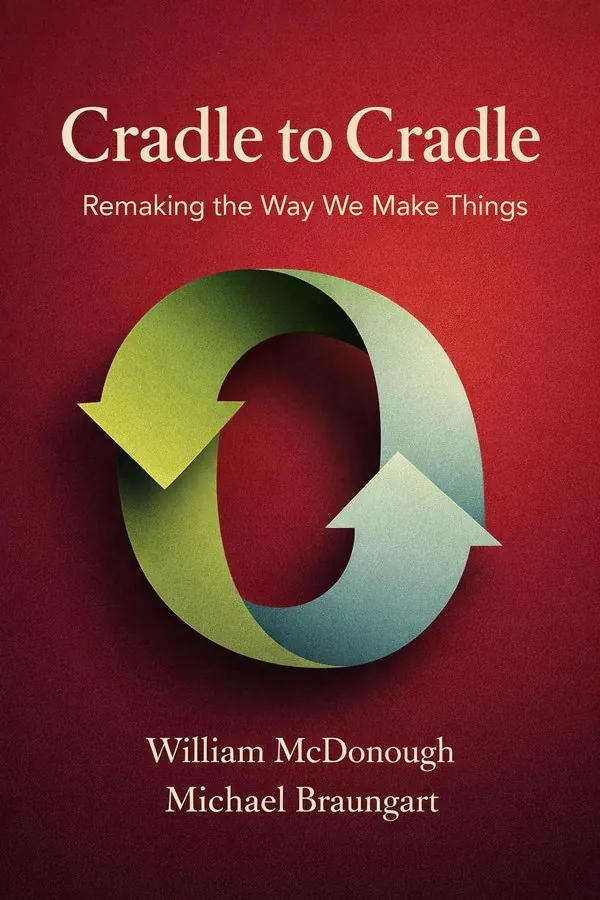
Cradle to Cradle: Remaking the Way We Make Things: Summary & Key Insights
by William McDonough, Michael Braungart
 10 min9 chaptersAudio available
What Is Cradle to Cradle: Remaking the Way We Make Things About?
Cradle to Cradle: Remaking the Way We Make Things by William McDonough, Michael Braungart is a environment book spanning 9 pages. Cradle to Cradle propone un nuevo paradigma para el diseño y la producción industrial, basado en los principios de la sostenibilidad y la economía circular. Los autores argumentan que los productos deben concebirse desde el inicio para ser reutilizados o reciclados completamente, eliminando el concepto de desperdicio. El libro combina ideas de diseño ecológico, ingeniería y responsabilidad social para transformar la manera en que las empresas crean bienes y servicios.
This FizzRead summary covers all 9 key chapters of Cradle to Cradle: Remaking the Way We Make Things in approximately 10 minutes, distilling the most important ideas, arguments, and takeaways from William McDonough, Michael Braungart's work. Also available as an audio summary and Key Quotes Podcast.
Cradle to Cradle: Remaking the Way We Make Things
Cradle to Cradle propone un nuevo paradigma para el diseño y la producción industrial, basado en los principios de la sostenibilidad y la economía circular. Los autores argumentan que los productos deben concebirse desde el inicio para ser reutilizados o reciclados completamente, eliminando el concepto de desperdicio. El libro combina ideas de diseño ecológico, ingeniería y responsabilidad social para transformar la manera en que las empresas crean bienes y servicios.
Who Should Read Cradle to Cradle: Remaking the Way We Make Things?
This book is perfect for anyone interested in environment and looking to gain actionable insights in a short read. Whether you're a student, professional, or lifelong learner, the key ideas from Cradle to Cradle: Remaking the Way We Make Things by William McDonough, Michael Braungart will help you think differently.
- ✓Readers who enjoy environment and want practical takeaways
- ✓Professionals looking to apply new ideas to their work and life
- ✓Anyone who wants the core insights of Cradle to Cradle: Remaking the Way We Make Things in just 10 minutes
Want the full summary?
Get instant access to this book summary and 100K+ more with Fizz Moment.
Get Free SummaryAvailable on App Store • Free to download
Key Chapters
The Industrial Revolution brought prosperity—and an illusion. We grew convinced that higher efficiency could solve every problem. Yet the opposite proved true: as productivity rose, so did waste and pollution. We built faster cars, taller buildings, and grander cities, while the air became thicker and rivers more contaminated. To cope, we invented strategies for 'less harm': cutting emissions, boosting resource use, adding filters. These are commendable, but they never touch the real cause. Less pollution still means pollution.
Our argument is simple but radical: true sustainability doesn’t come from slowing destruction, but from changing direction altogether. Industrial design since the eighteenth century has focused on economic growth as its prime goal; resources are fuel, and waste is a by-product. Nature knows no such linear logic. Humanity’s model of progress is like trying to fix the engine of a speeding car without stopping. We need to step back and ask: can we redesign the entire machine?
Take automobiles. Hundreds of millions are manufactured annually, and much of their material eventually ends up buried. The construction industry consumes over half of global energy, yet celebrates a ten percent efficiency gain as victory. The point is not to condemn, but to expose a flawed assumption: our design is built on destruction. Steel, concrete, plastic, paint—these materials are created with no plan for reincarnation. As long as design begins with a linear mindset, every improvement will only delay disaster. The problem lies not in technology’s limits, but in a misguided design philosophy. The Industrial Revolution taught us to conquer nature, but not to coexist with it.
To find a truly sustainable model, we don’t need innovation from scratch; we need observation. The Earth has operated for more than four billion years without external waste management systems. Forests do not produce trash; oceans leave behind no useless by-products. Every process sustains another—nature is the ultimate designer.
From this, three principles emerge. First, all outputs become inputs—fallen leaves feed the soil, plants release oxygen for animals to breathe. Second, energy flows through regeneration: the sun powers everything freely, without borrowing or added cost. Third, complexity is harmony, not chaos. Forests, rivers, and microbial networks collaborate dynamically to maintain balance.
Human systems, in contrast, break these rules. Our production chains run one way; our energy depends on finite fossil fuels; our materials stop at the barrier called 'waste.' We must recognize nature as our greatest teacher. Learning from its logic restores our identity within the planet’s ecology, not above it.
I recall visiting an eco-factory in Germany with Michael. The production process followed natural principles: cooling systems mimicked the transpiration of trees; algae captured and converted exhaust gases into biomass; wastewater was filtered by plants and reintroduced into circulation. These weren’t afterthoughts—they were intrinsic to design. We envision industries whose purpose is not to 'offset damage,' but to live symbiotically with the environment itself.
+ 7 more chapters — available in the FizzRead app
All Chapters in Cradle to Cradle: Remaking the Way We Make Things
About the Authors
William McDonough es arquitecto y diseñador estadounidense, reconocido por su trabajo en sostenibilidad y diseño ecológico. Michael Braungart es químico alemán especializado en ecología industrial y fundador del instituto EPEA. Juntos han desarrollado el concepto de 'Cradle to Cradle', que promueve sistemas industriales regenerativos.
Get This Summary in Your Preferred Format
Read or listen to the Cradle to Cradle: Remaking the Way We Make Things summary by William McDonough, Michael Braungart anytime, anywhere. FizzRead offers multiple formats so you can learn on your terms — all free.
Available formats: App · Audio · PDF · EPUB — All included free with FizzRead
Download Cradle to Cradle: Remaking the Way We Make Things PDF and EPUB Summary
Key Quotes from Cradle to Cradle: Remaking the Way We Make Things
“The Industrial Revolution brought prosperity—and an illusion.”
“To find a truly sustainable model, we don’t need innovation from scratch; we need observation.”
Frequently Asked Questions about Cradle to Cradle: Remaking the Way We Make Things
Cradle to Cradle: Remaking the Way We Make Things by William McDonough, Michael Braungart is a environment book that explores key ideas across 9 chapters. Cradle to Cradle propone un nuevo paradigma para el diseño y la producción industrial, basado en los principios de la sostenibilidad y la economía circular. Los autores argumentan que los productos deben concebirse desde el inicio para ser reutilizados o reciclados completamente, eliminando el concepto de desperdicio. El libro combina ideas de diseño ecológico, ingeniería y responsabilidad social para transformar la manera en que las empresas crean bienes y servicios.
You Might Also Like
A Life on Our Planet: My Witness Statement and a Vision for the Future
David Attenborough
10 min
A Sky Full Of Birds
Matt Merritt
10 min
Carbon Zero: Imagining Cities That Can Save the Planet
Alex Steffen
10 min
Eaarth: Making a Life on a Tough New Planet
Bill McKibben
10 min
The Social Contract and Environmental Governance
Various Editors
10 min
The Wild Places
Robert Macfarlane
10 minBrowse by Category
Ready to read Cradle to Cradle: Remaking the Way We Make Things?
Get the full summary and 100K+ more books with Fizz Moment.