
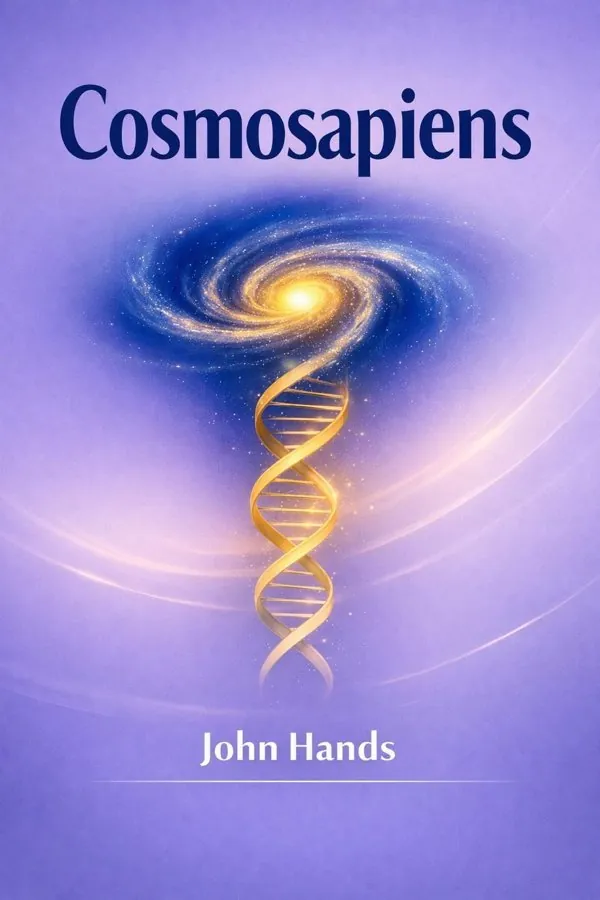
Cosmosapiens: Human Evolution from the Origin of the Universe: Summary & Key Insights
by John Hands
 10 min10 chaptersAudio available
Key Takeaways from Cosmosapiens: Human Evolution from the Origin of the Universe
To understand humanity, Hands argues, we must begin long before biology—with the birth of the universe itself.
Every cell in the human body is made from materials that were forged in stars.
The origin of life remains one of science’s greatest mysteries, and Hands argues that we should resist pretending otherwise.
His concern is that evolutionary theory can become too narrowly gene-centered, making it harder to appreciate the layered processes through which novelty arises.
Few facts are more immediate than conscious experience, yet few are harder to explain.
What Is Cosmosapiens: Human Evolution from the Origin of the Universe About?
Cosmosapiens: Human Evolution from the Origin of the Universe by John Hands is a popular_sci book spanning 11 pages. How did a universe of particles, stars, chemistry, and chance eventually produce beings capable of asking where they came from? In Cosmosapiens, John Hands tackles that immense question by tracing the story of existence from the Big Bang to human consciousness, language, science, and self-reflection. Rather than treating cosmology, biology, neuroscience, and philosophy as separate domains, he weaves them into one continuous inquiry: how matter became life, how life became mind, and how mind came to understand the cosmos that formed it. What makes this book stand out is its refusal to settle for easy answers. Hands surveys the leading scientific explanations for cosmic origins, evolution, consciousness, and human development, but he also tests their assumptions and limitations. He is especially skeptical of purely reductionist accounts that claim complex realities can be fully explained by breaking them down into smaller parts. Drawing on his background in chemistry, physics, and interdisciplinary research, Hands offers a broad, critical, and intellectually ambitious framework. The result is a challenging but rewarding book for readers who want more than isolated facts: they want a coherent account of humanity’s place in the universe.
This FizzRead summary covers all 10 key chapters of Cosmosapiens: Human Evolution from the Origin of the Universe in approximately 10 minutes, distilling the most important ideas, arguments, and takeaways from John Hands's work. Also available as an audio summary and Key Quotes Podcast.
Cosmosapiens: Human Evolution from the Origin of the Universe
How did a universe of particles, stars, chemistry, and chance eventually produce beings capable of asking where they came from? In Cosmosapiens, John Hands tackles that immense question by tracing the story of existence from the Big Bang to human consciousness, language, science, and self-reflection. Rather than treating cosmology, biology, neuroscience, and philosophy as separate domains, he weaves them into one continuous inquiry: how matter became life, how life became mind, and how mind came to understand the cosmos that formed it.
What makes this book stand out is its refusal to settle for easy answers. Hands surveys the leading scientific explanations for cosmic origins, evolution, consciousness, and human development, but he also tests their assumptions and limitations. He is especially skeptical of purely reductionist accounts that claim complex realities can be fully explained by breaking them down into smaller parts. Drawing on his background in chemistry, physics, and interdisciplinary research, Hands offers a broad, critical, and intellectually ambitious framework. The result is a challenging but rewarding book for readers who want more than isolated facts: they want a coherent account of humanity’s place in the universe.
Who Should Read Cosmosapiens: Human Evolution from the Origin of the Universe?
This book is perfect for anyone interested in popular_sci and looking to gain actionable insights in a short read. Whether you're a student, professional, or lifelong learner, the key ideas from Cosmosapiens: Human Evolution from the Origin of the Universe by John Hands will help you think differently.
- ✓Readers who enjoy popular_sci and want practical takeaways
- ✓Professionals looking to apply new ideas to their work and life
- ✓Anyone who wants the core insights of Cosmosapiens: Human Evolution from the Origin of the Universe in just 10 minutes
Want the full summary?
Get instant access to this book summary and 100K+ more with Fizz Moment.
Get Free SummaryAvailable on App Store • Free to download
Key Chapters
To understand humanity, Hands argues, we must begin long before biology—with the birth of the universe itself. Human beings are not an exception to cosmic history but its latest expression. That is why Cosmosapiens opens with cosmology: if we want to know what we are, we must first ask how anything came to exist at all.
Hands examines the standard Big Bang model, including the early expansion of the universe, the formation of matter, and the emergence of structure. But he does not simply repeat textbook explanations. He probes unresolved problems such as the origin of the initial conditions, the nature of physical laws, and the limits of scientific certainty when discussing events beyond direct observation. His point is not to dismiss cosmology, but to show that even our strongest scientific models rest on assumptions that deserve scrutiny.
This has an important practical effect on how we think. In everyday life, people often treat scientific narratives as finished stories rather than evolving explanations. Hands invites readers to distinguish between evidence, interpretation, and speculation. For example, we can confidently accept cosmic expansion while still admitting uncertainty about what preceded it or why the universe has the properties it does.
That habit of intellectual humility matters beyond astronomy. In work, politics, and personal belief, we often mistake dominant models for complete truth. Hands shows that serious inquiry begins when confidence and curiosity coexist.
Actionable takeaway: When encountering any big explanation—scientific, social, or personal—ask three questions: what is well established, what is inferred, and what remains unknown.
Every cell in the human body is made from materials that were forged in stars. That fact is more than poetic; it is the bridge between cosmology and biology. Hands shows that after the early universe cooled, clouds of hydrogen and helium gathered under gravity, igniting nuclear fusion and creating the first stars. In their interiors, heavier elements formed, and through stellar death—especially supernovae—those elements were scattered into space, making planets and life chemically possible.
Hands emphasizes that the formation of stars, galaxies, and planetary systems was not a side event but a necessary stage in the emergence of complexity. Earth itself is a product of cosmic recycling: iron in the blood, calcium in bones, oxygen in lungs, and carbon in tissues all have astronomical origins. This deep continuity challenges the idea that life is separate from the material universe. Life is a highly organized outgrowth of cosmic processes.
A practical implication of this perspective is that it changes how we understand environment and fragility. Planetary habitability depends on an extraordinary chain of conditions: stable stars, appropriate chemistry, liquid water, atmospheric balance, and geologic history. Even small disturbances can alter the possibilities for life. That insight helps explain why climate stability and ecological balance matter so much today.
Hands also pushes readers to appreciate probability without reducing everything to accident. Complex conditions can emerge through lawful processes without being simple or inevitable.
Actionable takeaway: Use the “stellar perspective” in daily life—treat Earth not as a disposable backdrop, but as a rare, hard-won environment whose conditions must be protected.
The origin of life remains one of science’s greatest mysteries, and Hands argues that we should resist pretending otherwise. Chemistry can explain many of the building blocks of life, but the leap from molecules to self-organizing, self-replicating, evolving systems is still deeply contested. In this section, Hands examines theories about how life may have arisen from prebiotic chemistry while highlighting the unresolved gaps in those accounts.
He reviews the idea that early Earth provided conditions in which simple compounds formed amino acids, nucleotides, and other precursors. Yet having ingredients is not the same as having a living system. Life requires not only molecules but organization, metabolism, replication, information storage, and some degree of boundary maintenance. Hands insists that explaining life’s emergence demands more than identifying parts; it requires understanding how those parts became integrated into a dynamic whole.
This challenge has practical relevance because it mirrors problems in many fields. In medicine, for example, knowing all the chemicals in a cell does not automatically explain health. In organizations, assembling talented individuals does not guarantee a functioning culture. Complex systems depend on relations, patterns, and feedback—not just components.
Hands’s larger point is that reductionism has explanatory power but may fail when complexity crosses a threshold. The mystery of life is therefore not a failure of science, but a reminder that some transitions in nature may require broader conceptual tools.
Actionable takeaway: When solving complex problems, do not focus only on ingredients or parts; also examine organization, interaction, and the conditions that allow a system to sustain itself.
Evolution is often described as a simple process of random mutation and natural selection, but Hands argues that this familiar formula can become misleading when treated as a complete explanation for biological complexity. He does not deny Darwinian evolution; instead, he asks whether standard neo-Darwinian theory fully accounts for the emergence of major innovations in life, from multicellularity to complex organs and sophisticated behavior.
Hands surveys the evidence for natural selection while examining questions about developmental constraints, self-organization, convergence, epigenetic influences, and the origin of new biological forms. His concern is that evolutionary theory can become too narrowly gene-centered, making it harder to appreciate the layered processes through which novelty arises. Organisms are not mere vehicles for genes; they are integrated systems embedded in environments, histories, and developmental pathways.
This broader view matters in practical settings such as education, management, and technology. In innovation culture, people often assume progress comes from isolated variation plus competitive selection. But many breakthroughs emerge through networks, cumulative interactions, and supportive conditions. Evolutionary thinking, properly understood, suggests that creativity often depends on ecosystems rather than lone events.
Hands encourages readers to see life as historically shaped yet open-ended. Evolution does not simply optimize existing forms; it can generate entirely new levels of organization. That insight helps explain both the resilience and unpredictability of living systems.
Actionable takeaway: Apply an “ecosystem model” to growth—whether in learning, business, or personal change—by supporting the conditions that allow new capacities to emerge rather than focusing only on competition and selection.
Few facts are more immediate than conscious experience, yet few are harder to explain. Hands treats consciousness as a central turning point in the story of the universe because it marks the emergence of beings for whom reality is not only processed but felt. Brain science can map neural activity with increasing precision, but Hands argues that correlation is not the same as explanation. The existence of subjective experience—the felt quality of pain, color, memory, desire, and reflection—remains a profound challenge.
He reviews major theories in neuroscience and philosophy while criticizing approaches that assume consciousness can be exhaustively reduced to brain mechanisms. The problem, as he sees it, is not that the brain is irrelevant; clearly it is essential. The problem is that explaining neural firings does not automatically explain why there is an inner point of view at all. This is one of the clearest examples of the limits of strictly materialist reduction.
The practical importance is significant. How we think about consciousness affects mental health, ethics, education, and artificial intelligence. If subjective experience matters irreducibly, then human well-being cannot be measured only through observable outputs or brain scans. Pain reports, meaning, attention, and introspection remain indispensable sources of knowledge.
Hands therefore encourages a more balanced view in which neuroscience is respected but not overextended. Consciousness is not an illusion to be explained away; it is the very medium through which all explanation occurs.
Actionable takeaway: In any discussion of mind—your own or others’—give first-person experience serious weight alongside objective data, because meaningful understanding requires both.
Human beings did not merely evolve larger brains; they evolved new ways of evolving. Hands presents human emergence as a biological event with far-reaching cultural consequences. Over time, changes in bipedalism, manual dexterity, social coordination, diet, tool use, and brain development created the conditions for a species capable of cumulative knowledge.
What distinguishes humans is not intelligence in a narrow sense, but the combination of imagination, cooperation, memory, planning, and symbolic transmission. Once cultural learning became central, evolution no longer operated only through genes. Skills, norms, technologies, and institutions could be passed across generations at far greater speed than biological inheritance allows. This produced a new dynamic in which cultural evolution increasingly shaped survival and possibility.
Hands’s account helps explain modern life. A child today inherits not just DNA but language, mathematics, tools, laws, stories, and scientific concepts. In workplaces, schools, and societies, success depends less on raw biological endowment than on access to cultural systems. That perspective also highlights inequality: when people are excluded from education, stable institutions, or shared knowledge networks, they are cut off from humanity’s most powerful adaptive advantage.
Hands does not romanticize human development. The same capacities that enabled art, science, and ethics also enabled domination, war, and environmental damage. Human evolution expanded both power and responsibility.
Actionable takeaway: Invest deliberately in cultural inheritance—learning, teaching, and institution-building—because what humans pass on socially is often more decisive than what they inherit biologically.
A species becomes truly transformative when it can think beyond the immediate present, and language is the instrument that made that possible for humans. Hands treats language and symbolic thought as decisive thresholds in human evolution because they allowed experience to be shared, stored, refined, and transmitted across generations. With symbols, humans could name invisible causes, imagine futures, preserve myths, formulate laws, and eventually build science.
Language does more than label objects. It organizes thought, stabilizes memory, and makes collective intelligence possible. A scientific theory, a legal system, a religious tradition, and a national identity all depend on symbolic structures that exist beyond any one individual mind. Hands shows that this symbolic layer transformed human beings into historical creatures: we do not simply live; we inherit narratives and create meanings.
This has immediate everyday relevance. The words people use shape attention and action. In families, workplaces, and politics, naming a problem often changes how people respond to it. For example, calling burnout a personal weakness leads to one solution; calling it a systemic issue leads to another. Symbolic framing influences not just communication but reality as socially lived.
Hands also suggests that language expanded the reach of error as well as truth. Humans can create mathematics and poetry, but also propaganda and delusion. Symbolic power therefore requires critical reflection.
Actionable takeaway: Be deliberate with language—choose words that clarify rather than obscure, because the symbols you use shape the world you and others are able to perceive.
One of the book’s most valuable lessons is that science is powerful not because it offers final certainty, but because it institutionalizes disciplined doubt. Hands traces the rise of scientific inquiry as part of humanity’s attempt to understand the universe through observation, experiment, and reason rather than authority alone. From the Scientific Revolution onward, this method transformed human knowledge and reshaped civilization.
But Hands also warns against turning science into scientism—the belief that current scientific methods or theories can answer every meaningful question. Scientific progress has always involved correction, paradigm shifts, and the replacement of once-dominant models. Recognizing this history should make us trust science as a method while remaining cautious about overclaiming in the present.
This distinction is highly practical. In public debates, people often swing between two errors: blind faith in experts or cynical rejection of expertise. Hands offers a better posture. We should respect evidence, understand probabilistic reasoning, and remain open to revision when new findings emerge. That is true in health decisions, environmental policy, education, and technology.
His historical perspective also reminds readers that knowledge grows when disciplines interact. The biggest questions—life, mind, origin, meaning—cannot always be solved inside one intellectual silo. Science works best when paired with philosophy, history, and conceptual clarity.
Actionable takeaway: Practice scientific thinking in everyday life by seeking evidence, updating beliefs when warranted, and distinguishing respect for science from uncritical acceptance of every prevailing claim.
A central argument of Cosmosapiens is that reductionism, though often fruitful, becomes misleading when treated as a universal philosophy. Breaking things into parts has yielded enormous scientific success, from physics to molecular biology. Yet Hands argues that some realities—life, consciousness, culture, and knowledge itself—cannot be fully understood by analyzing components in isolation. At higher levels of complexity, relationships, structures, emergence, and context become indispensable.
Hands does not reject analytical science; he rejects explanatory overreach. A poem is made of words but is not exhausted by dictionary definitions. A society is made of individuals but cannot be understood solely by listing persons. Likewise, a living organism is made of molecules, but life involves coordinated organization across levels. The whole is not mystical; it simply has properties that arise through arrangement and interaction.
This insight is useful far beyond philosophy of science. In business, a company is more than job descriptions. In healthcare, a patient is more than lab values. In education, learning is more than test scores. Systems fail when leaders optimize parts while ignoring wholes. Hands’s critique therefore supports more integrated thinking in policy, design, and daily problem-solving.
His holistic framework is not anti-scientific. It is an attempt to preserve the strengths of science while acknowledging that meaning, experience, and complexity require multiple forms of understanding.
Actionable takeaway: When confronting a difficult issue, zoom out as well as in—analyze the parts, but also ask what patterns, relationships, and emergent properties appear only at the level of the whole.
The deepest wisdom in Cosmosapiens may be this: humanity has achieved extraordinary understanding, yet there may always be limits to what we can know. Hands ends not with despair but with a sober sense of scale. The human mind, shaped by evolution for survival, has nevertheless uncovered galaxies, genes, and quantum phenomena. That achievement is astonishing. But our success should not tempt us into believing that every mystery is close to resolution or that reality must fit our preferred explanatory framework.
Hands proposes a holistic evolutionary perspective in which matter, life, mind, culture, and science are continuous yet not reducible to one another. Each level introduces new questions and forms of inquiry. The future of human understanding therefore depends not only on gathering more data, but on cultivating intellectual virtues: humility, imagination, rigor, and openness to conceptual change.
This perspective can influence how readers live. It encourages ambition without arrogance, skepticism without nihilism, and wonder without superstition. In a culture that rewards instant answers and ideological certainty, Hands defends a rarer stance: patient inquiry. Whether we are dealing with climate change, AI, medicine, or personal meaning, good judgment depends on accepting both the reach and the limits of human reason.
The result is a mature worldview. We are neither insignificant accidents nor omniscient masters, but evolving participants in a reality larger than our models.
Actionable takeaway: Build a habit of informed humility—pursue knowledge energetically, but hold your biggest conclusions with enough openness to keep learning.
All Chapters in Cosmosapiens: Human Evolution from the Origin of the Universe
About the Author
John Hands is a British author, teacher, and researcher known for his interdisciplinary approach to science and philosophy. With a background in chemistry and physics, he has spent much of his career exploring how scientific knowledge connects with larger questions about life, mind, and human existence. Hands is recognized for his ability to synthesize material from multiple fields, including cosmology, evolutionary biology, neuroscience, and epistemology, into arguments accessible to general readers without losing intellectual rigor. In both fiction and nonfiction, he combines analytical precision with philosophical depth. In Cosmosapiens, this breadth is on full display as he examines humanity’s place in the universe while critically evaluating the strengths and limits of prevailing scientific explanations.
Get This Summary in Your Preferred Format
Read or listen to the Cosmosapiens: Human Evolution from the Origin of the Universe summary by John Hands anytime, anywhere. FizzRead offers multiple formats so you can learn on your terms — all free.
Available formats: App · Audio · PDF · EPUB — All included free with FizzRead
Download Cosmosapiens: Human Evolution from the Origin of the Universe PDF and EPUB Summary
Key Quotes from Cosmosapiens: Human Evolution from the Origin of the Universe
“To understand humanity, Hands argues, we must begin long before biology—with the birth of the universe itself.”
“Every cell in the human body is made from materials that were forged in stars.”
“The origin of life remains one of science’s greatest mysteries, and Hands argues that we should resist pretending otherwise.”
“Few facts are more immediate than conscious experience, yet few are harder to explain.”
“Human beings did not merely evolve larger brains; they evolved new ways of evolving.”
Frequently Asked Questions about Cosmosapiens: Human Evolution from the Origin of the Universe
Cosmosapiens: Human Evolution from the Origin of the Universe by John Hands is a popular_sci book that explores key ideas across 10 chapters. How did a universe of particles, stars, chemistry, and chance eventually produce beings capable of asking where they came from? In Cosmosapiens, John Hands tackles that immense question by tracing the story of existence from the Big Bang to human consciousness, language, science, and self-reflection. Rather than treating cosmology, biology, neuroscience, and philosophy as separate domains, he weaves them into one continuous inquiry: how matter became life, how life became mind, and how mind came to understand the cosmos that formed it. What makes this book stand out is its refusal to settle for easy answers. Hands surveys the leading scientific explanations for cosmic origins, evolution, consciousness, and human development, but he also tests their assumptions and limitations. He is especially skeptical of purely reductionist accounts that claim complex realities can be fully explained by breaking them down into smaller parts. Drawing on his background in chemistry, physics, and interdisciplinary research, Hands offers a broad, critical, and intellectually ambitious framework. The result is a challenging but rewarding book for readers who want more than isolated facts: they want a coherent account of humanity’s place in the universe.
You Might Also Like

Structures: Or Why Things Don"t Fall Down
J.E. Gordon
10 min
The Road to Wigan Pier
George Orwell
10 min
Bonk: The Curious Coupling of Science and Sex
Mary Roach
10 min
First Bite: How We Learn to Eat
Bee Wilson
10 min
In Pursuit Of The Unknown: 17 Equations That Changed The World
Ian Stewart
10 min
Napoleon's Buttons: 17 Molecules That Changed History
Penny Le Couteur and Jay Burreson
10 minBrowse by Category
Ready to read Cosmosapiens: Human Evolution from the Origin of the Universe?
Get the full summary and 100K+ more books with Fizz Moment.