
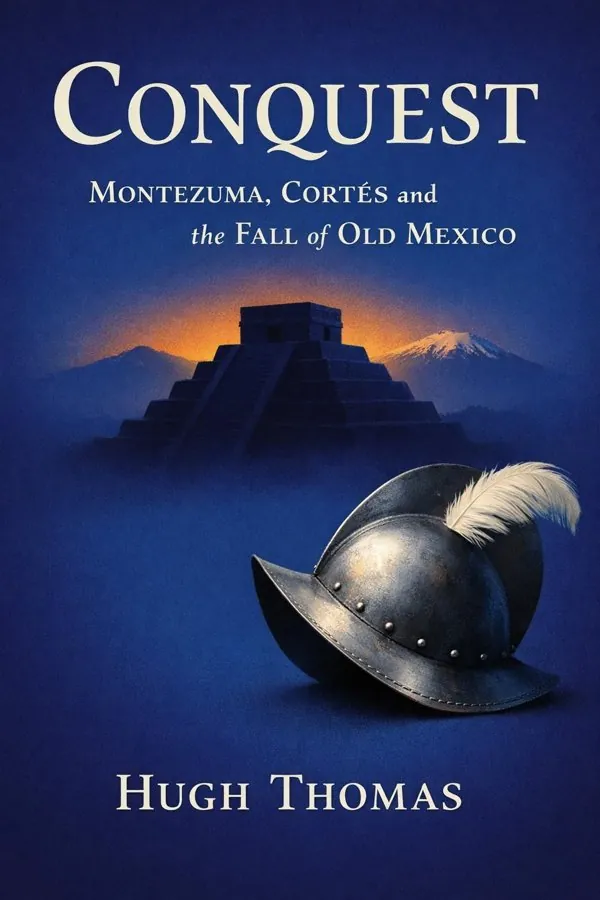
Conquest: Montezuma, Cortés and the Fall of Old Mexico: Summary & Key Insights
by Hugh Thomas
 10 min6 chaptersAudio available
What Is Conquest: Montezuma, Cortés and the Fall of Old Mexico About?
Conquest: Montezuma, Cortés and the Fall of Old Mexico by Hugh Thomas is a world_history book spanning 6 pages. A detailed historical account of the Spanish conquest of the Aztec Empire, focusing on the encounters between Hernán Cortés and Emperor Montezuma, and the dramatic fall of Tenochtitlan. Hugh Thomas combines meticulous research with vivid narrative to explore the cultural, political, and human dimensions of one of history’s most consequential encounters.
This FizzRead summary covers all 6 key chapters of Conquest: Montezuma, Cortés and the Fall of Old Mexico in approximately 10 minutes, distilling the most important ideas, arguments, and takeaways from Hugh Thomas's work. Also available as an audio summary and Key Quotes Podcast.
Conquest: Montezuma, Cortés and the Fall of Old Mexico
A detailed historical account of the Spanish conquest of the Aztec Empire, focusing on the encounters between Hernán Cortés and Emperor Montezuma, and the dramatic fall of Tenochtitlan. Hugh Thomas combines meticulous research with vivid narrative to explore the cultural, political, and human dimensions of one of history’s most consequential encounters.
Who Should Read Conquest: Montezuma, Cortés and the Fall of Old Mexico?
This book is perfect for anyone interested in world_history and looking to gain actionable insights in a short read. Whether you're a student, professional, or lifelong learner, the key ideas from Conquest: Montezuma, Cortés and the Fall of Old Mexico by Hugh Thomas will help you think differently.
- ✓Readers who enjoy world_history and want practical takeaways
- ✓Professionals looking to apply new ideas to their work and life
- ✓Anyone who wants the core insights of Conquest: Montezuma, Cortés and the Fall of Old Mexico in just 10 minutes
Want the full summary?
Get instant access to this book summary and 100K+ more with Fizz Moment.
Get Free SummaryAvailable on App Store • Free to download
Key Chapters
To understand what Cortés encountered, one must first enter the world of Montezuma. Tenochtitlan, the Aztec capital, was a marvel—a city built on water, its gleaming temples and orderly canals reflecting a society governed by both beauty and fear. The Mexica people, the ruling nucleus of the empire, had spent two centuries building a complex system of tribute, faith, and warfare. Montezuma II presided over this web of loyalty with religious intensity and ceremonial precision. Every aspect of life—food, clothing, speech—was bound to cosmic rhythms and sacred obligations. The empire’s theology was cyclical and sanguineous: the sun demanded blood to rise; wars replenished that blood through sacrifice. To contemporaries in Europe, it would have seemed barbaric, but to the Aztecs, it was civil order incarnate. Trade networks stretched across Mesoamerica, bringing cacao, cotton, gold, and knowledge to Tenochtitlan. The priestly class maintained astronomical observations rivaling those of Iberia. The empire’s political structure balanced autocratic majesty with intricate administration. Montezuma himself, both scholar and warrior, was revered and feared—a ruler considered divine, but plagued by omens. In the years before the Spaniards arrived, strange signs disturbed the empire’s calm: fires in the sky, unnatural floods, prophecies of pale gods returning from the east. It was within this mystic context that Cortés’s ships came into view, their sails mistaken for clouds of destiny. From my perspective as historian, the tragedy of Montezuma begins here—with a civilization so advanced in its own mythic logic that it could read the arrival of strangers only through the lens of prophecy, never through the possibility of invasion.
While Montezuma ruled from his island city, Spain dreamed of a new world. In the decades following Columbus, the Caribbean had become a staging ground for ambition and greed. Cuba, Hispaniola, and the coasts of Panama teemed with soldiers, priests, merchants, and outcasts—all eager for land and royal favor. Hernán Cortés emerged from this ferment as both opportunist and visionary. His journey from law clerk in Medellín to commander under Diego Velázquez in Cuba was driven by restless pride and fierce religious conviction. Spain, in these years after the Reconquista, considered its global expansion both divine command and imperial obligation: to spread Christianity and honor the Crown. I recount this in detail because Cortés personified this dual impulse—the pursuit of eternal salvation through temporal conquest. The Spanish Crown sought wealth to fund wars in Europe, but those who ventured west sought symbols of destiny: a cross planted in the unknown, a confession won through sword and sermon. Cortés’s decision to defy Velázquez and sail for the mainland in 1519 without formal authorization embodies the daring that made the conquest possible. He was inspired not purely by avarice, but by the intoxicating idea of discovery and redemption intertwined. His fleet of eleven ships left Cuba carrying six hundred men, a handful of horses, and a faith that was at once their armor and their blindness. When so few faced so many, it was belief—in Providence, in Cortés’s charisma—that held them together. This belief would soon meet the deeper, more perilous faith of the Aztecs.
+ 4 more chapters — available in the FizzRead app
All Chapters in Conquest: Montezuma, Cortés and the Fall of Old Mexico
About the Author
Hugh Thomas (1931–2017) was a British historian and writer known for his works on Spanish and Latin American history, including 'The Spanish Civil War' and 'Cuba: The Pursuit of Freedom'. He was a member of the House of Lords and a leading authority on Hispanic studies.
Get This Summary in Your Preferred Format
Read or listen to the Conquest: Montezuma, Cortés and the Fall of Old Mexico summary by Hugh Thomas anytime, anywhere. FizzRead offers multiple formats so you can learn on your terms — all free.
Available formats: App · Audio · PDF · EPUB — All included free with FizzRead
Download Conquest: Montezuma, Cortés and the Fall of Old Mexico PDF and EPUB Summary
Key Quotes from Conquest: Montezuma, Cortés and the Fall of Old Mexico
“To understand what Cortés encountered, one must first enter the world of Montezuma.”
“While Montezuma ruled from his island city, Spain dreamed of a new world.”
Frequently Asked Questions about Conquest: Montezuma, Cortés and the Fall of Old Mexico
Conquest: Montezuma, Cortés and the Fall of Old Mexico by Hugh Thomas is a world_history book that explores key ideas across 6 chapters. A detailed historical account of the Spanish conquest of the Aztec Empire, focusing on the encounters between Hernán Cortés and Emperor Montezuma, and the dramatic fall of Tenochtitlan. Hugh Thomas combines meticulous research with vivid narrative to explore the cultural, political, and human dimensions of one of history’s most consequential encounters.
You Might Also Like
The Age of Capital
Eric Hobsbawm
10 min
The Gulag Archipelago
Aleksandr Solzhenitsyn
10 min
Jerusalem: The Biography
Simon Sebag Montefiore
10 min
The Anglo-Saxons
James Campbell
10 min
The Boer War
Thomas Pakenham
10 min
The Industrial Revolutionaries: The Making of the Modern World 1776–1914
Gavin Weightman
10 minBrowse by Category
Ready to read Conquest: Montezuma, Cortés and the Fall of Old Mexico?
Get the full summary and 100K+ more books with Fizz Moment.