
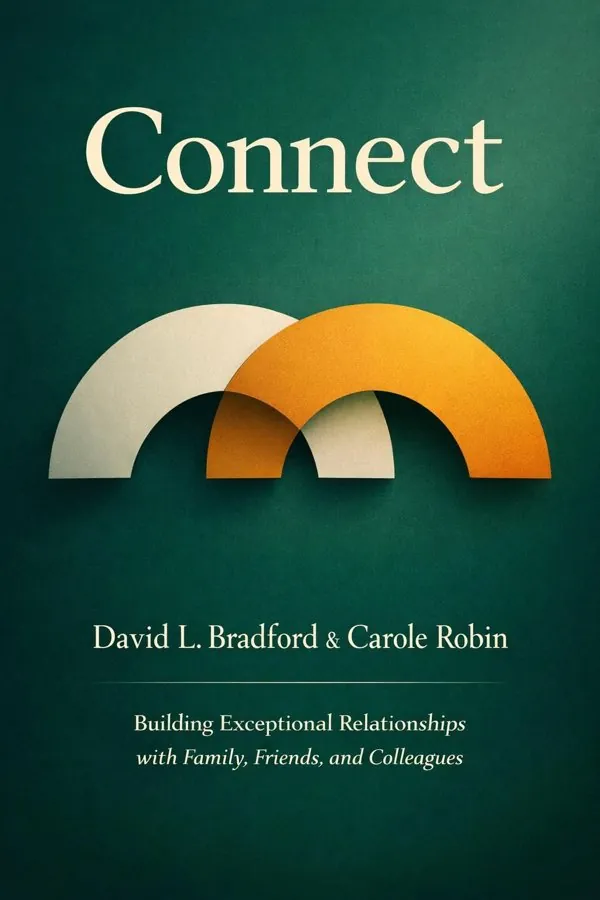
Connect: Building Exceptional Relationships with Family, Friends, and Colleagues: Summary & Key Insights
by David L. Bradford, Carole Robin
 10 min11 chaptersAudio available
What Is Connect: Building Exceptional Relationships with Family, Friends, and Colleagues About?
Connect: Building Exceptional Relationships with Family, Friends, and Colleagues by David L. Bradford, Carole Robin is a communication book spanning 11 pages. Connect is a practical guide to developing deeper, more meaningful relationships in both personal and professional contexts. Drawing on decades of teaching at Stanford’s Graduate School of Business, the authors present a framework for building trust, openness, and authenticity that leads to stronger connections and more effective collaboration.
This FizzRead summary covers all 11 key chapters of Connect: Building Exceptional Relationships with Family, Friends, and Colleagues in approximately 10 minutes, distilling the most important ideas, arguments, and takeaways from David L. Bradford, Carole Robin's work. Also available as an audio summary and Key Quotes Podcast.
Connect: Building Exceptional Relationships with Family, Friends, and Colleagues
Connect is a practical guide to developing deeper, more meaningful relationships in both personal and professional contexts. Drawing on decades of teaching at Stanford’s Graduate School of Business, the authors present a framework for building trust, openness, and authenticity that leads to stronger connections and more effective collaboration.
Who Should Read Connect: Building Exceptional Relationships with Family, Friends, and Colleagues?
This book is perfect for anyone interested in communication and looking to gain actionable insights in a short read. Whether you're a student, professional, or lifelong learner, the key ideas from Connect: Building Exceptional Relationships with Family, Friends, and Colleagues by David L. Bradford, Carole Robin will help you think differently.
- ✓Readers who enjoy communication and want practical takeaways
- ✓Professionals looking to apply new ideas to their work and life
- ✓Anyone who wants the core insights of Connect: Building Exceptional Relationships with Family, Friends, and Colleagues in just 10 minutes
Want the full summary?
Get instant access to this book summary and 100K+ more with Fizz Moment.
Get Free SummaryAvailable on App Store • Free to download
Key Chapters
Every relationship exists along a continuum. At one end, we find contact that is polite, functional, and shallow—conversations that revolve around roles or tasks, where each person remains partly hidden behind social masks. At the other, we experience exceptional relationships: spaces where we can be fully ourselves, where both people are known and accepted, and where candor enriches rather than threatens.
In our experience, moving along this continuum begins with authenticity. Authenticity is not a performative display of emotions; it is choosing to be real when pretense would be easier. It might mean admitting uncertainty to a colleague, owning up to irritation, or expressing appreciation without strategic purpose. Many of us mistakenly equate authenticity with transparency, yet they differ: authenticity is guided by purpose and empathy, not by impulsive disclosure. To move toward exceptional authenticity, one must continually ask, “What am I feeling? Why might it matter to share this?”
We have seen in our workshops that authenticity acts like a mirror—it reveals both who we are and how others perceive us. Relationships deepen when self-awareness grows in tandem with openness. When authenticity meets receptivity, trust begins its quiet work beneath the surface. The journey toward exceptional relating is not about quantity of time, but about the quality of presence two people can sustain together.
Openness, at its core, has two sides: disclosure and feedback. Disclosure is the act of telling others what is going on inside us—our perspectives, emotions, beliefs. Feedback is inviting others to tell us how our behavior affects them. Both sides are essential, but together they create an interplay that builds trust brick by brick.
Many people fear openness because they imagine it will expose them. The paradox is that guardedness, while meant to protect, often isolates us. When we disclose thoughtfully—sharing our perceptions in a way that honors both honesty and respect—we give others the chance to understand us, not guess at us. Similarly, when we ask for—and receive—feedback without defensiveness, we open the door to relational learning.
In our work with executives and families alike, we’ve seen what happens when this balance is maintained. Teams become more agile because misunderstandings surface early instead of festering. Marriages evolve beyond routine because partners no longer hide behind politeness. Openness becomes not a risk but a habit of trust. What matters is not how much we share, but how well we match our level of disclosure and feedback to the depth the relationship can contain at that moment.
+ 9 more chapters — available in the FizzRead app
All Chapters in Connect: Building Exceptional Relationships with Family, Friends, and Colleagues
About the Authors
David L. Bradford and Carole Robin are educators and consultants who taught the renowned Interpersonal Dynamics course at Stanford Graduate School of Business, also known as 'Touchy Feely'. They specialize in leadership development and interpersonal communication.
Get This Summary in Your Preferred Format
Read or listen to the Connect: Building Exceptional Relationships with Family, Friends, and Colleagues summary by David L. Bradford, Carole Robin anytime, anywhere. FizzRead offers multiple formats so you can learn on your terms — all free.
Available formats: App · Audio · PDF · EPUB — All included free with FizzRead
Download Connect: Building Exceptional Relationships with Family, Friends, and Colleagues PDF and EPUB Summary
Key Quotes from Connect: Building Exceptional Relationships with Family, Friends, and Colleagues
“Every relationship exists along a continuum.”
“Openness, at its core, has two sides: disclosure and feedback.”
Frequently Asked Questions about Connect: Building Exceptional Relationships with Family, Friends, and Colleagues
Connect: Building Exceptional Relationships with Family, Friends, and Colleagues by David L. Bradford, Carole Robin is a communication book that explores key ideas across 11 chapters. Connect is a practical guide to developing deeper, more meaningful relationships in both personal and professional contexts. Drawing on decades of teaching at Stanford’s Graduate School of Business, the authors present a framework for building trust, openness, and authenticity that leads to stronger connections and more effective collaboration.
You Might Also Like

Magic Words: The Science and Secrets Behind Seven Words That Motivate, Engage, and Influence
Tim David
10 min
Talking Across The Divide: How to Communicate with People You Disagree with and Maybe Even Change the World
Justin Lee
10 min
The Exceptional Presenter: A Proven Formula to Open Up! and Own the Room
Timothy J. Koegel
10 min
4 Essential Keys to Effective Communication in Love, Life, Work--Anywhere!: Including the 12-Day Communication Challenge!
Bento C. Leal III
10 min
Active Listening Techniques: 30 Practical Tools to Hone Your Communication Skills
Nisha Gupta
10 min
Bargaining for Advantage: Negotiation Strategies for Reasonable People
G. Richard Shell
10 minFeatured In
Browse by Category
Ready to read Connect: Building Exceptional Relationships with Family, Friends, and Colleagues?
Get the full summary and 100K+ more books with Fizz Moment.